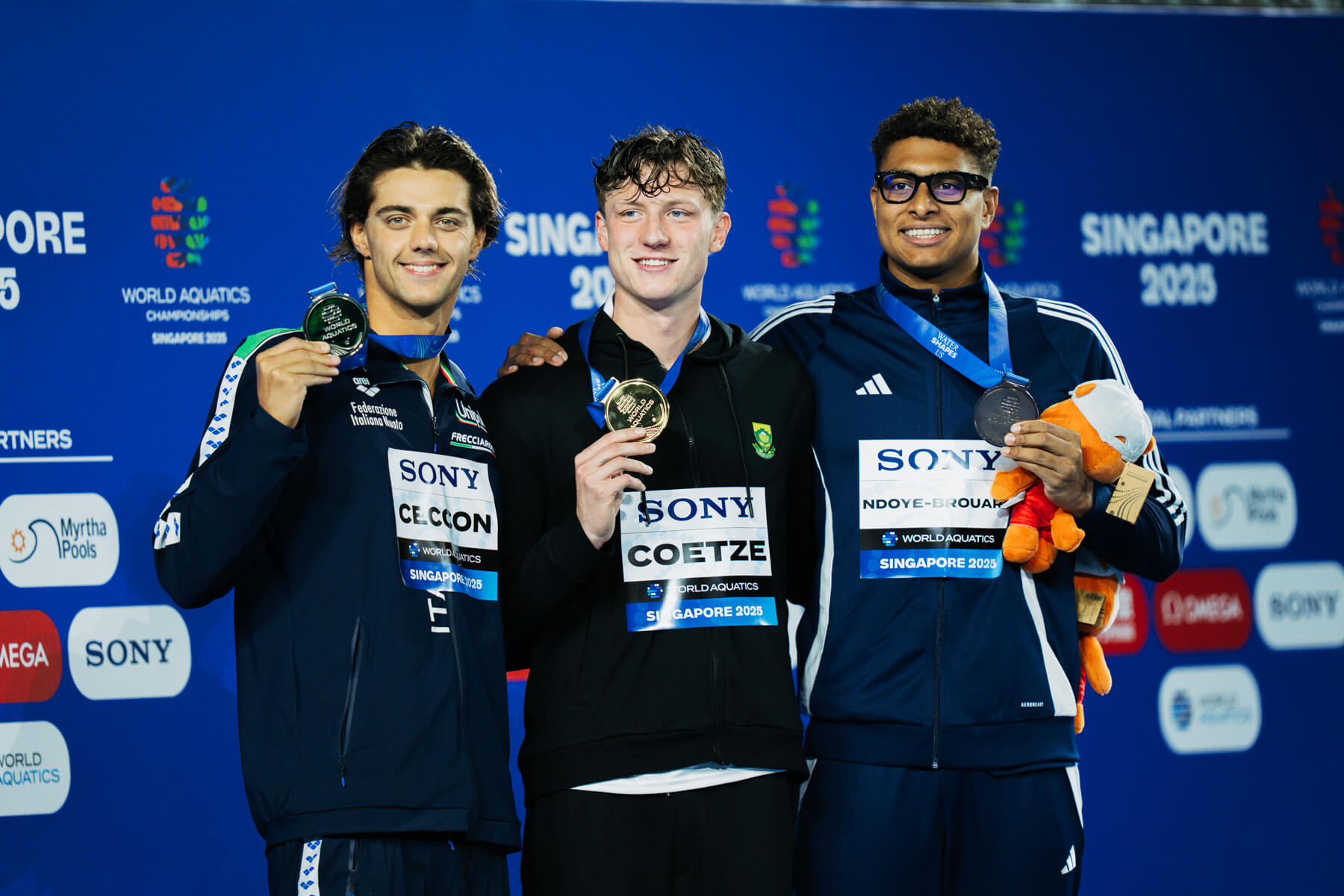
Pieter Coetze, Miron Lifintsev Among Contenders to Track Down Long-Standing 100 Back WR
In the last 16 years, the world record in the men’s 100 backstroke has fallen only twice. Aaron Peirsol, the Olympic champion in the event in 2004 and 2008, became the first man under 52 at U.S. Nationals in 2009, reclaiming a mark he had held for five years minus the previous week, and Peirsol’s record sat untouched for seven years. No one would get under 52 again until the 2016 Olympics, when Ryan Murphy clocked 51.97 to win gold and then 51.85 leading off the U.S. men’s 400 medley relay to break the record.
Murphy would remain among the best 100 backstrokers in the world through the 2024 Olympics, but he never swam faster. His mark would survive incursions from China’s Xu Jiayu, who went 51.86 less than a year after Murphy initially set it, and Russia’s Evgeny Rylov, who was clocked at 51.97 in winning the world title in 2017. No one would finish the deal until Thomas Ceccon. At the 2022 World Championships, the then-21-year-old Italian with little record of international success surpassed Murphy on the second length to win the world title and swim a time of 51.60, a quarter-second under the world record.
That was more than four years ago, and no one has been within two tenths of that time in an officially-recognized swim. Ceccon secured Olympic gold in Paris in 52.00, with Xu and Murphy joining him on the podium. But one year later at the World Championships in Singapore, a time under 52 seconds was required to earn a podium finish, with South African rising star Pieter Coetze taking gold as part of his incredible run of backstroke success in a three-week period.
Coetze arrived in Singapore coming off gold medals in the 50 and 100 back at the World University Games, his best times in Germany setting up medal runs at Worlds. He delivered on all expectations, touching in an African-record time 51.85 in the 100 back final to edge out Ceccon by five hundredths, with Frenchman Yohann Ndoye-Brouard just behind in 51.92. Coetze went on to lower continental records in the 200 back and 50 back, earning silver medals on both occasions.
But while he focused on other events, his 100 back rivals had more in store via relay leadoffs. Miron Lifintsev, a 19-year-old neutral athlete from Russia, was already the short course world champion in the 100 back, but he had fallen to seventh in the individual final, but the next day, he led off his team’s mixed 400 medley relay in 51.78, the fastest 100 back performance in three years. The time did not count as it was from a mixed-gender event, but it would have made the teenager the second-fastest man in history.
And on the final day of the meet, Ceccon also had one last effort in store. He led off the men’s medley relay in 51.80, the second-best effort of his career and also ahead of Coetze’s mark from the individual final.
Hubert Kos — Photo Courtesy: Peter H. Bick
One more 100 backstroke development would occur in the fall as Hubert Kos smashed the world record in the short course meters version of the event. At the World Cup finale in Toronto, Kos swam a time of 48.16 to surpass a four-year-old record. The Hungarian also destroyed the mark in the 200 back at that meet. In long course, Kos is already the world’s top performer in the 200-meter race, with Olympic gold and two world titles in his pocket, and he finished fourth in the 100 back final in Singapore with a time of 52.20.
These five swimmers are poised to battle for international medals in the event for years to come. Also worth including in that list are Great Britain’s Oliver Morgan, who swam as fast as 52.12 this spring, and Russians Kliment Kolesnikov and Pavel Samusenko, both 50 back medalists at Worlds. Of course, given Lifintsev’s trajectory, those two will likely be battling for one spot on the Russian team moving forward.
It’s weird to see the 100 backstroke without any significant American presence given the country’s long-standing dominance in the event. Aside from the boycotted 1980 Games, at least one American has reached the podium in this event at every Olympics going back to 1936. Most recently, Jeff Rouse, Lenny Krayzelburg, Peirsol, Matt Grevers and Murphy combined to win six consecutive gold medals. At the World Championships, the Americans won medals in six of seven global meets from 2013 to 2024, the lone miss coming in 2019 when Murphy was one hundredth off the podium, but no U.S. swimmer advanced out of prelims this year. There is a long way to go before the 2028 Los Angeles Olympics, but men’s backstroke is certainly a weakness for the U.S. at the moment.
As for the world record, the elite performers in the event have that target in sight. Coetze, Lifintsev, Ndoye-Brouard and Kos all swam big personal bests in 2025 and now begin 2026 with upward momentum. Ceccon, meanwhile, found his fastest speed in three years. There will not be a long course meet featuring all of these men until the 2027 World Championships, but it would be no surprise if the 51.60 is wiped from the top of the ledger before the best swimmers in the world race again.
