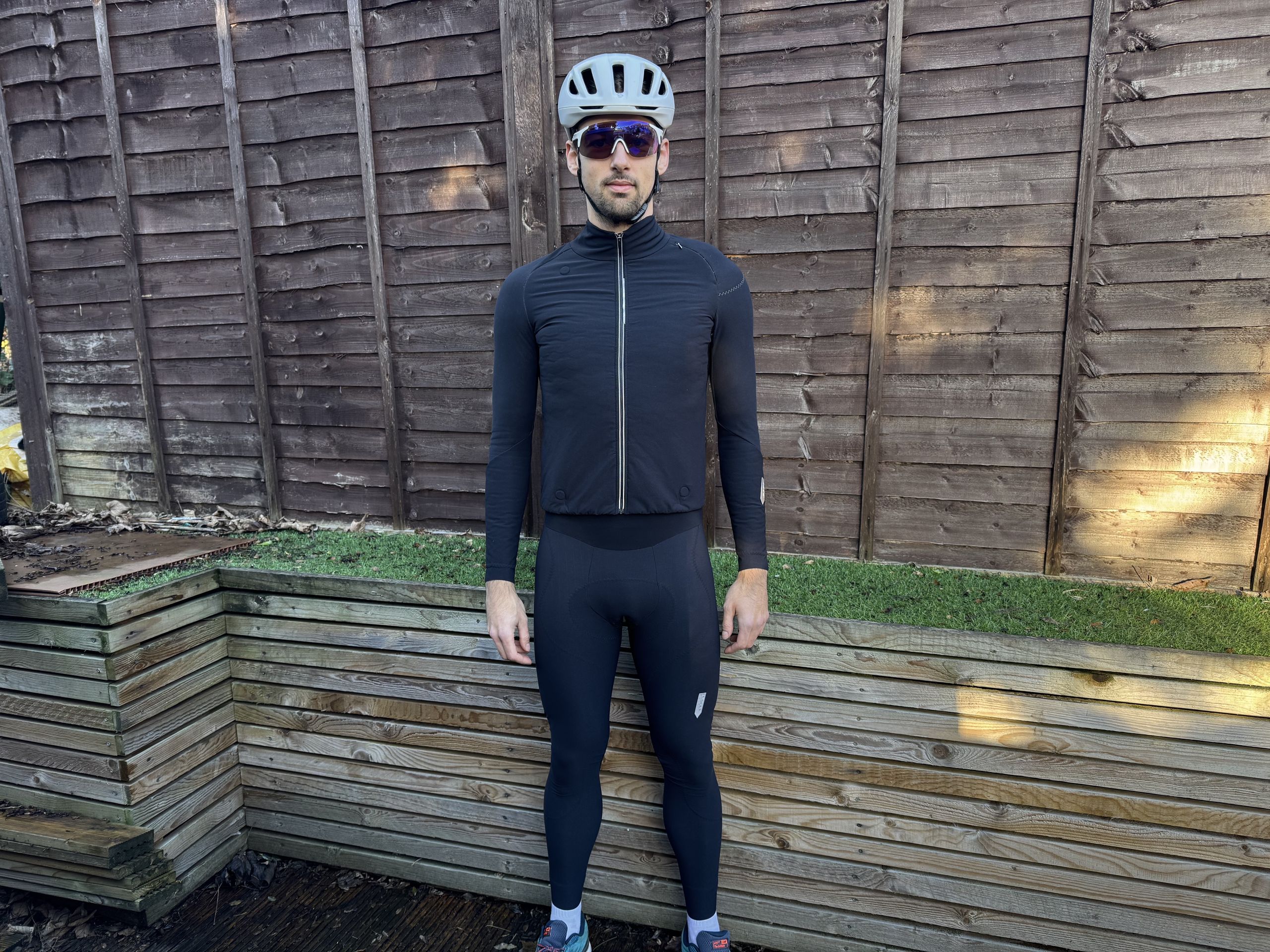
The Q36.5 Dottore Thermobolik Winter Skinsuit is a full one-piece winter cycling garment combining a cycling jacket, bib tights, and even a gilet or wind-stopper layer in one. Little wonder it’s described as the “Swiss Army Knife of winter training gear” by the brand.
Image 1 of 2


Construction
The primary component used in the upper jacket portion of the skinsuit is the UF Thermo Plus material. It’s a super high-density woven proprietary fabric which provides an extra warming effect by attracting far-infrared rays from the environment, according to Q36.5 at least. It’s also slightly water repellent to keep showers and road spray at bay. Reflective stripes are placed on the exterior of the sleeves, over the shoulders, and down the side of the torso.
Internally is where things start to get particularly interesting. On the front facing panels of the body there is a high density thick fleece material. Then on the sleeves, a more lightweight Air Insulation material has been used for added flexibility and reduced bulk. This also extends over the shoulders and upper back. Across the rear however is a more breathable and thinner material for the expulsion of excess heat to help prevent sweat builds up inside the garment. Behind the full length zip is a wind guard so that the zip is unobstructed for ease of use, but does not allow cold wind in.
On the left shoulder of the jacket portion of the skinsuit is a small hidden section. This zippered segment houses a Windshell membrane. This attaches onto three magnetic attachment points on the lower torso and right shoulder. It can then be stashed away back into this pocket when not required.
At the rear of this jacket portion are the cargo pockets. These are fairly spacious for phones, tools, spares, and food to be housed, but feature a slight lip at the top to prevent items from falling out of the pockets while moving around.
Moving onto the lower portion, and the main material is the UF-Hybrid Shell PLUS. Again, this is proprietary to Q36.5. It is a super high-density woven fabric with an extra warming effect thanks to a smart fiber on the inside face called the Heat Fiber, which is produced from the residue from coffee bean processing. Again, this apparently attracts far-infrared rays from the environment and uses them to heat the body. It is also body mapped with elastic components at the rear for comfort around the knee while the front facing panels are more weather resistant.
Additional features include reflective detailing across the cuff of the legs, while on the side of the hips is a 4D printed reflective grid detailing, which is a lesser version of the GridSkin technology that Q36.5 makes. This is designed to prevent impact bruising as well as road rash in the event of a crash.
Internally the Thermobolik suit uses the Q Lab Air chamois. This utilises a microfibre exterior for frictionless contact with the skin, while two layers move independently to each other in the pad itself so as to remain in contact with the skin and the saddle without rubbing on either.
Just one colour is available, black, while sizes range from XXS to XXL.
Image 1 of 2


The Ride
The first thing this suit reminds me of is the old Castelli Sam Remo Thermosuit, a combination of that brand’s Gabba top half and Sorpasso bib tights. It was cheaper than both items individually, and was designed to be more comfortable, warmer, and have some aerodynamic benefits compared to the two-piece variation.
The Q36.5 Thermobolik doesn’t aim to be more aerodynamic, purely more comfortable and insulated, while actually being slightly more expensive than the sum of it’s parts. But that isn’t particularly fair, given Q36.5 doesn’t actually have a jacket in its range that offers quite what this does.
Putting the suit on, it is certainly snug, without being restrictive. It feels like there’s an element of compression on the legs and arms, which I personally find quite comfortable. This also means the cuffs of the arms are not loose, stopping cold air getting up them, while the leg hem stays securely in place.
The most striking thing about this garment is the fleece material on the upper front facing sections. It’s heavy duty stuff, looking like the inside of something like an Oodie. It does add to the bulk a touch, especially on the front where it is situated, but, as I will get to later, it’s highly effective. The lighter duty fleece on the arms and shoulders is far less bulky, while the rear is a brushed material rather than having protruding fibres. On the legs a similar brushed material is used on front facing panels, while behind the knee is more elasticity and breathability, while the rest of the leg is more flexible.
Image 1 of 3


To really test the suit out, I took it up north, to the Darley Dales and the infamously cold and horrid Darley Moor race track. This is notorious in the UK for having its own microclimate, and it delivered. With temperatures in the low single figures, ‘feels like’ of around 0-2˚C, and a mix of biting wind and heavy wet fog, the scene was set to see just how this suit would perform in some harsh wintery weather.
Impeccable is the only way to describe it’s capacity to insulate and keep your body warm. Maintaining core temperature is key to staying warm overall, and that thick fleece at the front does a superb job, while the lighter fleecing doesn’t result in any loss of heat. Even with a thinner perforated base layer underneath I was not cold, but more impressively nor was I roasting. I often find that winter jackets leave me too warm, and sweating inside especially with harder efforts. Doing some steep climbs at a high pace, the Thermobolik actually does a fantastic job at keeping you a good temperature and shifting excess heat. This is likely due to the more breathable rear of the suit, and also the fleece inner promoting a degree of movement of air. This is similar to what some grid fleece structures promise, but works better in practice here. There have only been two winter kit items that have managed to keep me both warm at low intensities, and not over heat as intensity ramps up, this and the Assos Johdah S11 jacket. Both unfortunately are extortionately priced.
It means that the Thermobolik is impressively good across a full range of single figure temperatures, and even slightly above that if there’s a chill in the air. I did not expect it to have the breathability it does while offering this level of protection. It’s not waterproof, and doesn’t feature a specific DWR treatment, however the high density fabric has its own water repellent properties without compromising breathability. This is the same for the upper and the lower, and means that spray from the road and showers do not seep through. In the event of heavy rain, a proper rain shell is needed, but the insulation is so impressive that the rain doesn’t really cool you down or result in getting cold.
The Thermobolik has another little trick up its sleeve, or rather tucked away in its shoulder. Within a small zipped up pocket on the left shoulder, is a windshell. This attaches with three magnets onto the body of the suit very easily, and is designed primarily for long alpine descents. It just boosts the insulation that little bit further and works very well in biting wind when sitting in the wheels or descending and work rate decreases. I normally pack a small windproof gilet or such with me for rides at all times, and this feature takes over from that necessity without limiting access to rear pockets.
On to those pockets, and they are nicely spacious for various spares, food and tools. They are however one of the small areas of complaint that I have. For me a skinsuit is always tough to get right, as a medium is spot on for fit around my body an limbs. However, it appears that it isn’t quite long enough, or the fit of the pockets is not ideal. They sit low, which are easy to access, but means that they sit across the point of my back where the spine curves into my hips. This put a bit of pressure from my phone and tool wrap onto my lower back. It wasn’t overly uncomfortable, and riding for 5 hours was still fine. But it detracts a little, and for an item this pricey it has to be mentioned.
Another small gripe is the black only colour option. It’s not very visible in poor weather, even with the large reflective stripes on the wrists, up the arms, and down the side of the body, or with the reflective grids on the hips. Yes, you should ride with some of the best bike lights in the winter which are more effective than high vis, but I’d still like an option other than stealth black.
Image 1 of 2


Discussing the chamois brings me back to the positives. Since Q36.5 introduced the Q Lab Air chamois, it has been one of my favourites. It offers zero friction against the skin, in part due to the top layer material, and also due to the dual layer design meaning that rather than a pad rubbing between a saddle and body, two layers move independently of each other while maintaining contact with body and bike. It’s a highly effective design.
Another benefit to mention of wearing a winter suit rather than a two-piece design, is when it comes to nature breaks. Unzipping a jacket and then pulling down the front bib section of tights can be undignified, and downright difficult. The Thermobolik does what most road going speedsuits does, and has a jersey like front that can be unzipped, but also accessed easily for nature breaks.
I have to say, as I have with most Q36.5 items, that the progress to reduce the carbon footprint and use recycled materials is admirable in the current climate, environmentally and economically. It does mean the cost is not as low as it could be, but personally this is a price I am willing to accommodate; I think it is important to opt for clothing that is made and sourced more ethically. Q36.5 also offers repairs on garments so that the functional lifespan of these kit items is longer, somewhat lessening the hit of that initial price tag.
Value and Conclusion
At £850 / $1140 this is the area where the Thermobolik starts to struggle. Yes it is the amalgamation of several items into one, but it is still more expensive than high end time trial skinsuits that require hours of wind tunnel research and development to create. Even individual components such as a heavy duty winter jacket and bib tights comes up cheaper. The Dottore Termico jacket and tights are £470 / $600 and £330 / $440 respectively so still come up £50 or a $100 shy. It does beat the Assos Johdah Ultraz S11 range which comes un at £630 / $810 for the jacket and £380 / $485 for the tights, but against every other brand offering it far exceeds them.
Yes, it is an exceptional performer. The tights are not constrictive or stiff, while the upper is both insulating and breathable, with solid weather proofing and smart features. It is, arguably, a better performer than most other offerings on the market when it comes to winter performance. But that does not make it the best value. A Rapha Core winter jacket, Pro Team winter tights, and rain cape will still undercut this suit and offer most of the performance and comfort. Not all of it admittedly, but most of it and for a significantly lower cost.
This does mean that the Q36.5 Thermobolik winter suit is not a good value item. Even when you consider the local production, smaller carbon footprint, and use of recycled materials in the creation, it doesn’t make it worth this cost for most people. For those with the money to spare, and want the best regardless of price though, then this is a very effective winter garment that will certainly not leave anyone disappointed. But for those considering budget, there are better value and more suitable options available on the market.
Image 1 of 3


The Q36.5 Thermobolik Winter Skinsuit is an impressively comprehensive winter cycling clothing system. The placement of nearly every material, fabric panel, accessory and fleece choice is meticulously well done to create a supremely breathable, comfortable, insulated, and well protected winter garment. It follows the annoying trend of deep winter kit coming in black, but it does feature sizable reflective detailing, and I always ride with lights.
My only true grip with the design are the pockets, which sit a touch too low so that large items can put pressure on your back. Aside from that, the £850 / $1140 price is a hefty limitation. It’s too expensive for most people, and does not represent good value, but it’s a superb demonstration of technologies melded into one super winter suit.
