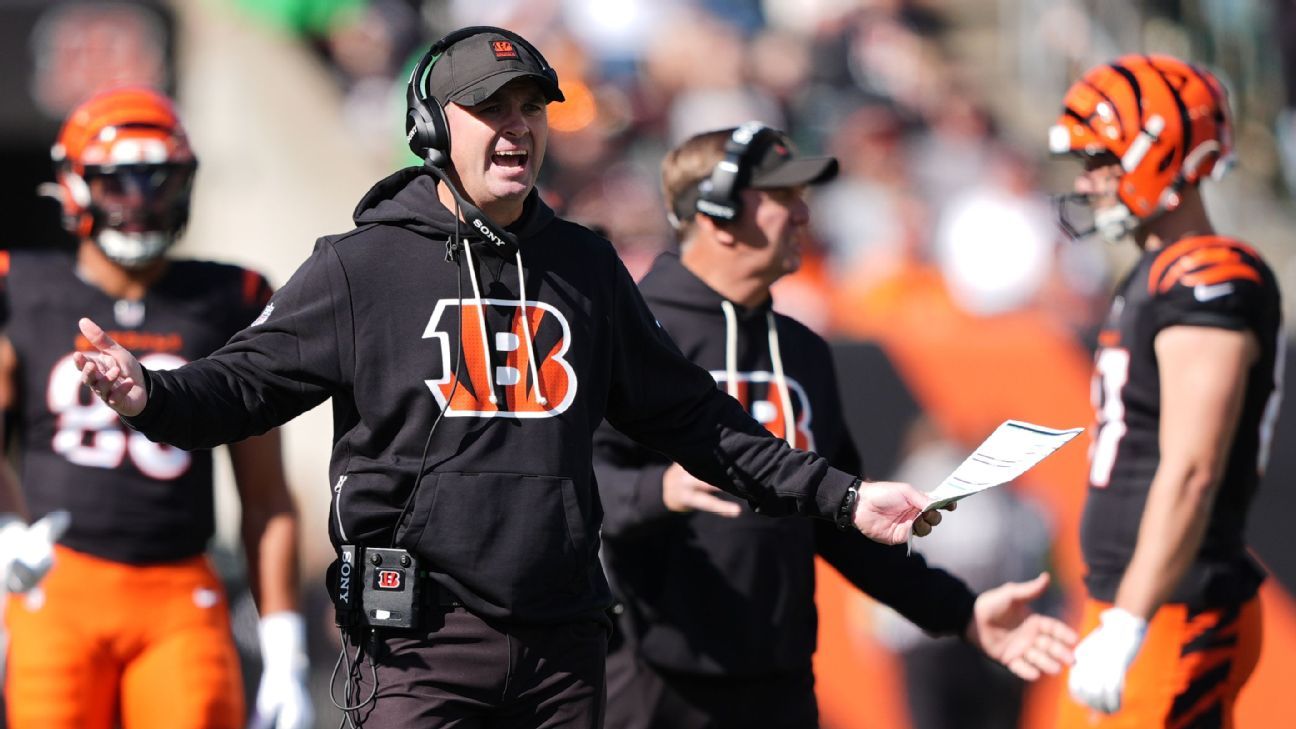
The NFL’s carousel of head coaching opportunities started spinning early this year. Brian Callahan was fired by the Titans midway through October, and about one month later, Brian Daboll was let go by the Giants. It’s safe to say that they’ll be joined by others in the weeks to come. An average of 6.5 head coaching jobs have changed hands each offseason over the past decade, and it would be a surprise if the league didn’t collectively approach that number again in 2026.
Today, I’m sorting through the various jobs that might (or might not) come open this offseason and how appealing those opportunities might be, given their roster construction, front office, ownership, cap situation and draft capital in 2026. (I’m using the league’s current standings, the traditional Jimmy Johnson draft chart and the compensatory projections from OverTheCap to figure in draft capital.) To be clear: This column doesn’t root for any coaches to get fired, and I’m not arguing that any of these teams should fire their respective coaches. This is just trying to help potential new coaches pick the best possible landing spot.
Subscribe: ‘The Bill Barnwell Show’
I’ll go from the most desirable job to the least, sorting through the pros and cons for each opportunity. But first, I need to start with two honorable mentions that would rank at the top of the list if they did come available. I’m just not sure either is likely to do so.
-
If Andy Reid retires, the Chiefs would represent one of the greatest opportunities a coach can have in the NFL — taking over a franchise with a generational quarterback in the (relative) prime of his career. Patrick Mahomes is recovering from a torn ACL, of course, and the Chiefs have work to do as they retool their roster, but I’m not sure there’s a coach on the planet who wouldn’t feel an urge to work with one of the greatest QBs of all time.
-
There has also been plenty of chatter about Mike Tomlin’s future in Pittsburgh, where the Steelers have been stuck in a cycle of being just good enough to compete for a playoff spot without ever making any sort of meaningful dent once they get there. It has been seven seasons and counting since the Steelers won a playoff game, and though Pittsburgh is on track to get back to the postseason, it would be a surprise if it went on a run in January, even in what seems to be a wide-open AFC. We’re a few weeks removed from “Fire Tomlin” chants in Pittsburgh, and though I don’t think that’s very likely (or deserved), the Steelers could choose to trade their coach if both sides want a fresh start. Pittsburgh doesn’t have a Mahomes on the roster, but it does have a track record of something nobody else in football can promise: stability. The Steelers have had three coaches (Tomlin, Bill Cowher and Chuck Noll) over the past 58 years, about as many as some teams go through in a single presidential administration. In a profession where losing jobs and moving from city to city is part of the business, being the Steelers head coach is the most stable opportunity imaginable.
Assuming both Reid and Tomlin stay put, though, we’re left with eight potential opportunities, two of which are already open. Getting to take over a team with Mahomes would be a fantasy for most coaches. The next-best thing might actually be a reality in 2026, which is where our rankings start.
Jump to:
Bengals | Browns | Cardinals | Dolphins
Falcons | Giants | Raiders | Titans


Projected 2026 cap space: fourth most ($110.7 million)
Projected 2026 draft capital: 10th most
We don’t often see a team give up on its season, which is why what the Bengals did in the fourth quarter against the Ravens was so curious last week. Admittedly, the Bengals weren’t in a great spot. At 4-9, they needed to run the table to have any shot at making it to the postseason. And after Joe Burrow threw a pick-six with 7:55 to go in the fourth quarter, the Bengals trailed 24-0 against the Ravens, whom they needed to beat to keep their playoff hopes alive.
What Zac Taylor did after the Bengals got the ball back stunned me. Even with a superstar quarterback and one of the league’s best passing games on paper, they didn’t try to sprint their way back into the game. With their playoff hopes dissipating, the Bengals … ran the ball. They chewed up clock. Eight of the 10 calls on their ensuing drive were runs, with the Bengals letting the clock run down before snapping the football.
By the time Samaje Perine was stopped on a fourth-and-1 to truly extinguish all hope, the Bengals had run 5½ minutes off the clock. And while you might understand giving up if Burrow was hurt or the situation was compromised, Taylor still had his franchise quarterback on the field, handing the ball off to Perine and Chase Brown for most of the Bengals’ final meaningful drive of 2025.
Burrow’s comments in recent weeks about not having fun playing football have understandably raised concerns in Cincinnati, where a fan base still scarred by Carson Palmer’s injury and eventual holdout before a trade to Oakland is afraid of losing its franchise quarterback. Both Burrow and his teammates have clarified that those comments aren’t about playing in Cincinnati, which should put Bengals fans at ease, at least for the time being.
If Burrow is not enjoying losing, though, what can the Bengals realistically do to change their fortunes? Since making runs to the Super Bowl in 2021 and the AFC Championship Game in 2022, the Bengals haven’t made it back to the postseason. Yes, injuries to Burrow in 2023 (calf) and 2025 (toe) have hampered their chances. But Taylor has gone 17-15 over that time frame when he has had Burrow on the field, which isn’t good enough given the floor a QB like Burrow should offer on a weekly basis. Burrow wasn’t great against the Ravens on Sunday, but he was an MVP-caliber quarterback in 2024, and the Bengals couldn’t even make it to the playoffs that season.
The defense remains the problem in Cincinnati, and though the Bengals fired defensive coordinator Lou Anarumo last offseason in the hopes of turning things around with Al Golden at the helm, the results haven’t been much different in 2025. The Bengals have the league’s worst-tackling defense. The defense routinely blows coverage assignments. And without Trey Hendrickson, who has missed most of the season with a core injury, the Bengals don’t have enough of a pass rush to create problems for opposing quarterbacks.
Firing Taylor and hiring a defensive guru would be the biggest step the Bengals could take to win while they have Burrow in his peak. And though there will be offensive coaches desperate to work with Burrow, this should be an even more appealing job for defensive minds like Chargers DC Jesse Minter and Packers DC Jeff Hafley. Turn the defense into even a league-average unit, and the Bengals would be a perennial playoff team. Mold it into a top-10 defense, and the Bengals would compete for Super Bowls.
1:28
Rex Ryan: Joe Burrow is the only one trying to bring it for Bengals
Rex Ryan believes Joe Burrow is disgusted with the performance of his teammates after their loss to the Ravens.
Of course, the old caveats about the Bengals still apply. The organization ranks 30th in cash spending over the past five years, ahead of only the Raiders and Rams. Cincinnati lost an essential defensive player in Jessie Bates III to free agency and never really recovered in the secondary, and it is likely to lose Hendrickson this offseason after a bitter contract dispute. The Bengals also have the smallest scouting staff in the league, something that reportedly has irked Burrow. A new coach might need to use their leverage to persuade ownership to invest in infrastructure as part of the hiring process.
But at the same time, there’s Burrow. There aren’t many Hall of Fame-caliber quarterbacks around the NFL at any one time, and given how successful they usually are, the chance to coach one of them through their prime years rarely comes available. Most coaches join organizations hoping (or promising) that they can find a QB of Burrow’s caliber. The Bengals already have a Burrow. Now, they just need to find someone who can get him to believe again.
Projected 2026 cap space: 17th most ($39.2 million)
Projected 2026 draft capital: sixth most
Are the Cardinals better than their record? Absolutely. They are 2-7 in games decided by seven points or fewer. They were a first down away from beating the 49ers, conspired against themselves to blow a lead through some of the most inexplicable play you’ll ever see against the Titans, failed in a goal-to-go sequence down four points to the Colts, blew a lead in the final two minutes against the Packers and lost in overtime to the Jaguars.
Is that good enough for Jonathan Gannon to keep his job? Probably not. The Cardinals have been without Kyler Murray (foot) for most of the season, but Gannon’s defense has also collapsed. Arizona has never really had everyone it was relying on stay healthy in 2025, but a defense that added multiple starters in free agency and through this year’s draft ranks 25th in EPA per play. It is dead last in points allowed per possession (2.9) across the current six-game losing streak. In a season during which the defense was supposed to take a major step forward, it’s falling behind.
I’d still argue that there’s a fair amount to like in Arizona. The Cardinals do have plenty of promising talent on defense, where Josh Sweat has been excellent and young players like Walter Nolen III, Will Johnson and Garrett Williams have had moments where they’ve looked to be potential standouts. Trey McBride has been spectacular, and though Marvin Harrison Jr. and Paris Johnson Jr. haven’t necessarily lived up to their draft position, they should settle in as above-average starters at key positions. GM Monti Ossenfort has done a good job of adding draft capital, and though there’s work to be done on the interior of the offensive line and at linebacker, there’s unquestionably young talent.
The problem, of course, is deciding what to do at quarterback. Murray seemed to wear out his welcome with the coaching staff this year before going on injured reserve, and though he’s under contract for 2026 and beyond, the Cardinals should be able to land something in return if they decide to trade the 2019 first overall pick. Arizona is currently sitting with the sixth pick in next year’s draft; if there’s a young quarterback that a potential coach likes in the class, the Cardinals should be in position to compete for that signal-caller. This roster might look very fun with, say, Fernando Mendoza throwing to McBride and Harrison on a rookie deal.
The other issue is the division. The Cardinals are stuck in a juggernaut of an NFC West, where the 49ers, Rams and Seahawks all have 10 or more wins under potential Coach of the Year candidates. If you’re a coach with options, the idea of ending up in, say, the NFC South might be a lot more appealing than an NFC West division where going 3-3 might feel wildly successful in any given season.
Then again, consider last season’s NFC North, where the Bears were looking up at the 15-2 Lions, 14-3 Vikings and 11-6 Packers. Less than a year after Ben Johnson took over, Chicago sits atop the division at 10-4. And though some fortuitous late-game breaks have helped the Bears jump to the top of the division, they feel like they belong right alongside the rest of the North. If the Cardinals nail the coach and get their quarterback situation right this offseason, they might have the ability to make that same sort of leap in 2026.
Projected 2026 cap space: 26th most ($7.9 million)
Projected 2026 draft capital: fourth most
If the Browns do move on from Kevin Stefanski after six seasons (and two Coach of the Year awards), their new coach will face a franchise that’s still in transition. There’s one year left on Deshaun Watson‘s five-year, $230 million disaster of a contract, and though the Browns hinted earlier this month that Watson will be on the 2026 roster, there’s no reason for Cleveland to keep its embattled former starter around. The Browns won’t be bringing Watson back in 2027, so there’s no reason for him to play in front of any of their other quarterbacks. They would love someone to trade for Watson and eat any of the $46 million remaining on his contract, but that ship has surely sailed.
A new coach would likely help determine whether the Browns use one or both of their first-round picks in 2026 (via trade up) to help land a new quarterback. The Jaguars’ first-rounder that the Browns landed as part of the Travis Hunter trade is set to fall toward the very end of the round, meaning the Browns will need to rely on their own first-rounder as the focal point of their efforts to get a new starter. Shedeur Sanders‘ league-worst 16.9 Total QBR since taking over as Browns quarterback is likely to interest exactly one potential head coaching candidate, and he’s likely to stick in Colorado.
What hurts most from the Watson trade, really, is all the missing talent the Browns don’t have after dealing three first-round picks and more to the Texans as part of the move. The Texans jumped up and around with those selections, but the actual players chosen in the draft slots the Browns sent to Houston turned into Jordan Davis, Dameon Pierce, Jahmyr Gibbs, Jalin Hyatt, Brian Thomas and Cade Stover. The Browns then had to use other draft capital to fill those spots in the lineup by selecting Quinshon Judkins in the second round, trading for Jerry Jeudy and using a first-round pick on Mason Graham. It takes years to retool after trading that much draft capital, especially when you really get nothing in return, as the Browns did in the Watson trade.
The good news is that Andrew Berry’s 2025 draft was a hit. Graham has flashed on the interior. Judkins might be the best back in the class. Carson Schwesinger is a deserved favorite for Defensive Rookie of the Year. Harold Fannin Jr. has made an immediate impact as a move tight end. Dylan Sampson has been explosive in a situational role. The only players who haven’t been quite as impressive are the quarterbacks in Sanders and Dillon Gabriel, but this is a very solid class and a much-needed boost as the Browns try to rebuild their roster.
Regardless of whether the Browns draft that quarterback in 2026 or 2027, Cleveland is probably still not going to be in position to be truly competitive until 2027 at the earliest. The Browns will have more than $131 million in Watson cap charges to pay off between those two seasons, with the timing of how that’s split depending on whether they cut Watson or let him play out the final year of his deal in Cleveland. Their roster still has major holes, and the Browns will need to rebuild virtually their entire offensive line, given that four of their five starters are free agents (and Jack Conklin, the fifth, could be a cap casualty).
And Browns ownership can be, well, inconsistent. Cleveland has spent more cash (more than $295 million per year) over the past five seasons than anybody else in football, but the Haslams haven’t always been patient team owners with their coaches. Before Stefanski, the Browns went through five permanent coaches over the first eight years of the Haslam era in Cleveland with very mixed results. It’s possible that they’ve mellowed with experience, and Stefanski has been much more successful than the prior coaches in Cleveland, but given how far the Browns are from seriously competing, I’m not sure I’d want to be the one waiting to find out.
2:18
Stephen A. blames Stefanski for not developing Browns QBs
Stephen A. Smith calls out Browns coach Kevin Stefanski for refusing to develop other quarterbacks while the team tries Shedeur Sanders at QB.
Projected 2026 cap space: most ($120.1 million)
Projected 2026 draft capital: fifth most
Could the Titans be next year’s version of the Patriots? The 2024 Pats went 4-13 and fired Jerod Mayo after one disappointing season, but there were reasons to believe that they had landed their quarterback of the future in Drake Maye. He didn’t put up impressive numbers in his debut season, but with little help at receiver and along the offensive line, Maye still flashed potential on film.
The Patriots hired the right coaches in Mike Vrabel and Josh McDaniels, leveraged the league’s most cap space by going on an offseason spending spree in free agency and built a competent offensive architecture around Maye. Playing one of the easiest schedules in league history has helped, but Maye is an MVP candidate in 2025 and the Patriots are in position to win the AFC East.
When I’ve talked to people around the league and asked them which team and which quarterback might profile as the 2026 version of the Patriots, the Titans have been the most frequent answer. Cam Ward is last in the league in Total QBR, and he has struggled to generate consistent yardage, but there are signs of real promise in the first pick’s tape, even if those plays don’t always result in catches or conversions. Ward has a live arm, and he’s getting to the right answers more often as the season goes along.
There’s just not a lot around Ward. The Titans have the worst group of receivers in the NFL, and though they’ve spent a lot between draft capital and free agency on their offensive line, the players protecting Ward haven’t been great. Free agent additions like Calvin Ridley, Dan Moore Jr. and Kevin Zeitler and draft picks like JC Latham and Tyjae Spears simply haven’t been good enough.
Of the 11 players who have suited up for at least 45% of the offensive snaps this season in New England alongside Maye, seven were imported via free agency or the draft this offseason. The Titans might require that sort of flood of new talent to right the ship around Ward, especially at receiver, where they could credibly justify bringing in three new starters. Chimere Dike is an excellent return man and should have a role in the offense as a deep threat, but Ridley is a cut candidate, and Elic Ayomanor hasn’t been reliable enough to guarantee a spot in the 2026 lineup.
There’s also work to be done on defense, where the Titans have a strong interior with Jeffery Simmons and T’Vondre Sweat but questions elsewhere throughout the lineup. The move to acquire Chiefs star L’Jarius Sneed has been a disaster, and the only player drafted by the Titans still on their rookie contract who has played more than 40% of the defensive snaps this season is linebacker Cedric Gray. Rookies like Kevin Winston Jr. and Marcus Harris have seen their roles expand as the season has gone along, but the Titans used seven of their nine top-100 selections between 2022 and 2024 on offense.
Coaches enamored with Ward will be comfortable taking on those responsibilities, and the Titans have plenty of cap space to work with, but there are real questions about ownership and its ability to stick to a long-term plan. The Titans fired general manager Jon Robinson in 2022, head coach Vrabel in 2023, successor general manager Ran Carthon in 2024 and most recently Brian Callahan early in the 2025 season. General manager Mike Borgonzi’s job appears to be safe at the moment, but you would forgive him for looking over his shoulder in 2026.
Good coaches want stability and a personnel department they can trust, and the Titans might not be able to offer either. Ward is more promising than the numbers indicate, and with no state income tax, Tennessee will always be an appealing landing spot for free agents. There’s even more work to be done here, though, than there was in New England 12 months ago.

Projected 2026 cap space: 18th most ($26.6 million)
Projected 2026 draft capital: most
We know the Giants will hire a new coach after firing Brian Daboll at midseason, and though there might have been a scenario where Mike Kafka would have inherited that role with an impressive end of the season, he has gone 0-4 as the interim coach in New York, struggling with game management at times along the way. Kafka should still have a path to head coaching opportunities in his future, but he’s more likely to land as a coordinator or offensive assistant somewhere else in 2026.
When Daboll was fired, there was significant chatter suggesting that the Giants job would be the plum opportunity of the 2026 offseason. Having the first overall pick and the most projected draft capital of any team in football would obviously go a long way if the Giants end up there, although ESPN’s Football Power Index gives Big Blue only a 16% chance of finishing the season with the worst record. Outside of the potential draft capital, I’m not sure I agree with the idea that this is an outstanding opportunity for the league’s best coaching candidates.
1:38
Why a full offseason could be key for Jaxson Dart’s growth
Jason McCourty and Jeff Saturday explain how the upcoming offseason will be important for Giants quarterback Jaxson Dart.
Coaches were expected to be thrilled at the possibility of working with Jaxson Dart, who got off to a promising start during his rookie season. Dart wasn’t winning many games, but his competitiveness, mobility and big-play ability made him an immediate fan favorite alongside fellow rookie Cam Skattebo, who was lost for the year with a serious ankle injury.
But Dart’s inability to avoid big hits and injuries is quickly becoming concerning. Sunday was the fifth time in 10 starts that he has been forced to leave the game to undergo a concussion evaluation, and he missed losses to the Packers and Lions. Kafka has taken the designed quarterback runs that the Giants leaned on early in Dart’s tenure out of the playbook. Removing scrambles, sneaks and kneel-downs from the equation, Dart had 24 designed runs in his seven starts before his concussion, per NFL Next Gen Stats. That has dropped to three over the two starts he has made since missing time.
Without his role in the quarterback run game, it’s unclear whether Dart is really as promising of a quarterback as he might have seemed. He has faced a difficult schedule and played without his top wide receiver in young star Malik Nabers for most of that stretch, of course. But on dropbacks that ended with a pass attempt or a sack, Dart’s 42.9 Total QBR is 26th in the league. It’s still too early to draw conclusions on what Dart will become, but coaches might not be inclined to tie themselves to a QB who seems hell-bent on putting himself in harm’s way on a weekly basis as part of his playing style.
The other issue is general manager Joe Schoen, whom ownership backed as part of the future when it fired Daboll in midseason. Schoen’s top-100 selections have been mixed at best during his time in New York, with major disappointments like Evan Neal and Deonte Banks joining the organization as first-round picks. Schoen oversaw the decisions to move on from Saquon Barkley and Xavier McKinney in free agency before the 2024 season, one year after the Giants elected to sign Daniel Jones to a four-year contract and use the franchise tag on Barkley.
There have been positives, of course. Nabers and Abdul Carter look like potential building blocks on both sides of the ball, and they’re in the middle of rookie contracts. The offensive line is in better shape than it had been over the past few years, although that’s an extremely low bar. Dart and Skattebo have the potential to be playmakers, though they’ll have to change their playing styles to stay healthy.
More than anything, though, the decision to retain Schoen and hire a new coach creates different timelines within the organization. Schoen and Daboll were hired together from Buffalo at the same time. There were no questions, at least for their first three years together, about whether they were compatible or working together. Schoen and Daboll each took their jobs in North Jersey knowing that the other guy wanted them in the building.
Now? That’s up in the air. Schoen will obviously hire someone he feels compatible with, but if the Giants decide to move on from Schoen in 2027 or 2028, it would create another mismatched timeline between the coach they hire now and the next general manager. Will that new personnel executive want to hire his own coach? Will the Giants just fire this next coach, as they (deservedly) did with Joe Judge after two seasons, so the next general manager can enter the building with his handpicked guy? Will there be more pressure on the next coach to succeed in a shortened time frame as a result? And if Dart proves to be a disappointment or can’t stay healthy, will this next coach get to go after the next quarterback?
It’s not fun to take over a job when you’re thinking about what the next general manager or next quarterback might do, but it’s fair to raise those questions about the situation in New York.

Projected 2026 cap space: 24th most ($10.9 million)
Projected 2026 draft capital: 30th most
In a different world, Atlanta might be in the thick of the playoff race right now. The Falcons have been close to a much better season this year. Their kickers have missed a field goal that would have pushed the first game against the Buccaneers into overtime and an extra point that would have tied the one-point loss to the Patriots. They lost overtime games in consecutive weeks to the Colts and Panthers. If the Falcons win two of those games, they’re 7-7 and tied for first place in the NFC South.
Atlanta approached this offseason like it was a pass rush away from being playoff contenders, and it was wrong — but not because of the defense. James Pearce Jr. is making a late surge for Defensive Player of the Year, and the Falcons have a 9.4% sack rate, the third-best mark in the NFL. They’re blitzing at the second-highest rate in the league, which obviously helps create more pressure, but for the first time since the John Abraham era, Atlanta might feel like it has a pass rush to build around moving forward.
The problem, of course, is everything else. GM Terry Fontenot traded his 2026 first-round pick to the Rams to acquire Pearce, and at the moment, that’s going to land in the top 10. Fontenot signed Kirk Cousins in free agency and then selected Michael Penix Jr. in the first round of the 2025 draft. Cousins, of course, was benched before the end of 2024 and has become the most expensive backup quarterback in NFL history in his second and what will presumably be his final season in Atlanta.
It’s unclear what the Falcons have in Penix. In his first full year as a starter, Penix’s 56.7 Total QBR was good for 17th in the league. He struggled with his accuracy, running the league’s worst off-target rate (22.2%), and consistency has been an issue. But Penix played really well in wins over the Bills and Commanders, and he has done a good job of protecting the football despite playing all season with a third-string tackle (Elijah Wilkinson) protecting his blindside.
Penix’s 2025 season ended in mid-November after the third torn ACL of his career, which creates further complications and uncertainty about the 25-year-old’s viability. Penix will have made just 12 starts as he enters Year 3, a make-or-break season for young quarterbacks. Can we really draw significant conclusions about what we’ve seen from Penix so far? There’s certainly talent here, but would a new coach want to hitch their wagon to a quarterback with such a significant résumé of injuries?
Arthur Blank has generally been a patient owner, but if the Falcons do fire Raheem Morris after three losing seasons, it will be the second time in a row that Blank’s coach hire has been three-and-done. The Falcons haven’t posted a winning record since 2017, which might hint at why Blank’s patience could be wearing thin. An incoming coach won’t have much draft capital to work with in 2026 and will be tied to Penix for at least one more season as he returns from another serious knee injury, and that limits how appealing this job might be to incomers.
Projected 2026 cap space: 28th most (minus-$2.6 million)
Projected 2026 draft capital: eighth most
Stephen Ross’ track record is clear: If you aren’t thriving by Year 4 as a coach, you’re out. Tony Sparano, who was the coach when Ross bought the team from Wayne Huizenga, was fired in the middle of his fourth season. The same was true for Joe Philbin, who succeeded Sparano. Adam Gase and Brian Flores got three seasons each. When Miami started 2-7 in 2025 and was blown out by the Browns and Ravens over a three-week span in October, I don’t think anyone would have batted an eye if Ross had fired Mike McDaniel, who is in the middle of his fourth year with the organization.
Instead, McDonald might have earned himself a reprieve by going on a winning streak. That run started with an impressive victory over the rival Bills, but the three ensuing games were victories over the Commanders, Saints and Jets — teams that are a combined 11-31 this season. When the Dolphins faced another competent team Monday night in Pittsburgh, the Steelers shut down Tua Tagovailoa and stomped the Dolphins 28-15, eliminating a 6-8 Miami team from the playoffs.
2:06
Schefter to McAfee: Tua benching the first step in Miami moving on
Adam Schefter joins Pat McAfee to break down the Dolphins’ options after benching Tua Tagovailoa.
One of the reasons the Dolphins might not want to fire McDaniel, of course, is that there aren’t many viable replacements on the open market. Ross has typically preferred to hire young offensive assistants; Philbin, Gase and McDaniel were all first-time coaches from offensive backgrounds, with Flores as the lone exception. If Ross goes down that path again, he’s looking at coaches like Seahawks OC Klint Kubiak and Bills OC Joe Brady. Are they really likely to be better than McDaniel, who would immediately attract interest from other teams looking for their offensive-focused head coach?
The identity of who the Dolphins would hire to replace McDaniel would also be defined by the identity the Dolphins want to take over the next two to three seasons. At the trade deadline, Ross moved on from general manager Chris Grier, who had overseen a multiyear rebuild during Flores’ time as coach. For all the advantageous moves the Dolphins made over that time span and the star talent Grier imported to Miami around Tagovailoa, the organization failed to win a playoff game during his nine-plus years as general manager, extending a run that stretches back to the Clinton administration.
Does Ross hire management to retool, hoping that there’s enough core talent here to make it back to the postseason in 2026 and win a game this time around? Or are the Dolphins about to launch another multiyear rebuild, which would likely involve moving on from Tagovailoa after the 2026 season, dumping some of the veteran talent on the roster and hoping that the next Dolphins core is more productive than the one Grier built that peaked in 2023?
The prudent thing would probably be heading in the latter direction, but Ross is 85 years old, and owners don’t necessarily have the same patience and big-picture timeline. He has also, frankly, plowed a lot of money into this version of the roster succeeding; the Dolphins have spent an average of $272.1 million in cash on their roster over the past five years, the fifth-most expensive figure in the league. He could use that as justification to throw more money at the problem in the hopes that the Dolphins are closer than they seem, or as evidence that the team needs to cut back and rebuild around young talent.
Miami is already going through a bit of that rebuild in 2025, as the Dolphins rank as the league’s eighth-youngest team per snap-weighted age. They’re relatively young along the line of scrimmage, and some of their highly drafted players there (Patrick Paul, Kenneth Grant and Chop Robinson) have shown promise, albeit on a more inconsistent basis than the Dolphins might have hoped. They’re older in the secondary, but those are mostly veterans signed on short-term deals to try and present something vaguely competent on the back end. A new coach wouldn’t have the sort of young superstar building blocks we see on rookie deals elsewhere, which would make this job less appealing.
The $54 million sword hanging over the new coach’s head is Tagovailoa, who was benched Wednesday for Quinn Ewers. We’ve seen benchings late in the season in the past for contractual purposes, with the hope of avoiding significant future injury guarantees triggering if a player the team no longer wants were to get hurt. That’s why the Raiders benched Derek Carr late in 2022, and the Broncos did the same with Russell Wilson in 2023. The difference between those situations and this one is that Tagovailoa’s $54 million compensation in 2026 is already guaranteed, meaning the Dolphins are staring down not playing one of the highest-paid quarterbacks in football all of next season as well.
1:07
What does Quinn Ewers at QB mean for Jaylen Waddle in fantasy?
Daniel Dopp breaks down whether fantasy managers should start Jaylen Waddle with Quinn Ewers starting as quarterback.
Tagovailoa has $3 million in 2027 compensation that fully guarantees in March, and there’s an additional $17 million in injury guarantees that would trigger if he’s injured while playing and unable to pass a physical. There are no really good solutions here. Designating Tagovailoa as a post-June 1 release in March would cause $67.4 million in dead money to hit Miami’s cap in 2026, which might just be the cost of doing business if the Dolphins want to move on. They would also be paying Tagovailoa $54 million to play for another team next season, which can’t feel great, although that’s similar to what the Broncos were willing to endure to get out of future guarantees in Wilson’s deal in 2024.
Trading him while eating the vast majority of that money is also an option, although there typically isn’t strong interest in quarterbacks who get benched for seventh-round picks in mid-December. A new coach would have to either be thinking in line with what the Dolphins are planning with Tagovailoa or be convincing enough about fixing Tagovailoa to get ownership on board with returning him to the lineup in 2026. There’s a good chance that 2026 is just a get-the-cap-right year for Miami, which would be a wasted season on what would appear to be a four-year clock for a new Dolphins coach.
On the three-to-four-year Ross timeline, a new coach would have to believe that they would be able to oversee the post-Tagovailoa era, acquire a new quarterback in the 2027 or 2028 drafts and then get multiple years to see that quarterback’s development through. The uncertainty makes me wonder whether the Dolphins would be better off breaking their rule and giving McDaniel a fifth year at the helm before considering a fresh start for their offense in 2028.
Projected 2026 cap space: second most ($116.5 million)
Projected 2026 draft capital: third most
Welp. We’re back again for another go-around in Las Vegas, where the Raiders enjoy a fervent fan base and zero income tax for potential free agents — and somehow seem further from winning than ever before. I was optimistic about the gambit of adding Pete Carroll, Chip Kelly and Geno Smith this offseason, but Kelly has already been fired, Smith has been one of the worst quarterbacks in the league this year and Carroll has been unable to stamp any sort of competence on one of the league’s worst teams.
Owner Mark Davis is in a hopeless situation, albeit one entirely of his own making. The Raiders have now been through four permanent coaches (Jack Del Rio, Jon Gruden, Josh McDaniels and Antonio Pierce) over the past nine seasons, with Carroll in danger of becoming the fifth. I’m not sure Del Rio should have been fired 12 months after leading the Raiders to a 12-4 record and a playoff berth, but the other coaches didn’t do anything to justify holding on to their jobs. Is anyone going to be capable of building a sustainably successful Raiders team?
Nobody’s going to do it overnight, and given the short leash Davis has had for recent coaches, this isn’t going to be a very appealing opportunity for coaches who have other options elsewhere. We’ve seen teams like the 49ers (with Kyle Shanahan and John Lynch) and Lions (with Dan Campbell and Brad Holmes) offer new hires six-year contracts to prove that they’ll get the time to rebuild the roster. It’s unclear whether John Spytek will stick around as general manager in Vegas if the Raiders do clean house yet again, but the Raiders are going to need to offer their new coach proof that he’ll get more than two years to build a team that will win in the long term.
The problem is that there’s just so much work to be done. The team’s two best players, Kolton Miller and Maxx Crosby, were drafted in 2018 and 2019, respectively. The only regulars left from the 2020, 2021 and 2022 drafts are Malcolm Koonce (who will be a free agent after the year) and Dylan Parham (who might be one of the worst starters in the league at guard). The only starter from 2023 might be speedster Tre Tucker, as Tyree Wilson, Michael Mayer and Byron Young have disappointed.
Brock Bowers was a hit in 2024, but the 2025 class has been underwhelming. Ashton Jeanty has struggled to make an impact behind a dismal offensive line, and the decision to take a running back at the top of one of the deepest classes at the position in league history just wasn’t sound for this version of the Raiders. Jack Bech and Dont’e Thornton Jr. haven’t been able to make a dent at wide receiver, even after the trade of Jakobi Meyers, who has thrived after leaving Vegas. Offensive linemen Caleb Rogers and Charles Grant, taken at the end of the third round, have combined for just 111 offensive snaps. There’s still time for these guys to develop, but this has gone about as poorly as possible for a rookie class in its first season.
I’ll say the same thing I’ve been saying for more than half a decade now: The only way the Raiders are going to turn things around is by hiring the right coach and the right talent evaluator and letting them spend years fixing the roster. This organization needs to stack drafts before it can credibly compete in the long term with the Broncos, Chargers and Chiefs, let alone the rest of the AFC. Davis has shown little aptitude for hiring those people and little patience in letting them work, which makes this a difficult opportunity to recommend.
