A large reflective logo graces the lower back
(Image credit: Future – Andy Turner)
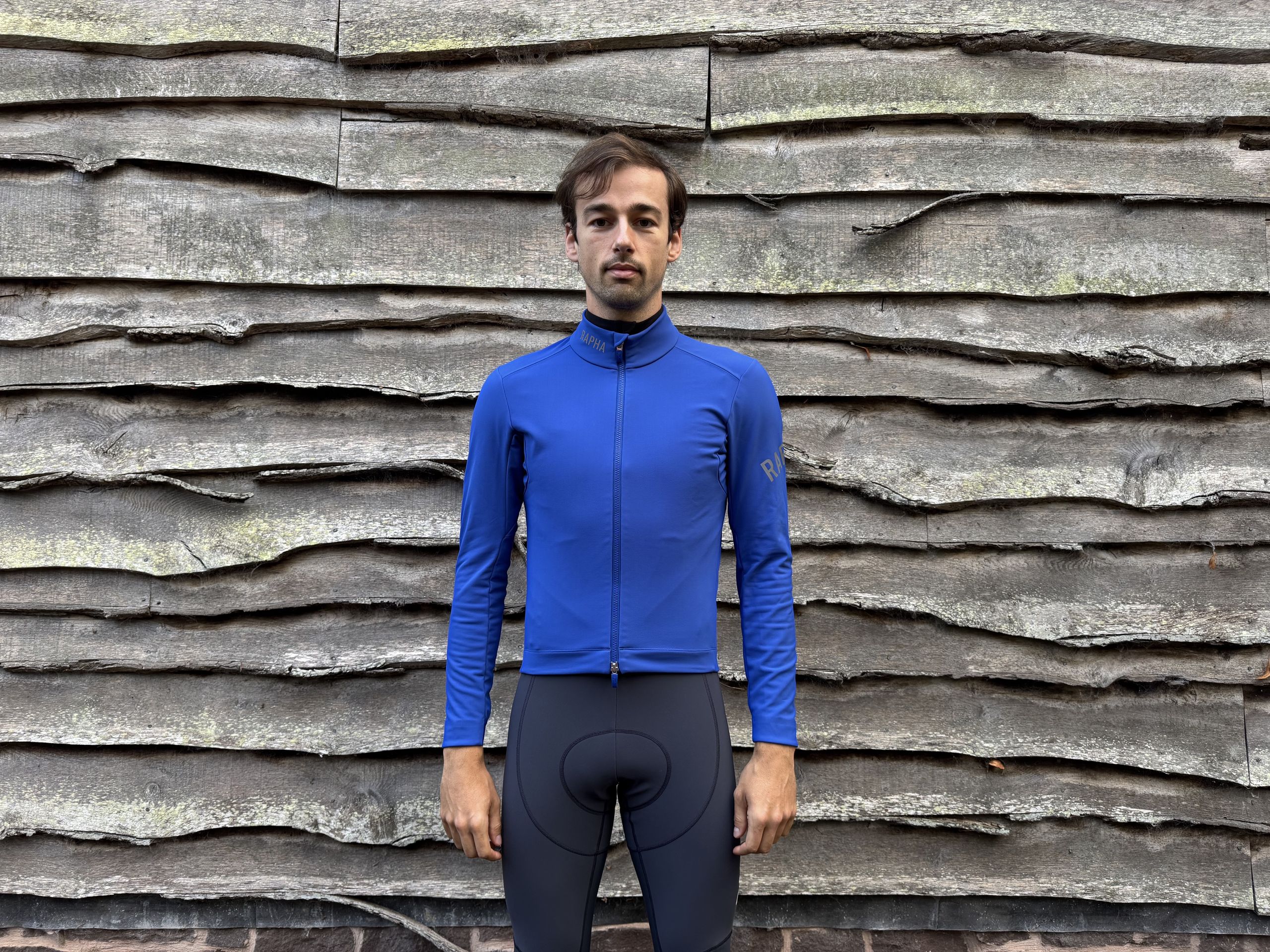
The Rapha Pro Team Shadow Jacket represents the brand’s deep winter offering, using the latest rain resistant Shadow technology with greater levels of insulation than the rest of the Shadow range.
Construction
Chief among the features of this jacket is the Shadow tech. This utilises a lightweight, breathable and windproof microporous membrane with PFAS-free DWR treatment to repel light rain. Add to this the internally taped seams, and it promises to keep out most of the water in harsh conditions. This fabric has also been designed to allow for high levels of stretch and freedom of movement.
In the event that water does get in, the jacket features a grid fleece inner to allow for a circulation of air which is designed to assist breathability as well as providing an additional insulating layer. Rapha gives a usable temperature range of 0-8˚C for this jacket.
Being part of the Pro Team range, high intensity riding has been a key consideration in the design of this jacket. As intensity rises, as does heat build-up. The microporous membrane assists with some heat dissipation, while the two-way zip allows for more tailored breathability. A wide silicone gripper on the rear hem aims to keep everything in place while riding.
Three rear cargo pockets are used for stashing spares, phone and food, while a zip-up valuables pocket is useful for keys or cards. Multiple reflective details are situated across the pockets, sleeves, and upper arm.
Four colours are available, with sizes from XS-XXL.
Image 1 of 2


The Ride
Fit wise, the jacket does a great job at balancing a close Pro Team fit, without being excessively tight so it can be worn over additional layers. It also remains easy to move around. The pockets are are not fitted overly high so as to remain accessible. One element that is missing, which is present on the far cheaper Core Jacket, are storm cuffs. The cuffs on the Shadow Jacket are good, with elastic under the wrists to fit securely over gloves. However, storm cuffs were a favourite feature of mine on the Core Winter Jacket, as they prevented cold air making its way up the sleeves with or without gloves. It’s a shame to see them excluded.
Weatherproofing is where this jacket really aims to excel, and the November weather has proven a perfect opportunity for me to test it out. Near freezing conditions and showery rain or heavy downpours have presented ideal chances to really see how this jacket performs.
The Shadow membrane works just as well as it does on the Shadow LS Jersey, beading water off the surface well in light to middling showers. When it comes to heavier rain it still takes a good while for the DWR to get saturated, and even then it still performs somewhat like a hardshell rather than a softshell.
Image 1 of 2


This also results in full wind proofing regardless of the temperature. The flip side of this is that the jacket can get quite stuffy, even in temperatures as low as 6˚C. In fairness though, Rapha states this jacket is for use in 0-8˚C. Using it across the freezing weather we’ve had this January, the jacket has been exceptional in -6˚C to around 4˚C but above this point I was getting rather sweaty inside the jacket. A grid fleece interior does a superb job at providing insulation, but the airflow is a touch limited. As with the Shadow Jersey I found that sweat tended to pool down the cuffs. Interestingly though, this was the main indicator of overheating somewhat, as I didn’t actually feel ‘too hot’.
I am also a big fan of this bright blue colour option for the jacket, as paired with several reflective details across the arms and rear, it leads to solid visibility in winter conditions. Other features that hit the mark well are the zips. Although they don’t feature the longest tabs to grab, they are relatively chunky so easily accessible while wearing quite thick and heavy duty gloves. The two-way zip also goes a good way to assisting in improving breathability. Unzip the top zip for a huge inlet of cool air but some fabric billowing. Unzip the lower zip to open up a bit of an exhaust at the rear with less fabric flapping at speed. A zip up valuables pocket is also a great addition for stashing keys, while the main pockets themselves are hugely spacious so you can load up on food and gear for winter epics.
Value and Conclusion
£325 is not cheap for a winter jacket, making the Pro Team Shadow Jacket a high end offering. It is of course a fraction of the price of the insane Assos Johdah Ultraz S11 jacket at £630 / $810, while the Q36.5 Dottore Termico Light is a hefty £450 / $600 but has a huge usable temperature range.
The most similarly performing jackets from my testing to the Rapha Shadow have been the PNS Mechanism Deep Winter jacket, and the Castelli Alpha 150. The PNS offering however is £390 / $530, with incredibly similar performance, but a less ideal fit. Meanwhile the Castelli is £360 / $420 but has potentially a higher usable temperature range but reduced weatherproofing capacity. Either way, I’d argue the Rapha Pro Team Shadow Jacket is relatively good value when it comes to designer brand Halo offerings.
Of course there are other options that represent far better value. At present I maintain that the Rapha Core Winter Jacket is one of the best performing jackets at just £140 / $200 representing hugely impressive value, arguably better than the Shadow jacket as you can also get a waterproof and the Core jacket for the same price as the Shadow.
Image 1 of 2


For properly foul weather winter rides with single figure temperatures, the Rapha Pro Team Shadow Jacket is an incredible performer. Even with frosty conditions and hammering rain, the Shadow jacket does a great job at keeping you warm, even if a bit sweaty inside. Add to this the two-way zip, large pockets, and good visibility, and it’s a very good jacket to use.
It even represents decent value compared to some other designer brand offerings, but it suffers when it comes to value compared to the likes of Rapha’s own Core Winter Jacket. So high is the performance of that jacket yet so low is the cost. I’d also argue that the Shadow Jersey represents a more versatile option, as a thick base layer with that can cope with most single figure temperatures as well as low teens.
