Chess Rebel
Ed Schröder is a Dutch software developer, computer scientist, born in The Hague, Netherlands. He learned chess from his father at a young age, and in 1980 he began programming chess – on a TRS-80! His chess playing software was ported to many platforms, including dedicated chess computers and microprocessors. Rebel became one of the top chess engines, winning multiple prestigious computer chess championships, including the World Microcomputer Chess Championship and the World Computer Chess Championship in 1992. Rebel also won several human championships and matches against top human players, including a famous 1998 match against GM Viswanathan Anand.
Rebel is notable for its innovative search techniques and evaluation functions. Schröder developed many versions of it. He retired from competitive computer chess in 2003, but continued to update Rebel as freeware. You can download:
- REBEL-16.3, the follow-up of REBEL-EAS, estimated 35-40 Elo stronger purely based on a stronger neural network. Code Base: Chris Whittington, neural network: Ed Schröder, opening book: Jeroen Noomen
-
Chess System Tal, the new EAS version plays unbelievable sharp games with lots of material sacrifices, Paul Morphy would have blushed.
I spoke to Ed, whom I have known for around forty years, and asked him how he is handling semi-retirement and his return to chess programming.
Frederic Friedel: Ed, I thought you had retired. Now it seems you are at it again.
Ed Schröder: Yes. It started about three years ago. My curiosity was roused when network programming was invented. Together with another old-timer, Chris Whittington, known from Chess System Tal, we started exploring neural net programming.
FF: And that looked promising?
ES: Indeed. Already the initial results were mind-blowing – they yielded an Elo increase of 450 points! After a year we added another 250 points, resulting in an incredible rating of around Elo 3600.
FF: Wow, that is quite fantastic…
ES: Fantastic, you say, but there was a negative side effect: an ever-increasing draw rate with each stronger version. This is a general trend. Today, top engines, especially on longer time controls, often produce a draw rate of 90%. Won games have become rare. I started to lose my interest and stopped working on new, stronger Rebel versions.
FF: So you returned to retirement?
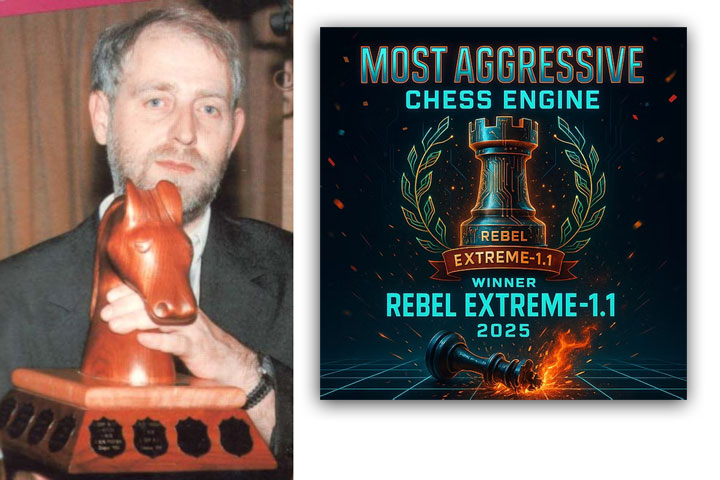
ES: No, instead I started working a new engine with the priority on playing style, rather than increased Elo. From the beginning, from 1980, when I started programming, I had always had a weak spot for engines that could sacrifice material and could play a good king attack. Long story short: my cooperation with Chris paid out, when two style engines saw the light of day: Chess System Tal 2.1 EAS and Rebel Extreme 1.1.
FF: Apart from engine programming, I know you have developed a tool that can evaluate and extract special kinds of games from general databases?
ES: Yes, and I am currently extracting the best games played by humans and computers, from ChessBase Mega Database. Give me a few days and I will show you the results.
FF: Sure thing. Please keep us briefed on your results and the progress you make.
