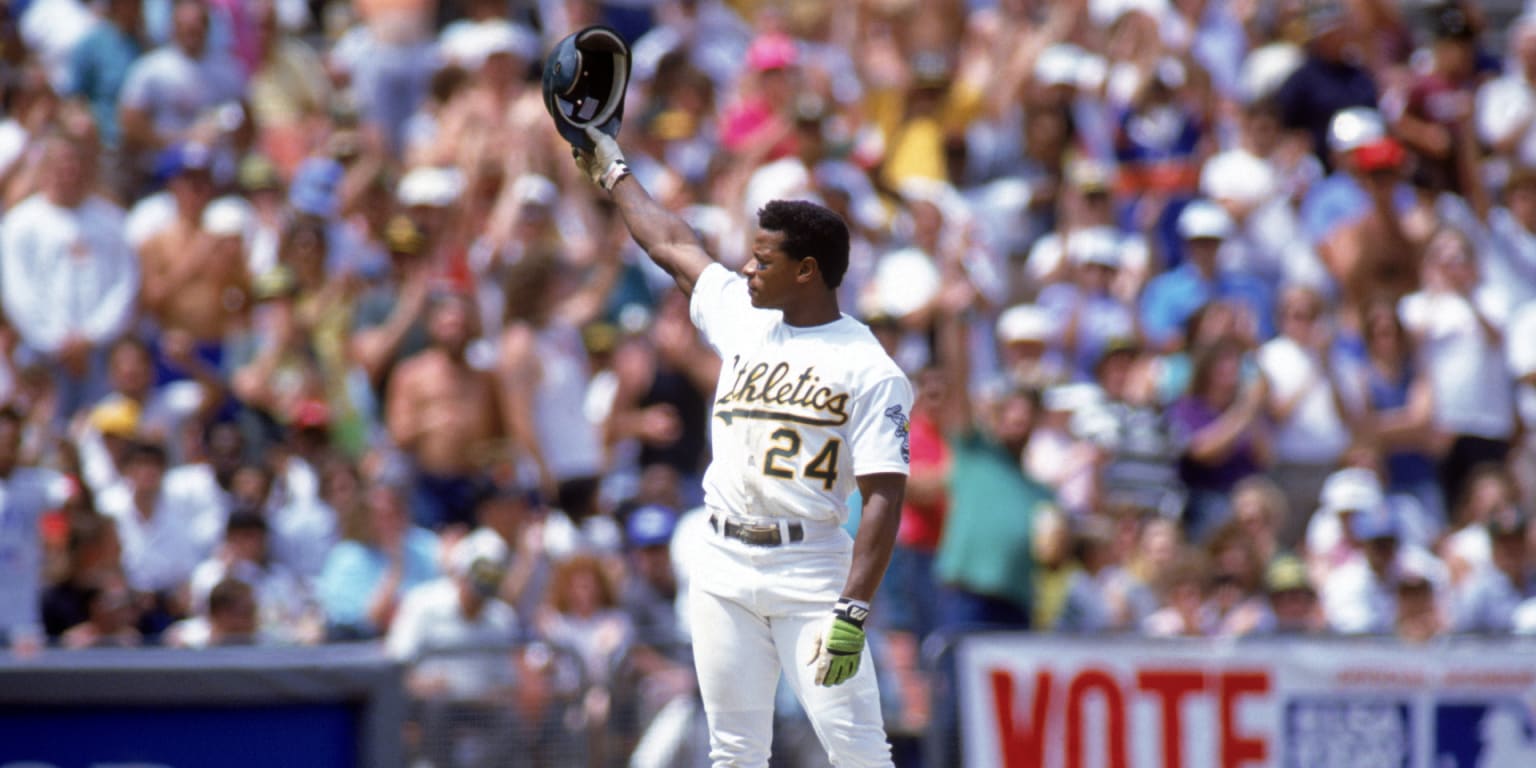
But the one Will Clark tells is definitely true.
A former All-Star first baseman for the Giants, “Will the Thrill” played against Henderson and the A’s in the 1989 “Bay Bridge World Series,” but this story is from a Spring Training game.
“So Rickey got on first base,” Clark remembers. “And [A’s manager Tony] La Russa puts the hold sign on Rickey because he wants Jose Canseco and Mark McGwire to see some pitches to hit.
“You could just see that Rickey was getting [ticked] off.”
Whether it was in the World Series or in Spring Training, you didn’t tell Rickey he couldn’t run.
“After about three pitches,” Clark said, “he goes, ‘Thrill, Rickey gone.’”
Clark turned to the San Francisco dugout and yelled, “He’s running!”
Rickey ran. The Giants pitched out. Rickey was safe anyway.
“After he slid into second base, he jumped up,” Clark said. “And he’s squatting down and pointing at me. He says, ‘I told you, Thrill! Rickey gone!’”
“Rickey gone.” When that happened on the basepaths, it was a thing to behold.
Clark’s wonderful story was just one of many that former teammates and opponents recounted for this story, remembering Henderson on the anniversary of his passing, from complications due to pneumonia on Dec. 20, 2024.
The baseball world was shocked and saddened at the news of Henderson’s sudden passing, and for many, it’s still hard to believe that he’s no longer with us.
The tremendous legacy he left, however, will endure. As will the legendary stories that only grow in their mythic quality as the years pass.
But Henderson was more than what we hear about in those stories. He was an incomparable gift to baseball, one who arrived on Christmas Day in 1958.
As we mark what would have been the all-time stolen base king’s 67th birthday, we asked some of those he played with and against, as well as some who managed him, what made Rickey so great and who he was beyond the famous anecdotes.
Rickey was Rickey before he was ‘Rickey’
Henderson’s tendency to speak in the third person was one of his most well-known idiosyncrasies.
Many of the most popular stories involving Rickey featured Rickey talking about Rickey. But lest you think that this began after Henderson reached superstardom in the Major Leagues, the truth is that Rickey had been referring to himself in the third person ever since he was a kid.
“Right around junior high or high school, he started doing that,” said Dave Stewart, a childhood friend of Henderson’s from Oakland who was his teammate with the A’s and Blue Jays. “I have no idea where it came from. Rickey was an original, man.”
If there is one word to describe Rickey, it might just be that one — “original.”
Stewart’s recollection of “Rickey on Rickey” also sheds light on something that many people who didn’t know Henderson well might have misunderstood based on what they saw when he was on the field.
Henderson was confident from the day Stewart met him when they were 12 and 13 years old, respectively. That confidence — which some may have perceived as cockiness — didn’t just emerge after he got to the big leagues.
The “snatch catch” in the outfield, where Henderson would often make a routine catch with a little extra — and in the minds of some, unnecessary — flair, was sometimes taken as showboating.
As was Rickey’s reaction to launching some of his 297 career homers — he would sometimes give a slight flip of the bat in front of him, pick at his jersey, touch his helmet and/or take such a wide turn at first base that it seemed he might be destined for the first-base dugout rather than the bag itself.
But for Rickey, it was all necessary. Because that wasn’t for show.
That was just Rickey being Rickey.
“That’s him,” Stewart said. “If you watched him playing football in high school — which I always thought was his better sport — he just did some incredible things. You can call it whatever you want to. It’s not disrespectful to call it ‘hot dogging.’ It was just unbelievable when he was playing football. It’s just natural that it would carry over into baseball.”
As much as it might have seemed like he was trying to put on a show, Stewart says Henderson was not an entertainer at heart. He was an eminently gifted athlete whose personality manifested in his performance on the field.
“I don’t think Rickey played to entertain, if I’m being totally honest,” Stewart said. “If that’s the case, then he was ‘entertaining’ all the way back in Little League and Babe Ruth league and high school football.
“He didn’t play to entertain. He played to be the best.”
What do the Angels, Orioles, Twins and Red Sox have in common (other than they’re all American League teams)? Henderson stole more bases than each of those teams did in the 1980s.
“The thing about Rickey,” said new Braves manager Walt Weiss, who was a teammate of Henderson’s with the A’s from 1989-92, “he was a trailblazer. He set the standard. Just the all-around body of work, you just didn’t see that back then.
“It’s like comparing someone to Babe Ruth. I mean, yeah, people have hit 50 homers and even 60 at times, but Babe Ruth was doing it when nobody did it.”
Ruth, of course, is the most transformational figure in baseball history when it comes to changing how the game was played. But like Ruth, Rickey did things no one had dreamed of before he arrived.
He was simply the best, taking the role of leadoff hitter and molding it into his own image.
It wasn’t that there were no great base stealers in the game when Henderson burst onto the scene. His first season in the Majors — 1979 — coincided with Lou Brock’s final season. Brock left the game as the all-time steals leader, with 938.
But Brock had been in a class of his own — the previous record holder was born in 1866 (Billy Hamilton — no, the other really fast Billy Hamilton — who stole 912 bases). And in the previous half century prior to Henderson’s MLB debut, only four others besides Brock had stolen more than 500 bases — Bert Campaneris (615), Maury Wills (586), Joe Morgan (573) and Luis Aparicio (506).
Then, Rickey changed the game. By the time he was 26, he had stolen more bases than each of those four. And he finished his illustrious career with 468 more steals than Brock.
“It’s like Michael Jordan,” Weiss said. “When he was doing the stuff he was doing, nobody was really doing that. Later, Kobe [Bryant] comes along and LeBron [James] comes along. When you put context to what Rickey was doing, it was otherworldly.”
Acuña is an elite talent who has the potential to be a Hall of Famer someday. But he suffered a torn ACL in each knee and has stolen 25 bases in 144 games since his 40-70 campaign.
Shohei Ohtani is perhaps the greatest baseball talent to ever live, and he founded the 50-50 club in 2024. This past season, though, he returned to a two-way role and stole 20.
Henderson led the AL or the Majors in steals in every year of the 1980s, except for one — he was limited to 95 games by injury and stole “only” 41 bases in 1987. For the decade, he swiped 838 bags.
Rickey ran. And ran. And ran. But his greatness went beyond what numbers — or anecdotes — can convey.
Rickey, for a time, was faster than time
When Don Mattingly first saw Henderson up close, he was awestruck.
“I was young and I really hadn’t seen him that much,” Mattingly said of when Henderson was traded from his hometown A’s to the Yankees prior to the 1985 season. “I was kind of just getting started when he got traded over. I was shocked at, like, how big he was — how physically put together he was.
“I remember him standing during the anthem with his hands behind his back. And I remember thinking, ‘This dude is ripped.’”
Henderson got stronger as he reached his mid-20’s, adding slug to his sensational speed.
Mattingly, the Yankees’ All-Star first baseman who would be named the AL MVP that first year of Henderson’s tenure in pinstripes, hit behind Rickey in the lineup. What he saw from the on-deck circle is as vivid for him today as it was 40 years ago.
“The power was unbelievable,” Mattingly said. “I saw him go upper-deck in left field at the old Yankee Stadium. That’s a bomb. There aren’t too many guys that went up there.”
Henderson was listed at 5-foot-10, 180 pounds. But it was all muscle. His chiseled physique helped him to not only steal more bases than anyone in MLB history (1,406), but also to hit more leadoff home runs (81) than anyone in MLB history.
Just as in his Yankees days, his teammates with the A’s were wowed by the steely strength of the “Man of Steal.”
“If you were gonna make an NFL running back in a lab,” Weiss said, “Rickey is exactly what he would look like.”
But as easy as he made the game look, what Rickey did wasn’t easy. It was grueling. And there were days on which he wasn’t in the lineup because of the wear and tear. Back then, that was often criticized.
“I actually had a conversation with him one time in those Oakland years,” Weiss said. “People would get on him for not being in the lineup at times when he had some leg issues — soft tissue stuff, like calves, hamstrings or a quad, that type of thing.
“And he said, ‘People don’t realize the pounding my body takes from all those bases I steal. No one takes that into consideration.’”
From 1980-83, Henderson played in 560 games. Over that span, he attempted 503 steals (not counting when the ball was fouled off or put in play). When he set the single-season steals record (130) in 1982, he attempted more steals than games played (172 attempts in 149 games). No one else in MLB history attempted more than 151 in a season (Brock, 1974).
Mattingly, who later became a big league manager himself, said that what Rickey knew in his day is something we take for granted today. And it led to a playing career that lasted a quarter of a century.
“In today’s game, there’s a lot more talk of recovery,” Mattingly said. “He played in a day when it was almost uncommon to not play hurt. And I think something Rickey did that was really smart was that he took care of himself. Because if his hammies weren’t right, or there was a little something going on, he wasn’t afraid to say, ‘Hey, I’m tight,’ and take a day.
“It probably wasn’t the most popular thing at that time. You’re supposed to gut it out, don’t go in the training room, all that. But Rickey knew he wanted to play a long time.”
Rickey took the long view. He was ahead of his time the way he was light years ahead of his peers on the field. And his foresight purchased him time. As a result, he became the only position player since 1930 to play in 25 Major League seasons. He even led the Majors in steals (66) at age 39 in 1998.
There have been and will be others who will steal 60, 70 or perhaps even 80 bases in a season. But we might never see someone quite like Henderson again.
“I think the thing we may not see again,” Mattingly said, “is somebody that has the longevity of Rickey.”
One of the most enduring mental pictures we have of Henderson involves him in the middle of his patented headfirst slide.
Terry Kennedy, a four-time All-Star catcher who played in the Majors from 1978-91, saw his share of Rickey diving into the next base at his expense.
Kennedy later got a glimpse of Rickey’s ingenuity when Henderson told him a different kind of Rickey story.
“He told me how he learned how to slide headfirst so well,” Kennedy said. “He asked an airline pilot how he landed the plane.”
When Henderson first began sliding headfirst, it was because he felt that sliding feet-first would result in too much wear on his legs, particularly with the amount of basestealing he did. But his initial attempts were painful, resulting in bruised shoulders and even laceration.
After falling asleep on a flight during a road trip, he was jolted awake by the team’s plane making a rough landing on a windy day in Chicago. Later, on a flight back to Oakland, the aircraft — with the same pilot at the helm — made a very smooth landing.
Little did the pilot know that his second landing would contribute to a Hall of Fame baseball career.
“Rickey asked the pilot, saying, ‘That was so smooth, how did you do that?’” Kennedy said. “He somehow converted that into — instead of sort of a jump, like some guys would do the Pete Rose ‘Superman’ jump and land hard — Rickey learned how to go into the slide a little gentler.”
Henderson has said that one of the major takeaways he had from his discussion with the pilot was that he needed to get himself low to the ground gradually as he went into the slide, rather than all at once a la Rose. A low center of gravity while running made a smooth landing possible.
The result was a thing of beauty — powerful poetry in motion, a graceful aggression harnessed to perfectly balance forceful utility with an artful aesthetic.
Rickey was in love with the game
Twenty-five seasons in the big leagues. A surefire Hall of Famer. More records than you can keep track of.
For Rickey, that wasn’t enough. Because love knows no bounds.
“When he came to me, he was in better shape than any of the young players I had,” said Bill Madlock, who managed Henderson in 2003 and ’04, when Rickey was 44 and 45 years old. “In fact, he was in better shape than any player I had as a hitting coach in Detroit [from 2000-01].”
After his stint as hitting coach for the Tigers, Madlock — a three-time All-Star and four-time batting champion over a 15-year MLB career — became the manager of the Newark Bears of the independent Atlantic League. Ahead of his second season there, Henderson said he wanted to play for him.
The prior year, Rickey posted a .223/.369/.352 slash line in 72 games with the Red Sox. After not receiving any interest from Major League teams in 2003, he wouldn’t take no for an answer.
“The young guys on the team, they had only heard about Rickey,” Madlock said. “But then when they saw what Rickey could do, they were in awe of him.”
In 56 games with the Bears that year, Henderson hit .339/.493/.591. That got the attention of the Dodgers.
Dan Evans was the Dodgers’ general manager at the time, and he wanted what Rickey had.
“We thought that his combination of experience, skills and clutch performances would be a terrific addition to our club,” Evans said. “And that love of the game was evident.”
Over 30 games with Los Angeles, Henderson struggled to a .627 OPS. But he was undeterred, returning to Newark the next year and stealing 37 bases in 39 attempts while posting an .897 OPS.
In 2005, at age 46, Rickey signed with the San Diego Surf Dawgs of the Golden League.
His manager? Kennedy, the only person who ever tried to throw Henderson out from behind the plate and later managed him.
Rickey was not who some thought Rickey was
Kennedy learned toward the end of Henderson’s professional playing career that Rickey was much more than what could be gleaned from the stories Kennedy had heard about him.
“The perception of Rickey was not what he was,” Kennedy said. “I don’t know if there was anybody like him. You don’t really know until you get to meet him and know him.”
When Henderson joined Kennedy’s Surf Dawgs, he was 46 years old, going on 47. But while his body was older, he was still Rickey. And he still wanted to play the game he loved.
He was also more than willing to bestow his wisdom upon the next generation.
“One day I asked him — I didn’t think he would do it — but I knew these guys were never gonna have this chance,” Kennedy said. “I said, ‘Can you take them around the bases, starting at first and take ’em around the bases doing the baserunning thing?’
“And he goes, ‘Oh, yeah, sure. No problem.’ So I didn’t know what to expect, right? He was so linear, and it was so good, that I was amazed. And the guys on the other team, they were all on the top step of the dugout. And I said, ‘Come on out.’ So he talked to both teams and he spent like 45 minutes, and it was the best thing.”
While Henderson’s aim may not have been to entertain, that didn’t mean he didn’t rise to the occasion. He did it throughout his career, including when he set the all-time runs scored record by homering on Oct. 4, 2001, to eclipse Ty Cobb’s mark of 2,244 (Rickey’s record of 2,295 still stands).
He also did it when he was playing independent ball at age 47.
“We were playing in Surprise, Ariz.,” Kennedy said. “And ESPN comes, and they’re making a big deal about it and they go, ‘Is Rickey gonna play?’ And I told them he wasn’t in the lineup and needed a day of rest — that if anything, it would be a pinch-hit appearance.
“I went to Rickey and told him they wanted to get some film of him playing. I said, ‘If a situation comes up and I need you for one swing, you good with that?’”
Rickey was good with that.
“So we were tied in the seventh inning,” Kennedy said. “He goes up to hit, and he hits a homer. And ESPN got it. And then I go, ‘There it is. That explains it all, right there.’”
On May 1, 1991, Henderson and the A’s were playing the Yankees on an overcast day at the Oakland Coliseum. Sitting on 938 career steals — tied with Brock for most in MLB history — Henderson took his lead off second base with Harold Baines at the plate in the fourth inning.
As Yankees starter Tim Leary lifted his leg to deliver the next pitch, Henderson broke for third and slid in safely with his signature headfirst dive. He was now the all-time steals king.
Eighteen years later, when he was inducted into the National Baseball Hall of Fame, Henderson ended his speech — which he literally went back to school to perfect — this way:
“I am now in the class of the greatest players of all time. And at this moment, I am … very, very humbled.”
Rickey Henderson is widely considered the greatest leadoff man in baseball history, the likes of which we may never see again. There is a treasure trove of tales that give us a glimpse of Rickey. But they don’t tell the whole story.
There is one particular story, however, that is precious to Stewart and indicative of the man whom most didn’t see.
“Nobody talks about this,” Stewart said, “everybody talks about the funny stories. But Rickey, when he would get his meal money — back in the day, we got our meal money in envelopes on road trips — Rickey would never spend his meal money. He would keep the envelope and when he got home, he put that envelope in a drawer.
“So when his daughters came home with good grades on their report cards, he would tell them, ‘Go in the room, you know where the drawer is — pull an envelope out.’”
As he reflected on Henderson on what would have been Rickey’s 67th birthday, Stewart summed him up this way:
“Rickey was just a loyal, unbelievably kind, generous and loving father, son and friend.”
Rickey’s gone. But he’ll never be forgotten.
