
In the first two articles of this series, 60 Minutes video courses against the Sicilian Defence and courses against the French Defence were presented.
60 Minutes Courses against the Caro-Kann
For this article, I examined courses that each present a complete repertoire against the Caro-Kann Defence. These courses are suitable, on the one hand, for club players who want to avoid the time-consuming study of main lines while still playing promising variations. Stronger players will find alternative repertoire choices here that allow them to surprise well-prepared opponents.
The Exchange Variation 1.e4 c6 2.d4 d5 3.exd5 cxd5 is very popular among amateur players. It is relatively easy to learn and, with limited risk, offers chances of achieving a small opening advantage. Three of the courses presented here focus on the Exchange Variation, each in a different form.
The Caro-Kann Exchange Variation with 4.Nf3 (Nico Zwirs)
This new course by the Dutch IM covers the line with 4.Nf3 (instead of the more frequently played 4.Bd3).
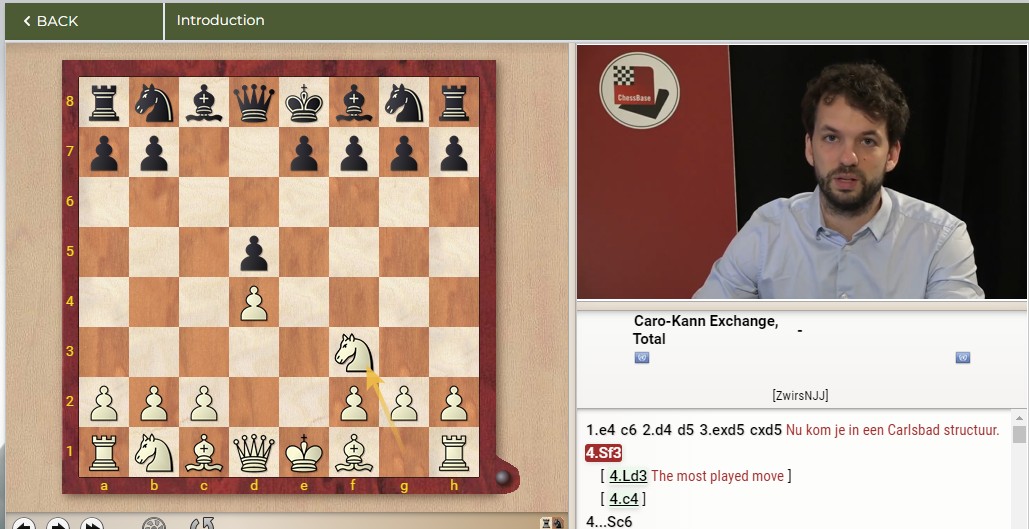
The aim is to reach a so-called “Carlsbad structure”, which can also arise with colours reversed, for example in the Exchange Variation of the Queen’s Gambit. White subsequently aims to exchange the dark-squared bishop and then obtains a very pleasant and solid position. After an introductory summary of the theory, the author goes on to cover the following variations:
1.e4 c6 2.d4 d5 3.cxd5 cxd5 4.Nf3
- 4…Nc6 5.c3 Nf6
- 4…Nc6 5.c3 Bg4
- 4…Nc6 5.c3 Bf5
- 4…Nc6 5.c3 Qc7 and g6
Early deviations: 4…Nf6/Bf5
The course is very well suited for players who want to avoid complications in the opening and prefer to focus more on the strategic development of the game.
A dangerous weapon against the Caro-Kann in 60 Minutes (Andrew Martin)

A different approach is presented by the English IM and coach Andrew Martin: 1.e4 c6 2.Nf3 d5 3.exd5 cxd5 4.Ne5!? This is also an Exchange Variation, but here White delays the move d4 and instead, with 2.Nf3 and 4.Ne5, tries to pose problems for Black, for example along the a4–e8 diagonal.
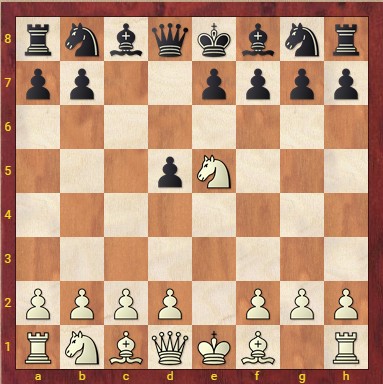
In addition, there are further ideas such as tactical tricks against c6 and f7, or reinforcing the knight with f4. This is often accompanied by an attack on Black’s king position. It is a tricky sideline in which the defending player needs to be well prepared in order not to fall into an inferior position. The author presents the ideas and plans through ten illustrative games.
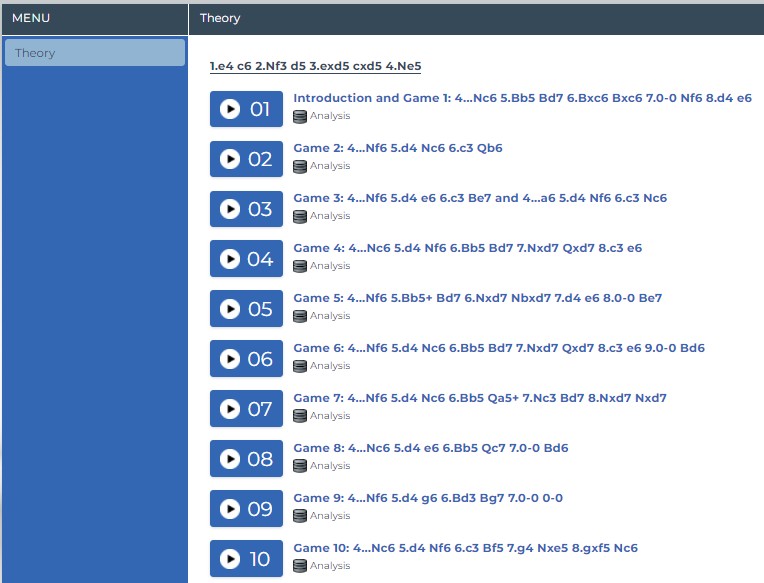
As a complement to the Exchange Variation, there is also a slightly older course:
Play the Exchange Variation against the Caro-Kann (Nigel Davies)
Here, the classical approach to this variation is explained, namely 1.e4 c6 2.d4 d5 3.exd5 cxd5 4.Bd3.
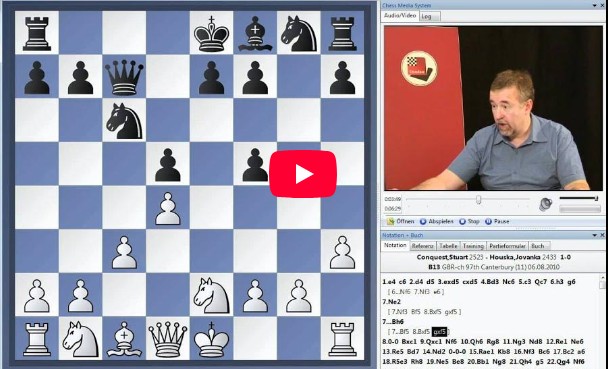
The English GM presents a clear explanation of the strategic ideas for both sides, as well as answers to popular replies such as 4…Nc6 5.c3 Qc7.
We now move away from the Exchange Variation and look at two courses by the English IM Lawrence Trent.
The Ne2 Caro-Kann (Lawrence Trent)

The idea behind the rather unusual move 2.Ne2 is to meet the “normal” reply 2…d5 with 3.e5, reaching a kind of Advance Variation in which the knight on e2 is already lying in wait for Black’s light-squared bishop, intending to attack it with Ng3 or Nf4.
If Black follows the usual Caro-Kann scheme too closely here, with an early …Bf5, he can run into problems.
I particularly like the fact that the author complements his analysis videos with four exercises in the interactive FritzTrainer format, allowing us to test what we have learned straight away.
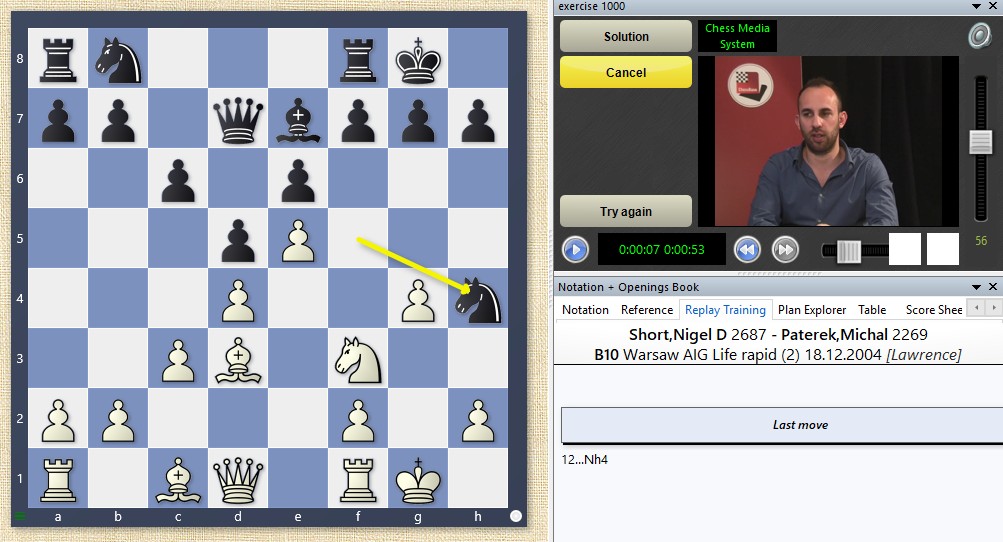
Also very popular among amateur players is the “Fantasy Variation” 1.e4 c6 2.d4 d5 3.f3, which Lawrence Trent presents in this course:
Winning with the fantasy variation (Lawrence Trent)

White invites Black to accept a gambit and, after 3…dxe4 4.fxe4 e5, continues with 5.Nf3, since 4.fxe5 does not work for tactical reasons.
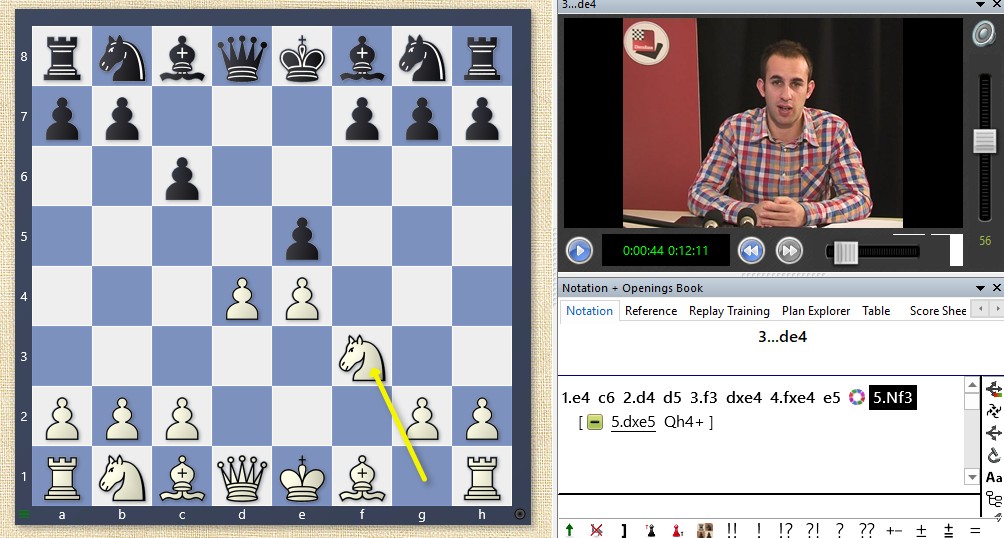
Accepting the gambit is very dangerous, so Black may be well advised to opt for more solid lines such as 3…e6 or 3…g6. These are also discussed by the author in separate videos.
Once again in this article, I would like to present a course that is somewhat “out of the ordinary”. Although it is primarily aimed at Caro-Kann players, it is also very interesting for White players who like to play the Panov Attack. Incidentally, this was my very first 60 Minutes course.
A clear program to fight the Panov Attack (Henrik Danielsen)

In this course, the Danish grandmaster presents a repertoire for Caro-Kann players against the Panov Attack (2.d4 d5 3.exd5 cxd5 4.c4). He recommends the line with 5…Nc6 (after 3.exd5 cxd5 4.c4 Nf6 5.Nc3) and then goes on to cover the individual continuations. The key idea of his repertoire suggestion is that he avoids the famous Panov endgame arising after 6.Nf3 Bg4 7.cxd5, without drifting into obscure sidelines. Specifically, the focus is on the following position, which arises regularly in this line:
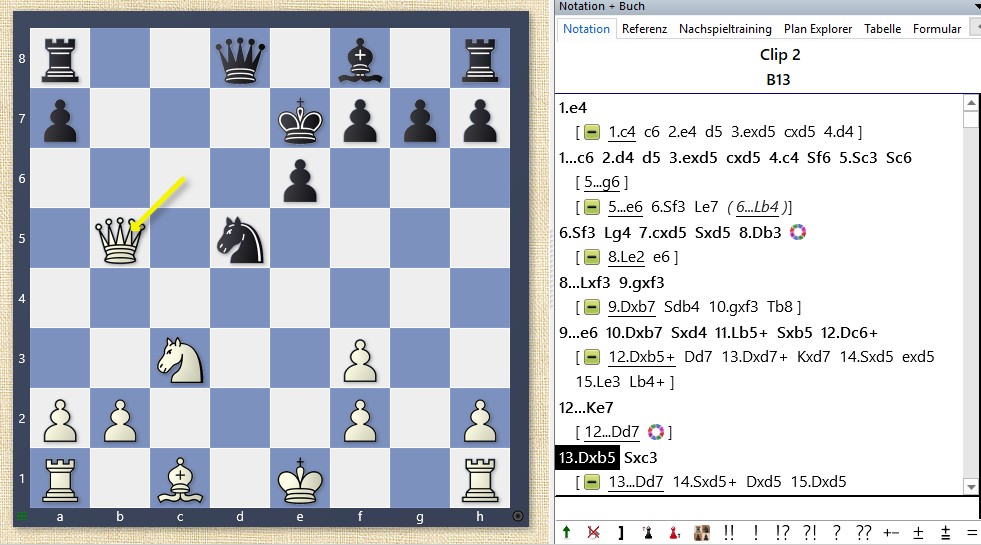
Black usually continues here with 13…Qd7, which, after the exchange of queens, leads to the aforementioned “Panov endgame”. The move 13…Nxc3 is a risky but also very dynamic option, in which White has to play very precisely in order not to slip into an inferior position. I myself once defeated a significantly stronger player with this line, who was not familiar with the variation. Here is an example:
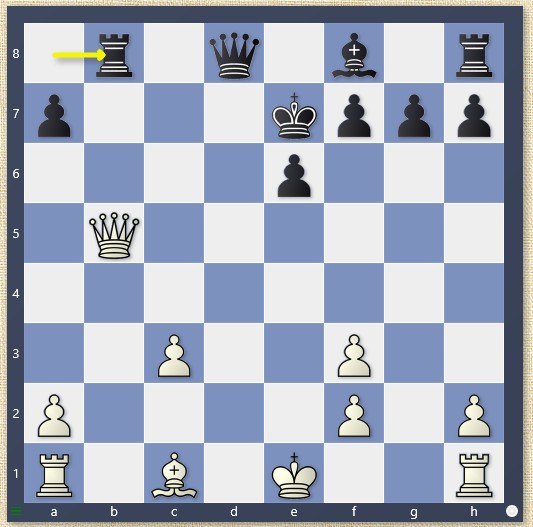
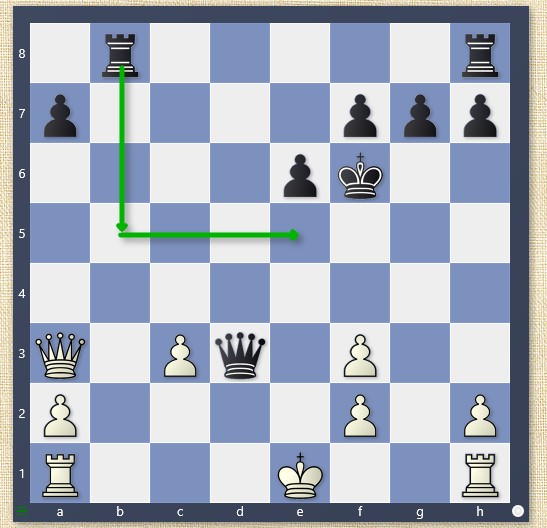
In this position (after 14.bxc3 Rb8), White should by no means play the tempting 15.Ba3+, because after 15…Kf6 16.Qa4 Bxa3 17.Qxa3 Qd3! White is virtually lost due to the threats of …Rb5 and …Re5+.
The lines arising after 6.Bg5 (instead of 6.Nf3) dxc4 form another major focus of the presentation.
