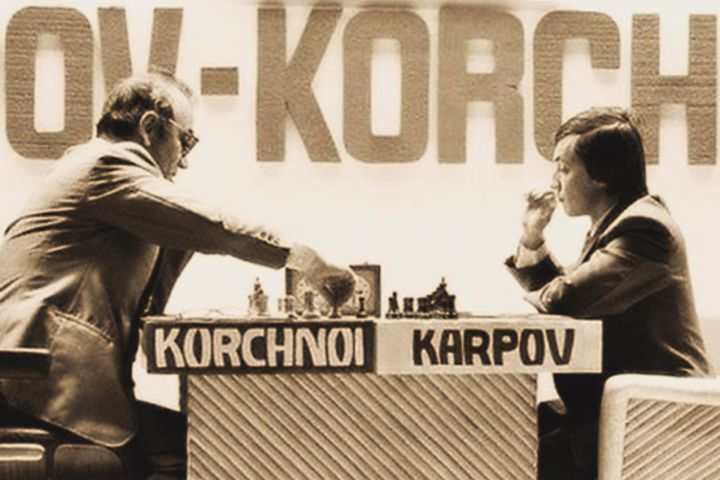
The annotations in Mark Dvoretsky’s famous Analytical Manual were not convincing. And not just one or two variations seemed “off” – Fishbein had questions about everything. It turns out recent excavations have uncovered some fascinating points about this game from 47 years ago. GM Fishbein suggested to GM Karsten Müller that the game would make a good endgame puzzle, so here we go.
I’ve compiled the most important variations for this game from some of the most famous annotators, starting with the 22nd move. You can play over these moves in the score below. Our ultimate goal will be to pinpoint Black’s final critical error.
A) Black’s 24th move: As Kasparov says, “this move was generally condemned.” Timman defended the move (24…Qe5), but Kasparov, in 2021, identifies it as the “likely” game-losing error. Kasparov thought 24…Be7 would hold and Dvoretsky thought 24…Bf8 offered drawing chances. What moves hold the draw for Black?
B) Black’s 30th move: GM Alex Fishbein thought that 30…axb5 was not only playable, but drawish. Is he right?
C) White’s 31st move: Conventional wisdom was that Larsen’s suggested 31.b6 probably would be a winning endgame. Fishbein thinks it is a draw. What do you think?
D) White’s 35th move: Dvoretsky says that 35.Ra7+ was a winning move. Do you agree?
E) Black’s 38th move: Early commentators thought 38…Rb4 gave good drawing chances, but both Kasparov2021 and Fishbein think White still wins. Do you agree?
F) Black’s 40th move: How do you evaluate Müller’s variation?
G) White’s 45th move: After 45.Rd8 Ke7 46.Rd7+ Ke8 47.e4 Rb5, do you prefer Timman’s 48.Rd5 variation or Kasparov2021’s 48.exf5 recommendation?
H) Black’s 46th move: Does Black have a chance of saving the game after 46…Rb5?
So what was Black’s fatal error? Was it Black’s 24th move or Black’s 46th move, or something in between?
Sources consulted were:
- Viktor Kortschnoj, My Best Games (Russian edition, Loan from Zoran Petronijevic)
- Jan Timman, The Art of Chess Analysis (Everyman Chess paperback reprint of 2003, first published in 1980 by RHM)
- Mark Dvoretsky, Dvoretsky’s Analytical Manual (Russell Enterprises, 2008)
- Gary Kasparov [Kasparov2006], My Great Predecessors, Vol. 5 (Everyman Chess 2006)
- Gary Kasparov [Kasparov2021], My Great Predecessors, Vol. 5 (Russian edition 2021, Loan from Wolfram Schön)
- Karsten Müller, Master Class No. 15, Viktor Korchnoi (ChessBase 2022)
- Alex Fishbein, emails (October, 2025)
At the beginning of this game, Karpov led 4 victories to 1 (6 victories needed). Here is the game with all annotations available. YClick on the notation to get a replayer with engine support.
About the author
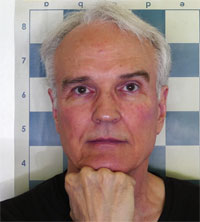 Charles Sullivan, who is 76, grew up in the San Francisco Bay Area. While at the University of California, Berkeley, he was captain of the golf team, marched with the Cal Band for one year, played trumpet in the concert band, and was tear-gassed by helicopter during the People’s Park demonstrations in 1969 (it was a weird time). He taught elementary school for three years (his hardest job ever) before switching to computer programming until retirement. A favourite memory is playing chess while sitting on the steps (which was allowed in those days) of the Parthenon in Athens in 1973. Today he lives with his wife in Davis (near Sacramento).
