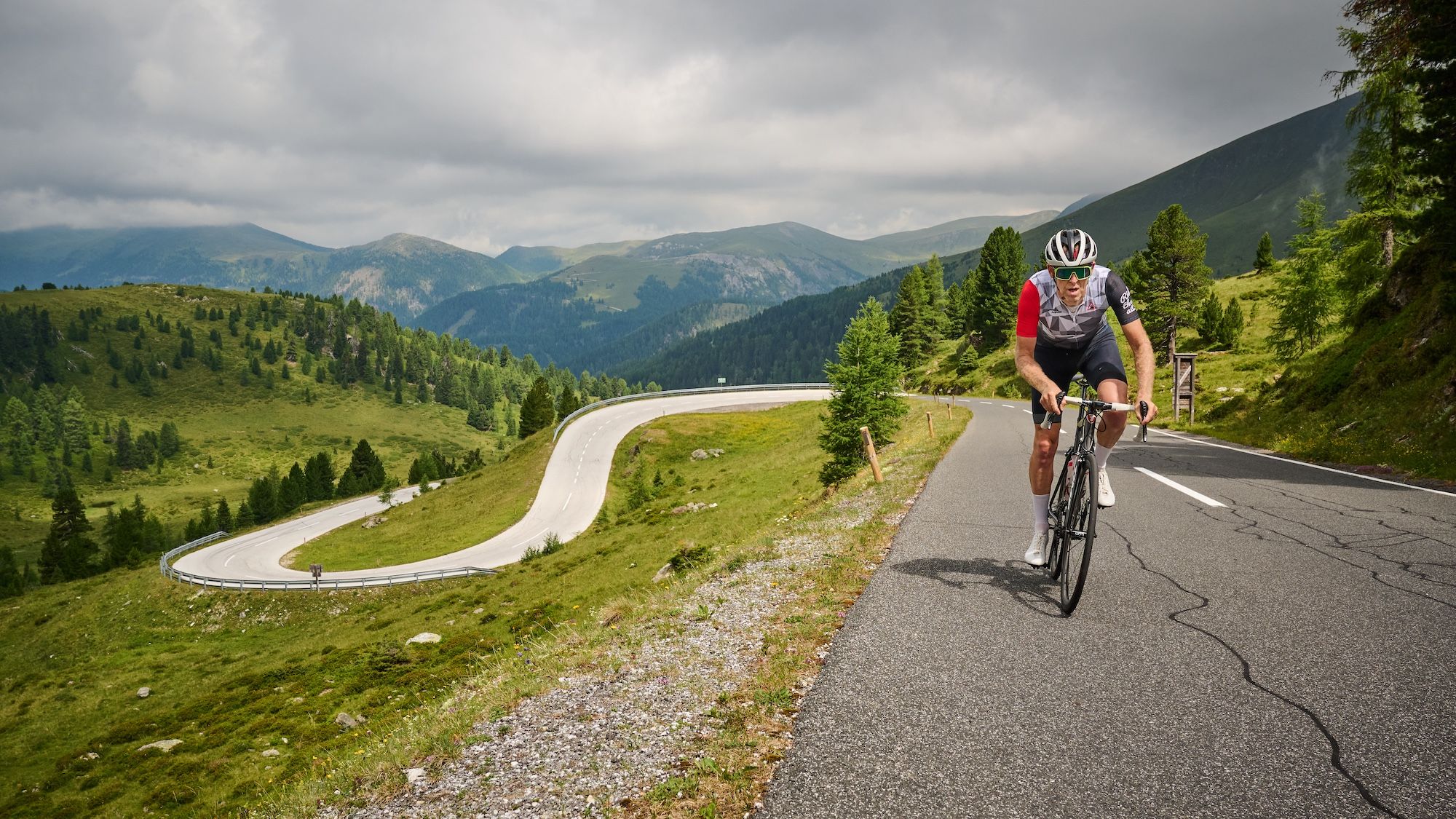
There are few places on earth that match Austria’s roads for savage gradients and spectacular scenery. It’s a central European country with almost nothing but mountains and lakes within it’s borders. Home to countless 2,000m-plus peaks, each so remote that no one can hear you scream. A skiers playground in the winter, and a cyclists paradise in the summer
Many of Austria’s climbs remain unknown. With the country’s national tour commonly taking place in July, it remains overshadowed by the Tour de France, and the stunning mountains it takes riders over fail to make it into the public conscience.
I’ve cut my teeth on some of these climbs that many outside of the die-hard cycling fans will never heard of; such as the Kitzbüheler Horn, the Grossglockner and the dreaded Rettenbachferner. But this time, I wanted to find something different – to look past the more well-trodden ascents and head into Austria’s unknown high parts. That is what brought me to Carinthia.
Carinthia is Austria’s southernmost state, bordering the regions of Salzburg to the north, Tyrol to the west, Styria to the east and its neighbouring countries of Italy and Slovenia to the south. It is the least populated and least visited part of the country. Of course, fewer people means fewer cars, so its roads are blissfully empty.
(Image credit: Future)
It wasn’t just the promise of quiet roads that brought me here, though; it was the lure of three extraordinary climbs I’d read about, a triple threat that had my mouth watering and my heart racing.
They go by the names of Oscheniksee, Hochwurtenspeicher and Grosssee. The stats alone are enough to scare people away: kilometre upon kilometre of double-digit gradients, even harder than the big Alpine climbs of the Tour de France and Giro d’Italia. They make Alpe d’Huez and the Stelvio Pass seem like child’s play.
As I pored over the numbers, I began to wonder if there was once an international convention of road planners to agree on a sensible pitch for a mountain road, to which the Austrian delegation didn’t turn up. They mustn’t have got the memo that a gradient of 6–8% is enough for a long climb. Instead, they pitched almost all of theirs at 10% or above. The thought of climbing them filled me with both excitement and dread.
“The road is so deathly quiet that I wonder what would happen if I keeled over and fell off the edge – would anyone ever find me?”
Simon Warren
With three days to fill, I wanted to pack more into my trip than just this trio of beasts, so I made a list of 10 mountains and built them into three monster routes that provided scenery like nowhere else and tested my fitness. Nestled deep in the Möll Valley, an hour’s drive from Klagenfurt Airport, the town of Flattach serves as my base. It’s a small, sleepy place with a handful of hotels and shops. But with three days and 14,000m to climb, there’s little time to meet the locals. The plan is simple: ride, eat, sleep, repeat.
Day one’s hit list is the triple whammy of the Oscheniksee, Hochwurtenspeicher and Grosssee, all in one ride. Each one is named after the bodies of water at their summits, and all are relentlessly steep dead-ends, set on tiny, rugged roads that will push me and my bike to our limits. I jump out of bed, as excited as a kid on Christmas morning, and devour four different cuts of cold meat, five mountain cheeses and as many fresh bread rolls as I can manage. My route is plotted at 173km, with a whopping 5,590m of climbing – this is not a day for cereal.

Filling a water bottle from a mountain stream flowing over an avalanche gallery
(Image credit: Future)
First up, it’s the Oscheniksee. The road immediately kicks skywards at 15% from the valley floor, but this is just the prelude; in fact, the first 7.5km are a warm-up, before I turn east and disappear into the forest for 9km at a leg-sapping average of 13%. Already, barely one climb in, and I’m crunching through my gears.
There’s barely time to recover before the Hochwurtenspeicher unfurls before me. It’s a road so deathly quiet that I wonder what would happen if I keeled over and fell off the edge – would anyone ever find me? Making this a likelier than usual outcome, the brutal ascent has stretch after stretch of punishing slopes. I’m almost on my knees, with one climb still to come.
Fortunately, I’ve saved the best for last. The Grosssee is the most visually striking of this Alpine triptych. Devoid of the ski lifts and apartment blocks that tend to adorn mountain summits, here it’s just me, the road and the mountains that enclose us. I kick on in awe of the utter remoteness, before descending back to my hotel, and collapsing onto my bed.
I start day two’s ride in Seeboden, a 30-minute drive south of Flattach. The first climb is the horrendous Lammersdorfer Hütte – 5km at an unrelenting 15%. It batters my legs right from the first metres and has me thinking that maybe I should have left it until last, or dodged it altogether. Oh well, too late.
Travelling north-east, I push on towards the wonderful 34km of the Nockalmstraße toll road. In Austria, most roads through national parks, and almost all the famous passes, are toll roads, charging car users €10–35. Cyclists swan through for free.

(Image credit: Future)
The Nockalmstraße contains two brilliant climbs: the Schiestlscharte and the Eisentalhöhe. Crossing this wide, sweeping mountain pass, I’m again shocked at how few cyclists I see. If it was anywhere else in the Alps, it’d be teeming, but here in this sparsely populated region, humans are few and far between. Almost entirely free from traffic, aside from the ubiquitous motorcycle tourists, it’s a real haven for adventurous cyclists.
I loop south to Gmünd, the most immaculate Alpine town I have ever passed through. It has a hyper-real perfection: multicoloured building facades, gold adornments and tall church spires, set against a mountain backdrop. From here I head north up the valley towards the Malta Hochalmstraße.
This climb is an adventure in itself. Following the long valley approach, I pass the toll booth and the road kicks up with pure venom. Then comes a tunnel, a one-way system, and a string of hairpins, including one inside a tunnel – something I’ve never experienced before. Bypassing obstacle after obstacle, all interspersed with wicked stretches of brutal gradient, I eventually reach the grandeur of the Kölnbrein dam wall, which, measuring 200m, is the highest in all of Austria.

The wide hairpins of Austria’s mountain roads take you into the clouds
(Image credit: Future)
Breathless from both the riding and the views, I take a moment to look across the reservoir’s milky blue, glacial water and marvel at the snow-capped peaks on the horizon. Dropping back down to Gmünd to return to Seeboden completes the 180km loop, adding 4,460m to my climb tally.
Inspired by the ‘Club des Cinglés du Mont Ventoux’ ride, which climbs the Giant of Provence three ways in a day, I set myself a challenge on day three: three ways up the Gerlitzen Hüttersteig. Starting from Annenheim on the shores of Lake Ossiach, it’s 3,685m of climbing over 108km.
I start with the Gerlitzen Alpenstraße, followed by the Kanzelhöhe, then close with the Gerlitzen Gipfelstraße, which has been used many times by the Tour of Austria as a mountaintop finish. By the end of the three ascents, my legs are sore, but I’m satisfied that I have extracted every last drop from them.
I leave Carinthia feeling that there’s something here for everyone. Yes, I chose to seek out the most vicious gradients, but there are also gentler climbs, like the Villacher Alpenstraße, while the valley roads are perfect for flatter days. Far from the madding crowds elsewhere in the Alps, the region is a real cycling paradise. Though I liked the calmness of the hills, the only thing that could make them better is the sight of more intrepid cyclists, wrestling against the mountains and relishing the challenge. So what are you waiting for?

The sun might be shining, but you’ll need a light for the tunnels
(Image credit: Future)

(Image credit: Future)
Carinthia’s 10 must-ride climbs
1 Oscheniksee
Rated the third toughest climb over 2,000m in the Alps, you’ll have to wrestle your bike up its 15% slopes all the way.
Length 8.8km
Height gain 1,161m
Average gradient 13.2%.
Strava KOM 53:29.
2 Hochwurtenspeicher
A never-ending road of beauty and drama, with multiple rugged kilometres of savage gradients, tunnels, hidden lakes, breathtaking views and a summit of pure wonder.
Length 14.1km
Height gain 1,268m
Average gradient 8.1%
Strava KOM 1:07:35.
3 Grosssee
Another of Carinthia’s wild wonders, packed with horrific stretches of 12–15% slopes. The real beauty comes after passing the gate halfway, where the car-free road winds up to a reservoir.
Length 16.1km
Height gain 1,429m
Average gradient 8.6%
Strava KOM 1:11:24.
4 Malta Hochalmstraße
This popular tourist road up to a giant dam wall is packed with excitement, from wickedly steep stretches and pitch-black tunnels to hairpins and views to die for at the top.Length 13.8km
Height gain 1,062m
Average gradient 7.3%
Strava KOM 50:03.
5 Schiestlscharte / Nockalmstraße
The eastern ascent of the Nockalmstraße is 12km of absolute cycling paradise. It’s quiet, smooth, and set on a fluctuating gradient which keeps you guessing all the way.Length 12.2km
Height gain 906m
Average gradient 7.4%
Strava KOM 38:10.

Many of Austria’s ski lifts sit dorment through the summer
(Image credit: Future)
6 Eisentalhöhe / Nockalmstraße
The climb from the west is slightly easier than its twin at the other side, but no less enjoyable to ride, and features hairpins and a cafe at the summit.Length 8.1km
Height gain 567m
Average gradient 6.9%
Strava KOM 24:57
7 Lammersdorfer Hütte
An utterly evil beast of a climb, the numbers speak for themselves – 5km at 15%, with some sections above 20%. It’s hairpins all the way, winding up through the forest to the restaurant at the top, where your legs will disown you.
Length 5.2km
Height gain 852m
Average gradient 14.9%
Strava KOM 32:50.
8 Goldeck Panoramastraße
A beautiful road, and a relative breeze to ride up by Austrian standards. After rising up through the forest, the panoramic views at the top are well worth the wait.
Length 13.6km
Height gain 1,275m
Average gradient 8.1%
Strava KOM 43:34
9 Gerlitzen Gipfelstraße
Blink and you’ll miss the start of this exceptional little road, packed with hairpins and wickedly steep ramps.
Length 10.4km
Height gain 1,006m
Average gradient 9.6.
Strava KOM 40:52.
10 Villacher Alpenstraße
Long but comfortably pitched around 7%, freshly surfaced and shaded by forest.
Length 16km.
Height gain 1,186m.
Average gradient 7.2%.
Strava KOM 44:27.
How to get there, and where to stay
How to get there
Carinthia is in central, southern Austria, bordering Slovenia and Italy. The best option is to fly into Klagenfurt, although it’s a small airport serviced only from a few European countries. (Ryanair fly there from Stansted in the UK.) The larger airports of Vienna, Innsbruk and Salzburg will then require a transfer to Carinthia
Where to stay
We stayed in Flattach, in the north of the region, at the bike-friendly Hotel Flattacherhof (from €200 per night). The kind staff insisted I took extra sandwiches for my lunch. Other towns that would make a good base are Seeboden or Villach.
When to go
As with all high-mountain regions, the weather in Carinthia can change in an instant from 30°C heat to rain. Travel between June and September for the best conditions and to ensure the snow has melted.
What to bring
You’ll be fine on a road bike, but for the rougher climbs, we recommend wider tyres, not just your best 26mm slicks. As for gearing, fit the smallest you can – our 34×32 was adequate, but only just. As there are unlit tunnels on some roads, make sure you bring some lights.
Toll roads
Most of the major passes are toll roads, with car tolls costing €10–€35. Our fixer arranged a Kärnten Card for us, which significantly cut the costs, but doesn’t include the Lammersdorfer Hütte or Gerlitzen Gipfelstraße. Bikes are free.
