The gravel road is empty, spooling towards the horizon as far as I can see. The air is the driest I’ve breathed, the sun is hot and the altitude high. We’re still in winter, they claim, not yet spring – how can it be? Racing through the emptiness, my heart rate stays annoyingly high, my power annoyingly low. I’ve not had enough time to adapt to the conditions since landing, and I’m on the back foot. My body is on autopilot, going through the motions to get to the finish line.
I’m in Namibia, in southwest Africa, taking part in the UCI Gravel World Series. The race situation – struggling, hanging on – is familiar, but the setting is unlike anything I’ve seen before. While my legs are churning around near-automatically, my eyes are continually distracted by wildlife: baboons, oryx and springboks. It’s like riding through a David Attenborough documentary. After nearly five hours of torrid racing, I cross the line in sixth place, 18 minutes adrift of the winner, Namibia’s reigning national road race champion Alex Miller.
How I ended up here owes much to my change in cycling mindset three years ago. When it became clear I wasn’t going to accomplish my dream of turning pro while still in the U23 ranks, I promised myself I’d continue racing – by saying yes to every opportunity. If I wasn’t going to race the Tour de France, I was at least going to travel the world and race everywhere else. So, when the prospect of Namibia was put to me, there was only one possible answer. On paper, it was a race, but more importantly it was a week-long adventure. I’d never been to Africa, and this was as good an excuse as any.
Namibia is three-and-a-half times the size of the UK but has 67 million fewer people, a population of just 3.1 million. It borders Angola and Zambia to the north, Botswana to the east, South Africa to the south, and the Atlantic Ocean to the west. Out on the road, it’s hard to imagine reaching a border – no end is ever in sight and the sheer scale is baffling. It’s one of the emptiest countries on Earth, and that emptiness makes for a unique cycling experience.
(Image credit: Nuka Nuka)
Touching down at Hosea Kutako International Airport, some 45km east of Namibia’s capital, Windhoek, I got an immediate taste of what was to come. The airport itself was tiny, and the 40-minute taxi ride to the city revealed vast swathes of nothingness. I could tell this place was unlike anywhere I’d been before. The time in Namibia aligns with central Europe, so although it’s a long flight, there is little risk of jetlag. Starting a bike tour from Windhoek makes sense: there’s the nearby airport and decent infrastructure, as this is where almost 15% of the population lives. It’s an extremely safe place to visit and, given the lack of traffic, almost everywhere is suitable for touring by bike. Though the flat expanses can feel boring in a car, on a bike the spaciousness is liberating.
My unofficial tour guide for the week is Dan Craven, a born-and-bred Namibian and six-time national road race champion. Dan raced in the UK with Rapha-Condor from 2009–2011, before graduating into the WorldTour with Europcar in 2014. He retired in 2020. We first met in our adopted home city of Girona, Spain, and we’ve stayed in touch ever since. For years he’d been telling me I needed to explore his country. With Dan as prospective guide and a UCI World Series race on the calendar, no further encouragement was needed.
We have two other guides: husband and wife Martin and Chrystal Freyer. Martin is a multi national champion in almost every discipline, and he and Chrystal have bikepacked across the world. Having them with us brings yet more local knowledge – I was going to get a real insight into Namibia from three people who really know it.
Chrystal follows in a support truck, which allows us to ride without luggage on our bikes and throw caution to the wind when it comes to route-planning. With so few places to stop for supplies, touring Namibia without a support vehicle would be challenging at best.

(Image credit: Nuka Nuka)
Ahead of the adventure, Dan had warned me that you have to pre-plan in Namibia. You can go hours without being able to get water, and the tar roads have to be avoided by bike. My trip began with the Khomas100 UCI race, which took us from Windhoek some 160km north to the edge of Okahandja. The gravel roads between the two cities roll up and down for as far as the eye can see, passing through not a single settlement.
We have four days of touring planned, and the first, the day after the race, takes place on gravel trails more like farm tracks than roads. Even the few local riders who have joined us are in new territory. Hours pass without seeing a car; the endless terrain rolls past, becoming more and more sandy. Crossing one of many dried-up river beds, I approach too fast and somersault over the handlebars. My body is fine, bar a small cut on my shoulder, but a part of my pride remains in that Namibian river bed.
Our destination for the first night is Omaruru, Dan’s hometown. It’s an arduous six-hour ride on legs already tired from the race. The final few kilometres are ridden on tarmac, which feels like a red carpet after all the sand.
The Onguza Bicycles workshop is our headquarters for the night. This has been the hub of Dan’s life since leaving behind European racing, producing handbuilt steel bikes that he hopes to export across the world. Seeing the process in person is mesmerising. Everything measured, filed, and built by hand.
Rather than sleeping in the workshop, we spend the night under the Omaruru stars, camping in a riverbed on the edge of town. It’s like being in a Top Gear special as our convoy of cars heads into the farmland and Dan’s Land Rover gets stuck in the sand. Our tents are barely up as the sun drops behind the mountains. Sitting around the campfire in this riverbed in Namibia feels a million miles away from, well, everywhere.

(Image credit: Nuka Nuka)
Namibia’s modern history has been shaped by colonial rule. From the late 19th century, the country was under German rule. After World War One it was ruled by South Africa and was known as South West Africa. This meant it was subjected to apartheid until gaining independence in 1990. The legacies of that past are still visible. Leaving Omaruru the next morning, our route passes through a township of tin shacks and sandy yards. The divide isn’t as glaring as in some neighbouring countries, but it’s unmistakable. The legacy of segregation runs deep.
The next day is anything but plain sailing. We ride 50km and call it a day at Erongo Rocks – 50 of the roughest kilometres I’ve ridden in my life. The washboard surface is miserable to ride across, with not a single smooth kilometre. Our grand plan of nearing the coast is thwarted by an average speed almost 40% slower than planned. Entering the campsite, a sign warns of rhinos – another reminder that you don’t come to Namibia just for the riding. The campsite gives me a new perspective on the phrase middle of nowhere. We speed-hike up to the top of the Erongo rocks to take in the sunset over the savannah – the most epic I’ve ever seen.
Being so far from anywhere, there’s little light pollution, and the Milky Way is visible as I’ve never seen it before, a brilliant spectacle. Around the campfire, the evening ends with a braai, the Afrikaans word for barbeque. It’s a ritual that encompasses collecting the firewood, building the fire, huddling around it for warmth and, of course, eating. The air may be hot and dry in the day, but the moment the sun drops, it turns cold. With the campfire as our centrepiece, we eat and chat into the night.
Riding in Namibia reminds me why I first started riding bikes: not just the novelty of being here, but the strangeness, feeling so small in this vast landscape – nothing and no one around to notice my presence. To pass through unnoticed feels like floating in space, and so far away from my normal chaos of chasing race results. Riding here is not about distance, speed or power, but something rawer and realer.

(Image credit: Nuka Nuka)
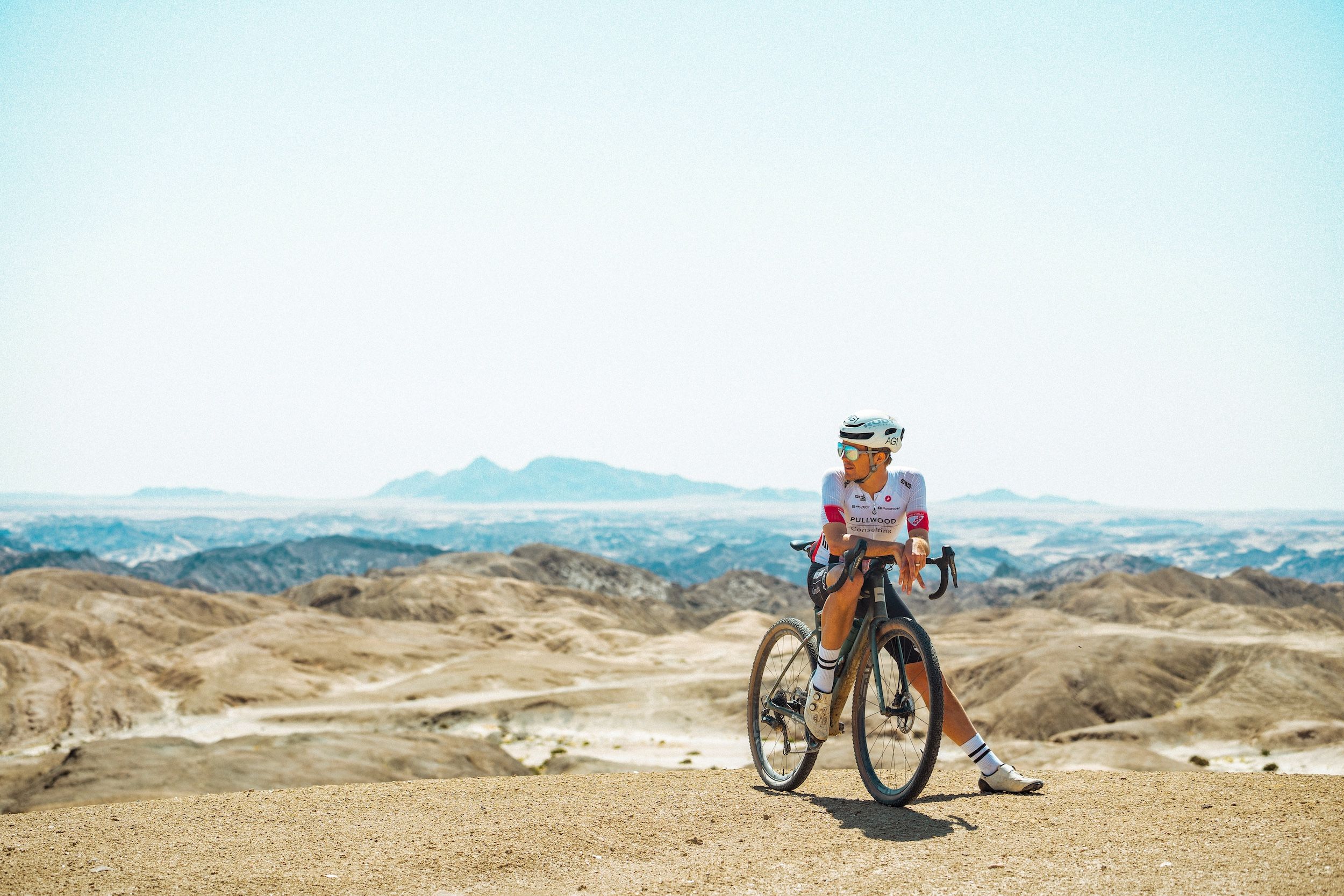
Floating is even more apt on our final day, as it takes us to Moon Valley, near the coastal town of Swakopmund – a place that retains a German flavour from colonial times. The valley is a breathtaking lunar landscape, hundreds of little hills packed close together – a bike park created by nature. There’s a childlike thrill, each choosing our own course, going up and down natural banks, flowing in and out of nature’s haphazard trails.
Namibia’s vast, open landscapes leave me with an altered sense of cycling and why it matters to me. It’s no longer about racing, mileage or even the bike itself. It’s about space – the kind that slows you down, makes you look around, and forces you to accept how small you really are. Our trip ends with the long drive from Swakopmund back to Windhoek. The car is quiet; everyone’s spent. It’s been anything but a normal racing trip, and it’s one I’ll never forget. As we leave, a strange nostalgia settles in – as if I’m saying goodbye to a part of cycling I hadn’t realised I’d needed to find.
How to get there and where to stay
How to get there
Flights from London cost £800–£1,200 return and take around 15 hours, often including a layover in Addis Ababa, Johannesburg or Frankfurt. A tourist visa (£65), completed and paid online or with local currency on arrival, is required to enter Namibia.
Where to stay
Plan your route carefully between Windhoek and Swakopmund – it’s the best area for gravel riding and has the most reliable infrastructure, though accommodation can be sparse. Campsites and basic lodges start around N$500–1,000 (£20–45) per night, while mid-range guesthouses and safari lodges cost N$1,500–2,500 (£60–120).
When to travel
The best time to ride is May to September, during Namibia’s dry winter – clear skies, cooler days and little rain. Summer (October–March) brings heat, wind and occasional storms.
Touring by bike
A handful of trip operators run cycling tours in Namibia. If doing it self-supported, it’s strongly advised to ride in a small group and hire a vehicle, which gives the option to be flexible with plans and take turns riding. Many roads are rough. I rode an Enve Mog with 50mm tyres and would not advise anything narrower.
Vaccinations, currency and communications
Consult your GP at least eight weeks before travel. Vaccinations depend on your itinerary and flight layovers. The Namibian dollar is pegged to the South African rand. Carry some cash, although card payment is widely accepted. Buying a local SIM card at the airport is recommended, as e-sims do not work in Namibia.
