The sport of baseball has changed a lot under MLB commissioner Rob Manfred, with the institution of the pitch clock, the infield shift ban, the ghost runner and, starting next year, the automatic ball-strike challenge system. What he floated on Thursday might be the biggest change yet.
Speaking on WFAN’s “The Carton Show,” Manfred addressed the possibility of MLB expanding to 32 teams, after nearly three decades of 30 teams. The commissioner sounded more than open to the idea, saying there are several cities that want an MLB team.
Advertisement
“When people want your product, you ought to try to find a way to sell it to them,” Manfred said. “It’s kind of basic.”
That’s not too new. Manfred has been flirting with the idea of expansion for years and said just a few months ago he intends to select two cities for expansion before his planned retirement in 2029. It got interesting, however, when Manfred made pretty clear he intends to realign the league once the two teams are aboard.
So say goodbye to the American and National League, and hello to the East and West league, or whatever MLB wants to call it.
Among Manfred’s reasons for the change was easier travel for the players:
“It does a ton for us from a format perspective. You would realign, you would do it along geographic lines, which could alleviate a ton of the travel burden that’s on players.
“Remember, we ask our players 162 times in 186 days. So most of the play between 162 and 186 travel, right? So you can eliminate a lot of that travel, make it less burdensome, which would be a great thing in terms of player health and safety.”
MLB has been composed of the American and National League for 125 years. They used to be very distinct leagues, with separate governing systems, rulebooks and umpire crews, but that line dissolved in 2000 under former commissioner Bud Selig to more closely resemble the rest of the sports industry.
Advertisement
Manfred’s other pitch was how some playoff series would align better time-wise for fan bases (i.e. East-Coast fans not having to stay up late to watch an ALDS game on the West Coast):
If you play geographically, we get in a postseason. You know, we have those four-window days that I love, right? You get four baseball games in a day, it’s awesome. But when you think about the fans in the individual markets, you always end up with, because of the way we’re set up, you know, you get Boston versus Anaheim in one of the early rounds. So you’re either going to be too late for the fans in Boston or too early.
So if you realign geographically, you would look more like other sports where you play up East into the World Series and West into the World Series. And that 10 o’clock game on the West Coast, that sometimes is a problem for us, becomes a prime time game on the West Coast for the two teams that are playing. So there’s a lot of advantages to it.
Manfred added a vision of eight divisions of four teams and keeping teams in the same city separate.
How would that look? To throw out a quick mock-up, let’s just say the two expansion cities are Nashville and Portland. If we try to create eight geographically distinct divisions with no teams in the same city, while trying to preserve some premier rivalries, we could get something like this:
-
West: Seattle Mariners, Portland, San Francisco Giants, Los Angeles Dodgers
-
Southwest: Los Angeles Angels, San Diego Padres, Las Vegas Athletics, Arizona Diamondbacks
-
South: Texas Rangers, Houston Astros, Colorado Rockies, Kansas City Royals
-
Midwest 1: Minnesota Twins, Milwaukee Brewers, Chicago Cubs, St. Louis Cardinals
-
Midwest 2: Chicago White Sox, Cleveland Guardians, Detroit Tigers, Cincinnati Reds
-
Northeast: New York Yankees, Boston Red Sox, Toronto Blue Jays, Pittsburgh Pirates
-
Mid-Atlantic: Washington Nationals, Baltimore Orioles, New York Mets, Philadelphia Phillies
-
Southeast: Atlanta Braves, Nashville, Tampa Bay Rays, Miami Marlins
Please note: that is absolutely not a serious attempt to create permanent, harmonious divisions for MLB. There are some obvious problems. It’s just meant to show how different things could get if Manfred is serious. And condolences to the Pirates if those divisions actually do come to pass.
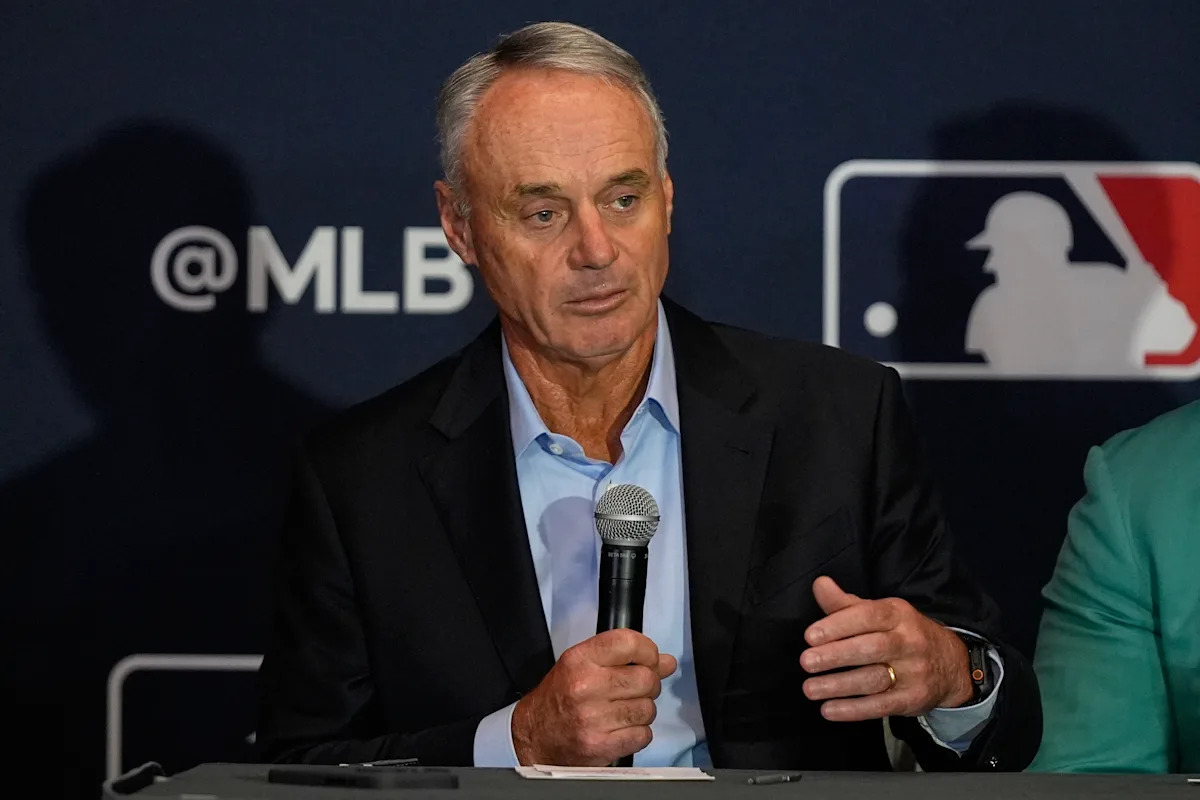
Rob Manfred wants MLB to look very different by the time he’s done. (AP Photo/John Raoux)
(ASSOCIATED PRESS)
That might not be the only major change to the structure of MLB he’s considering, as Manfred was also asked about the NBA Cup in-season tournament. He didn’t deny his office has discussed a sort of MLB Cup, but seemed hesitant given some obvious drawbacks:
“We’ve talked about split seasons, we’ve talked about in-season tournaments. We do understand that 162 [games] is a long pull. I think the difficulty to accomplish those sort of in-season events, you almost inevitably start talking about fewer regular-season games.
“It is a much more complicated thing in our sport than it is in other sports, because of all of our season-long records. You’re playing around with something that people care a lot about.”
Manfred also confirmed he still intends to retire at the end of his contract in January 2029. His successor could find themselves running a very different league.
