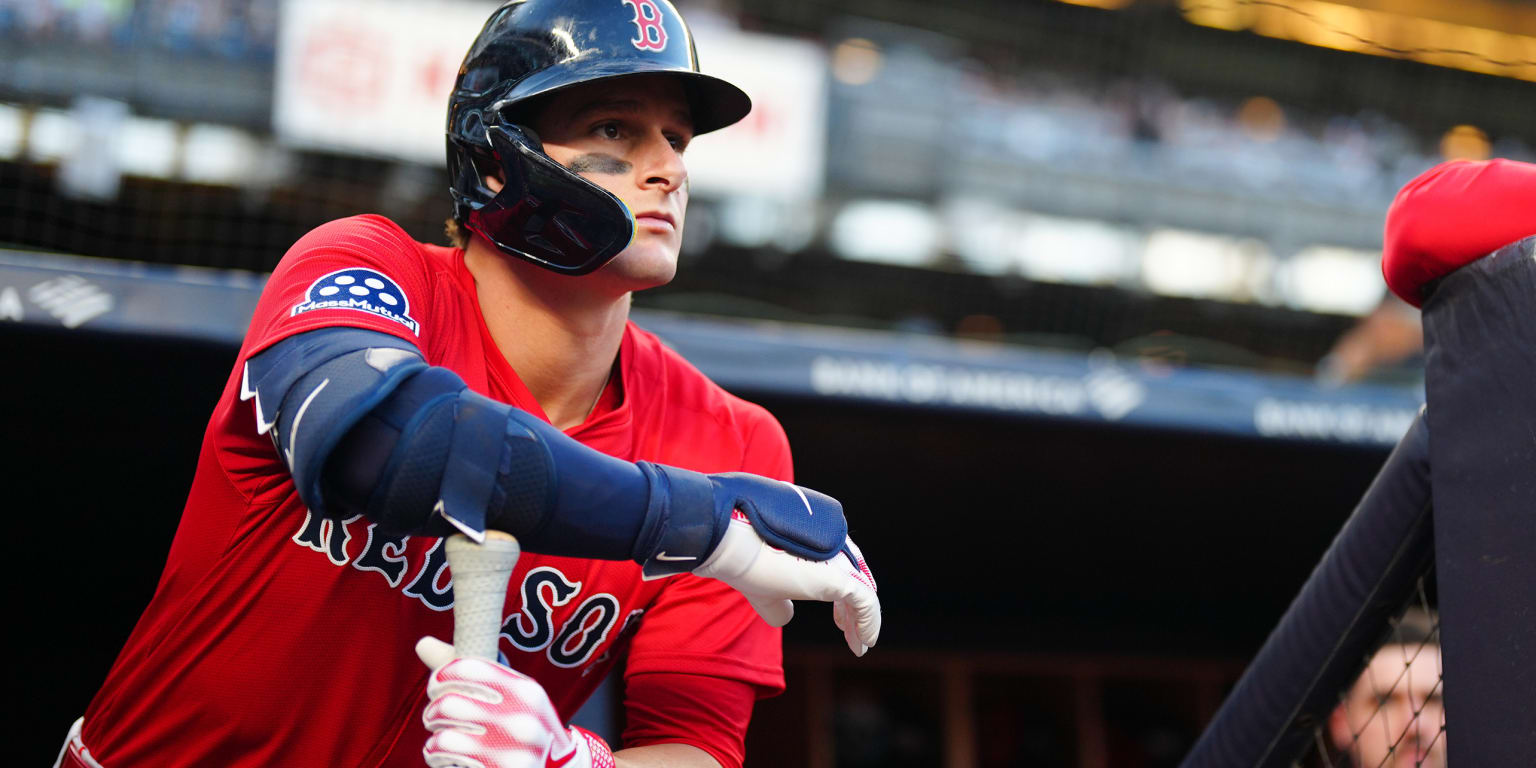
But just how big of a star could Boston be looking at here? There obviously are no guarantees — health, as Anthony has already experienced, will play a pivotal role — but history always provides some helpful parameters for understanding the range of possible outcomes.
Despite a slow start upon arriving at Fenway Park (5-for-44 over his first 15 games), Anthony finished his rookie year at .292/.396/.463, which was good for a park-adjusted 140 OPS+ (in other words, 40% above league average), to go along with eight home runs, 18 doubles and 32 RBIs. Combined with strong defense in the outfield corners and above-average baserunning, that was good for 3.1 WAR (per Baseball-Reference). Scale that to 150 games and Anthony would have notched 6.5 bWAR at that pace, which would have ranked seventh among MLB position players in 2025, right up there with the likes of Shohei Ohtani and Juan Soto.
It’s not as simple as that, of course. But even just the fact that Anthony was a well-above-average hitter last season was a rare feat, given his age and level of experience. If you go back to 1900 (the beginning of baseball’s Modern Era), Anthony became only the 14th AL/NL hitter age 21 or younger to reach each of the following marks in a rookie season:
Let’s take a look at the previous 13 hitters in this cohort and see what we can glean that might be relevant to Anthony’s future. (Each player is listed with his rookie season in parentheses.)
Group 1: Raked their way to the Hall of Fame
5 players: Tim Raines (1981), Frank Robinson (1956), Stan Musial (1942), Ted Williams (1939), Heinie Manush (1923)
Red Sox fans obviously will gravitate toward Williams, but there’s no real comp to the Splendid Splinter, who was an immediate force of nature at age 20, leading the Majors with 145 RBIs and 344 total bases. Robinson and Raines show the wide range of this group, with the former launching 38 home runs and the latter swiping an NL-best 71 bases in just 88 games. At a time when baseball had barely moved beyond the Dead Ball Era, Manush hit just four homers in 109 games but batted .334 with only 21 strikeouts.
The closest statistical comp to Anthony here is Musial, other than the fact that, unlike Anthony, Stan the Man played a full season (536 plate appearances). Musial also was 21 in 1942, and while he would go on to hit 475 home runs, just 10 of those came as a rookie. (It wasn’t until his age-27 season that he cracked the 20-homer plateau). But Musial was immediately a great pure (and patient hitter), and his .397 OBP, .490 SLG and 151 OPS+ look a lot like Anthony’s. Needless to say, though, one of the greatest hitters who ever lived sets an unfairly high bar.
Group 2: Keep the light on in Cooperstown
3 players: Juan Soto (2018), Mike Trout (2012), Albert Pujols (2001)
Pujols was the NL Rookie of the Year in 2001, and he’s now just two years away from likely sailing into the Hall when he becomes eligible on the 2028 ballot. Both he and his former Angels teammate, the still-active Trout (the 2012 AL ROY), unquestionably established themselves in the sport’s upper echelon as rookies. Both reached the 30-homer mark in full seasons, with Pujols racking up 130 RBIs and slugging .610, while Trout led the AL with 49 steals and 129 runs.
Soto put together a more similar rookie season, with the caveat that he was even younger at the time — just 19. In just under 500 plate appearances, he hit an identical .292, with near-matches in OBP (.406) and OPS+ (142). Rookie Soto still had notable edges over Rookie Anthony in both BB-rate (16.0% to 13.2%) and K-rate (20.0% to 27.7%), but few stack up favorably to Soto in that area. If Anthony can come anywhere near channeling Soto’s progression as a hitter — with, perhaps, significantly better outfield defense — he’ll be a frequent MVP candidate.
Group 3: Star? Or superstar?
2 players: Fernando Tatis Jr. (2019), Jason Heyward (2010)
It’s perhaps a stretch to lump Tatis and Heyward together, but if there’s a common thread here, it may be players who set immense expectations as rookies that became a difficult bar to reach. To be sure, it’s far too early to say that definitively in the case of Tatis. Still, there’s no denying that he 1) Has not been nearly the same caliber of hitter in the three seasons since losing all of 2022 to injury and suspension (121 OPS+) as he was in three seasons prior to that point (160 OPS+), and 2) Still has two All-Star selections and two 5+ WAR seasons during that more recent stretch, in part due to two-time Gold Glove Award-winning right field defense. The Hall of Fame still figures to be in play, but it’s a more complicated situation than, say, Soto’s.
Anthony has plenty of parallels to Heyward, an elite prospect who hit the ground running with a top-notch OBP (.393), above-average power (.456 SLG) and strong defense in right field. Yet Heyward’s 131 OPS+ as a 20-year-old rookie surprisingly proved to be a career-high mark, as the on-base skills regressed and the power potential never quite materialized. Still, Heyward’s well-rounded skill set allowed him to accrue more than 40 career WAR, an enviable total.
Group 4: Careers derailed
3 players: Carlos May (1969), Curt Blefary (1965), Hal Trosky (1934)
These players’ strong rookie seasons are almost beside the point because of the unique circumstances that followed. May reported to the U.S. Marine Reserves in August of his rookie year and lost part of his right thumb in an accident involving a mortar. He played eight more seasons after that, and made one more All-Star team, but his career never fully blossomed as hoped. Blefary, in the words of his SABR biography, “had three productive seasons for the Orioles before his intertwined personal demons, alcohol and anger, overcame his terrific natural ability.” Trosky was excellent through age 27, but issues with severe migraines caused him to miss two full seasons at his peak and essentially ended his career.
The specifics of these three cases are almost certainly not applicable to Anthony, but the broader lesson is an important one: Life is unpredictable, and sometimes, unfortunate twists of fate intervene.
Overall, though, it’s fair to say that Anthony’s rookie year puts him in great company — and bodes well for his career.
