-
Jeremy Woo
-
Jeff Borzello
Close
Jeff Borzello
Basketball recruiting insider
- Jeff Borzello is a basketball recruiting insider. He has joined ESPN in 2014.
At the start of the men’s college basketball season, the soft consensus among NBA front office personnel was that Darryn Peterson had the edge on AJ Dybantsa and Cameron Boozer for the No. 1 pick in the 2026 NBA draft.
Dybantsa was considered a hair ahead of Boozer based on perceived long-term upside, while Boozer offered a higher floor. Peterson offered the best combination of both. But each of these freshmen are considered legitimate No. 1 prospects; they just happen to be in the same class.
After a historically strong start from Boozer and massive performances by Dybantsa — combined with a hamstring injury that waylaid the start of Peterson’s season and has lingered in his return — the debate about who should go No. 1 has yet to lose intrigue. Peterson remains in the top spot in ESPN’s latest Big Board, followed by Dybantsa and Boozer. But to gain a deeper understanding of where all three stand in the race, ESPN’s Jeremy Woo and Jeff Borzello spoke to a half-dozen NBA scouts and college coaches to build the case for — and against — each as the No. 1 pick.
With the top of the 2026 draft class strong enough to add depth to the lottery, they also asked which prospects could round out the top five.
Jump to: Darryn Peterson | AJ Dybantsa | Cameron Boozer | Who should be No. 4?


Why Peterson could go No. 1
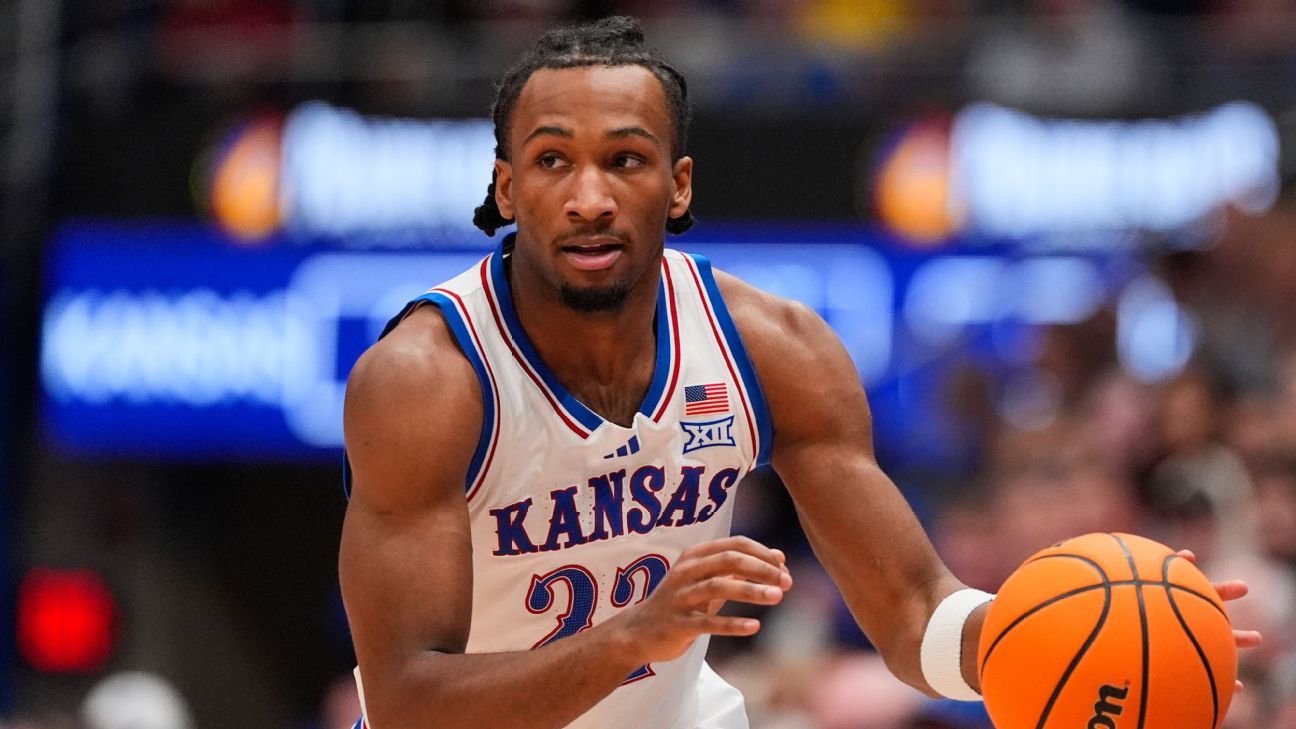
The No. 2 prospect in the SC Next 100 coming out of high school, Peterson entered the season as the favorite to be the top pick of this class. At 6-foot-6 with the ability to be a team’s primary playmaker and scorer, Peterson’s projected high-usage role at Kansas was also expected to help him put up huge numbers as a freshman.
Peterson had 26 points on 9-for-15 shooting (nearly all of it in one half) in the Jayhawks’ exhibition game at Louisville, cementing himself as the front-runner for the No. 1 pick early on. He backed that up with 21 points in the regular-season opener against Green Bay and 22 points against North Carolina.
“He has the most complete offensive game of anybody in college,” said one college coach who scouted Kansas. “When you combine the variety of shotmaking, the deep 3-point shooting potential, his ability to play ball in hand, I think he’s a guy that’s reminiscent of some of the great young players in recent memory, the last 15-20 years.”
The high-level performance against the Tar Heels was the last we would see of Peterson for a full month, though, as a lingering hamstring injury sidelined him for seven games. There was plenty of mystery surrounding his injury, as he was consistently a gameday decision before being ruled out hours before tipoff.
He returned against Missouri on Dec. 7, posting 17 points in just 23 minutes. And while he left Saturday’s overtime win against NC State early with quad cramping, he still finished with 17 points.
“I thought he was pretty impressive [against Missouri],” an Eastern Conference scout told ESPN. “I think he tried hard to fit in and not be disruptive. Maybe [he] should have been even more assertive.
“To me he’s No. 1 and I don’t know what scenario [the others] can get to that would have me bump [him down]. He’s so cold and collected and poised and consistent. Even Darryn’s tough nights to me are incredibly productive.”
1:26
Darryn Peterson’s best Plays vs. Missouri Tigers
Darryn Peterson’s best Plays vs. Missouri Tigers
While not unanimously considered a true point guard yet, Peterson has continued to improve his distribution and ability to run an offense. The likelihood he’ll be able to shoulder high usage at the NBA level gives him the advantage over Dybantsa and Boozer in the eyes of many insiders.
“What a point guard is now in the NBA, he’s that,” another Eastern Conference scout said. “Are you able to create advantages, are you able to [be a] playmaker, are you a scorer when you see a defense break down? Darryn can do all those things.”
Why Peterson wouldn’t go No. 1
Whether Peterson can make the full-time transition to the point as opposed to needing another ball handler or shot creator on the floor alongside him is one of the few questions.
“I don’t look at him as a complete point guard yet,” said a college coach who scouted Kansas. “To me, he doesn’t have that true ball-on-a-string deft handle and passing like some of the elite, elite guards in the NBA. So I think that’s going to be something that he needs to continue to grow.
“He’ll have to continue to show evolution as a play creator, get more and more comfortable as a passer, as somebody that can comfortably play on both sides of the floor. I think for him, when he’s met with more aggressive coverages, when teams put pressure on his ballhandling, how does that sort of change things for him?”
As for the hamstring injury that kept Peterson out of action for a month, multiple NBA scouts acknowledged it would come up during the draft process. But as of now, it is unlikely to be much of a factor when it comes to taking him with the No. 1 pick.
“That was never going to stop anyone from drafting him,” one scout said. “You just have to talk to your doctors and if your doctors think you can manage it. Everyone’s got their medical teams. As long as it’s not like a damning injury, he’s still going top two.”

Why Dybantsa could go No. 1
Dybantsa was in the discussion for best prospect in high school basketball early in his career, playing up multiple age groups on the Nike circuit, ultimately reclassifying from the 2026 class to the 2025 class back in 2023. The Brockton, Massachusetts, product finished his senior year as the No. 1 prospect in the SC Next 100.
Through the first nine games of BYU’s season, Dybantsa is averaging 20.9 points, 6.7 rebounds and 3.4 assists while shooting 55.5% from the field and 34.8% from 3. He hasn’t consistently posted the eye-opening stat lines of Boozer, but Dybantsa’s second-half performances against UConn and Clemson were among the best this season.
“He’s got a very advanced offensive scoring package, reminiscent of what an NBA wing player looks like playing in college,” said one college coach who faced Dybantsa this season. “In high school and FIBA settings he was a little bit of a ball stopper. He’s been allowing the offense to function around him and then picking his spots when he gets really aggressive.
“It’s his ability to make tough shots, it’s his size at that position, which is a valued position in the NBA. Those bigger wings that have the ability to make plays, ball in hand, put pressure on the rim, make tough shots. He’s toolsy enough to become a good defender. He plays hard.”
Dybantsa’s incredible physical tools at both ends of the floor, size (6-9) and ability to score at all three levels makes him a tantalizing option at the top of the draft.
“I would have AJ No. 1 still,” one Western Conference scout told ESPN. “The positional versatility, the size, is so unique. His ability to be able to create off the dribble, be dynamic from the midpost. The fadeaway jumpers, that style of play. I think he can make really crisp passes off one hand, really good adjusting midair. … He takes long strides on defense, someone that you can insert in very different lineups playing different positions.”
Dybantsa had the best game of his college career at the Jimmy V Classic against Clemson on Dec. 9, going for 22 of his 28 points, 7 of his 9 rebounds and 5 of his 6 assists in the second half to spark a comeback win from 22 points down. It reminded NBA decision makers, many of whom were in attendance at Madison Square Garden, of Dybantsa’s true potential.
“Can he play at that level for an entire game so they don’t need these second-half comebacks? It was the perfect encapsulation of AJ,” one Eastern Conference scout told ESPN after the game. “If he’s consistent, he’s the best player.
“All these guys can be franchise-changers, but AJ has always had the highest ceiling as far as a scorer, a playmaker, a defender. He’s had the ability to impact the game just because he’s bigger. Darryn can do a lot of those things, too, but AJ is a 6-foot-9, three-level scorer. He’s a scorer, not a shooter. The shot is always going to be streaky. The highs you’ve seen from AJ are just so high.”
0:23
AJ Dybantsa throws down exclamation point jam for BYU
AJ Dybantsa takes the open lane to the basket and throws down a massive jam for BYU.
Why Dybantsa wouldn’t go No. 1
While Dybantsa’s mid-range game is the best in the class, whether it’s rising up for a shot out of the mid-post or pulling up against a smaller defender, there are questions about the consistency of his perimeter jumpshot. Dybantsa’s 3-point percentage is a solid 34.8%, but he’s making less than one 3-pointer per game and has attempted only 23 through 10 games.
“It will limit him to some degree how great a player he becomes unless he becomes a great 3-point shooter,” an opposing college coach said. “He’s gifted, so he’ll find ways to score points, even if he’s just an average 3-point shooter. And I think he’ll work at it enough so it doesn’t become a deficiency, but I don’t know if it will ever become a major strength either. Throughout his path in basketball, he’s needed a rhythm dribble to make shots from the perimeter, so catch and shoot is an area of improvement for him moving forward in the pros.”
Dybantsa’s size and skillset is in line with what we’ve seen from recent NBA stars on the wing, but questions linger as to how he’ll fit if the offense isn’t built around him. There are also still concerns about his tendency to stop the ball, as well as inconsistent defensive effort.
“It’s easier for me to see how he fails relative to the other two,” another Eastern Conference scout said. “I think the other guys can play in the NBA right now and be moderately productive. AJ can be more of an acquired taste at times.”

Why Boozer could go No. 1
Boozer entered college as one of the most decorated amateur basketball prospects in recent history, winning four state championships at the high school level, two gold medals with USA Basketball — earning MVP honors at both events — and three Peach Jam titles on the summer circuit. The son of former NBA veteran Carlos Boozer, he has been wildly productive at every stop.
That’s carried over to the college game, as Boozer is the clear-cut National Player of the Year favorite through the first month of the season. The 6-foot-9 forward is averaging 23.0 points, 9.9 rebounds, 3.8 assists and 2.7 steals plus blocks through the first 10 games, shooting 56% from the field and 37% from 3.
“[It] feels like people are crushing Cam because he can’t catch a lob, but he can do so many things,” one Eastern Conference scout told ESPN. “Incredibly polished, incredibly smart, I don’t see where there’s not a use for him. … I think some of the weight is gonna shed — maybe he has room for his athleticism to grow. Laterally you can switch him a bit, he’s above average.
“I’ve been really impressed with him, and at some point you just have to give credit. Winning is hard; it’s a skill, and he wins whenever people watch him. He’ll step up when needed and make a play.”
Boozer is perceived as less of a sure bet at the next level due to his lack of explosiveness compared to Peterson and Dybantsa. But Boozer has consistently produced against high-level opponents that have NBA-caliber size, posting 35 points against Arkansas, 29 against Florida, 18 points and 15 rebounds against Michigan State, as well as double-doubles against Kansas and Texas.
“He projects to get better as a shooter and he already has good [mechanics] on his shot,” one coach who faced Duke this season said. “Is he the top player in this class? I don’t know, but he’s going to help a team win and he’s going to average 20 and 10. Probably forever.”
0:54
Cameron Boozer’s best Plays vs. Florida Gators
Cameron Boozer’s best Plays vs. Florida Gators
While not necessarily a factor in Boozer’s draft stock, it should also be mentioned that Duke is 10-0 this season with the best Quad 1 record in the country. Consistently winning is a plus on Boozer’s résumé.
“I think he’s the best player in college basketball this year, he should win the Wooden Award, the Naismith Award, he’s the most dominant player in college this year,” one college coach said. “From an NBA standpoint, I sort of look at him being slightly less projectable than the other two — but not far off.”
“At some point being the best player at every level has to pay off,” another Eastern Conference scout added.
Why Boozer wouldn’t go No. 1
Entering the season, the race for the No. 1 pick looked like more of a Peterson vs. Dybantsa battle than a three-way fight. Boozer has forced his way into the discussion with his spectacular start to the campaign, but the difference in physical tools between him and the two perimeter players is still a talking point.
“Can you put the ball in his hands and you know he’s going to be able to get a bucket or create something at the end of a game, when the game’s on the line? Is he good enough at that at the NBA level?” an Eastern Conference scout said. “It’s not a knock on Cam, it’s just that those other two guys have the potential to be the best player on NBA championship teams.”
While Boozer’s final stat lines have been impressive, there have been long stretches in tougher contests in which Boozer has really struggled — particularly to start games. He had zero points on seven shots in the first half of the season opener against Texas; he had 7 points on 2-for-6 shooting in the first half against Kansas; and he had just 2 points in the first half against Michigan State. It’s a credit to Boozer that he bounced back to dominate in the second half in each of those games, but the struggles against length and size could be a differentiator when it comes to the No. 1 pick.
“I know a lot of people have talked about it, but the rim finishing concerns are legitimate,” another college coach who scouted Duke said. “He’s always been a below-the-rim finisher around bodies, around size. … He always finds ways to be productive, but at that size, without that freakish athleticism in and around the rim, I have no doubt he’ll be a really, really good player, I just look at those other guys having a higher ceiling in terms of potential.”
Who rounds out the top five?
Long expected to be an elite NBA draft class, there’s enough depth at the top of the 2026 board that the battle to be a top-five pick will be as fascinating as the race for No. 1.
Two freshmen, however, are solidifying themselves as the best candidates to round out the top five: Louisville’s Mikel Brown Jr. and North Carolina’s Caleb Wilson.
Brown, a 6-foot-5 point guard, has seen his stock steadily rise over the past couple of years, particularly after his star turn at the FIBA U19 Men’s World Cup in Switzerland over the summer. He was arguably the best player in the event, winning his second gold medal. Two Eastern Conference scouts we spoke to indicated Brown could be in play at No. 3, depending on how the rest of this season and the lottery shake out.
“Mikel Brown just outplayed AJ Dybantsa [as teammates] at the U19s,” one of the two Eastern Conference scouts said. “He’s a true point guard. That’s not to say he should therefore be ahead of AJ, but when you think of a prototypical point guard, he is that.
“If we get to [No. 3], and [it’s] a team that really needs a floor general, I think he’s going to be in play at that point.”
Brown has been one of the best freshman guards in the country so far this season, averaging 16.7 points and 5.3 assists, highlighted by a 29-point performance against Kentucky and 22 points against Darius Acuff Jr. and Arkansas.
“We’ll see how it looks in a month, but he impressed me at Arkansas so much,” another Eastern Conference scout said. “His size is tremendous, he’s grown physically and mentally, how he’s getting into shots is impressive, and he’s sometimes carrying [Louisville] off second and third actions, not just jacking shots.
“A guard at that size who can get a good look at the rim off the bounce and play pick-and-roll, there’s intrigue.”
1:25
Mikel Brown Jr.’s best Plays vs. Arkansas Razorbacks
Mikel Brown Jr.’s best Plays vs. Arkansas Razorbacks
Meanwhile, Wilson has been arguably the most productive high-major player not named Boozer. The 6-foot-10 forward from Atlanta is averaging 19.4 points and 10.6 rebounds.
“He continues to show that aggressiveness, the ability to attack the lanes and be a good baseline cutter, score off the dribble and pull up from deep range while just hustling and working hard on defense,” a Western Conference scout said. “He’s got similar size and tools and athletic abilities as AJ does.”
Wilson has put together multiple huge performances in big games: 24 points, 7 rebounds and 4 assists in a win over Kansas; 15 points, 12 rebounds and 6 assists in a road win at Kentucky; 18 points and 7 rebounds against Michigan State.
“Caleb could be the fourth guy,” said one college coach who scouted North Carolina. “He seems to have taken it to another level at Carolina. Playing the 4 has been great for him, he’s been able to use his speed and athleticism. And just his commitment level; he’s busting his ass out there.”
“He has a wider range of outcomes,” one Eastern Conference scout added. “But he has a chance to crack that top three.”
