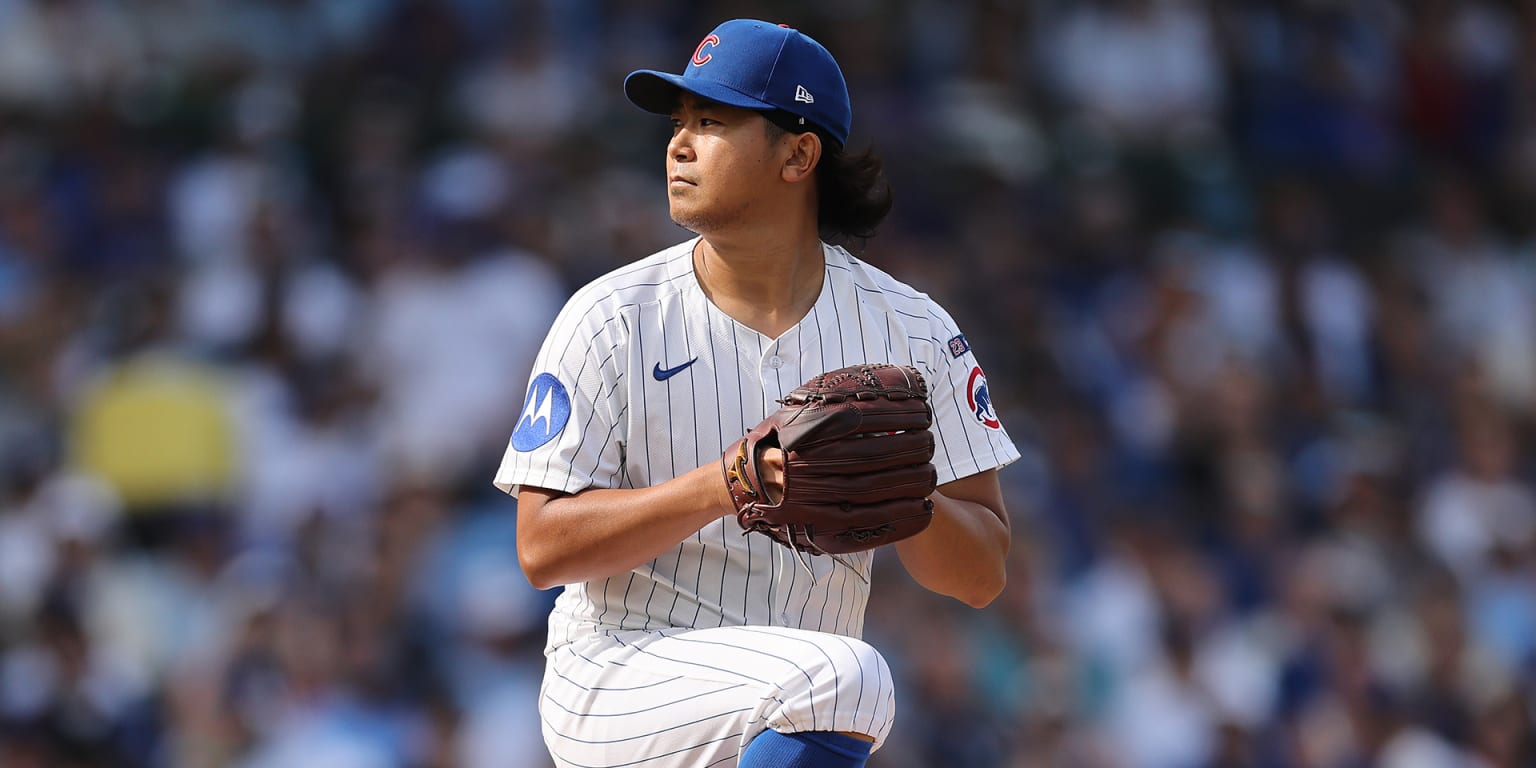
CHICAGO – The Cubs took the appropriate steps to safeguard against the potential departure of both lefty Shota Imanaga and outfielder Kyle Tucker in free agency. Imanaga opted against delving deeper into free-agent waters, while Tucker is continuing forward as one of baseball’s top available stars.
On Tuesday, Imanaga accepted a one-year qualifying offer worth $22.025 million to remain with the Cubs for at least the 2026 season. Tucker declined the same offer, which now means Chicago has secured Draft-pick compensation in the event that he signs a new contract elsewhere.
Here is a breakdown of the situation:
Imanaga’s situation had a few layers involved, giving his camp a little more to consider before officially agreeing to the Cubs’ one-year proposal.
To get to this stage, the Cubs first had to decline a three-year, $57.75 million club option that would have kept Imanaga in the fold through ‘28. Once that option was off the table, Imanaga elected to decline a $15.25 million player option triggered by Chicago’s initial decision. With both options rejected, Imanaga hit free agency and became eligible for the QO.
Imanaga’s camp had time to survey the market before deciding to accept the offer, which provides a $6.8 million pay raise over the initial ‘26 salary under his original contract structure. The lefty would also be eligible to enter free agency next offseason without going through the QO process.
Over his first two seasons with the Cubs, Imanaga had a 3.28 ERA with 291 strikeouts against 54 walks in 54 starts. He was an All-Star in ‘24 and garnered down-ballot votes for both the Rookie of the Year and Cy Young Award in the National League that year. This season, Imanaga had a 3.73 ERA in 144 2/3 innings, but struggled with allowing homers (31 overall and 20 in his final 12 outings).
“It felt like a no-brainer for us,” Cubs general manager Carter Hawkins said last week of giving Imanaga the QO. “We like Shota a lot. Obviously, we enjoy having him. … I know it was a complicated contract structure.”
“We told him, ‘We’d love to figure out ways to put you in a Cubs uniform again,’” Hawkins said. “But, we’ll see how it plays out.”
Tucker was an All-Star and Silver Slugger recipient this year for the Cubs, ending with 22 homers, 25 doubles, 25 steals, 73 RBIs, 91 runs, nearly as many walks (87) as strikeouts (88) and an .841 OPS in 136 games. He missed time with injuries, but still posted 4.6 bWAR, marking his fifth straight season above 4.5.
“When we were at our best, he was at his best,” Cubs president of baseball operations Jed Hoyer said last week. “He’s a great player. We had a really good experience with him. And obviously we’ll be talking to [his agent].”
The Cubs can keep negotiating with Tucker, but the ballclub has set itself up for compensation in the ‘26 Draft if he signs with a new team.
In that scenario, Chicago would be in line for a pick after Competitive Balance Round B, which follows the Draft’s second round. As an example, the Cubs received the 68th overall pick in ‘23 after catcher Willson Contreras turned down a QO and signed with St. Louis. With that selection, Chicago drafted righty Jaxon Wiggins (currently No. 67 on Pipeline’s Top 100 list).
On the flip side, there is a cost to signing a free-agent attached to a QO. In the Cubs’ case, they would lose their second-highest Draft pick and $500,000 in international bonus pool money. Signing a second player in this category would mean Chicago also would forfeit its third-highest Draft pick.
During the GM Meetings last week, Hoyer said the QO penalties would not necessarily stop the Cubs from pursuing a free-agent. Chicago has multiple needs in the rotation, for example, and free-agents Dylan Cease, Zac Gallen, Michael King, Ranger Suárez and Framber Valdez (each of whom declined a QO) present potential targets for the North Siders.
