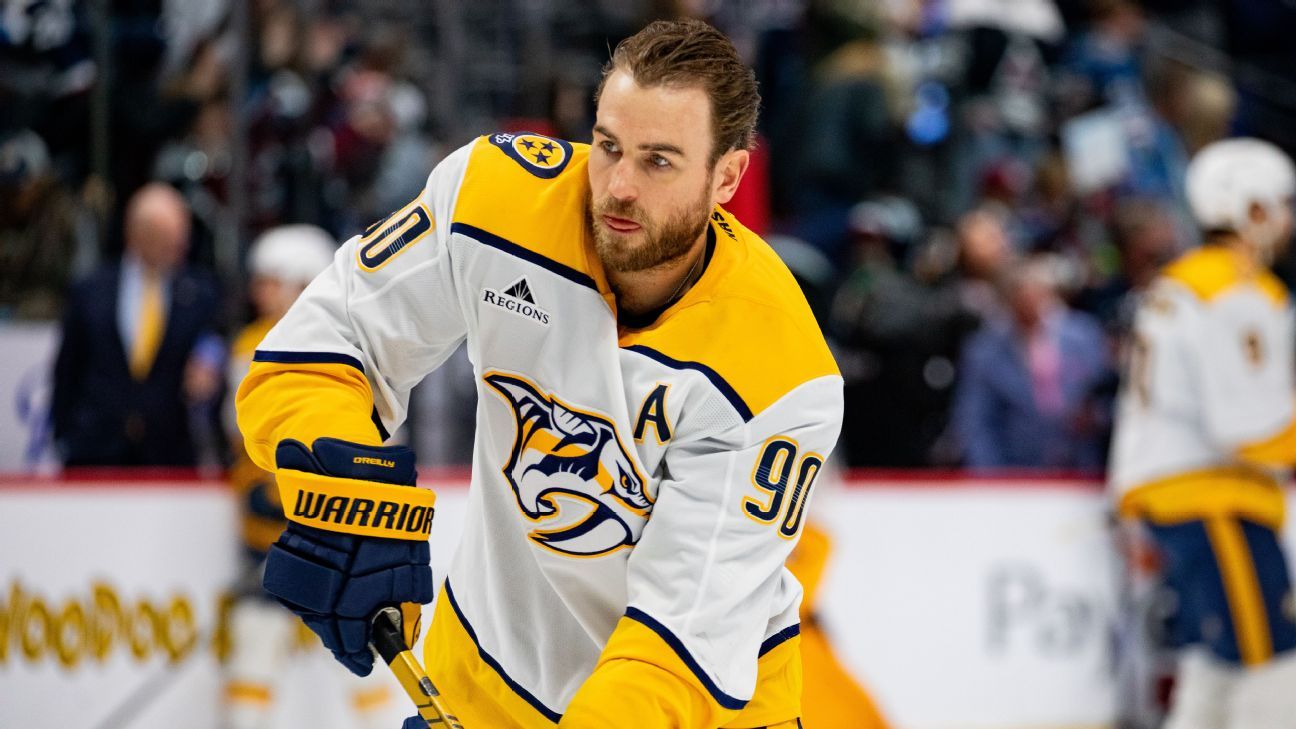
The NHL’s 2025-26 roster freeze goes into effect at midnight ET on Saturday, meaning no players can be moved until it lifts Dec. 28.
The biggest shoe has already dropped. Quinn Hughes was traded from the Vancouver Canucks to the Minnesota Wild on Friday in one of the biggest blockbusters in recent memory. Hughes was not injured like Jack Eichel when he was traded. He was not part of a sign-and-trade, the way Mitch Marner left Toronto. No, this was a team in desperate need of a rebuild dealing one of hockey’s best defensemen to another team when it became clear he would not extend his contract, and every team was interested in his services to some degree.
With the Hughes drama over (at least for now), teams will move to better their teams sooner rather than later. For their part, the Canucks sent a memorandum to the league indicating they were open for business. Sources indicated that not only are the unrestricted free agents available, but that Vancouver will listen on Marcus Pettersson, Conor Garland, Drew O’Connor and many other players with forms of trade protection. While some might not be willing to leave town, others might not be excited to stick around for a rebuild and would consider waiving to a more favorable situation.
Certainly, the likes of Marcus Pettersson, Tyler Myers and Filip Hronek would have value on the market, but they have ultimate control of their situations. It would be unwise for the Canucks to carry $13 million in the form of a goalie tandem, though it remains to be seen whether the Canucks can or will move either netminder.
Outside of the Canucks, there are quite a few names on the trade board that would benefit from a change of scenery or be able to help competitive teams for the remainder of their contracts. When the roster freeze lifts, who could partner in a trade? There are many options that make sense, and I’ve come up with six here. Note: Players will appear multiple times in these projected swaps, as their fit makes sense on multiple teams.

Washington Capitals get:
F Ryan O’Reilly (25% salary retained by NSH)

Nashville Predators get:
F Hendrix Lapierre, 2026 first-round pick
Ryan O’Reilly is the perfect fit for a Capitals team that wants some certainty with Pierre-Luc Dubois currently out of the lineup. Washington is not a particularly fast team, and O’Reilly is not a particularly fast player. He is a stylistic fit, because a player with more pace would be a stylistic mismatch with Washington’s current personnel. O’Reilly brings strong defensive ability; he can kill penalties and take on tough matchups. He is useful in the middle six, will take key faceoffs and contribute secondary offense.
In return, Nashville gets Hendrix Lapierre, a young center who fits their timeline and has potential to be a middle-six offensive contributor. Given his speed, he doesn’t fit in Washington’s playstyle, but he should be a stylistic fit with Filip Forsberg, Matthew Wood and Fedor Svechkov, and future players such as Brady Martin, Cole O’Hara, Yegor Surin and Teddy Stiga.
The first-round draft pick is likely to be in the mid-20s, but Nashville needs to acquire draft capital as it is more important for its franchise than veterans who will not be valuable when Nashville is ready to compete for a playoff spot.

New Jersey Devils get:
F Nazem Kadri (50% salary retained by CGY)

Calgary Flames get:
F Dawson Mercer, D Ethan Edwards, 2026 first-round pick
It is well documented that New Jersey needs center depth. Some scoring behind Nico Hischier and Jack Hughes, when the latter is healthy, would significantly boost the Devils. Kadri and Hischier can play the difficult matchups, allowing Hughes to take the lion’s share of the offensive zone starts and maximize his offensive skill set.
Adding Kadri’s dimension helps the Devils through their contending window and gives them a little more competitive fire, along with some of the winning pedigree that GM Tom Fitzgerald has discussed during his tenure.
Kadri can drive play, kill penalties and contribute offensively. Given uncertainty around Hughes’ injury history, Kadri is more than suited to fill in as the second-line center for lengthy periods of time. Coach Sheldon Keefe prefers faster-paced, possession hockey, making Kadri a better fit than Ryan O’Reilly. Kadri’s physicality, offensive capability and play style fits the profile of a player that would succeed with the Devils.
On the other side, the Flames get a top-six NHL player in Dawson Mercer who can play center or the wing, whichever Calgary prefers. He fits Calgary’s age range, in line with Dustin Wolf, Matt Coronato and Connor Zary. Ethan Edwards is caught behind a plethora of talented defenders in New Jersey and has performed admirably in the AHL. Calgary can use some NHL-ready talent on the left side of the defense, especially if Rasmus Andersson is on his way out.
The first-round pick would be seen as necessary, not only for a player of Kadri’s caliber, but also for Calgary to retain salary for the three remaining seasons on his deal. Calgary can retain that salary, given its cap situation and available retention slots, but it would likely require a primary draft pick to do so.
0:21
Nazem Kadri nets a backhand shootout winner for Flames
Nazem Kadri wins the shootout for the Flames with a fantastic backhand goal vs. the Stars.

Minnesota Wild get:
F Nick Schmaltz

Utah Mammoth get:
F Yakov Trenin, 2027 first-round pick
It is no secret that Minnesota needs centers, because running Joel Eriksson Ek and Danila Yurov against Nathan MacKinnon, Roope Hintz, Wyatt Johnston, Connor McDavid and Leon Draisaitl is not a good idea.
Schmaltz gives the Wild a top-six center capable of providing reliable offense outside of their top line. Moving Yurov to the third line — where he will face secondary matchups — gives him a better opportunity to thrive. The domino effect of adding Schmaltz to the lineup is meaningful for the Wild, and given their all-in approach, it’s an option they should explore.
For Utah, Trenin provides some size in the middle six, be it at center or the wing. He brings a different physical package than many of Utah’s smaller, skilled wingers. He can forecheck, win battles and provide a more physical element in a very physical Western Conference — he’s the current NHL leader in hits, with 164 through 34 games.
The first-round pick is the necessary asset in the trade, one Minnesota can afford to part with given it is expected to go for it after the Quinn Hughes acquisition and has a scouting staff capable of finding value outside of the top two rounds.

Vancouver Canucks get:
D Owen Power, F Jack Quinn

Buffalo Sabres get:
F Kiefer Sherwood, F Conor Garland, F Nils Hoglander
In what is colloquially known as a “fantasy hockey trade” in the halls of most NHL front offices, a few scouts opined this is one that might work. Both teams very clearly need to make some moves for various reasons. Buffalo has been out of the playoffs since 2011 (Adele’s “Rolling in the Deep” was the No. 1 song that year, for refence), while Vancouver clearly wants to retool.
The feeling is that new Sabres GM Jarmo Kekalainen might want to move off Owen Power’s deal and bring in some established veterans who bring a different dynamic to a Sabres team with tons of skill. Vancouver needs young skill in the lineup, and both Power and Quinn fit that profile.
Getting off Conor Garland’s deal before any form of trade protection kicks in would be important to reaching Vancouver’s stated goal of getting younger. Buffalo surely values Garland’s work ethic and scoring ability. Sherwood is coveted around the NHL, and Buffalo has the requisite cap space to offer him the $4 million per season he is reportedly seeking. Höglander would be a good fit in the middle six for Buffalo, and would benefit from a change of scenery given his inability to find a consistent role.
The Canucks get significantly younger in this deal, potentially stabilizing the left side of the defense for years to come. Power is currently playing the right side in Buffalo, meaning the Canucks can deploy him as they see fit. He might have fallen out of favor under Lindy Ruff, but Power has potential to be a top-pairing defender, and he turned 22 a couple of weeks ago. Quinn gives the Canucks something they do not have in great supply: a winger with scoring potential. There are players ahead of him in Buffalo, something he will not have in Vancouver outside of Brock Boeser. He would immediately slot into the Canucks’ top six and play valuable power-play minutes.
The trade might be a “fantasy trade,” but each player is uniquely fitted to their new team and the deal accomplishes the goals of both. The new Sabres help immediately, and the new Canucks help the team get younger and more skilled.
0:47
Kiefer Sherwood notches goal on the power play
Kiefer Sherwood notches goal on the power play

Dallas Stars get:
F Alex Tuch (50% salary retained by BUF)
Buffalo Sabres get:
F Mavrik Bourque
The sun seems to be setting on Alex Tuch’s time in Buffalo. He has been excellent for the Sabres and has provided the most value of the players acquired in the Jack Eichel trade (though Noah Östlund has a chance to overtake him). Given Kekalainen’s belief in his roster and the desire to acquire players who can contribute at the NHL level, Bourque seems to be the obvious fit.
Bourque could potentially flourish in a middle-six role in Buffalo. He’s a pending restricted free agent with arbitration rights, and the rest of the season would give Buffalo a chance to determine where he fits in the plans going forward.

Boston Bruins get:
F Kiefer Sherwood
Vancouver Canucks get:
2026 second-round pick
The concept of a fantasy trade is fun, but the chances of a trade like this happening are much higher.
Vancouver was said to be seeking a first-round pick for Sherwood given his cap hit and hot start to the season. However, he has scored one goal in the past 12 games, and is currently playing on the third line — where he would likely play on a contender. Sherwood’s physical play has earned him the “hard to play against” moniker, something that is valuable in the playoffs.
Boston is believed to have interest in Sherwood, a player who fits perfectly with the Bruins’ playoff style and someone who would aid in any playoff series against the likes of the Florida Panthers or Tampa Bay Lightning.
