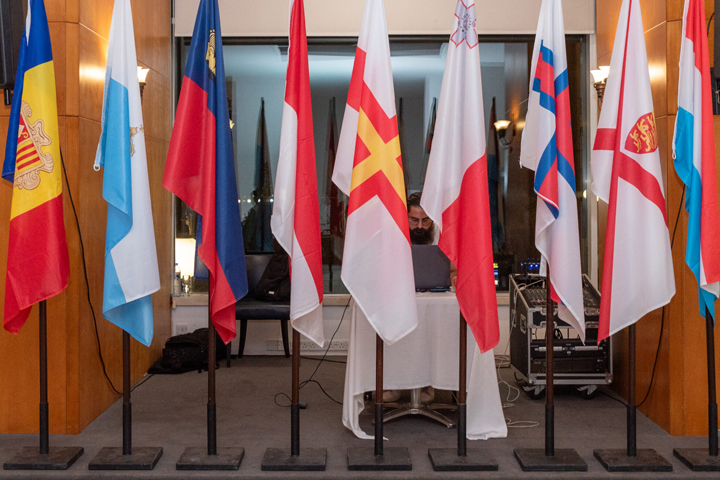
On 15 November 2025, the moment had arrived: in the sunny coastal city of Larnaca on Cyprus, the 9th edition of the ESNA Team Tournament began, organised by the European Small Nations Chess Association (ESNA) together with the Cypriot Chess Federation. The venue for this chess festival was the elegant Sun Hall Hotel, located directly on the seafront promenade – an environment more commonly associated with summer holidays than with chess games.
The opening ceremony was more than just a formal gesture. With the symbolic first move, Zurab Azmaiparashvili, President of the European Chess Union (ECU), provided exactly the right sense of dignity. It was already clear that this tournament was not merely a “networking event for the small nations” but a serious sporting occasion with real European significance.
The attention will be paid to the castled king and in particular on ways of exploiting the weakened kingside. Several well-known themes, pawnformations and other attacking weapons are covered in 8 chapters.
The field of participants was typical for ESNA: the ten teams came from Andorra, Cyprus, the Faroe Islands, Guernsey, Jersey, Liechtenstein, Luxembourg, Malta, Monaco and San Marino. Each delegation consisted of four players plus one reserve player, and the tournament was a 10 team round-robin, with 90 minutes for the first 40 moves, then 30 minutes for the remainder, plus a 30-second increment per move.
Field of participants and favourites
In terms of rating, a few teams were expected near the top: the Faroe Islands were considered one of the top favourites, followed by Luxembourg and Andorra. On an individual level, well-known chess players sat at the boards, including grandmasters and international masters, demonstrating that small nations, too, can achieve major chess successes.
Many teams used the event not only to compete for victory but also to gain experience, exchange ideas and strengthen team spirit. Yet already in the first rounds there was palpable tension on the boards, and a fair but hard-fought contest developed. The Cypriot hosts produced impressive performances, but the road to victory was anything but easy. Other teams, such as Luxembourg and the Faroe Islands, offered strong resistance.
In this insightful video course, Grandmaster David Navara shares practical advice on when to calculate deeply in a position — and just as importantly, when not to.
Free sample video: Introduction
Free sample video: Invisible moves
Final standings after 9 rounds
| 1 | Faroe Islands | 16 | 29,5 | |
| 2 | Andorra | 16 | 27 | |
| 3 | Cyprus | 15 | 25 | |
| 4 | Luxembourg | 13 | 26 | |
| 5 | Monaco | 9 | 20 | |
| 6 | Liechtenstein | 9 | 14 | |
| 7 | Malta | 4 | 15 | |
| 8 | Jersey | 4 | 10 | |
| 9 | Guernsey | 3 | 7,5 | |
| 10 | San Marino | 1 | 6 |
The players from the Faroe Islands secured the winner’s trophy. | Photos ESNA
The top teams on the seeding list fought a close race, with only Luxembourg dropping back somewhat. The top three, however, took points off each other. But while Cyprus had to forgo another point against Luxembourg and thus had to settle for the bronze medal, Andorra and the Faroe Islands won all their other matches. In round 5, the islanders from the far north defeated the hosts 3:1 and left no doubt about their ambitions after that. In the end, they had 2.5 board points more than Andorra and thus held the lead in the race for the gold medal.
Two Super Grandmasters from India explain the ins & outs of Attack, Tactics an Calculations in these two video courses.
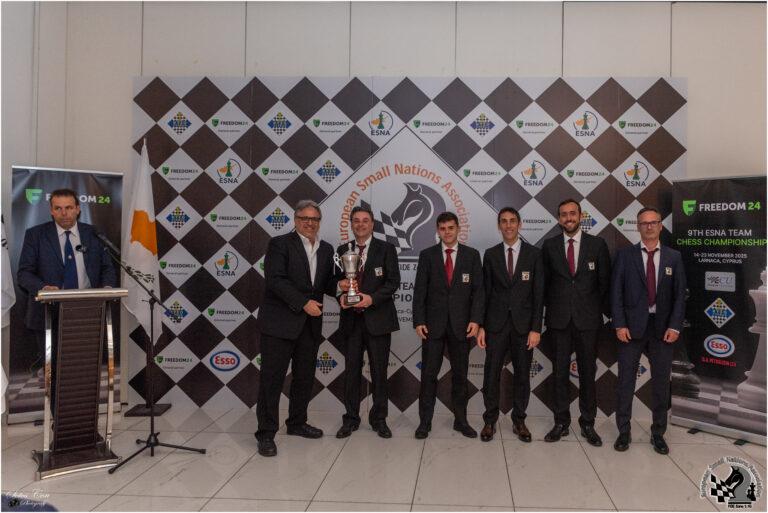
Second place went to Andorra (above), and third place went to the home team from Cyprus (below). | Photos ESNA
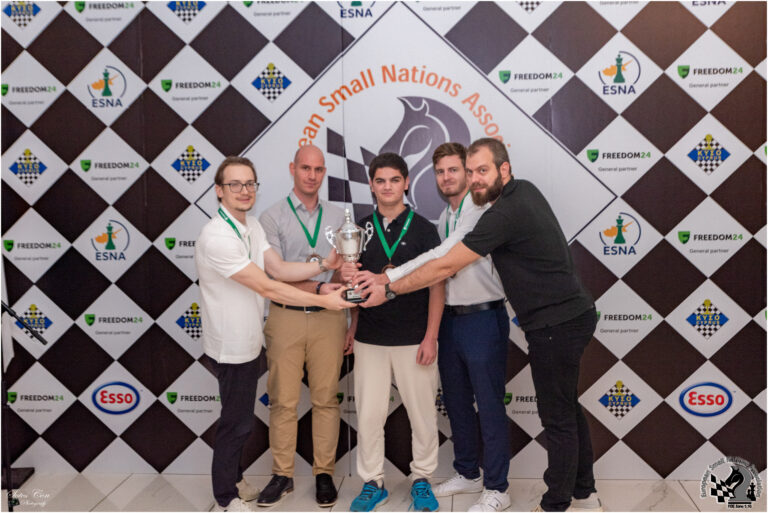
Behind the top teams, Monaco and Liechtenstein formed a small midfield, and the national teams of Malta, Jersey, Guernsey and San Marino had to drop quite a few feathers. But at least no team finished completely without points.
The blitz championship was dominated by the hosts
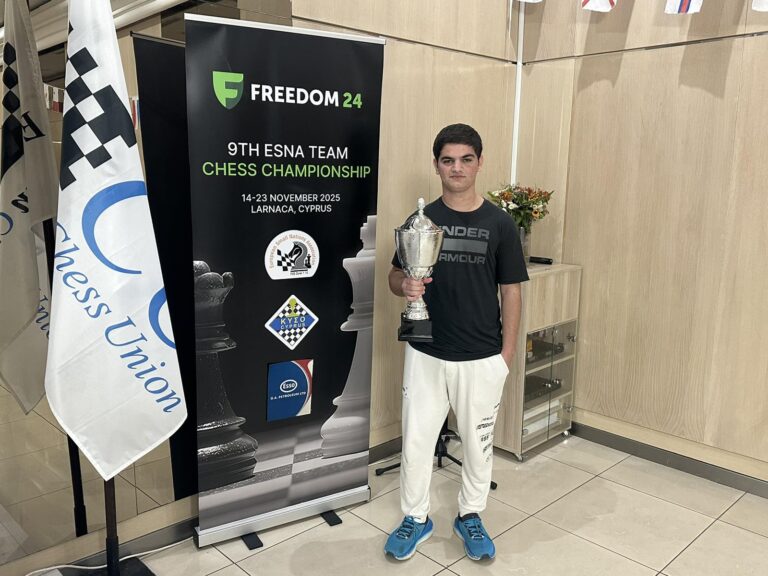
Between the serious match rounds, there was also the traditional blitz evening. Thirty-four players competed against each other in rapid-fire mode. In the end, two Cypriots stood at the top: Raphael Antoniou and Alexandros Isaakidis shared first place. Since they had the same number of points, it went to a dramatic sudden-death duel. After a balanced first blitz game, Antoniou (photo right | ESNA) struck in the second and secured the title.
Conclusion
Here is a close, faithful English translation, keeping structure and tone very near the original and without added formatting:
What makes this tournament so special is the spirit behind it. ESNA does not stand for powerful, wealthy federations, but for a European chess community in which the “small” nations are allowed to take part – with pride, commitment and sporting ambition. Here, nations that may not belong to the giants of the global chess circuit meet, but when it comes to passion, they are right at the forefront.
The organisation appeared well thought out: the hotel not only offered comfortable playing conditions but also space for conversations, networking and a genuine sense of community. Between the games, people did not only talk about chess but also deepened friendships and exchanged ideas. For many participants, the tournament was more than a competition – it was a forum to strengthen their chess community.
In this video course, kings will play a role of strong and active pieces. We will explore how Kings can be helpful in defence and prophylaxis, or even in attack!
The outlook for the future is optimistic: a tournament as successful as the one in Larnaca lays the foundation for future ESNA events. The structure is solid, the association is growing, and the sense of cohesion among the small chess nations seems stronger than ever. Moreover, this tournament shows that ESNA is not just a marginal phenomenon but an important part of the European chess scene. Once again it became clear: being small does not mean being insignificant.
Games
 Links
Links
access your chess data in cloud databases – and 13 million games.
ChessBase Mobile has everything you need as a chess player on the go:
- Access the ChessBase online database – with more than 13 million games: search for players, positions, openings etc.
- Save your own games and analyses in cloud databases
- Synchronise your personal databases across all your devices
- Analyse your games with the built-in engine
- Live opening book: use the most comprehensive and up-to-date statistics for every opening position
- Access your opening repertoire in the cloud: create and edit your personal opening repertoire
- 300 opening overviews, with repertoire suggestions: get started with new systems!
- Practise opening variations with three modes.
- Advanced notation: add comments, symbols, variations, arrows and markings to your games
- Advanced sharing options: share games and positions via link, image, GIF, FEN or QR code
- PGN compatibility: upload and download games or databases as PGN files
