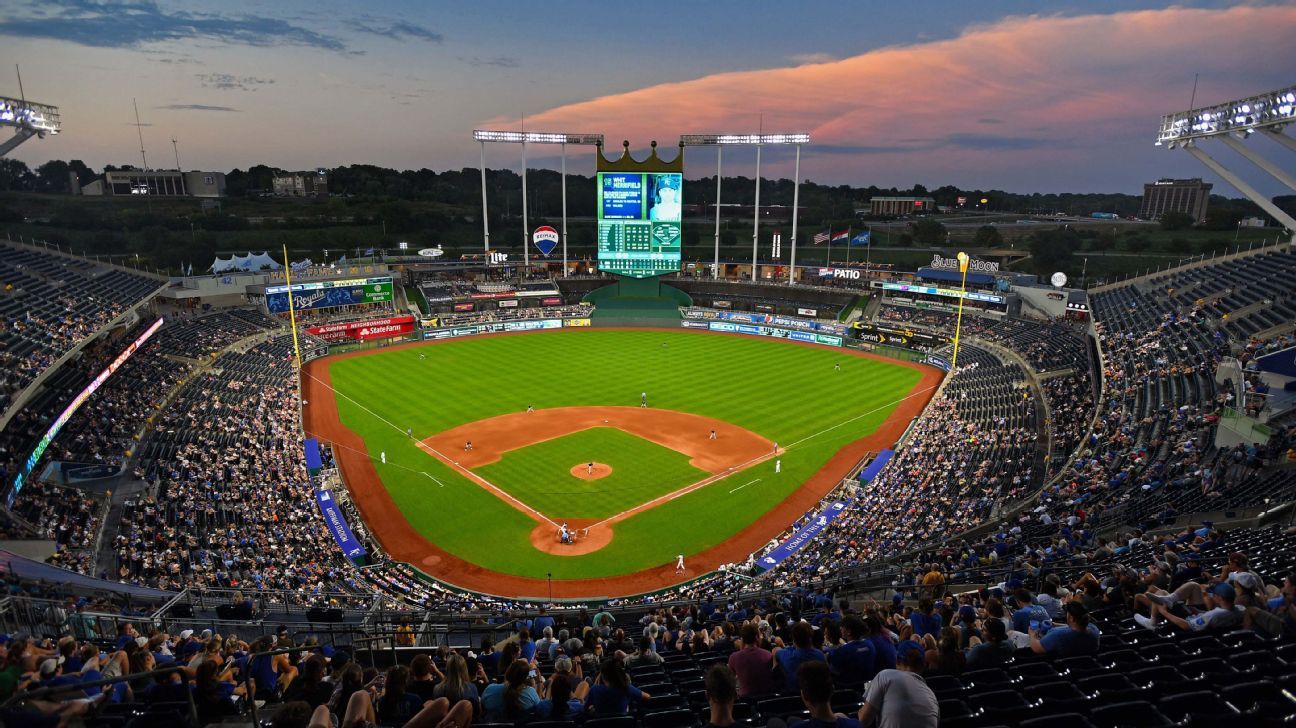
The Kansas City Royals are moving the majority of their outfield fence in by 10 feet, drastically changing the offensive environment of a notoriously bad stadium for home run hitting into one the team hopes will play as league-average, sources told ESPN.
The decision, which the Royals are expected to announce Tuesday, comes after years of discussion by Kansas City’s front office about tinkering with dimensions and months after the organization commissioned its analytics department to find a palatable middle ground between the fly ball dead zone of Kauffman Stadium and other stadiums where home runs soar at extreme rates.
“We want a neutral ballpark where if you hit a ball well, it should be a home run,” Royals general manager J.J. Picollo told ESPN. “The second they start feeling like they can’t get the ball out of the ballpark, they start changing their swing. I watched it for years and years and years, and I just felt like this is the time to try to push it and see if everything we felt for however many years is accurate.”
While the Royals will keep center field at 410 feet, they plan to taper in the fences starting in the power alleys, which will be shortened from 389 feet to 379, sources said. The fences will continue on that path, 9 to 10 feet shorter, nearly all the way to the corners, where the 330-foot foul poles will remain. The height of the fence will also be shortened from 10 feet to 8½.
Kauffman has played as a slightly above-average offensive park because the size of the outfield — which was second only to Coors Field — promoted more doubles and triples. The distinct suppression of home runs, however, left the Royals concerned that hitters were changing their approaches on the road, consciously or subconsciously, and that altering the dimensions for the 81 games played at Kauffman without turning it into a bandbox would aid in Kansas City’s efforts to build a perennial playoff contender.
“It’s not that we’re trying to jumpstart our offense,” Picollo said. “The more neutral it is at home, the better success we think we’ll have overall.”
Kansas City has modified its fences in the past, moving them in 10 feet between 1995 and 2003 and seeing it play as a slightly above-average home run park. The Royals returned to the stadium’s original dimensions in 2004, and over the past two decades have seen ball after ball die on warning track, prompting Picollo this spring to finally approach owner John Sherman and ask permission to authorize a study on the effects of a potential modification.
Given the go-ahead, Picollo tasked Dr. Daniel Mack, the Royals’ vice president of research and development and an assistant GM, to consider all the factors and make a recommendation. Mack, who has a PhD in computer science and earned a masters with a concentration in machine learning, had the benefit of a far more robust set of data than was available even 10 years ago, with detailed information on wind and temperature information capable of being factored in.
“What we wanted to focus on was how could we find dimensions that would create a more consistent approach for us as a team,” Mack said. “It’s one thing when you say, ‘OK, well, Kauffman’s so large, it’s great for pitchers, you can’t really bring in power hitters.’ Can we find dimensions that make it so that regardless of when we we’re home or on the road, we didn’t have to need to worry about the spectrum as much?”
The project launched in early May and started with Mack and Alan Kohler, a senior R&D analyst, applying a run value to every fly ball at Kauffman. The goal, Mack said, was to find fence distances and heights that left the stadium with a near-league-average run value on fly balls.
Doing so wasn’t easy. Not only does Kauffman boast the fifth-highest altitude of any stadium in Major League Baseball, its wind conditions — particularly in the power alleys — on average make the fences play about 5 feet longer than their listed distances. With four years of thorough climate data as well as the batted-ball information, Mack and his team split the stadium into left field, center field and right field and assessed each for potential improvements.
Over time, Mack believed that moving the entire fence structure in would be counterproductive. Ultimately they settled on a fence line that is almost perfectly symmetrical, keeps center the same — Kauffman has a notoriously well-loved batter’s eye below its enormous Crown Vision scoreboard — and will allow for more home run robberies with the shortened height.
Mack presented the findings to Picollo and assistant GM Scott Sharp in mid-August, and they were compelling enough to seek Sherman’s go-ahead. In Picollo’s suite during games, it became a running joke on deep fly balls that wound up in gloves for someone in the room to say: “That needs to be a homer next year.”
Now, with Sherman’s blessing, it will be. And with Kansas City finally fielding a lineup with legitimate power hitters — in addition to superstar Bobby Witt Jr. and slugging first baseman Vinnie Pasquantino, the Royals’ two best prospects, outfielder Jac Caglianone and catcher Carter Jensen, have massive raw power — the instinct to target players whose skill sets fit better in the old dimensions will no longer be necessary.
“I feel like that’s just chasing lightning,” Mack said. “I don’t think that’s smart in general. It’s certainly not smart for a smaller-market team that needs to be adaptable to the personnel that you can acquire.”
Though the days of Kauffman as a safe haven for pitchers is likely over, Mack said he does not expect the new fences to have a whipsaw effect on their ability to pitch effectively. The change strives, he said, to be fair — though admittedly the Royals believe that with the new run values on fly balls, they project to add 1½ wins annually in home games.
And if it helps Salvador Perez get closer to 400 home runs to bolster his Hall of Fame case or put Witt into the annual 40-home run territory before the team’s lease at Kauffman expires in 2030 and they move into a new stadium, all the better.
“You know, in the end, we might go, ‘You know what? We shouldn’t have done that,'” Picollo said. “But I think it’s a five-year window to give a shot and see if we like how it plays.”
