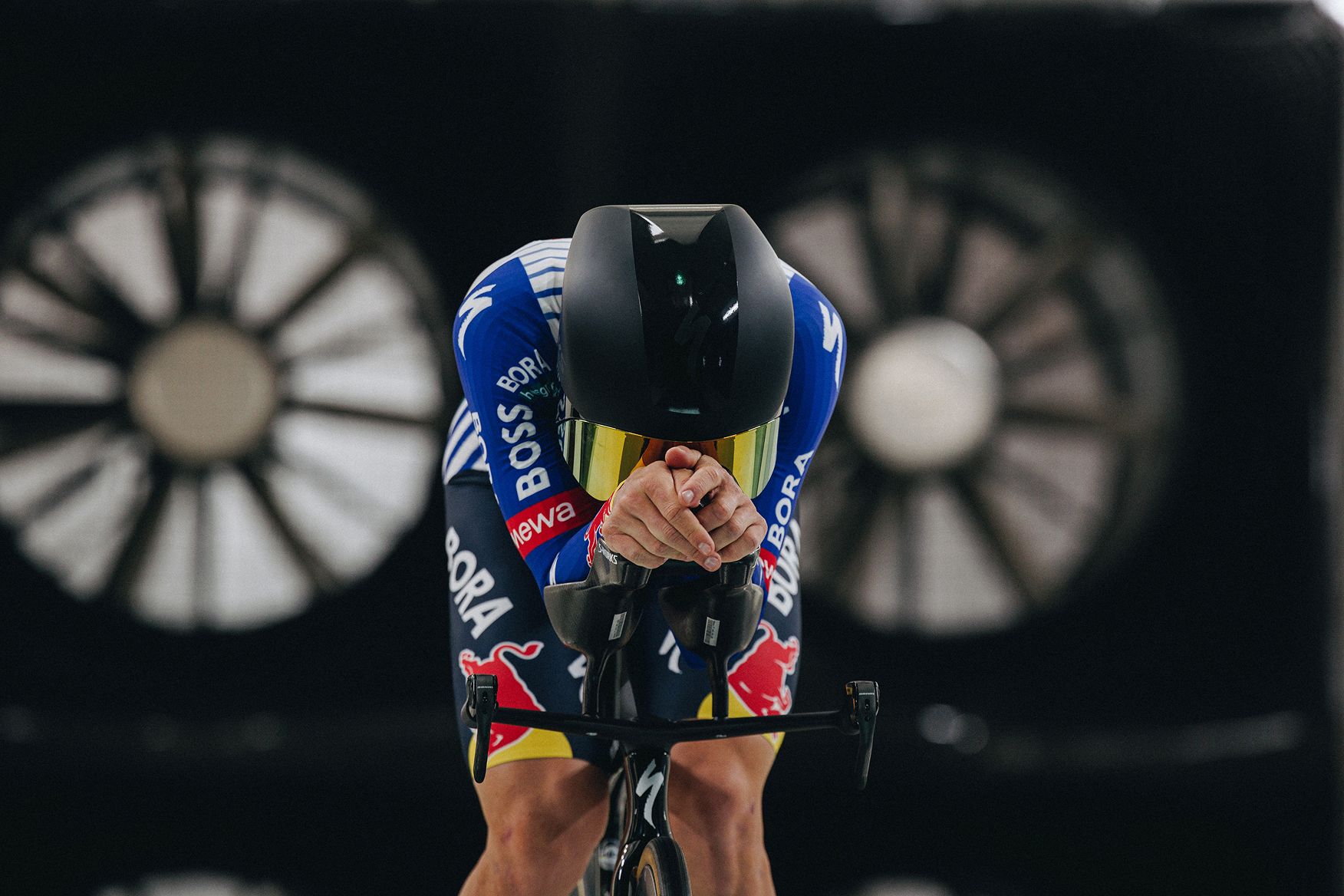
Specialized has today launched a new team race kit in partnership with Red Bull–Bora–hansgrohe, and the team has gone further than most brands with these items. Rather than simply tweaking colours and logos, it says it’s completely reengineered the kit from the ground up. The headline result? According to Specialized, it’s some 25 watts faster.
Taken at face value, that’s astonishing. It’s also a hell of a press release number – the kind that makes you sit up, spit out your coffee, and read on. Which, of course, is exactly what it’s designed to do. Big wattage claims are marketing gold in cycling, but they’re also worth a little gentle interrogation.
To put that 25-watt figure into context, last year Cyclingnews put the Cervélo S5 in the wind tunnel. It was the fastest aero bike the site has ever tested with a rider onboard, and it was found to be some 27.6 watts faster than the baseline bike. That baseline, it should be noted, was a ten-year-old rim-brake road bike they happened to have lying around. In other words: about as aerodynamic as my Christmas belly is today, after ten days of mince pies and round-the-clock snacking.
Now, before you sprint to the nearest concept store, it’s worth clarifying what’s actually being claimed. The 25-watt figure applies when comparing the new team race jersey to Specialized’s SL jersey, not to last year’s team kit. If you currently ride in a 2024 team jersey, pro-issue, with logos in the breeze as you rush for the checkout, you’re likely saving around five watts on the ride home wearing the new version.
Still, in a sea of recent kit launches where many have opted for just new colours or a new supplier altogether, five watts is not to be sniffed at. In fact, taken on its own, it’s a genuinely impressive and far more relevant claim.
The claimed performance gains come courtesy of Specialized’s proprietary SlipLayer aero fabric, which they say is custom-woven for maximum aerodynamic performance and arranged in a “kinetic pattern that moves like a second skin”. We’ve also spotted some impressively clever trips on the sleeves, seemingly designed to work with the rider in position rather than simply running parallel to the arms. A reduction in panels and seams further suggests the fabric’s ability to conform closely to the rider’s shape has been improved and, therefore, further exploited than in the outgoing version.
Taken together, these details add up. This is the modern approach to aerodynamics: marginal gains delivered through incremental changes to cut, fabric, seam placement, and surface texture that combine into something far more meaningful overall. We’ve seen the same philosophy play out in frame design over the last season or two – notwithstanding Factor’s more revolutionary design in their One platform – and it’s encouraging to see that level of detail and incremental work applied to clothing.
Coming full circle to that original headline claim, what’s genuinely interesting here is the broader implication. Fit, cut, seams, fabric choice, and sleeve treatment clearly have a huge impact on aero performance. The SL jersey – the one against which the big numbers in the headline are measured – is a decent balance of forgiving-ish fit, practicality and high performance for most of us, and is actually similar to the “standard fit” jerseys many riders will already own. If you’re interested in big aero gains, maybe you’ve even shelled out on an aero bike or deep-section wheels, but you’re still riding a versatile jersey like the SL, this may well be the nudge you need to grab something specialist and dump some serious watts.
There is another caveat, however. Specialized also understands that not all of us are honed, 60kg racing snakes. That’s very important in this slippery context.
That doesn’t mean there’s no fun to be had. Some riders simply want the look, especially when the race version may not fit – or function – particularly well in the real world.
With that in mind, Specialized has also launched a replica version for the full-kit fan. It’s nearly as technical and shares the same performance aims, so you can expect a close fit, though it makes no aero-performance claims of its own. It features a knowingly stretch-fitted front panel, a breathable back, and an extra pocket for your phone or spare tube, bringing the total to three. It also offers SPF30 sun protection, which the pro-race version notably does not.
So yes: the race version is definitely faster than your old baked-bean-era jerseys, and Specialized says it’s 25 watts faster than the already excellent SL jersey, so there’s big gains to be made there. If you’re lucky enough to fit it.
The main takeaway? Team kits are loads of fun, and if you’re chasing aerodynamic gains, a closely fitting, aero optimised race jersey may well be a bigger upgrade than an aero bike, and at a fraction of the cost.
(Image credit: Specialized)
