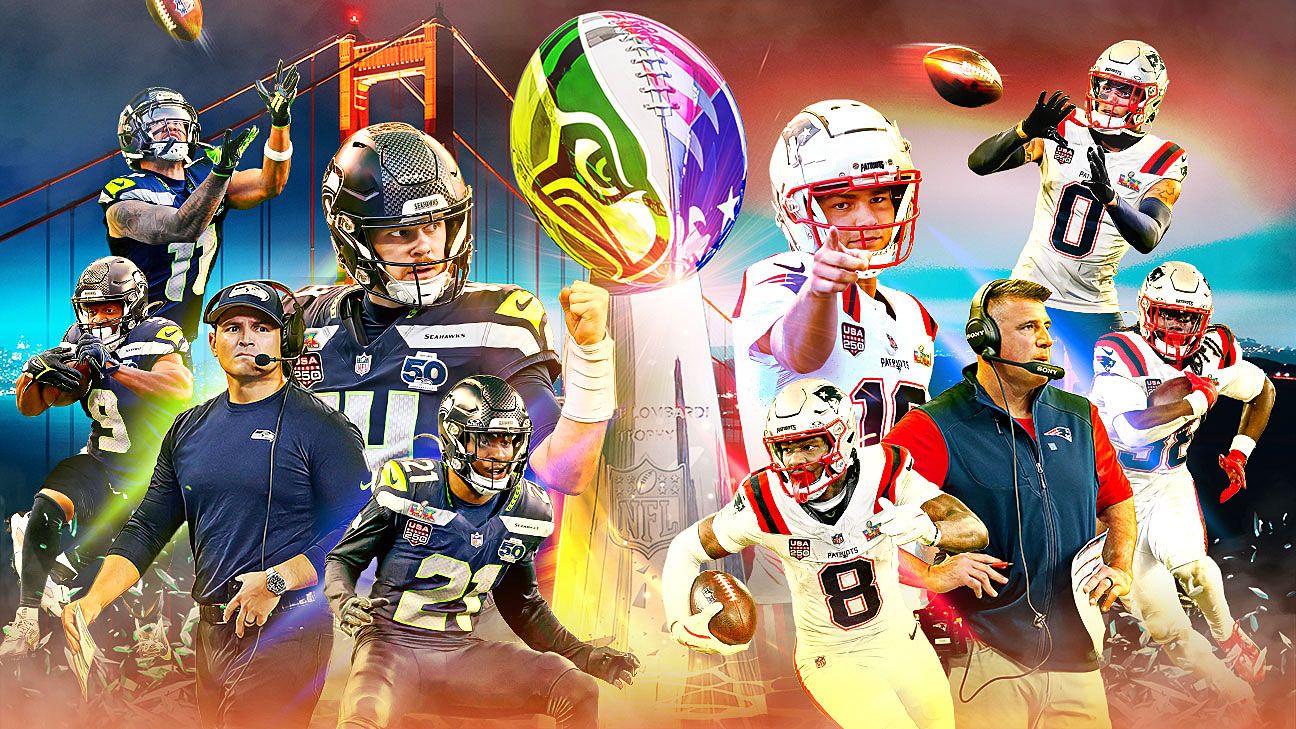
On Sunday, the Seattle Seahawks and New England Patriots will meet in Super Bowl LX. But we might as well call it the Explosive Play Bowl.
The big play has always mattered, but in the past few years, NFL games have become battlefields between teams trying to create and prevent explosive plays. Defenses, tormented by quarterbacks like Patrick Mahomes and Josh Allen, have leaned into Vic Fangio-style philosophies and continued to raise their rates of two-high safety looks, funneling teams toward the run and short passes. Teams played two-deep shells more than 45% of the time on early downs in 2025, up from 38% in 2020 and 35% in 2017.
Offenses have evolved too. They’ve taken what the defense has given, running the ball more often and with more efficiency than in past years. Quarterbacks have been forced to make small profits and take the safer pass. With a leaguewide increase in willingness to go for it on fourth down, third-and-short has become an opportunity to hit those explosives, while third-and-medium has become a situation where the run is still in play.
The league’s rule changes have also altered the way teams play offense. The move to a dynamic kickoff and placing touchbacks at the 30-yard line (in 2024) and 35-yard line (in 2025) have made it more difficult to play the field position game as a defense. The average drive after a kickoff starts with 69.3 yards to go for a touchdown, 5 full yards ahead of where it was five years ago.
The league also changed the rules for preparing K-balls during the week, which has combined with better technique and a generation of stronger-legged kickers to create compressed fields. Even as recently as 15 years ago, NFL teams were punting if their drives were stopped short of the opposing team’s 35-yard line. Now they’re going for it on fourth down once the ball crosses their own 40, and they’re in field goal range when they cross the opposing team’s 40. Kickers hit 60.6% of their attempts from 55 yards or more this season, up from 48.1% in 2020.
All this has created a league where explosive plays are the great differentiator. Manufacture one explosive play on offense after a kickoff, and you’re probably already in field goal range. Successful defenses either force a ton of takeaways or stall the opposing offense from hitting a big play, trusting that they’ll come up with a sack, force a penalty or produce a negative play to throw the offense off-schedule. Great offenses either force teams out of the two-high world by running the football too effectively and have quarterbacks who can break defenses down by using their legs or reliably hitting throws into narrow windows downfield. Having an uncoverable receiver or two helps.
And so, over the past three years, as the league has gone further into its new form, winning the explosive-play battle has been critical. (There are a lot of ways to characterize explosive plays, but the definition I’m using here is any run of 12 or more yards or any pass of 16 or more yards.) Teams that produce more explosive plays than their opposition have won 61.2% of the time. Teams that win the turnover battle — the classic, traditional measure of playing smart football — have won 59.1% of the time. The Patriots (plus-3) and Seahawks (minus-3) ran turnover margins toward the middle of the pack this season.
It should be no surprise then that the best teams at creating and stopping explosive plays made it through the postseason. In terms of explosive-play differential — the gap between the rate at which teams generated explosive plays and prevented their opposition from doing the same — each of the four teams in the conference championship games ranked in the top five during the regular season. The Rams created explosives 12.6% of the time on offense and allowed teams to make their own only 9.5% of the time on defense, with that resulting 3.1% difference being the third-best mark in the league. The Packers (3.2%) were second, and the Broncos (2.3%) were fifth.
The Patriots were in fourth at 2.8%, buoyed by a league-best explosive creation rate of 13.6% on offense. And the Seahawks, who will be favored on Sunday, outpaced everyone. Their 4.7% explosive-play differential was the best mark in the NFL and the ninth-best figure posted by any team of the past 25 years. And they were truly elite on the defensive side of the ball, meaning we’ll get the league’s best offense at creating explosive plays versus the league’s best defense at stopping them Sunday.
Of course, one-game variance can swamp regular-season stats. The six best teams by explosive-play differential over the past 25 years all made it to the Super Bowl; they all lost. A Patriots defense that was ordinary during the regular season by advanced metrics has allowed just six explosives through three postseason games while playing a series of compromised, injury-impacted offenses. The Seahawks gave up 12 explosives to the Rams in the NFC Championship Game.
Subscribe: ‘The Bill Barnwell Show’
They won that matchup because quarterback Sam Darnold responded to two months of middling football by playing one of the games of his life. His opponent, Drake Maye, has followed an MVP-caliber regular season with a wildly inconsistent postseason, mixing turnovers with spectacular plays.
In this postseason, we’ve seen individual games decided by unexpected injuries, fumble luck, missed kicks and ill-timed weather systems. One of those unpredictable factors might decide Sunday’s game too. All things being equal, though, this should be a fun Super Bowl matchup of two of the league’s explosive-play kings in 2025 (6:30 p.m. ET, NBC). Whoever manages to win that battle in Santa Clara, California, should be the favorite to take home the Lombardi Trophy. Let’s see if we can figure out who might have the inside track.
Jump to:
The Seahawks’ nickel and dime packages
The Seahawks’ four-man pass rush
Maye and the Patriots’ big-play offense
Two versions of Darnold, the Patriots’ defense
How Seattle runs ‘the best play in football’
Why we could see ‘1 Double 11’
The Patriots’ blitz and a weak spot
The special teams advantage
The coaching X factor and possible tactics
Barnwell’s Super Bowl LX pick

How the Seahawks’ defense breaks the rules
While Mike Macdonald doesn’t come from the Fangio tree and doesn’t run the same defense, their philosophies share some common ground and break opposing offenses in similar ways. The Seahawks want to live in two-deep safety shells pre-snap and force the quarterback to process post-snap, daring them to take the safe checkdown. They play two-deep coverages after the snap nearly 57% of the time on first and second down, the third-highest rate of any defense. One of the two teams ahead of the Seahawks is the Chargers, whose defense was run by Jesse Minter, Macdonald’s former colleague in Baltimore.
Macdonald’s defense then compounds the lean toward the pass by operating almost exclusively out of subpackages. The Seahawks have a deep, talented secondary, led by superstar cornerback Devon Witherspoon. Macdonald wants to get as many of those defensive backs on the field as possible. The Seahawks are in their base defense just 5.7% of the time on first and second down, which is comfortably the lowest rate in the NFL. The league average is 35.2%.
The Seahawks are committed to staying in their nickel and dime groupings just about everywhere away from the goal line. In the NFC Championship Game, the Rams leaned heavily into their 12 (one back, two tight ends) and 13 (one back, three tight ends) personnel groupings, trying to overpower the Seahawks or get them to play their base defense and put a third linebacker on the field. Seattle faced 40 plays from those groupings and stayed in nickel on 36 of them. Even with the Rams having plenty of success working out of those packages, averaging nearly 10 yards per play and posting a 55% success rate, the Seahawks were nickel-or-bust against multi-tight end sets.
More often, it’s the opposing offense that busts. Playing two-deep shells and staying in nickel or dime at the highest rate in the league on early downs should be a red carpet for opposing teams to run the football. The Seahawks have eight men in the box against the run on early downs only 7.7% of the time, lowest in the league. And they have a numbers advantage versus the opposing run game in those spots only 20.8% of the time, fourth lowest. They’re behind the Eagles (Fangio’s team), the Rams (under Chris Shula, who incorporates Fangio principles from his time working under Brandon Staley) and the Panthers (whose defense is run by Ejiro Evero, another former Fangio and Staley assistant).
And yet, the Seahawks have the best run defense in the NFL on early downs. They allow 3.5 yards per carry and minus-0.13 EPA per play against designed runs on first and second downs, No. 1 in the NFL. Their 64.6% success rate against those runs is the third-best mark. And as you can probably guess, they don’t allow big runs; the Seahawks allowed just seven explosive runs on early-down designed runs all season, fewest in the league.
Macdonald’s defense dares opposing teams to run and then beats them at the game they want to play, pushing the offense behind schedule. They challenge opponents to thumb wrestle and then beat them with their pinkie.
The Macdonald defensive rebuild
How does he do it? The same way every great coach does it — with excellent players who fit his scheme. Macdonald has turned over much of the defensive rotation over the past two seasons. Of the 15 most used defenders from Pete Carroll’s final season with the organization in 2023, nine are no longer on the roster. Of the six who remain, Jarran Reed and Boye Mafe are in reduced roles from where they were two years ago. Uchenna Nwosu, who missed most of 2023 with a torn pectoral muscle, has been healthy for much of 2025.
Instead, Macdonald has gotten more out of players who were already on the roster, made meaningful additions in the draft and imported talent that fits the style of defense he wants to play. By getting more of what was already there and making the right additions, he has turned the Seahawks from a frustrating, disappointing unit into one of the league’s best defenses in two years, just as he did in Baltimore.
Unheralded players on the bottom of Carroll’s roster have grown into bigger roles. Macdonald moved benched slot cornerback Coby Bryant to free safety, where he has excelled in coverage, allowing a 54.0 passer rating in coverage this season. Backup safety Ty Okada has stepped in when Bryant and Julian Love have been injured and stood out, with the special-teamer proving to be one of the league’s more reliable tackling defensive backs.
2:06
Stephen A.: The Seahawks are a great story
Stephen A. Smith explains why the Seahawks are on a more impressive Super Bowl run than the Patriots.
There’s a special place in the lineup for starting linebacker Drake Thomas, an undrafted free agent in 2023 who played just four defensive snaps as a rookie. There was interest in Thomas entering the league as a special-teamer, but as a 228-pound linebacker with middling athleticism markers, there weren’t many teams who saw him as even a reserve linebacker, let alone a starter. Instead, Thomas has taken Tyrice Knight‘s spot in the starting lineup and popped this season. Playing behind an excellent defensive line, his instincts and ability to quickly diagnose run concepts have played up. He has batted away eight passes and made 10 tackles for loss, creating explosive plays for the Seahawks on defense. He has filled what had been a problematic position for Macdonald in 2024.
General manager John Schneider deserves credit for importing the right guys too. The Seahawks signed Josh Jobe off waivers from Philadelphia in 2024 and built him into a solid outside cornerback. The Rams and Titans both gave up on Ernest Jones IV in 2024, and when the Seahawks decided that free agent addition Jerome Baker wasn’t working out, they ate a sunk cost and traded Baker and a fourth-round pick to the Titans to add Jones.
In one of the rare cases of a player getting traded twice in six weeks and then emerging as a Pro Bowl-caliber talent, Jones has been transformative for the Seahawks’ defense. Macdonald’s run defense was 15th in EPA per snap against designed rushes before Jones arrived last season; it has been the league’s best since then. Jones’ ability to control opposing run games from light fronts (and alongside a 228-pound starter) has freed up the Seahawks to play in Macdonald’s vision. And Jones, 26, allowed a 54.0 passer rating in coverage this season, intercepting five passes. Two of those were on tips and one was on the snap where Max Brosmer lost his mind, but Jones has been able to create explosive plays.
While Darnold was the team’s most notable free agent signing last offseason, Schneider made a quietly valuable addition by bringing in veteran DeMarcus Lawrence. He had a resurgent year as a pass rusher after fading during his time with the Cowboys, but his most significant impact has been as an elite run defender on the edge — another critical element for the Seahawks as they try to stop the run with two deep safeties, a nickel on the field and a 228-pound linebacker. Lawrence’s ability to set the edge has been noticeable against zone runs, something I’ll get to more in a moment. And he made one of the plays of the postseason for the Seahawks by coming off his assignment and doubling Kyren Williams in coverage on fourth down in the NFC title game, something Rams coach Sean McVay characterized as a “fortuitous bust” afterward.
In Baltimore, Macdonald had Nnamdi Madubuike, who emerged as a superstar pass-rushing defensive tackle in the coach’s second and final year as coordinator. Macdonald was lucky to inherit a standout tackle in Leonard Williams, but it seemed telling that Schneider’s first draft pick with Macdonald in town was a young defensive tackle with the potential to be a disruptive 3-technique.
Byron Murphy II is not quite on Madubuike’s level yet, but after a quiet, injury-impacted rookie season, he managed seven sacks and 13 quarterback knockdowns in his second year. He ranked 16th in pass rush win rate and 14th in pressure rate among interior linemen. Playing next to Williams helps, but Murphy has taken over games for stretches in 2025, with noticeably impressive showings against the Cardinals and Titans during the regular season.
0:45
Graziano praises the ‘common sense’ of Seahawks in roster-building
Dan Graziano discusses the Seahawks’ roster-building strategy, and in particular their decision to sign quarterback Sam Darnold.
The key rookie for this Seattle defense
I left the most unique player for last. Rookie safety Nick Emmanwori might be the skeleton key that makes this work. The Seahawks traded up to get the superathlete with the 35th pick in last year’s draft. South Carolina had used Emmanwori as both a free safety and a strong safety in the box, but since his arrival into the NFL, Macdonald has been loath to use the 21-year-old as a deep safety, instead leaning on Love, Bryant and Okada to play those roles.
Emmanwori has instead been the team’s nickel defender and jack-of-all-trades player near the line of scrimmage. During the regular season, NFL Next Gen Stats listed Emmanwori for 326 snaps as a slot cornerback, eight snaps as an outside cornerback, 12 snaps as a safety, 250 snaps as an outside linebacker, 34 snaps as an inside linebacker, 77 snaps as an edge rusher and nine snaps as a defensive tackle. Emmanwori is not necessarily taking on the responsibilities of a defensive tackle when the automated methodology records him as lining up in that role, but that range gives you an idea of how comfortable Macdonald has become with moving his rookie defender around the lineup.
Most often, Emmanwori is essentially playing a linebacker’s role in Seattle’s defense alongside Thomas and Jones while leaving Macdonald with the ability to drop him into coverage against a slot receiver, a tight end or a running back out of the backfield. It’s easy to draw that up on paper, but coaches need a true superstar in the mold of Derwin James Jr. (who Minter had in Los Angeles) or Kyle Hamilton (who worked with Macdonald and will now work with Minter as the latter takes over in Baltimore) to actually hold up in coverage while regularly taking on blocks from linemen while fitting the run.
Emmanwori might not be quite as spectacular of a playmaker as James and Hamilton, but at 6-foot-3 and 220 pounds, his physicality and ability as a blitzer stands out. He has 2.5 sacks, four knockdowns and nine tackles for loss in 11 starts this season. He’s better in tight quarters than he is having to cover large swaths of space as a deep safety, and it’s tough for even great offensive playmakers to separate from his length and athleticism. The Rams loved getting to Kyren Williams on choice routes in key spots this season, and one of the few times it didn’t work was when Emmanwori fought through a pick to close down Williams and tackle him short of the sticks on third down before a fourth-down stop.
There are better players on this defense, but Emmanwori is the piece that really makes so many other things fall into place. His presence in the lineup allows the Seahawks to stay in those subpackages regardless of what the opposing team sends out in terms of offensive personnel. However, Emmanwori hurt his ankle Wednesday in practice, so that will be something to monitor.
With all these playmakers, the Seahawks can control other teams on the ground with lighter personnel and box counts. And because they can do it without needing to commit extra defenders, that leaves five defensive backs with two deep safeties to limit explosives.
How the Seahawks win with four
It’s not just about the run, of course. Macdonald’s defense is excellent against the pass, creating significant pressure without blitzing. The Seahawks posted the league’s fifth-best pressure rate this season at 35.2%, despite blitzing at the sixth-lowest rate. Macdonald has sim pressures and creepers in his playbook, but Seattle runs them about 3.6% of the time, which is just below league average. And while the Seahawks have plenty of good pass rushers, there’s no Myles Garrett or Micah Parsons in the mix as the sort of super-rusher who keeps opposing offensive coordinators up at night.
Instead, the Seahawks win with a four-man rush by collapsing pockets and using twists and defensive line games to create difficult blocking angles, forcing offensive linemen and running backs to communicate in real time. One common tactic the Seahawks use is a “pick stunt,” where an athletic player like Emmanwori sprints toward the hip of an offensive lineman while a D-lineman twists behind. It’s nominally a way to create a rushing lane for an end or a tackle, but in practice, the pick player is usually the one who finds his way through to create pressure. If the offensive lineman isn’t aware of what’s coming or isn’t agile enough to stop it, the results can be spectacular.
The Patriots have two key targets in pass protection the Seahawks will exploit. One is running back TreVeyon Henderson. While the rookie has gotten better as a blocker as his debut year has gone along, his early-season struggles have meant that opposing defensive coordinators routinely go after Henderson in pass pro. Macdonald will use twists, overloads and the occasional blitz to pick on Henderson in pass protection, forcing the rookie to both make the right decision and actually win his block cleanly. The Patriots might respond by simply keeping Henderson off the field; he played just four offensive snaps against a ferocious Broncos front during the AFC Championship Game.
The other player the Seahawks will target isn’t coming off the field. Rookie left tackle Will Campbell has been an upgrade on the various replacement-level options the Pats lined up on Maye’s blind side in 2024, but the fourth overall pick is still a below-average pass blocker at this point of his career. During the regular season, Campbell allowed 8.5 sacks in 13 games. Opposing pass rushers generated quick pressures on 3.6% of their snaps against Campbell, the ninth-worst rate in the league among left tackles.
Campbell suffered a knee injury late in the year and missed four games in December. Since returning, he has been an outright liability. We’ve seen pass rushers such as Khalil Mack and Will Anderson Jr. bull rush through Campbell for pressures, while Anderson and Odafe Oweh have also gone around him for strip sacks. In three postseason games, Campbell has allowed four sacks, 15 pressures and seven quick pressures. His 6.8% quick pressure rate during the playoffs would be the worst mark for a full-season starter on the blindside.
It’s fair to note that Campbell has played a murderers’ row of great pass rushes. And for all the deserved talk about how the Patriots played one of the easiest schedules in recent league history during the regular season, it’s only fair to note that they’ve faced a brutal stretch of opposing defenses during the playoffs. During his first run to the Super Bowl, Maye will have played the best (Seahawks), third best (Texans), sixth best (Chargers) and seventh best (Broncos) defenses in the league by EPA per defensive snap.
The results, outside of a second half mostly spent running the ball in awful conditions in Denver, certainly haven’t been boring. Maye has thrown two picks and fumbled a whopping six times, the latter most often a product of holding on to the ball a tick or two too long. It’s easier to get away with that against the Jets and Titans than it is against the Texans and Chargers. Maye was better about getting the ball out against the Broncos, although he was lucky to avoid an interception when Denver fooled him by passing off coverage on his first third down of the game, only for safety Talanoa Hufanga to drop a would-be INT. (Darnold, coincidentally, threw a pick in the Week 16 win against the Rams into a virtually identical trap.) If Maye holds the ball for those extra beats against the Seahawks, the results are going to be fatal for the Patriots.
Of course, Maye has also been involved as a runner or passer on 18 of New England’s 22 explosive plays on offense over that three-game span, which has helped make up for those giveaways. He has had a handful of absolutely perfect passes, including the fourth-down slant that set up the opening touchdown against the Texans (which weirdly doesn’t come up when anyone talks about how offenses should take the points). And he has layered in a series of flawless throws on corner routes, including a 31-yard completion to Mack Hollins on the flea-flicker the Patriots dialed up in the snow against the Broncos.
I laid out how and why the Seahawks are the best defense in the league when it comes to limiting explosive plays. But remember that the Patriots are the best offense in the league at creating those explosive plays. How do they do it? I watched every explosive play the Pats put together this season — and each of the ones the Seahawks allowed — to get a sense of how the Patriots stand out and whether they’ll be able to create those big plays in the Super Bowl.
Maye and the Pats’ big-play machine
The Patriots created explosive plays on 13.6% of their offensive snaps during the regular season. Some wrote that off as a product of their schedule. But as I said in my MVP discussion, while the Patriots as a whole played an easy schedule, the actual defenses Maye faced were much closer to league average and in line with what Matthew Stafford faced in Los Angeles.
While getting a much tougher slate of opponents in the postseason, Maye and the Patriots have still managed to generate explosives on 11.5% of their plays. Take out the fourth quarter of the Broncos game, when the Patriots were working into the wind in the middle of a snowstorm and running the ball into the line to chew up clock, and that jumps to 12.5%. The Broncos were just behind the Seahawks in explosive play rate on defense, but the Patriots still had six of them in three quarters before sitting on the ball in the fourth. The Patriots have made more mistakes against great defenses in January, but the stiffer competition hasn’t stopped them from producing huge gains on offense.
Of course, there are a lot of ways to create explosive plays. Like many other quarterbacks of this era, Maye generates them with his legs, taking advantage of defenses that are pushing their safeties downfield and whose linebackers are stretched thin at the second level. Maye produced 11 explosives on scrambles this season, just behind guys such as Caleb Williams (13) and Justin Herbert (12) and ahead of Josh Allen and Patrick Mahomes (both 10).
Quarterbacks such as Allen and Mahomes also create explosives by extending plays and breaking defenses with their passes on scramble drills, long after the initial route combinations have been taken away. The two future Hall of Famers each generated nine explosive plays this season on throws where they held the ball for more than five seconds. As good as NFL defenses have become at taking away big plays, no defense is going to consistently hold up in coverage for six or more seconds per play, especially if they’re facing a quarterback who’s capable of putting the ball anywhere he wants.
0:50
Why Kurt Warner is excited for Seahawks-Patriots Super Bowl
Kurt Warner joins Rich Eisen and offers his thoughts on the Seahawks playing the Patriots in Super Bowl LX.
While Maye is capable of extending plays to produce completions and did so regularly throughout 2025, what’s noticeable is how many of the big plays he generates come within the rhythm and structure of the offense. The second-year pro had just four explosive completions come after five seconds. A league-high 77 of Maye’s big plays came within what’s typically considered the standard rhythm of pass plays, with the ball coming out after 2.5 seconds and before the five-second mark.
The only other quarterback in the league within 10 explosives of Maye in that time window was Stafford, who was also the only QB carving up the Seahawks down the stretch. Over the second half of the year and into the postseason, the Seahawks allowed a 77.4 Total QBR to Stafford and a 31.5 mark to all of the other quarterbacks they’ve faced. That’s roughly the difference between how Maye (77.1) and Dillon Gabriel (31.5) performed in 2025.
And what’s even more remarkable and unique about Maye and the Patriots is the sheer breadth of concepts they used to create explosives. Darnold and the Seahawks offense created plenty of big plays themselves, but those were mostly built around a few core pass concepts that we’ll hit on in a bit. Maye worked defenses with everything. He hit seven explosives in rhythm on slants, seven off digs and seven from variants of Y-Cross. Those are all in-breakers, but Maye also added plenty more explosives on outs, sails and flats. Josh McDaniels, who had a great year as offensive coordinator, found opportunities for Maye to hit playmakers of all types out of the backfield on choice routes.
Where Maye was at his best, though, was throwing vertically. He hit hole shot after hole shot to either sideline, throwing fades and go routes into tiny windows against zone coverage. When teams gave his tight ends or wideouts space over the middle of the field, Maye was both ready to throw the ball into dangerous places and consistently good at putting his passes exactly where they needed to go.
Maye was excellent at diagnosing post-snap coverage shifts. Here’s a good example of how all those things come together. Going up against the Bengals in Week 12, Maye was facing a third-and-11 from deep inside his own territory. The Bengals spun their safeties after the snap and played Tampa 2 coverage, with two deep safeties and a linebacker trying to take away the traditional hole in that coverage in the middle of the field by running with any vertical threat. Because the Bengals tried to disguise their coverage, though, linebacker Barrett Carter had a long way to go to catch up with DeMario Douglas out of the slot. Maye recognized the coverage and threw a perfect seam route to his wide receiver for 37 yards.
On third-and-11 deep in his own territory, Drake Maye throws a seam against a disguised Tampa-2 look for a 37-yard completion pic.twitter.com/DPxEkJ3dQC
— Bill Barnwell (@billbarnwell) February 2, 2026
New England’s most reliable way for creating explosive plays, though, was isolating a cornerback in coverage on either sideline and trusting Maye to deliver a perfect ball off the defender’s leverage. He was excellent at throwing back-shoulders when cornerbacks were in man or playing tight coverage, and he consistently put fades and routes over the top in places where only his receiver had a shot at the football. You saw a good example of that in the divisional round win over the Texans, when Kayshon Boutte made a stunning catch past star cornerback Derek Stingley Jr. for a 32-yard touchdown.
If you’re going to create explosive plays against the Seahawks, well, that’s how they’re typically going to happen. Stafford was able to hit digs and in-breakers into small windows and stretch Seattle’s linebackers in coverage, but most of the explosive plays the Seahawks allowed this season came when offenses had the time to attack their cornerbacks. Riq Woolen can be susceptible to double moves, like the one Puka Nacua hit on him for a touchdown in the NFC title game. Josh Jobe, meanwhile, can be physically overwhelmed when he’s on the field.
Even Devon Witherspoon, Seattle’s best cornerback, can have moments when receivers get right on him and overpower him. Witherspoon fell down twice in coverage on completions to Davante Adams in the NFC Championship Game. Marvin Harrison Jr. also helped set up a late touchdown in September with big catches in tight coverage against the 2023 first-round pick. And while Emmanwori is a force near the line, when offenses have been able to force the rookie to work in space and chase opposing receivers in man or trail coverages, they’ve been able to hit big completions against him too.
Maye was the league’s best quarterback on deep throws outside the numbers this season, posting a 98.3 Total QBR. He also tried and hit a lot of those passes, throws that other offenses are frankly terrified of having their quarterbacks attempt. The only QB who completed more deep passes down either sideline was Stafford, who was fifth in Total QBR on those same throws.
The Seahawks were the league’s second-best defense in Total QBR in terms of taking away those throws. Guess who gave them problems? Stafford, who went 15-of-24 for 521 yards and two touchdowns on deep throws outside the numbers in three games against the Seahawks. He posted a 98.7 Total QBR on those passes. The only QB who posted a better figure against the Seahawks on more than one such attempt was Baker Mayfield, who went 6-of-8 for 174 yards and a 100.0 Total QBR on those throws in Seattle earlier this season.
Mayfield and Stafford are responsible for the three worst games of the year for the Seattle defense, with Mayfield & Co. dropping 38 points on a Witherspoon-less Seahawks team in October, while Stafford’s offense scored 37 points in December and 27 in the postseason rubber match. If you’re looking for a case where the Patriots defy expectations and play more like the few offenses that gave the Seahawks real problems in 2025, it’s here. A Patriots win probably would require a few big throws by Maye over the outstretched arms of cornerbacks.
The other way to attack aggressive, intelligent defenses is to fool them. McDaniels has never lacked for trick plays, and with two weeks to prepare for the Super Bowl, I would be shocked if he didn’t have something unexpected in the playbook for Sunday. McDaniels learned from Bill Belichick, who adored coaching legend Paul Brown, who was a proponent of using trick plays before opponents got a chance to do the same. Don’t be surprised if you see a trick play from the Pats on offense before Bad Bunny performs at halftime.
At the same time, there’s uncertainty about whether we’ll be getting a healthy version of Maye in the Super Bowl. He was reportedly dealing with a shoulder injury after the AFC Championship Game, although he seems ready to go for Sunday. Assuming he is close to 100%, the second-year QB also should be able to create with his legs. Maye’s aggressive vertical movement within the pocket allows him to both exit for sudden scrambles and minimize the yards lost by any potential sack.
The Seahawks don’t rely heavily on using a spy against mobile quarterbacks, instead trusting their pass rushers to maintain their gap discipline and collapse the pocket back into the QB, eliminating the room he needs to make those dangerous forward scrambles. They also just haven’t faced many signal-callers who lean on their legs beyond individual games against Kyler Murray, Trevor Lawrence and Jayden Daniels. I’ll be intrigued to see if Macdonald has some unexpected bespoke packages to handle Maye as a runner with those two weeks of prep. Maye has been great at finding uncovered running backs for huge gains when defenses have been focused on him and let Henderson or Rhamondre Stevenson slip out of the backfield, and the Seahawks can’t afford to make that same sort of mistake .
One other way for the Patriots to try stretching the Seahawks would be to work out of empty. Offenses generally didn’t go empty against Seattle this season, given that they were playing against sub packages anyway, but the Seahawks were 20th in EPA per play against empty looks on defense over a 54-play sample.
I suspect that their plan will revolve more around running through Seattle. With Maye struggling and subpar weather conditions in two of their three playoff games so far, the Patriots have run the ball 49% of the time on early downs in neutral game scripts. That’s up from a 43.4% clip during the regular season, which was the sixth-heaviest pass lean in the league. A 49% early-down run rate during the regular season would have been slightly ahead of league average.
Weather is not expected to be a concern in Santa Clara, but McDaniels still might lean into the run on early downs to keep Maye grounded and create manageable third downs for his young quarterback. The Patriots know what they’re getting from Macdonald in terms of defensive personnel, so they might feel like they can gain a size advantage by going with bigger groupings and multi-TE sets on offense, as the Rams did in the NFC title game.
Where the Patriots run the ball might be as important as who runs it. After their bizarre move to a zone scheme about five years too late under Joe Judge and Matt Patricia in 2022, McDaniels has returned and restored a more diverse rushing attack alongside offensive line coach Doug Marrone. The Pats hit many of their biggest plays this season off duo, taking advantage of their backs’ vision and ability to accelerate through tackles in the open field. They’ll use the crack toss concept to try to seal off Seahawks edge rushers lined up outside the tight ends.
The Patriots still have some zone runs in their playbook, though, and the Seahawks show a pronounced split in where those zones hit. When facing zone runs where the back’s path hits the C or D gap — which we would typically associate with outside zone — the Seahawks allow 3.0 yards per carry and minus-0.19 EPA per rush attempt, both of which are the best marks in the league. The Seahawks are just so stout on the edges, and it’s tough to get much payoff if you can’t budge the likes of Lawrence and Nwosu.
When those same zone runs target the A and B gaps — which we would associate with inside zone — the Seahawks give up 4.7 yards per carry and 0.06 EPA per attempt, which rank 26th and 27th, respectively. (Runs to the B and C gaps might also be considered midzone, but we’re trying to keep things simple here.) The Pats were better running outside zone than inside zone this season by EPA per play, but they might have more luck hitting their runs to the interior in this game.
2:35
Stephen A. calls out Woody’s take on Pats’ path to Super Bowl
Stephen A. Smith gets fired up after hearing Damien Woody’s take that the Patriots had a harder path to Super Bowl LX than the Seahawks did.
There’s also the possibility that we see a lot of Thayer Munford Jr., who has quietly become a more important part of the Patriots’ offense. There has been a leaguewide shift toward using six offensive linemen more often in 2025. In 2020, teams used a sixth offensive lineman on 2.6% of snaps, and those were mostly in goal line and short-yardage situations. There were teams that flirted with the tactic more often, including the Bills with Alec Anderson last season, but it wasn’t a widespread pattern.
This year? Teams are using sixth linemen on 5.2% of snaps, doubling the rate from five years ago. That figure has risen to 7.0% in the postseason. Good teams notice what’s working around the NFL and incorporate it, and the Patriots managed to add this to their offense in-season. Through Week 10, McDaniels had run a total of just five snaps out of six-lineman groupings. The tipping point really came in Week 15, when Henderson ran for 52- and 65-yard touchdowns on six-linemen snaps with Munford on the field against the Bills.
Since then, the Patriots have run an average of 14.5 snaps per game out of six-linemen sets. Munford, a 331-pound tackle, adds some significant heft and physicality to the Pats’ offense, especially against a Seahawks team that will respond by staying in their nickel looks. At the same time, while we usually think about using a sixth lineman to get a bigger body on the field and attack on the ground — and offenses of course use it for that purpose — the real value that smart teams generate from those groupings is hitting explosive pass plays downfield.
Maye has averaged 9.4 yards per attempt when the Patriots have thrown out of six-linemen groupings, and the league as a whole has averaged 7.4 yards per attempt throwing in those sets. For years, teams were trying to create big plays by getting as much speed as possible onto the field. Now, offenses like the Patriots’ are responding by instead focusing on size, manipulating defenses before throwing over them for a huge gain.
If the Patriots do score a bunch of points in this game on offense, they’ll have two paths to getting there. One is by winning this explosive-play battle between the league’s most dynamic offense and its most stifling defense. The other is a scenario where the Seahawks hand them a series of short fields with giveaways. For most of the season, Darnold was a legitimate MVP candidate. He also ran the league’s highest turnover rate this season, thriving by — you’ll never guess — creating explosive plays at one of the highest rates in the NFL. Darnold was the best quarterback in football over the first half of 2025 by Total QBR, only to fall to 24th over the past 10 games, a stretch which includes all three of those matchups with the Rams.
We just saw Darnold play arguably his best game as a pro, given the stakes, against a defense that tormented him three times over the prior 12 months. He is entirely capable of putting together a performance like that again. But he is also capable of throwing the Super Bowl away. No player in this game has a wider range of variance or a more direct impact on deciding who ends up winning the Lombardi Trophy.
Will the real Darnold — or the real Patriots — show up?
The NFC Championship Game win over the Rams was an outlier performance for Darnold. He had been struggling for the better part of two months, as the same Seahawks team that had won because of Darnold over the first half of the season was mostly winning games around him after the November loss to the Rams. Their run game improved, their defense grew even stingier, and the addition of Rashid Shaheed grew an already solid special teams into the league’s best unit.
Darnold’s performance two weeks ago wasn’t just a statistical outlier; it was also a stylistic outlier. At his best in 2025, Darnold had leaned heavily into the play-action game that new offensive coordinator (and future Raiders head coach) Klint Kubiak brought along to Seattle. Against the Rams, Darnold went 17-of-25 for 248 yards and two scores without play-action. The 13.9 EPA Darnold generated on dropback passes in that contest was the third-highest total he has posted in a single game during his career.
Darnold also avoided negative plays. He took just three sacks, and two of them were essentially unavoidable hits from free rushers. He didn’t put the ball in danger outside of a bobbled snap, which he quickly fell on for a 9-yard loss. Darnold has had clean games this season, including a turnover-free performance in the blowout win over the 49ers in the divisional round, but he has turned the ball over at least once in 11 of 18 games. The Seahawks, notably, are 8-0 in the games when Darnold doesn’t commit a turnover.
After winning the rubber match against the Rams, I wrote that it was time to stop assuming that Darnold would turn into a pumpkin in the games that mattered most. I stand by that. It’s not fair to say that a Darnold collapse is the most likely scenario in those games, given how he played in the biggest game of his life to date. He was solid against the 49ers in a divisional round game where the Seahawks didn’t need him and great against the Rams the following week when they did. We’ve seen quarterbacks such as Eli Manning, Joe Flacco and Nick Foles get white-hot for a postseason run and lead their teams to Super Bowls. Darnold could be next in that lineage.
That all said, he could also still collapse; we’re only a few weeks removed from a stretch where Darnold turned the ball over 10 times across seven games. It would be naive to pretend that a game like that is no longer in the range of possibilities for the eight-year pro, even if it’s also simultaneously fair to say that Darnold’s most likely performance isn’t a stinker.
The guys on the other side might have something to say about that, because they’re on a heater too. During the 2025 regular season, the Patriots’ defense was all over the place per advanced metrics. New England was seventh in the league in points allowed per drive, 11th in EPA per snap, 18th in ESPN’s Football Power Index and 23rd in DVOA.
The latter adjusts for strength of schedule, and as you already know, the Patriots played a very generous schedule of opposing quarterbacks. In addition to facing replacement-level backups such as Dillon Gabriel, Brady Cook and Quinn Ewers, the Pats faced just a handful of notable starters. They did play four games against Josh Allen, Lamar Jackson and Joe Burrow, but their toughest competition beyond that quarter of the season might have been games against the likes of Baker Mayfield, Aaron Rodgers and Bryce Young. It was a soft slate.
During the postseason, things also have broken well for the Patriots — but in a different way. The offenses they’ve faced have been without key players. The Chargers didn’t have starting tackles Joe Alt and Rashawn Slater. The Texans didn’t have receiver Nico Collins and lost tight end Dalton Schultz in the first quarter, depriving C.J. Stroud of his top two receivers (three, if you include Tank Dell, who missed the entire season). The Broncos, of course, didn’t have starting quarterback Bo Nix after he broke his ankle in the overtime win over the Bills. Life is easier against backups in key positions.
Still, I’m not sure we appreciate just how dominant the Patriots have been on defense during this postseason. Through three games, they’ve allowed a total of 26 points. They’ve done that despite Maye’s turnover issues, which have handed the opposing offense five drives starting in Patriots territory. And they’ve allowed one touchdown drive from the opposing side of the field.
2:05
Troy Aikman raves about Sam Darnold ahead of Super Bowl LX
Troy Aikman joins “The Rich Eisen Show” and says he’s thrilled for Sam Darnold and what he has been able to accomplish.
In all, the Patriots are allowing just 0.7 points per possession over their three playoff games. That’s pretty rare company. The only team over the past 25 years to play three games in their conference bracket and allow fewer points per drive is the 2000 Ravens, who were at 0.4 points per possession. When you’re being compared to a peak Ravens defense, you’re in a good spot.
We rightly remember those Ravens as one of the greatest defenses of all time, but what’s lost to history is that Baltimore also enjoyed some of the same luck the Patriots have had along the way. In the wild-card round, the Ravens played at home in 27 mph winds against a Broncos team without starting quarterback Brian Griese; Denver turned to backup Gus Frerotte and third-stringer Jarious Jackson in a 21-3 Ravens win. In the conference championship game, the Ravens knocked first-team All-Pro quarterback Rich Gannon out of the game with an injury in the second quarter, forcing the Raiders to alternate between Bobby Hoying and a compromised Gannon for the remainder of a 16-3 manhandling.
The Patriots aren’t the 2000 Ravens on defense. But you get the idea: As time passes, we remember what teams accomplished more than how they got there or what help they had along the way. Just as Darnold might be able to piece together a stretch of three hot games and win a Super Bowl, this New England defense might be able to do its best 2000 Ravens imitation and stifle opposing offenses for a month too.
Other teams have pulled it off. The 2011 Giants were 25th in the league in scoring defense during the regular season, then held Aaron Rodgers, Matt Ryan, Alex Smith and Tom Brady to 14 points per game en route to a Super Bowl victory. It helps to be great all season if you want to be great for a month in the postseason, but it’s not necessarily a prerequisite. And Patriots fans will rightly point out that they’ve gotten star defensive tackle Milton Williams back for the playoffs after he missed five games during the regular season with an ankle issue.
The Patriots will have to find a way to handle something few teams have been able to stop this season. Kubiak is finishing his third one-and-done stint in three tries as an offensive coordinator, but this time, he’ll be leaving his current team to take over as the head coach of the Raiders. Kubiak’s calling card, unsurprisingly, has been a modernized version of the offense his father, Gary, ran with the Shanahan family in Houston and Denver. The Patriots once changed the course of NFL offenses with a dominant defensive performance in their last Super Bowl appearance; now, they’ll face the evolution of that attack in another title game.
The evolution of the Shanahan offense
In Super Bowl LIII, the Patriots delivered what I believed to be the best defensive performance in Super Bowl history, holding a fearsome Rams offense to one field goal in a 13-3 victory. A game that had a 55.5 over/under produced exactly one touchdown, when the Patriots ran the same play (Hoss Y-Juke) three times in a row to set up a Sony Michel touchdown plunge.
That game helped transform NFL offenses. The Patriots borrowed and popularized the scheme that Vic Fangio’s Bears had run to slow down the Rams earlier in the season, playing a 6-1 front with quarters defense behind. The extended line prevented the Rams from stretching the Patriots with their outside zone-heavy approach, which then took away their play-action offense, much of which was built off the zone run concepts. Belichick turned Jared Goff into a dropback passer, and the Rams couldn’t adjust. There’s a direct line from that game to Sean McVay eventually giving up on his prize pupil and trading Goff to the Lions for Matthew Stafford.
1:22
What Marcus Spears loves about Super Bowl LX matchup
Marcus Spears joins Rich Eisen and details what he finds cool about the Super Bowl matchup between the Patriots and Seahawks.
Around the same time, defenses that were sick of being gashed by the play-action bootleg game found their own solution to slow that passing attack. The most frequent play-action concept off those zone runs saw the quarterback fake a handoff to a running back and wheel off in the opposite direction without any blockers, on what’s popularly known as a “naked.” The play-action fake put the backside defensive end away from the run motion in conflict, as the defender had to either chase down the run play from behind to try and prevent the running back from hitting an easy cutback or chase down the quarterback if he kept the football. Most of the time, the DE did neither.
At some point, defensive coaches actually went and did math. The outside zone game was tough to stop, but even a great running game averaged 5 yards per carry. The play-action passing attacks were producing 8-plus yards per attempt and a much higher rate of explosives. Coaches started telling their weakside edge defenders to ignore the run and just go after the quarterback. Losing a defender in the run game was going to make life more difficult, but the potential for taking away the play-action attack and getting free runs at unblocked quarterbacks for sacks was worth the risk.
Offenses adapted. McVay shifted his run game away from zone and built a new play-action offense on top of it. The league as a whole has shifted toward more gap scheme runs, which has made bigger interior linemen and backs with great vision more valuable. Play-action is still efficient, but the days of spamming the same flood or sail combination on naked bootlegs as the core component of an offense eight or more times per game seemed over.
And then Kubiak and Darnold showed up in Seattle and produced one of the most effective play-action games in recent memory. Darnold averaged nearly 11 yards per dropback with play-action, the best rate of the past decade among offenses that threw at least 100 play-action passes in a season. The prior record-holder was Matt Ryan, working under Shanahan during the former’s lone MVP season in 2016. What’s (a little) old is new again.
The best play in football
At first glance, Kubiak’s offense looks a lot like the classic play-action boot game that made those Shanahan offenses great, stretching all the way to the John Elway days in the late 1990s. The fake gets the linebackers flowing the wrong way. Darnold boots to the sideline. He has three receivers heading his way, all crossing the field at different levels. He has a quick option in the flat, an intermediate receiver in the 10- to 12-yard range and a deeper target clearing out the coverage and presenting the opportunity for a shot play. The route combination floods zone coverage and allows for receivers to run away from man defense. Pretty good setup, which is why it worked for so long.
There’s still outside zone boot play-action in this offense, but Kubiak does much more to complement and supplement that core concept. The 38-year-old didn’t suddenly invent some new killer play, but Kubiak does an excellent job of dressing up the play-action game with a wider range of flourishes, creating a myriad of problems for defenses in the process.
Having watched every Darnold play-action dropback this season, there’s a handful of wrinkles that stood out as essential in Seattle’s success:
1. A much wider range of run concepts. Just as coaches from the Shanahan tree have needed to add more gap schemes to their zone run games to keep defenses off-balance, Kubiak has done the same in Seattle. More than 60% of Seattle’s play-action passes this season have come off gap runs such as duo, power and trap. Kubiak typically uses Darnold under center, but their third-most frequently used play-action concept is lining Darnold up in the pistol and running play-action off counter, where the Seahawks pull two linemen and create dramatic throwing lanes for Darnold over the middle of the field.
What makes Kubiak’s offense so flummoxing for defenses, though, is that he built a wide-ranging play-action game across those various run concepts. The Seahawks will fake outside zone and boot Darnold to the right — but then they’ll also reverse paths and boot Darnold to the left nearly 40% of the time, a concept Kevin Stefanski leaned into with Baker Mayfield during their time together in Cleveland. They’ll also tease outside zone and then not boot Darnold at all, leaving an edge rusher hungry for a sack with no quarterback to feast upon as Darnold sits comfortably in the pocket.
In Kubiak’s offense, Darnold might boot out to the sideline after faking duo or trap, plays that weren’t as commonly associated with putting a QB on the move. And when teams do recognize that the same play-action flood concept is coming off a naked boot, Kubiak will have his deep receiver break the opposite way and have Darnold throw to the opposite side of the field for a huge gain. (Broncos fans will recognize this as the same concept Bo Nix hit a touchdown pass on in the divisional round, while Pats fans will remember Maye hitting DeMario Douglas for a 53-yard score on the same look against the Saints.)
2. Quicker solutions in the flat. One of the ways Kubiak and other coaches have mitigated the problem of edge rushers selling out to go after the quarterback on the boot game is giving the signal-caller more answers. Some quarterbacks have the athletic traits to routinely beat those edge rushers one-on-one in the open field to get out to the flat, which helps, but Darnold’s not going to consistently do that time after time.
Instead, the Seahawks find ways to get that flat receiver open earlier for Darnold if he does need an outlet. Kubiak will use jet motion at the snap away from the fake to give the defense more eye candy and get Darnold an immediate place to go with the football if he’s under pressure. That’s typically not going to be a huge completion, but it turns a sack or a potential throwaway into a safe catch and positive yardage.
Many offenses around the NFL lean into using motion to help block up their runs, as they’ll bring a blocker across the field to get him a head start as he tries to kick out a defensive lineman or linebacker on the edge. We saw offenses mix that up this season by having a blocker go in motion one way and then immediately change paths and head in the opposite direction at the snap. Kubiak used that on his counter plays to get a tight end in motion before the snap and then reverse the other way into the flat, often with favorable leverage, for an easy outlet.
3. Schematic choices that limit defensive creativity. Defenses are harder to figure out than they’ve ever been at the pro level. Coordinators have a wider menu of simulated pressures and exotic blitz concepts, owing in part to the fact that they have faster players on the field by playing in their subpackages more often.
McVay’s mantra of playing the same personnel and making everything look identical until it isn’t has been matched by coaches such as Fangio and Macdonald, who do everything they can to muddle the picture for quarterbacks, especially the ones who are successful turning their back to the defense for play-action fakes. It’s one thing to spin your safeties and show one look to a quarterback pre-snap and another post-snap, but it’s another to try and muddle your safeties’ actual coverage responsibilities and leave the quarterback without the landmarks they might rely upon to deduce where to go with the football.
Both offenses and defenses try to do what they can to reduce the range of options available to the other side. Defenses try to use certain fronts or pressure looks to dictate potential pass protection calls, then take advantage of the protection they know to be coming. Offenses use motion, stacks and formational width to both get intelligence on what the defense wants to do and narrow down the range of what defensive calls might be available on a given snap — then exploit what’s left.
Kubiak’s offense majors in three factors that help dictate defensive playcalls and make life easier for Darnold. One is putting the formation into the boundary, or what’s commonly referred to as FIB. Putting the formation into the boundary means that a team starting a play on either hashmark puts the strong side of its offense on that same side of the field, which typically means it will have more eligible receivers releasing to that side after the snap. The Seahawks use FIB on nearly 12% of their offensive snaps, the second-highest rate in the NFL.
In one way, this goes against what teams typically want for their receivers: space. But at the same time, putting the formation into the boundary limits what defenses can do in response. There are only so many ways to check while dealing with stacks, bunches, picks and flood concepts to that side of the field. And because defenses don’t see FIB all that often at the pro level, their reaction to those looks is more predictable. Offenses are also creating a lot of space to run into after the snap if they’re going to run those receivers across the field — which is exactly what Kubiak wants to do when he does boot Darnold the other way.
The Seahawks then use nub tight ends nearly 15% of the time, which is the second-highest usage rate in the league. A nub tight end is when a team lines up a tight end on one side of the field without any wide receiver split out to that same side, instead putting all of its other eligible receivers in the backfield and/or on the other side of the formation.
Again, that tactic isn’t some genius move in its own right, but it’s asking a very specific question from the defense. If you are playing zone, are you putting your cornerback on the line of scrimmage to take the tight end? Does that limit the range of coverages you can play on that side of the field? And if it’s man, do you move your cornerback to the other side of the formation? Kubiak and Darnold can use those answers to help get a quicker sense of what’s coming from the defense and how to attack it.
0:54
Schlereth: Seahawks the better all-around team in Super Bowl
Mark Schlereth explains why the Seahawks have the edge over the Patriots in Super Bowl LX.
4. Going big. The other way teams have attempted to dictate defenses is by putting bigger bodies on the field. I mentioned earlier how offenses are using sixth linemen more often. Other teams are using multi-tight-end sets. The Rams made the most dramatic personnel shift of the McVay era this season. They used 13 personnel on a grand total of three snaps last season. In 2025, after Puka Nacua went down in a win over the Ravens with an ankle injury, McVay leaned into those three-tight-end sets and liked what he found. The Rams used 13 personnel roughly 29 snaps per game from that point forward. It was their primary grouping in the NFC Championship Game.
The goal is to force defenses into a bind. With nickel packages becoming the most commonly used personnel grouping on defense, organizations have optimized their investments around the idea that they’re going to be playing five defensive backs most often. The success of those play-action attacks often came at the expense of overmatched run-stopping linebackers in the past, but with the shift to the nickel, defenses are typically getting those guys off the field.
Bigger personnel groupings dare defenses to put them back in the lineup. Stay in your nickel package against six-lineman sets or multi-tight-end groupings, and you’re going to be physically overwhelmed by bigger bodies against the run. Most defenses want to play their base personnel, in either a 3-4 or a 4-3, against those bigger personnel packages.
The Seahawks’ defense stays in nickel when facing 12 or even 13 personnel. It is an exception to the rule. But on offense, when the Seahawks line up in 12 personnel, opposing teams overwhelmingly line up their base defense in response. Defenses played their base defense nearly 74% of the time when the Seahawks were in 12 personnel this season. Some teams — such as the Vikings, Jaguars and Falcons — lined up in their base defense every single time the Seahawks sent out 12 personnel this season.
Let me make this very clear: Base defense against 12 personnel is exactly what Kubiak and Darnold want. The best play in football in 2025 was the Darnold play-action pass out of 12 personnel. He went 35-of-49 for 757 yards, three touchdowns and one pick when he used play-action from 12 personnel. That’s a 71.4% completion rate and 15.7 yards per attempt. If it were a video game, you’d want to increase the difficulty.
Including all dropbacks, Darnold was 61-of-82 for 1,104 yards, six touchdowns and no interceptions throwing against base defenses this season, averaging 13.5 yards per attempt and posting an 87.0 QBR. He was 25-of-37 for just 215 yards, two touchdowns and three picks when he threw out of 12 against nickel or dime looks, and his 28.3 QBR on those throws was good for only 23rd out of 28 quarterbacks.
It’s true that the Seahawks are more efficient running the ball when teams respond to 12 personnel by going with their nickel or dime defense, but that tradeoff is more than paid off for opponents by avoiding a devastating passing attack. The Seahawks have a higher success rate when teams play nickel, but because they aren’t hitting as many explosives, they go from being the league’s best offense by yards and EPA per play against base to a below-average offense against nickel or dime defenses.
The Patriots have been agnostic against 12 personnel this season. They play base 45% of the time and nickel 48% of the time. They’re 16th in EPA per play allowed against those groupings when they line up in base and 15th in nickel. Their response to those groupings, though, changed dramatically from week to week. In Weeks 3 and 4, the Patriots were in their subpackages for 40 of 45 snaps against the Steelers‘ and Panthers‘ 12 personnel. Two weeks later, they were in base 100% of the time against the Saints.
You can probably guess where I’d urge the Patriots to land this week. Personnel issues might make the decision for inside linebackers coach Zak Kuhr and returning defensive coordinator Terrell Williams, who missed the entire year due to prostate cancer. But starting linebacker Robert Spillane is questionable for the game with an ankle injury. If he can’t go or isn’t 100%, the Patriots might have to choose nickel against 12 personnel by default.
Will the Patriots ‘1 Double’ up on Sunday?
Another question, regardless of formation, is how the Patriots will choose to actually cover Seattle’s receivers. There’s obviously a huge focus here on Jaxon Smith-Njigba, who was arguably the best receiver in football this season, but the Seahawks have plenty of secondary playmakers. Cooper Kupp had a 60-yard game against the 49ers and a touchdown against the Rams. Rashid Shaheed started the Rams game with a 51-yard catch. AJ Barner had 519 receiving yards and six scores this season. After playing so many compromised offenses, the only place New England will see a weakened Seahawks team is with their secondary playmakers, as running back Zach Charbonnet (knee) and third wideout Tory Horton (shin) are out injured.
How the Patriots choose to cover Smith-Njigba will inform what they do with everything else. The conservative option would be to drop seven into coverage, live in split-safety shells, encourage the Seahawks to run the ball and trust that Darnold and the Seahawks’ offense will make a mistake before the Patriots’ defense does. Limit the Seahawks to field goals and maybe Maye wins the game with a couple of touchdowns.
The problem with that philosophy is New England’s red zone defense was one of its biggest weaknesses on either side of the ball. Facing what I will again characterize as a moribund group of opposing quarterbacks, the Patriots ranked 30th in the league in opponent red zone conversion rate, allowing offenses to score touchdowns on 67.5% of their trips inside the 20-yard line. They’ve been much better in the postseason, of course, and red zone performance can fluctuate wildly from one stretch of football to the next, but I’m not sure coach Mike Vrabel should want this to be a game in which they’re relying on what was a big problem for them during the regular season.
0:39
Who is Jerry Rice’s pick for Super Bowl LX?
Jerry Rice explains to Rich Eisen why he’s siding with the Seahawks over the Patriots in the Super Bowl.
The alternative is more fun. When the Patriots signed Carlton Davis III during the offseason and joined him with superstar corner Christian Gonzalez, it seemed to hint toward them being one of the most man-heavy coverage teams in the league. Belichick’s defenses had leaned heavily into man coverage when he had stars such as Darrelle Revis and Stephon Gilmore in the secondary, both because they were great talents and because the ability to play man afforded Belichick more schematic flexibility.
Man/zone coverage splits can differ from place to place depending on how they’re being tracked, but the Patriots were not one of the league’s leading man coverage teams in 2025. According to NFL Next Gen Stats, they used man coverage on 29.8% of opposing dropbacks, which was the 12th-highest rate in the league. That’s still above league average, but it wasn’t anywhere close to what I would have anticipated from the Pats given their cornerbacks heading into the season.
Then in the AFC Championship Game, Gonzalez & Co. manned up. They played man coverage on 48.6% of Denver’s dropbacks, their second-highest man coverage rate in a single game all season. Some of that could have been the presence of Jarrett Stidham and the awful weather conditions in Denver, but the game plan worked. Stidham went 6-of-15 for 36 yards and a touchdown with one interception against man coverage in the 10-7 defeat.
Playing Smith-Njigba and the Seahawks is very different than facing Courtland Sutton and the Broncos. As good as Gonzalez can be at his best, I’m not sure I like anybody’s chances of locking down Smith-Njigba one-on-one in man coverage for 60 minutes. And given how we’ve seen Smith-Njigba thrive at all levels this season, even one false step could be a house call. Heck, Gonzalez gave up a 52-yard completion to Marvin Mims Jr. in zone last time out on a snap when he was expecting a throw to the sticks and got something deeper.
What if there was a solution for this very problem and it involved New England’s former coach? Belichick famously had a tactic to deal with the opposing team’s top receiver. In this case, it would be known as 1 Double 11. The Patriots would bracket the opposing team’s top wide receiver and play single-high safety coverage. The opposing offense would have one-on-one opportunities in man coverage elsewhere, and superstars still escape the brackets once in a while, but the tactic served to limit how effective the opposing team’s best player could be in a critical game.
What made it even more effective is that Belichick didn’t use his best cornerback in the bracket, instead preferring to use his second-best CB on the opposing team’s top wideout, trusting that the safety help would more than compensate for the difference. Belichick would instead stick his star cornerback on the offense’s second-best receiver, hoping that Revis or Gilmore could win that matchup one-on-one without any help over the top. So, spinning this forward to Sunday, the Pats would have Davis and a safety over the top on Smith-Njigba, while Gonzalez would be on Kupp or Shaheed.
If Belichick were in the game plan, we would be seeing 1 Double 11 on Sunday. He’s not, so I’m not as sure. Vrabel and McDaniels worked under Belichick as player and assistant, respectively, but Kuhr and Williams did not. Gonzalez played under Belichick two years ago, but Davis wasn’t part of that team. The Patriots might be able to install this coverage in two weeks, but they might not trust their ability to reliably run it in key spots without running it during the regular season.
With that being said, there also are ways to bracket the opposing team’s top wideout with explicitly relying on Belichick’s form of the coverage. The Patriots will have to seriously consider doubling Smith-Njigba and hoping that their cornerbacks can hold up. And the Seahawks will do what they can to avoid those double-teams. Kubiak has lined up Smith-Njigba in the slot for 24% of his routes during the postseason, where he would likely see slot corner Marcus Jones. Kubiak even lined up Smith-Njigba in the backfield for a touchdown against the Rams on a play Chris Shula’s defense clearly wasn’t expecting. This cat-and-mouse game will go on for 60 minutes, and both sides will have looks they haven’t shown on tape pop up in key spots on Sunday.
Can the Patriots win with their blitz?
Regardless of whether you consider this recent version of the Patriots’ defense to be the real one, we need to look at how it is different from the one we saw during the regular season. On the field, the difference would be having Milton Williams, who was on injured reserve for a chunk of the second half. Williams would have finished 10th among defensive tackles in pass rush win rate if he had played enough snaps to qualify. There’s no doubt the Patriots are better with him on the field, although I’m not sure he’s enough to make me believe they’re a redux of the 2000 Ravens.
Schematically, though, Kuhr has made a meaningful change to the defense. Since Week 9, the Patriots have been the second-most blitz-happy defense in the NFL. Outside of one game against Cincinnati, when they blitzed just 10.5% of the time, the Patriots have blitzed on at least 30% of the opposing team’s dropbacks in every game over that span. Overall, the Pats have blitzed 35.1% of the time over that stretch, a figure topped only by the Vikings, who sent extra rushers on a whopping 51% of dropbacks.
Has the blitz driven New England’s success? Yes, but not in the way you would expect. Everyone’s going to get more pressure when they blitz, but the Patriots actually rank fifth in pressure rate when they send four rushers or less, a figure that drops to 15th when they send five or more. The Pats generate a 5.8% sack rate when they blitz, which is only 23rd in the league.
Instead, the blitz has helped the Patriots force incompletions and limit opponents to short completions. Opposing quarterbacks average 6.1 yards per attempt against the Patriots when they don’t blitz, but that figure drops to an NFL-low 4.3 yards per attempt when they do send extra pressure. The Pats have posted a 67.5% success rate when they’ve blitzed on defense since Week 9, the best mark of any defense. That number has stayed consistent throughout the postseason, with New England succeeding on 67.3% of its blitzes.
1:39
Kyle Juszczyk: I like the Patriots’ chances to win the Super Bowl
San Francisco 49ers fullback Kyle Juszczyk joins “The Rich Eisen Show” to explain why the Patriots have the edge over the Seahawks in Super Bowl LX.
Injuries might again dictate how extensively the Patriots choose to lean into the blitz. Edge rusher Harold Landry III, another offseason addition, has been dealing with a knee injury for most of the season. He left the win over the Texans after just 11 snaps and didn’t play in the AFC Championship Game. K’Lavon Chaisson has had a career campaign and has continued to make plays, but Landry is the Pats’ best pure edge rusher. If Landry isn’t available or can play only a limited menu of snaps, the Patriots might need to blitz more often to create a steady pass rush. And if they do, expect them to play more man coverage behind those blitzes.
The Seahawks were ninth in the NFL in success rate against the blitz during the regular season and 12th in EPA per play. As with so many other factors in this game, a heavy Patriots blitz package creates a higher-variance scenario for both teams and the potential for explosive plays on either side. Five of the eight turnovers the Patriots have forced this postseason have come on blitzes. If New England can’t stop the Seahawks’ offense, leaning into the blitz might be the best way to try to create field-flipping plays on defense and get the short fields it’ll need to get back in the game.
The weak link to target
After a 2025 season in which Seahawks fans repeatedly rued the state of their offensive line, GM Schneider resisted the urge to make wholesale changes. He used a first-round pick on guard Grey Zabel, who has been very good in his rookie campaign, but the real shift came within the scheme. Moving from Ryan Grubb’s five-out scheme to a Kubiak offense that moves the launch point and manipulates pass rushers with eye candy and the play-action game has made life easier for Seattle’s offensive linemen.
There’s still an obvious place for the Patriots to attack, though. Right guard Anthony Bradford allowed a team-high 13 quick pressures this season. Pass rushers have repeatedly given him trouble when they’ve worked Bradford’s outside shoulder and gone around him. There also have been a number of plays when he has simply made a mental mistake and blocked the wrong guy in pass protection, although Darnold has had a habit of overcoming those free rushers to find Smith-Njigba for completions anyway.
One weak link offensive lineman can swing a Super Bowl. The Chiefs didn’t have a real left tackle last year, and while Joe Thuney did his best, the star guard was overmatched against the Eagles. The Chiefs tried to help their tackles with chips, but that just kept their receivers from getting into their routes, leaving Patrick Mahomes as a sitting duck in the pocket.
In a more direct scenario, the 49ers were forced to insert Spencer Burford for an injured Jon Feliciano in the previous season’s Super Bowl, and the young guard blocked the wrong guy on a crucial third-down snap in overtime, allowing Chris Jones a completely free run at Brock Purdy, who never got a chance to see his open receivers on the play. What could have been a touchdown turned into a field goal, and the Chiefs took the ball on the next possession and marched down the field for a championship-winning TD.
1:45
Mark Schlereth’s Super Bowl MVP prediction
Mark Schlereth joins Rich Eisen to give his predictions for the Super Bowl LX winner, score and MVP.
On the other hand, a weak spot in the lineup doesn’t always sink your chances. Before Super Bowl LV, one of the talking points was Buccaneers guard Aaron Stinnie, who had never started an NFL game before taking over for an injured Alex Cappa in the wild-card round. It was easy to imagine a scenario in which Jones ran over Stinnie in a Chiefs victory. But the Bucs got out to a 14-3 lead, repeatedly harassed Mahomes behind an injury-hit Chiefs line and never looked back. Stinnie spent most of the game run blocking with a big lead.
Game situation matters. If the Seahawks get ahead and can protect the football, Bradford is unlikely to be exposed. If they fall behind or need to throw in key spots to win the game, expect the Patriots to target the third-year pro with their rush schemes. They can twist defenders toward Bradford and force him to stay aware and communicate with his fellow linemen. They also might line up in five-man fronts, force the Seahawks to declare one-on-one blocks across the board and get Williams or Christian Barmore matched up against Bradford without any help. If the Seahawks are playing from ahead, though, they’d be able to lean into the play-action game and avoid putting Bradford on an island in obvious dropback pass situations.
If Seattle can run its way out of those third-and-long situations, it might not need much from Darnold to win, in general. The run game improved over the second half of the season as the Seahawks started to generate more explosives, but without Charbonnet, Kenneth Walker III struggled in the NFC title game. Including the playoffs, the Seahawks rank 15th in EPA per play and 21st in success rate on designed runs.
Again, it might be too much to ask for the Seahawks to generate consistent success against a stout Patriots front that ranked in the top 10 in EPA per rush snap when Williams was in the lineup, but this game isn’t going to be built around consistent success. If Walker (or backup George Holani, who played 35% of the snaps against the Rams in Charbonnet’s absence) can manage a 30-yard run and pick up a few first downs in short yardage, that might be enough to qualify as a good day on the ground for Seattle, even if the final yards-per-carry mark isn’t all that impressive.
The truly special teams
The Seahawks might not be here without the league’s best special teams unit. Rashid Shaheed has been a revelation as a return man since joining the team in a midseason trade from the Saints, and his punt return for a touchdown helped spark the December comeback against the Rams that spurred the Seahawks to the NFC West crown and home-field advantage throughout the conference’s bracket. Recovering Xavier Smith‘s muffed punt for a short field and a touchdown might have been the deciding factor in the NFC Championship Game too.
Seattle has had a significant special teams advantage over just about everybody it has faced, and that will mostly continue to be true against the Patriots. Vrabel’s team does have an elite punt returner in Marcus Jones, who took two kicks to the house this season. The Pats have cycled through various kick returners to replace the injured Antonio Gibson. It remains to be seen whether they’ll use TreVeyon Henderson on kickoff returns in the Super Bowl, given that the rookie’s role on offense has been marginalized in recent weeks. The second-round pick produced a 100-yard kickoff return for a score in the preseason, but he hasn’t returned a kick since Week 8.
The issue for the Patriots will come when they kick to Shaheed. They ranked 23rd in EPA per kickoff and 30th in EPA per punt this season. The Seahawks, meanwhile, led the league in EPA on kickoffs. Seattle’s Michael Dickson ranked second in the league in Puntalytics’ ranking of punter performance, which focuses more on the punter than team coverage. Bryce Baringer of the Patriots was 25th by the same metric, and he struggled badly in the Denver weather.
Likewise, the Seahawks have an advantage on scoring kicks. Seattle’s Jason Myers hit only 85.4% of his field goal attempts in the regular season, but facing a more difficult set of opportunities than the average kicker, his expected field goal conversion rate per Next Gen Stats was just 76.7%. Myers was 8.7% over expectation, which ranked 14th among kickers with 20 attempts or more. Pats rookie Andy Borregales hit a kick to win the game against the Bills, but he had one of the highest expected success rates in the league and finished with the fifth-worst field goal points per game over expected of any kicker. He also missed two kicks against the Broncos, although one of them was a 63-yarder, while the other was a 46-yard boot as conditions worsened just before the start of the fourth quarter.
Can Vrabel manage his way to a victory?
If there is one place the Patriots have a decided advantage, though, it’s in game management. Macdonald has been better as the season has gone along, but he had a markedly conservative streak during the regular season. The Seahawks went for it just 17.6% of the time on fourth down on the offensive side of the field, the lowest rate of any team in the NFL. Macdonald got more comfortable going for it on fourth-and-1 when AJ Barner proved himself to be a viable tush push sneaker, but the Seahawks were one of the more conservative operations in the league.
Vrabel, meanwhile, cost his team less win probability this season than any other coach besides Carroll on fourth downs (and that’s partly because his Raiders weren’t in position to win many games regardless of what they did on fourth down). Vrabel has been aggressive throughout the campaign, including during the playoffs, where the Patriots picked up a critical touchdown on a fourth-and-1 call against the Texans. The Pats also converted a fourth-and-1 in the third quarter against Denver as they drove for the game-winning field goal, although that decision has curiously flown under the radar in the postgame analysis of Sean Payton’s choice to go for it on fourth-and-short in the first half.
Vrabel also gained another more subtle advantage. Defenses are afforded the opportunity to substitute after the offense makes personnel changes, and it’s fair to say that Vrabel has encouraged his players to take their time as they come on and off the field. Vrabel’s substitutions nearly wound the play clock down against the Broncos, both killing time off the running game clock and forcing the Broncos to hurriedly snap the ball to avoid a penalty, leading to a Jarrett Stidham interception.
The AFC title game wasn’t the first time Vrabel has encouraged his substitutes to ponder existence and soak in the adoration of the crowd as they waltz off the field, but it was a reminder of how the former linebacker has found ways to exploit loopholes in the league’s rules to manipulate the clock in his favor. Titans fans will remember Vrabel taking deliberate penalties before a punt to run down the clock in the fourth quarter of their playoff win over the Patriots, infuriating Belichick (who used the same tactic earlier that 2019 season) on the opposing sideline.
I suspect the league noticed Vrabel’s tactic and quietly told him it won’t be so patient with New England’s substitutions in the Super Bowl. Don’t be surprised, though, if Vrabel and McDaniels (who helped run the previously unseen unbalanced line/substitution trick that fueled a Patriots playoff win over the Ravens) have another wrinkle or tactical ploy in their arsenal saved for the Super Bowl. No better time to use it than now.

My pick: Seahawks 20, Patriots 13
After taking a closer look, my strongest feeling about this game is that the offenses won’t play very well. The Seahawks are too dominant on the defensive side of the ball, and the Patriots have been much improved there over the past month. I wouldn’t be surprised if both teams leaned into their run games to try to take some of the pressure off their respective quarterbacks, and that could lead to plenty of punts while each team tries to find an opportunity for an explosive play.
There’s a chance we get a high-scoring game, but I would expect that to come from the offenses being handed short fields by their defenses and special teams as opposed to some form of shootout. Then again, we know both of these teams can hit shots downfield, so if the Seahawks get out to an early lead, the Patriots might have no choice but to air it out to get back into the contest.
In the scenario I see as most likely, though, we get a low-scoring game with the occasional explosive shot as opposed to one with steady gains on the offensive side of the ball. In such a game, I’m always going to like the team that has the better defense and special teams. Barring a disaster outing from Darnold, I think the Seahawks gain a measure of revenge for what happened on the goal line in Glendale, Arizona, 11 years ago.
