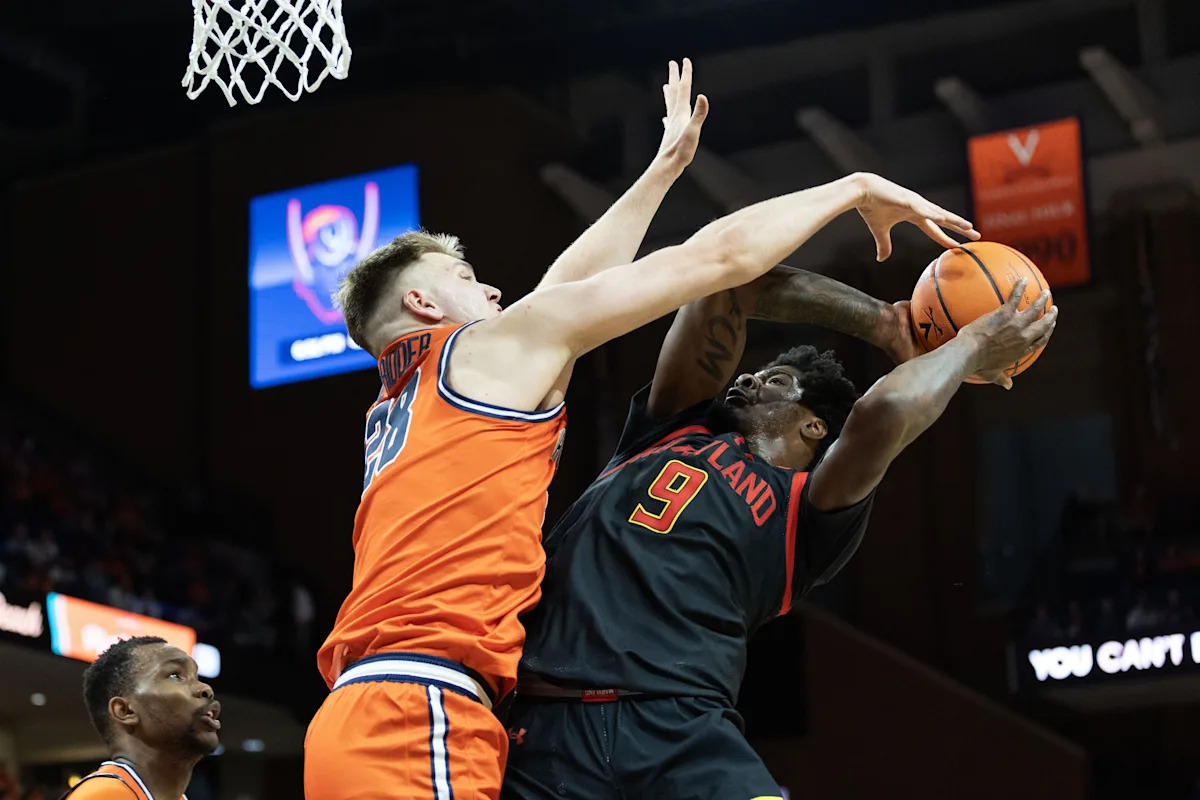
Maryland men’s basketball rekindled a local rivalry with No. 23 Virginia Saturday. The teams played for the first time in six years, and like old firewood, it took a long time for the game to ignite.
Quick sparks from both sides balanced out dry stretches and kept the game fairly close, but a 15-2 run from the Cavaliers early in the second half saw Maryland’s chances to win go up in smoke.
Advertisement
Unlike its previous loss, where the Terps lost to Michigan by 18 points but had plenty of reason for encouragement, the 80-72 defeat against Virginia felt like a setback for the Terps in spite of the relatively close scoreline.
Here are three takeaways from the game.
A certified “Buzz ball” classic, until it wasn’t
In many ways, Saturday’s contest was a strange game of basketball.
Thijs de Ridder, a 22-year-old freshman forward and Virginia’s star player, was shut down despite his team’s overwhelming success attacking Maryland inside.
Virginia’s offense, which entered Saturday averaging over 87 points per game, made just one basket over an 11:56 span.
Advertisement
Through 20 minutes, there were more combined offensive rebounds (22) than defensive rebounds (21).
And by the end of the game, Maryland had 17 offensive rebounds to Virginia’s 18 defensive rebounds — despite missing Pharrel Payne, its best rebounder by a wide margin, especially on offense.
In many ways, though, it started out a prime example of how head coach Buzz Williams wants his basketball.
Virginia was a team that played in the muck for a long time under former head coach Tony Bennett before turning the offensive corner under first-year leader Ryan Odom. The first half turned back the clock on Cavaliers basketball, though, as they went 9-of-33 overall and made just one 3-pointer.
Advertisement
That is exactly what Maryland hopes to do. Williams wants to slow the game down, work with set defense and set offense, and get teams into a rock fight.
Coaches know that. And when Williams’ teams are at their best, coaches can’t stop it.
This Maryland team is not near Williams’ best, though.
Virginia shot 21-of-33 in the second half, adjusting to blitz past the Terps. That run was led by 6-foot-4 graduate point guard Dallin Hall, who scored 18 second-half points, including a perfect 6-of-6 mark from inside the arc — another oddity.
The Terps played ugly. They were clearly the second-best team. But the team’s spirit never appeared to waver. That Williams hallmark may be the most important to impart in this transition season.
Advertisement
Maryland’s frontcourt was exposed
The first time Pharrel Payne went down for Maryland, he only missed one game — the 95-90 overtime thriller against Mount St. Mary’s, a team that Maryland should have beaten far more comfortably. Just 17 of those points came from the Terps’ frontcourt.
Judging by the game against Virginia, that sort of performance is about what Maryland should expect from the rest of its big men going forward.
The George Turkson Jr. experiment for Maryland went about as poorly as it could have. The redshirt freshman was ineffective at both ends — while he has the size to grab boards, it did not translate into a physicality that would allow Maryland to compete with the Cavaliers. He finished with one point and five rebounds.
Advertisement
Elijah Saunders, who was part of the overall first-half atrocity, is not comfortable as a paint-heavy player. Solomon Washington is, but as a more mobile defender. Anchoring him to the rim limits his defensive ability, which Maryland needs.
And Collin Metcalf, who would best fit the traditional center replacement, had two offensive rebounds and nothing else in six minutes.
Because of that, Maryland struggled mightily inside against Virginia. The Cavaliers scored an astonishing 44 of their 80 points in the paint against the Payne-less Terps, consistently getting an open man the ball under the basket. Virginia’s ball movement was excellent, and Maryland’s help defense on the rotations was not quick enough.
Maryland’s guards are inconsistent
The aforementioned struggles from the Terps’ frontcourt without Payne means guard production will be critical until he returns. But that’s not a predicament they want to be in.
Advertisement
Guillermo Del Pino’s injury-related absence left Diggy Coit as the only player Williams would consider a true point guard for his offense. And despite being matched up against a power-conference player (roughly) his size for the first — and maybe only — time, Coit had a horrific first half against Virginia. He missed three shots and had one turnover to zero assists, not giving Maryland’s offense anything to work with. Two fouls also limited his impact.
However, he turned it around in the second half. Once one basket went in, it seemed he was tuned to the right frequency. He was connecting with teammates, and shots kept falling. Coit logged 15 points and six assists in the second half.
He absolutely has the potential to be a transformative player for Maryland. Coit’s 41 and 31-point outings against Mount St. Mary’s and Michigan laid the foundation for him to be a true Maryland legend. But he also has three games where he has finished with six or fewer points.
The Terps cannot afford for Coit’s downs to even out his ups. At the same time, though, he may be the steadiest performer there.
Advertisement
Myles Rice made two baskets in 22 seconds of clock early in the game. Through the other 23 minutes of his game, he went 1-of-8 from the field. His four assists were negated by three costly turnovers, and it seemed like the Terps’ offensive rhythm stuttered whenever he touched the ball for an extended period.
Andre Mills continues to be a high-volume 3-point shooter in spite of his 23% make rate on the season. Darius Adams is an even higher-volume shooter, with a marginally better 24.5% mark of his own.
With Payne on the court, Maryland only really needed one of its guards to have an on game. But now, it needs more. The Terps’ contributors can all produce what is needed on their day — but their days have not yet come frequently enough.
