For the first time since Feb. 3, the Anaheim Ducks played NHL hockey on Wednesday evening, hosting the Edmonton Oilers after the extended Olympic break.
The Ducks entered Wednesday holding the second wild-card spot in the Western Conference playoff race. They trailed their Wednesday opponent, who entered the game in second place in the Pacific Division standings, by just one point, making this the biggest game of the season for both teams to date.
Advertisement
Game #57: Ducks vs. Oilers Gameday Preview (02/25/26)
Jackson LaCombe Discusses Olympic Experience, Winning Gold, Ensuing Events
Despite arriving in Anaheim on Tuesday and following his gold medal win on Sunday in Italy, Jackson LaCombe was inserted directly back into the lineup as the Ducks’ top defenseman. Leo Carlsson returned to action after missing the Ducks’ final 11 games heading into the break. Mikael Granlund missed this game with an upper-body injury sustained in Finland’s bronze medal game on Saturday. Ryan Strome and Drew Helleson served as healthy scratches.
Here’s how the Ducks lined up to start this game:
Advertisement
Killorn-Carlsson-Sennecke
Kreider-Poehling-Terry
Viel-McTavish-Gauthier
Johnston-Washe-Harkins
LaCombe-Trouba
Zellweger-Gudas
Mintyukov-Moore
Lukas Dostal got the start for the Ducks after starting four of Czechia’s five games in Italy last week. He saved 22 of the 27 shots he faced in this game. Dostal was opposed by Tristan Jarry in the Edmonton net to start. Jarry saved 20 of 25 shots before he was pulled with just over 13 minutes left to go in the third, and in a tie game. He was relieved by Connor Ingram, who stopped three of the four shots he faced in the final 12:41 of the game.
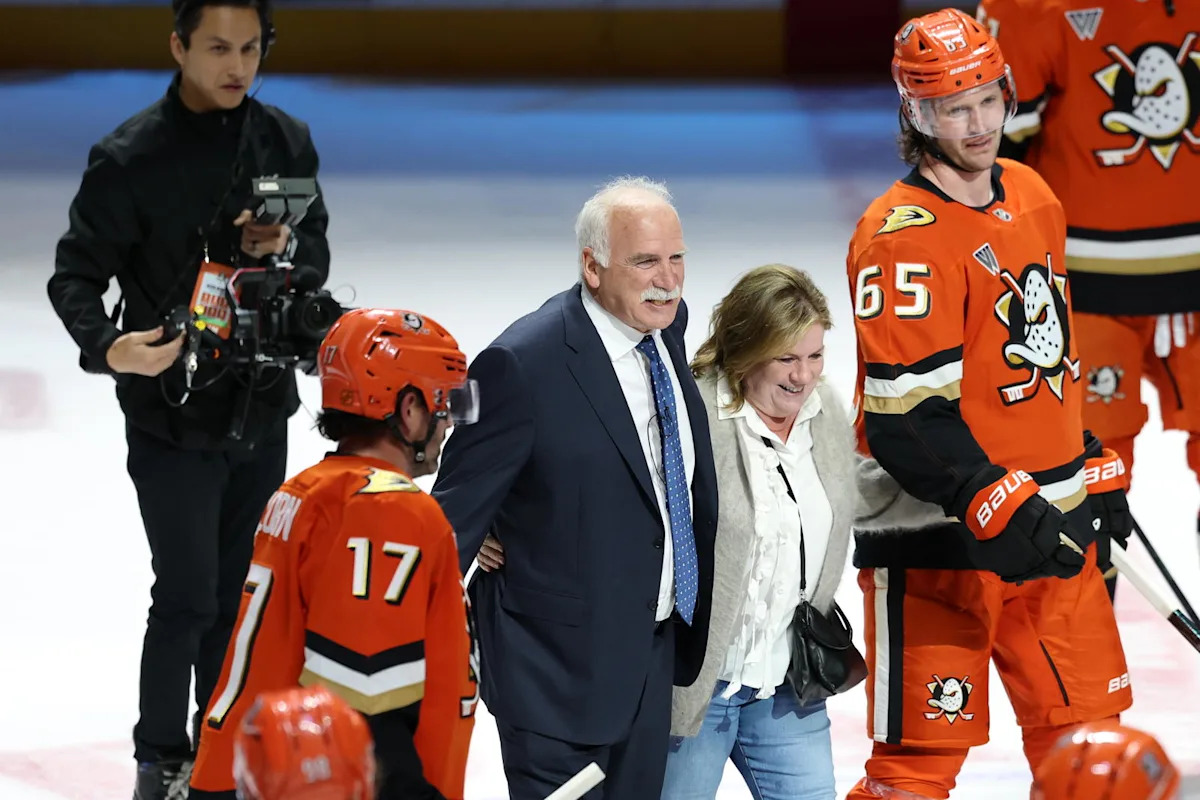
Ducks head coach Joel Quenneville earned his 1000th career win as an NHL head coach in a wild 6-5 win over the Oilers. He’s just the second coach in NHL history to reach the milestone, trailing only Scotty Bowman.
Advertisement
“The game was running through my mind,” Quenneville said when asked what his thoughts were when the final buzzer sounded. “It was a tremendous game as far as the unpredictability of the outcome. Both teams were swinging; it looked like they were in complete control of the game.
“It was an important game for us in a lot of ways. They had the puck a lot more than we did, but I thought we found a way to win a game.”
There weren’t many themes to take away from this game, as goals were scored of all varieties, and it was a sloppy affair from both clubs throughout. Though the Ducks gave up two goals early in the first period and two late in the second, with a pair of their own in between, those two-goal leads from Edmonton never felt safe, and this game always felt like one that was going to be decided by which team could harness the chaos best and score last.
The underlying numbers weren’t kind to the Ducks at 5v5, as they held just 40.45% of the shot attempts share, 44.19% of the shots on goal share, and 31.88% of the expected goals share.
Advertisement
Leo Carlsson: After attempting to play through injury for most of December and January, Carlsson regained the explosion that made him one of the NHL’s most dominant players through the first month of the season. His first three steps were quick and powerful, and he was making smart plays through neutral and after entry to optimize his ability to drive defenders back toward their goal line.
“A little tired, a couple of long shifts,” Carlsson said of how he felt returning to game speed. “I was absolutely gassed on the bench, but I felt okay. Stickhandling was okay, too. Speed was fine. So, pretty good.”
Carlsson would settle for distance shots off the rush, but again, optimized them by pouncing on ensuing loose pucks and establishing pressure or finding teammates through the chaos he created. He was processing plays at a faster rate than anyone on the ice at times.
Alex Killorn: Nobody on the Ducks roster can feed Carlsson pucks in transition and at full speed like Killorn can. He makes subtle adjustments as an outlet option, retreating toward his end or hooking his blade around a defending stick to lead his strong, speedy center with a slip pass.
Advertisement
Power Play: The Ducks only went 1-5 on the power play in this game, but manufactured several quality looks, as the coaching staff went to the drawing board over the break. They rotated the point defenseman to one of the flanks in attempts to get forwards out of position before changing sides of the ice with the puck.
When they’d get the openings to do so, the bumper was fed every chance the perimeter players got so that they could get quick shots off before defenders and the goaltender could react and adjust.
Pavel Mintyukov struggled a bit on his unit when carrying pucks up ice, as he had a difficult time fending off the first pressure in the neutral zone and finding his trailing forward with speed.
Lukas Dostal: Dostal has the ability to make difficult saves look incredibly easy. Edmonton worked several pucks low to high in the zone, changed angles on shots, and sent layered screens in front of Dostal’s field of vision, and he would find ways to make saves and even control ensuing rebounds, deflecting them to safety.
Advertisement
Defensive Zone Coverage: The Ducks struggled in this game, not in front of the net or against the rush so much, as they had throughout most of the season. In this game, they often got beaten back to the front of the net, one way or another, when the Oilers moved pucks off the walls and funneled them to the crease. They overcommitted a bit at times, and those little mistakes proved costly and could again if they persist, and if they don’t get the volume of goals they achieved in this game.
The Ducks will next host the Winnipeg Jets on Friday at 7 PM PST at Honda Center.
Ducks’ Dostál, Gudas on Their 2026 Olympics Experience
