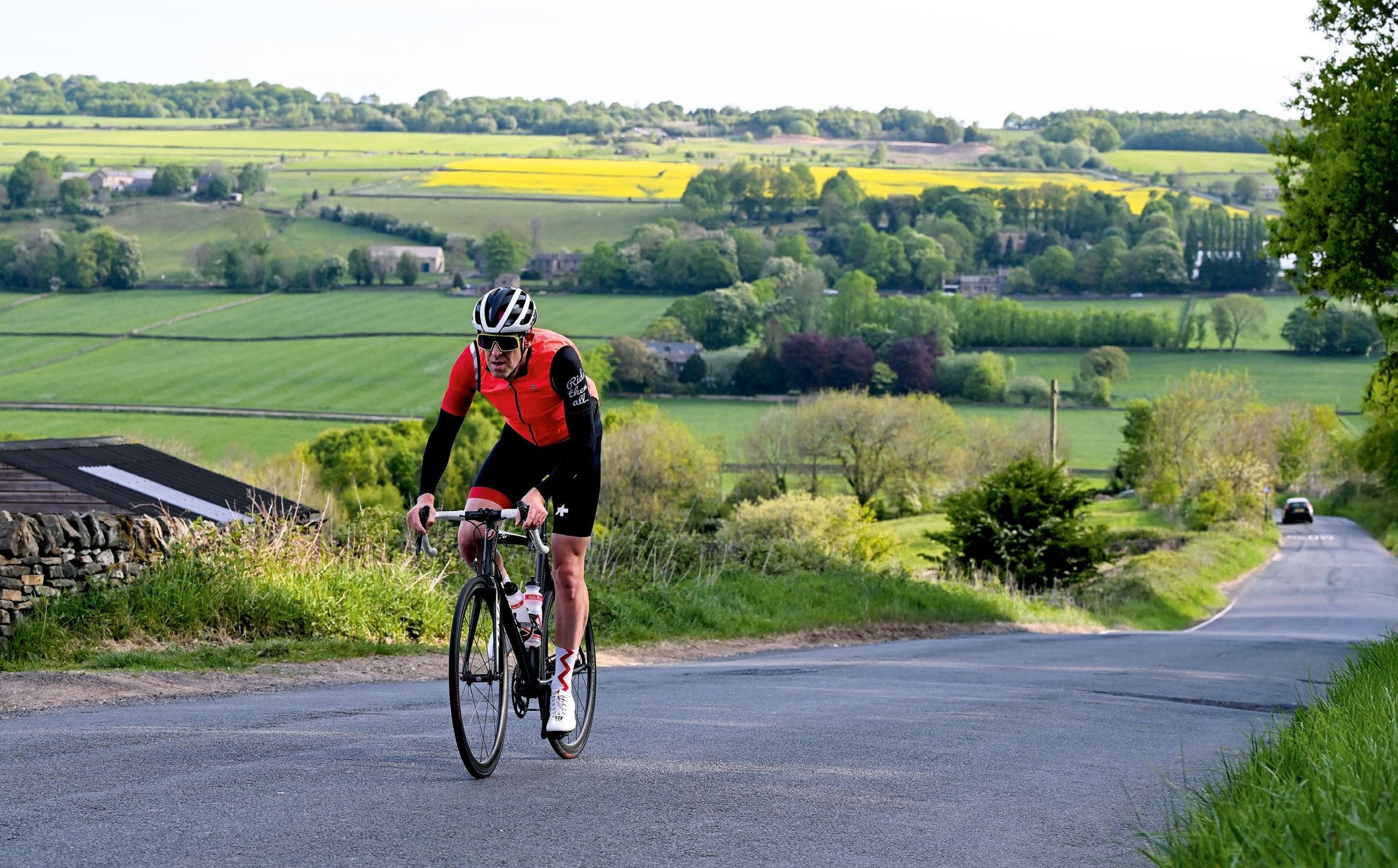
According to legend, Sheffield is built on seven hills – just like Rome. Along with steel, snooker, Def Leppard and Pulp, those hills define the city. It was part of what attracted me to the place; I’ve lived here since 2018. There was barely a single flat road to be found. But where exactly were these seven hills? Did they have names, and could I plot a killer route to ride over each one without crossing the city boundaries? I knew that one day I would have to find out.
In the case of Rome, the Eternal City, the seven peaks – Palatine Hill, Aventine Hill, Capitoline Hill, Caelian Hill, Esquiline Hill, Viminal Hill and Quirinal Hill – are all well defined, each home to a separate settlement before they merged to form the heart of the Roman Empire. With Sheffield, it’s not quite that simple. I found out that there are not seven hills, in fact, but eight – and to make it even more confusing, they are actually long ridges, rather than distinct peaks.
Simon Warren is a hill climb expert best known for his 100 Greatest Climbs series of books that covers the best cycling climbs from all over the world.
These ridgelines are defined by the seven rivers that separate them and can be identified by the eight roads that run along their spines (see box). Armed with this knowledge, I started to plot my route, aiming to cross each ridge while also taking in a fair share of the city’s classic ascents. It was then that the plan began to escalate – and an idea hit me. What if I could plot a route that ticked off not seven or eight but 100 distinct climbs all within the city limits? Suddenly I had the most on-brand challenge I’d ever set myself.
Seven hills? How did the myth begin?
It appears the first popular reference to Sheffield having seven hills can be traced back to George Orwell’s 1936 book The Road to Wigan Pier: “The town is very hilly (said to be built on seven hills, like Rome),” he wrote, “and everywhere streets of mean little houses blackened by smoke run up at sharp angles…” It seems that, like many Orwellisms, this one stuck in the public consciousness. In any case, Rome has seven hills and who doesn’t want to be associated with Rome?
“COULD I PLOT A ROUTE TO TICK OFF 100 CLIMBS WITHIN THE CITY LIMITS?”
Much more recently, local historian JG Harston took the question seriously and tried to locate each hill, and ended up instead identifying eight ridgelines. The urban myth, forged in steel, is represented across the city, from convenience store names to the Seven Hills Cycling Club.
Before I went any further, I set some rules. First, the route must not exceed 100 miles; second, no road can be climbed twice; third, there can be no dead-ends; and fourth, the ride must start and finish in the same place. To qualify as a climb, each road must gain elevation between a determined start and finish point, but with no minimum height or distance. Starting from my home in Greystones, the route I plotted went up and down, back and forth, using the eight ridges as a framework. Several times I ended up with an indecipherable tangle and had to start again.

(Image credit: Unknown)
Days later, it was finally complete – a thing of beauty: 100 distinct climbs across the city. It resembled some sort of Strava Rorschach test – is that shape a duck or the devil?
Gearing down for the day
With the prep done, it was time to hit the roads. Climb number one was Brocco Bank, and it’s steady away – really steady away. I’d made the sensible decision to fit my compact chainset so I had smaller ratios for the big climbs later on. It was disconcerting, therefore, to be already in bottom gear on the third climb of the day, Shore Lane, which ramps up to 20%. Steep gradients are the norm around here, and even Sheffield hasn’t enough steel to make a warning sign for them all. Atop Shore Lane I was also at the apex of the first of the eight ridges, which is defined by Redmires Road.
I needed to make the most of the few places where my legs got a rest, and the first one arrived very early on, descending into the Rivelin Valley. My next conquests would be a couple of solid ascents up either side of the second ridgeline, Stannington Road. The best of these, and the first serious climb of the day, was Spout Lane, a real beast with a couple of choice 20% hairpins. From the top of Stannington Road, it was back into the Rivelin Valley once more, then up some more 20% through Bole Hills as I made my way over to Blake Street.

Simon Warren 2025 100 climbs of sheffield
(Image credit: ANDY JONES)
The steepest residential road in the city, Blake Street is famous for its gradient and even featured in the movie The Full Monty. If I’m riding it in competitive company, I hate it – I simply don’t have the punch for such short climbs. Thankfully, today was not about combat, but just about cresting the summit. Next, I headed into Walkley, where I was able to tick off five climbs in a couple of kilometres. With rows of terraces set on a slope, it was up one, down the next – and repeat until they ran out – bagging multiple climbs in a short distance.
Crossing into the Dykes Hall Road, I repeated the same exercise of up and down in Wadsley, before facing the fearsome Langsett Avenue. This climb is a brute. Ditto the following climb, Long Line. There are two Long Lines; both evil, dead-straight roads up the hillside.
“THERE ARE TWO LONG LINES; BOTH EVIL, DEAD-STRAIGHT ROADS UP THE HILLSIDE”
Mercifully, the next rise was my very favourite Sheffield climb, Wheel Lane. Actually three roads in one, Wheel Lane snakes back and forth past some very nice houses, has some 20% sections, and is everything I love about short, steep climbs.
I felt compelled to include roads I hated, as well as those I loved, and the next was an absolute beast: climb 26 of the day, Jaw Bone, or Oughtibridge Lane, is sacred ground in Sheffield because it was one of the climbs featured in the 2014 Tour de France. Permanent signs adorn it, reminding people forever of that fantastic day. Another nine rapid climbs later, it was time for another Tour veteran, the horrible Jenkin Road.

Simon Warren 2025 100 climbs of sheffield
(Image credit: ANDY JONES)
I rarely come to this side of town unless I’m picking up family from Meadowhall shopping centre – or “bloody Meadowhall” as I like to call it – and hadn’t ridden Jenkin Road more than a couple of times. Rising into Wincobank from the industrial environs of the Don Valley, this road traces one of the eight ridges, which made it very satisfying to ride.
City of contrasts
Over the course of the day, I was getting a fairly comprehensive overview of the city, from the industrial grime in the east to the millionaires’ mansions in the west, and a bit of everything in between. Sheffield is a city of contrasts, of rich and poor, clean and dirty, and the stretch from Wincobank, through Page Hall and Burngreave, was without doubt the dirtiest. Traversing glass-strewn roads, I was lucky to escape without getting a flat. Heading south past the famous Park Rise flats, I ticked off the shortest climb on the route, Coates Street, which is just 50m long.
Remember my rule: if a road ends at a higher altitude than it starts, it counts.

Simon Warren 2025 100 climbs of sheffield
(Image credit: ANDY JONES)
To rack up 100, I was going to need to accept some short ones.
This brought me to 40, still 10 short of halfway, and to Blackstock Road, through Greenhill, and ticking off 11 climbs in the terraced streets of Woodseats and Meersbrook. Heading west, having navigated the Derbyshire Lane and City Road ridges. I’d now ridden climbs up seven of the eight Sheffield ridges – but my quest for 100 climbs was far from over. I’d plotted the route to pass my front door, so I popped in to grab some home-made onigiri (Japanese rice balls) I’d left waiting for me.
The perfect sustenance, I stuffed one down my throat and another in my pocket – celebrating 67 climbs ridden, a mere 33 to go.
“THAT FINAL CLIMB TURNED MY LEGS TO JELLY”
Up next were my local hills, including the mighty Dobbin Hill, which my daughter used to have to walk up every day on her way to school – I’ll never forget the moment she realised: “Dad, can we move back to London?” she sobbed. With Greystones ticked off, I faced a date with Lodge Lane, which had been looming large on the horizon all day. What was I thinking when I made it climb number 76? One of the hardest climbs in the city, it’s the road Malcolm Elliott used to use for intervals.

(Image credit: ANDY JONES)
Next came the quietest part of the route, and the bit that best highlights Sheffield’s close proximity to nature. Still within the city’s boundary, when I looked left I saw buildings glistening below, but when I looked right my vision was filled with the green hills of the Peak District. Skirting the edge of the National Park, I headed to the affluent areas of Dore and Totley – a stark contrast to the grimy streets of earlier in the day. Riding up Devonshire Road, past the mansions with their manicured gardens, felt more Beverly Hills than Sheffield hills.
By now the legs were a little sore and made worse by Twentywell – ‘Twentyhell’, as it’s known – Lane, but the end was within sight. I was racing through the final 10 climbs and not holding back anymore, as there was now nothing to lose, treating each one like a short interval. Before I knew it there was just one left: Botanical Road.

Former Tour climb Jaw Bone chews you up and spits you out…
(Image credit: Unknown)
Cresting that final climb, having ridden just shy of 99 miles, my legs turned to jelly. What a relief – the satisfaction of a mission accomplished – and what a day. All that planning, the sleepless nights turning the route over in my mind, had been worth it, executed to perfection. Never had there been a moment to lose my head or get bored, such was the concentration needed to follow the script.
If anyone ever tells you there are seven hills in Sheffield, or even eight, tell them they are way off the mark. There are thousands, and this ride climbed just 100 of them. Now I’m wondering: which city’s topographical myth should I rewrite next?

(Image credit: Unknown)
