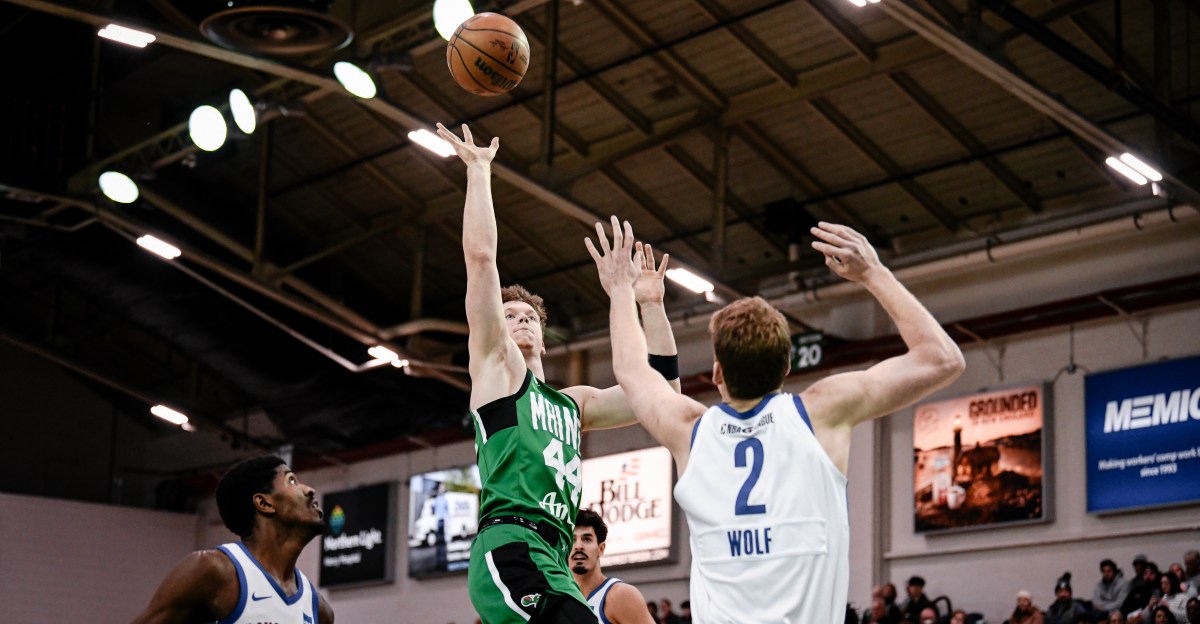
In their second matchup in three days against the Capital City Go-Go at CareFirst Arena, the Maine Celtics, much like their NBA counterpart, saw a win streak taken down on Friday afternoon in a 103-70 thumping.
Maine, down two-way players Amari Williams (right hand hairline fracture) and Ron Harper Jr. (right knee sprain), saw a franchise-record nine-game win streak conclude at the hands of the Go-Go, whom they had previously beaten 112-101 on Wednesday behind rookie Max Shulga’s career-high 25 points.
While the Celtics of Boston are surprising the NBA with a roster of championship holdovers and overachieving G League graduates, something eerily similar is also brewing in Maine, where first-year head coach Phil Pressey has guided the team through an 0-3 start to a 9-4 record.
Traveling down I-95 to beat the morning D.C. traffic before Maine tipped off with Capital City for a second time this week, CelticsBlog got an exclusive interview with coach Pressey and Shulga before tipoff, where we discussed Pressey’s first year on the job, Shulga’s rookie progress, and the arrival of Keon Johnson.
Pressey is finding his voice, but learning to listen
In his first season as a head coach, Phil Pressey has been all ears.
Starting his professional playing career with two years as a Celtic, Pressey found his way to stops in the NBA Development League, Liga ACB, Turkish Basketball Super League and the Bundesliga before a return to Boston as an assistant coach in 2023.
Now a head coach in Maine, he’s surrounded by a staff with similar worldly experience, and he’s taking full advantage of the knowledge they’ve acquired in their paths to Maine.
“Our staff is strong, and without them, it’d be very difficult to do my job,” Pressey said.
Pressey made sure to mention every coach on the staff during our sitdown, highlighting the experience they bring to the table.
Mike Malat was head coach for the Lakeside Lightning in the NBL1 West before taking the job in Maine, Boaz Mensah was the head video coordinator and assistant player development coach with Basketball Netherlands, and Schuyler Rimmer was a player development coach for the Milwaukee Bucks under head coach Mike Budenholzer and an assistant under Darvin Ham with the Los Angeles Lakers. Taaj Ridley, who was an assistant at Holy Cross before his start with Maine, had a professional playing career similar to Pressey’s, featuring overseas stops like Germany, Finland and Brazil along with the Long Island Nets of the G League.
“I just try to the best of my ability to be an active listener, understanding that I don’t know it all,” Pressey said. “Other people have brains too.”
That last line is one Pressey learned from another coach: UCLA legend John Wooden, who Pressey considers a virtual mentor.
Pressey is in the process of reading Wooden’s 1966 book Practical Modern Basketball, which he found on a colleague’s desk and focuses on Wooden’s coaching philosophies and approach to the game.
Even as the way we think of the game has changed since Wooden’s historic Bruins tenure, Pressey says he’s finding a lot of the information has endured through basketball’s evolution, and in the process, he’s using that old knowledge to help with a new career opportunity.

Shulga stays level-headed through the two-way lifestyle
108 miles separate CareFirst Arena from VCU’s Siegel Center, where Max Shulga spent two fruitful years growing into an Atlantic 10 Player of the Year and a beloved figure among the Rams faithful.
On Wednesday, Shulga had his best game as a Celtic, scoring 25 points, hitting four of his nine 3-point attempts, and helping the Celtics outscore the Go-Go 58-44 in the second half for their ninth-straight win. Later that night, he drove back to Richmond, Virginia to watch his old team take on New Mexico.
“I drove down there, and it was all love,” Shulga said. “It’s always a warm welcome when I go over there. I loved everything about VCU and my time there.”
Shulga is the only two-way Celtic to not make an appearance for Boston so far this season, but he’s been a fixture on the bench, working with player development coach Craig Luschenat, and using the opportunity in Maine to get acclimated to the jump in competition.
Shulga has averaged 32.7 minutes with Maine in 12 games, but has struggled to find the scoring touch that was so prevalent in his days as a VCU Ram. Currently, he has shooting splits of 39/33/65, while turning the ball over three times per game. Against a Go-Go team that ramped up its ball pressure in their Friday afternoon rematch, Shulga had five turnovers, while the team as a whole struggled with 17.
Shulga has shown promise in those same opportunities, averaging 5.6 assists and grabbing 4.8 rebounds while commanding the Maine offense with Harper Jr. sidelined.
Through the highs and lows, Shulga is staying level-headed through his first months as a pro, and taking all of his experience in stride.
He says Baylor Scheierman and Neemias Queta have been particularly helpful figures in his NBA acclimation. Scheierman was a teammate of Shulga’s during this year’s Las Vegas Summer League, while Queta is no stranger to that role with Shulga, having been an older teammate of his during his freshman year at Utah State.
“You just have to stay level-headed,” Shulga said. “It’s a long, long year between G League games and NBA games. You can’t get too high and you can’t get too low, you just have to stay balanced.”
From Pressey’s perspective, he sees a player with a growth mindset. When he first met Shulga during Summer League, he saw a player coming up short on his 3-point attempts in warmups, perhaps because he hadn’t yet adjusted to the deeper NBA 3-point line. Telling Shulga to lift his elbow and get the shot up higher, he figured that work would come next to another coach. Instead, he found Shulga working on that tweaked shooting mechanic himself, finding the touch soon after.
“He figured that out on his own,” Pressey said. “Being able to see him come in and the growth he’s had since Day 1 in the Summer League until now, it’s a huge difference.”
Keon Johnson embracing defense as his calling card in Maine
Keon Johnson was 19 years old when he set the NBA Combine record for the vertical jump with a 48-inch result before the 2021 NBA Draft. He would soon after be selected 21st overall by the Knicks (later traded to the Clippers) after one season at Tennessee.
Now at 23 years old, with 161 NBA games under his belt between stops with the Clippers, Trail Blazers and Nets, Johnson is looking for that next opportunity, and it starts in Maine.
In four games with the Celtics, Johnson has been an all-around threat, scoring 14 points, dishing out four assists and grabbing seven rebounds. It’s on the defensive side of the floor, however, that Johnson wants to make his mark.
“Defensively, that’s where I come in, that’s what I’m known for, and for me to come in and make an immediate impact on the defensive end guarding and getting guys out in transition and making simple reads, that’s where I feel like my game has grown,” he said in a press conference on Dec. 6, right after his 16-point, 5-rebound Maine debut.
Johnson is by no means taking the demotion from the NBA to the G League with a negative attitude, saying the opportunity gives him a chance to focus on the finer, minute details of his craft so that he’s a more well-rounded player if that next opportunity comes around. Simply looking past the situation makes it that much harder to get back to the top.
“I do understand that coming here is a stepping stone to perfect how I approach the game, and just create some type of separation to get back up top, wherever that may be,” he said.
Pressey says he’s seen a player with eye-opening athletic ability, just as we’d seen during his historic NBA Combine leap, but it’s the defensive mentality that he applauds as Johnson battles on that side of the floor in his first two weeks in a Maine uniform.
“He’s a relatively young player in the NBA, so he just has to keep at it,” Pressey said. “His opportunity is going to come, he just has to be ready.”
