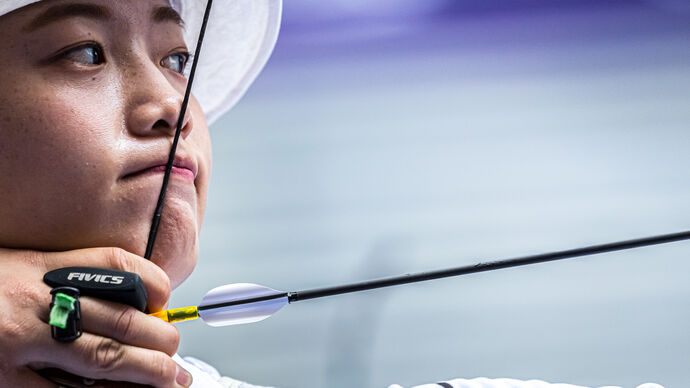
In archery, the smallest movements carry the greatest weight. Fixing their aim, holding it steadily, and releasing at the right moment all require extraordinary precision. But in competition, when pressure creeps in, even familiar movements can shift – and pressure changes timing, though not equally for everyone.
During the Tlaxcala 2024 Hyundai Archery World Cup Final, I set out to understand how pressure affects an archer’s timing. Watching the world’s top female recurve archers, including Japan’s own Waka Sonoda, I wondered: how does aiming time change when the stakes are highest? And does that difference decide the winner?
To explore this, I identified crucial moments as situations when the match balance could shift quickly: the first shot of the match; any moment when an archer’s points lost matched the opponent’s; and any moment when an archer’s points lost exceeded the opponent’s by one. All other situations were considered normal moments.
I measured how long each archer spent aiming in both normal and crucial moments.
The results were clear: seven out of eight archers took longer to aim when it really mattered. On average, they took about 1.4 seconds in normal moments and nearly 1.9 seconds in crucial moments. Even the most experienced athletes paused slightly longer under pressure, while only Jeon Hunyoung aimed faster in high-pressure situations.
Across all quarterfinals, winners were more consistent than losers. Their aiming times changed only a little under pressure – roughly 20%, compared with around 75% for losers. Winners adjusted slightly but stayed on rhythm, while losers either hesitated too long or changed pace noticeably. Among the quarterfinal winners, Deepika Kumari had the most stable rhythm.
Analysing all matches, Alejandra Valencia had the most consistent rhythm, showing that steady timing is a quiet but powerful factor in success. Minor adjustments are natural, but large swings in timing often lead to loss.
