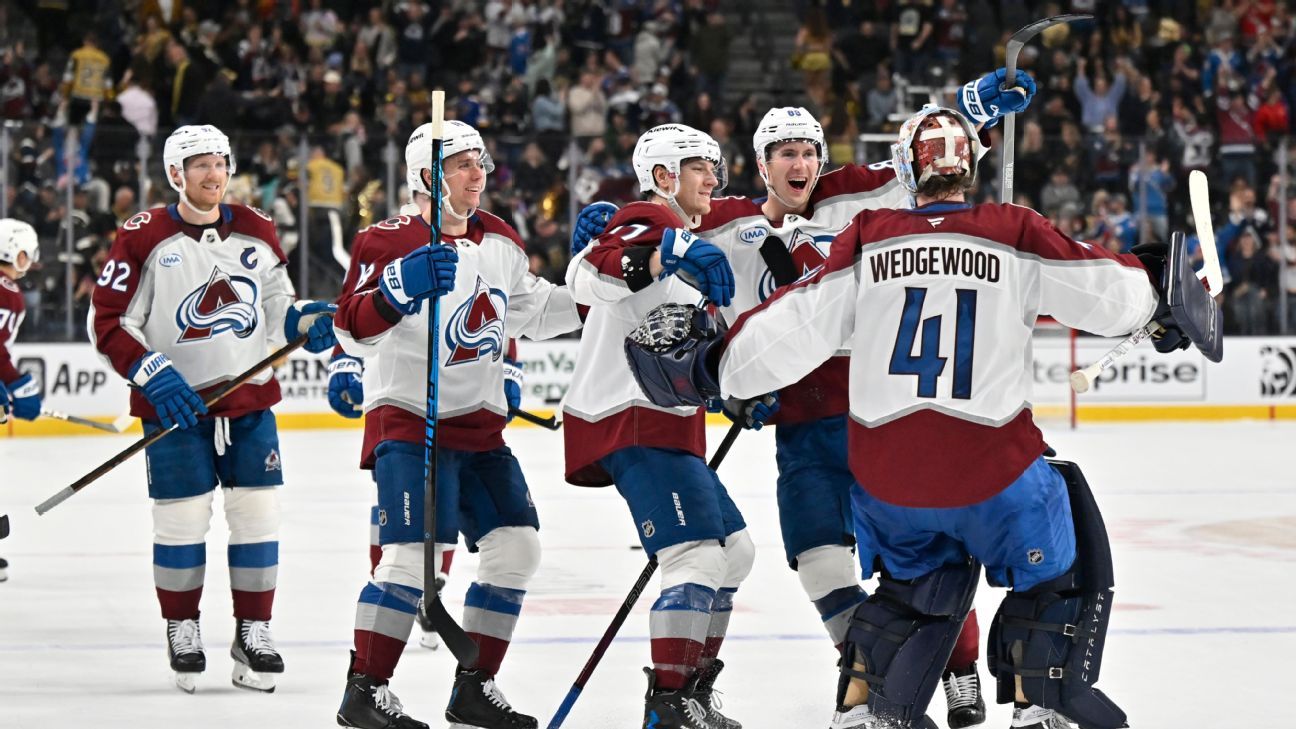
DENVER — There was recently some concern from the outside hockey world about the Colorado Avalanche, because they’d lost consecutive games in regulation.
No single team is going to win every game, especially not in an 82-game season. But the Avalanche had only two regulation defeats in the 2025-26 season entering the first week of January. Losing two in a row led to questions about what’s gone wrong — considering that everything else has gone right for them.
That’s when Avs goaltender Scott Wedgewood, the most loquacious player on the roster, had a thought that actually turned out to be more of a prophecy in hindsight.
“For whatever reason, the whole vibe is an expectation that because we’re a league leader and a threat that we are tense and guys are uptight and thinking, ‘Oh, s—. We might get our butts kicked tonight,'” Wedgewood said. “That’s where we like, ‘We can kick someone’s a–. Let’s go to work.’ I think that’s freeing for the team.”
Six hours later, that’s exactly what they did to the Ottawa Senators in an 8-2 win that was more emphatic than the final score suggests.
It was the way Josh Manson fought Tyler Kleven early in the first that set the tone. It was the two-goal lead at the end of the opening frame. It was the six goals they scored in the second period. It was how they kept pushing to score more. It was even the way defenseman Samuel Girard, who hadn’t fought since 2019, fought Tim Stutzle and won.
It was a performance that proves how multiple things can be true at once. It was just one game; that’s fair. But the game itself fits within a larger scope of a season in which the Avalanche have emerged as the favorite to win the Stanley Cup, despite the number of teams who believe they can win a title.
That’s what happens when a team wins 34 of its first 48 games. Winning that much presents the idea they could be more than just Stanley Cup favorites — it ignites a discussion about whether the Avs could finish this season as one of the greatest teams the NHL has ever seen.
Hyperbolic? Possibly. Realistic? Again, possibly. The Avs are projected to finish this season with 131 points. That’s four shy of tying what the Boston Bruins did in 2022-23 when they set a new NHL record for the most points in a single season … only to lose in the first round of the Stanley Cup playoffs.
The Avs have scored more total goals and are averaging more goals per game than everyone else. They have allowed the fewest total goals and are allowing fewer goals per game than everyone else. They have two of the five best players in the world, in Nathan MacKinnon and Cale Makar. They also have the supporting cast that shows they are more than just MacKinnon and Makar.
“I think for us, especially when we come home, our first couple shifts we can tell pretty quickly if guys are rolling,” Makar said. “When the goals start coming, we keep the heat going and we can keep that pressure on the team — I think it just gives guys confidence to keep continuing to do it every single shift. You get that high and then score another one and you want to keep it going.”
THERE ARE A FEW WAYS that Avalanche general manager Chris MacFarland and his front office staff built a roster that might be the best they’ve had since winning the Cup in 2022. First, the Avs continue to build a reputation as a team that’s allowed new players to look as comfortable in a system as if they’d been there for years.
From there, it was about identifying the elements that had been lacking from that Stanley Cup team and finding players who could provide something similar. There was also a decision to cultivate the sort of supporting cast that essentially allowed anyone on the roster to be the reason they won games.
And they were trying to figure out how to do this while still staying under the salary cap.
“The depth, I think every line just goes out there, and they compete extremely hard,” Avs center Brock Nelson said. “There’s a focus on a lot of different details of the game that’s ever-changing depending upon the matchups, the other team’s strengths and how we can maybe counteract that.”
0:29
Brock Nelson nets goal for Avalanche
Brock Nelson nets goal for Avalanche
Let’s start with how players come to Denver and find success. The Avs saw it with Andre Burakovsky, Matt Calvert, Joonas Donskoi, Jonathan Drouin, Nazem Kadri, Devon Toews and Manson, among others.
Nelson — acquired in trade last season and then re-signed — is a continuation of that dynamic. He’s a 10-time 20-goal scorer that is projected to finish with his first 40-goal campaign. Martin Necas — who came to Colorado in the Mikko Rantanen trade with Carolina — is on pace to finish with 38 goals and 103 points. That would be his first 30-goal season, and his previous career high was 83 points.
Free-agent signing Brent Burns has been on the second or third pairing depending upon the Avs’ injury situation. The 40-year-old is on pace for 43 points. That would be the third-best season by a defenseman in their age-40 season behind Nicklas Lidstrom and Ray Bourque should that hold. Bourque won the Stanley Cup with the Avs in that season.
Another free-agent signing, Victor Olofsson, could finish with 40 points for the fourth time in his career. Bottom-six anchors like Jack Drury and Parker Kelly are both on pace to finish with more than 10 goals. There’s also defenseman Sam Malinski, who is on pace for 41 points having come into this season with 25 career points.
Burns, Drury, Kelly, Malinski and Olofsson cost the Avs a combined $6.525 million in cap space, with the reality that they’re doing this while Logan O’Connor, who is one of their most important bottom-six players, has been out this season while recovering from hip surgery.
“The team has a lot of depth and that’s a big part of why we’re doing well,” Burns said. “It’s all four lines, all three of our D. All that about first, second, third [lines and pairings] — we don’t really emphasize that here. There’s some world-class talent. But it’s a team mentality. It really is and I think that’s the most special thing about it.
“You come to work every day. You work and then hope you can keep it going.”
NOW COMES THE SECOND PART: having personnel reminiscent of their Stanley Cup team in 2022. That process that started last season when MacFarland and the front office made the sweeping changes that have continued to have an impact this season.
The need for a second-line center was arguably the most glaring challenge facing the Avs in their bid for a second title with their current core. Part of the reason Nazem Kadri left in free agency was the concern around signing a second-line center that was older than 30 to a deal that would expire once he reached his mid-to-late 30s. Kadri signed with the Calgary Flames on a seven-year deal worth $7 million annually.
Kadri’s departure left the Avs shuffling through options. They traded for a 31-year-old Ryan Johansen at a cut-rate price, but traded him after 63 games because he struggled to find the consistency that made him a 50-point player seven times. They tried going younger and trading for Casey Mittelstadt. He had a strong start with the Avs, and signed a contract extension. But Mittelstadt struggled to find consistency thereafter, and was traded after 63 games — the same as Johansen.
That opened the door for the deal for Nelson. He had 13 points in 19 games with the Avs in the 2024-25 regular season, and four points in seven playoff games. He avoided free agency by signing a three-year deal worth $7.5 million annually. Questions were raised at the time about signing a 34-year-old center. The counter to that is that he gave the Avs a bona fide second-line center, and has proven he can handle what comes with being on a team in a championship window.
Of course, re-signing Nelson came with another reality: This whole thing could have been avoided if they had found a way to sign Kadri, who makes $500,000 less than Nelson per season, but has an extra year on his contract. Nevertheless, Nelson has been a superb fit.
“I don’t think I’ve changed my preparation or strategy,” Nelson said. “It’s just kind of going out there and trying to impact in all three areas of the game. It’s special teams, 5-on-5 and being in a support role for Nate, Cale, Marty [Necas], Val [Nichushkin], Gabe [Landeskog] — all these guys are good.”
Nelson, among others, have provided the depth that can win the Avs game without having to always rely on MacKinnon and Makar.
Last season’s team had 13 players that finished with 20 or more points. Three of them were either traded to or away from the team. Through 50 games, the Avs have 12 players who have scored 20 or more points — and Parker Kelly has 19.
It’s a group that includes Landeskog, who is playing again after missing the majority of the last three seasons recovering from a chronic knee injury. Landeskog sustained a lower-body injury on Jan. 4 that has kept him out of the lineup. But that list of 20-point scorers, however, does not include Toews. He’s also been out of the lineup since early January with an upper-body injury, but has averaged 46 points per season in his five campaigns in Denver.
Scoring goals is important. But so is the ability to stop them, which is another part of the equation for the Avs when it comes to what Mackenzie Blackwood and Wedgewood have meant this season.
Blackwood and Wedgewood were also in-season acquisitions last season who provided stability in net. Blackwood signed a five-year extension after just four games with the Avs, while Wedgewood had a year left on his contract upon being acquired. They combined for a .915 save percentage last season — a major boost from what the Avs had with Alexandar Georgiev and Justus Annunen, who teamed up to have a joint .873 save percentage. The Avs have a league-leading .916 save percentage this season.
“We’ve both proven over time that we’re very good goalies on different teams and we’ve also struggled when teams have struggled,” Wedgewood said. “Now you’re seeing us play behind good teams and us having confidence and playing off each other. I think the recipe has become a little more of, you expect to win because you can’t predict hockey. But you have the confidence to go out there and think you’re going to win every night.”
That’s been proven throughout this season. Blackwood has navigated injuries in a campaign that has seen him play just 19 times. Wedgewood, who had previously been a career backup, became the de facto starter. His 30 starts are already the most he’s had in a single season in his career.
It’s a set of circumstances that have allowed the Avs to discover that they can win no matter who is in the net whether it’s Blackwood or Wedgewood. They’ve even found success when their third goalie, Trent Miner, has played with Miner posting a .933 save percentage in four games.
0:33
Scott Wedgewood makes big-time save vs. Mammoth
Scott Wedgewood makes big-time save vs. Mammoth
Perhaps the most crucial part of all? Blackwood and Wedgewood cost the Avs just $6.75 million in cap space. PuckPedia’s data shows that it’s the 10th lowest amount of cap space a team has committed toward its goaltending.
Altogether, the Avs have what a little more than $5 million in projected cap space at the trade deadline, also according to PuckPedia.
“I feel like [the Avs’ front office] has found a way to do what a lot of teams would like to do with their rosters here,” Wedgewood said. “You’re still at a spot where they can make moves, which is still kind of crazy.”
PRIOR TO 2022, the Avs were billed as a promising young team with a first-time NHL coach that was either on the verge of or in the early stages of a championship window.
Now? They’re seen as a perennial Stanley Cup favorite that’s trying to add at least one more title for the core group. They have a coach that’s developed into one of the best — and longest tenured — bench bosses throughout the NHL.
That’s what comes with being the fifth-oldest team in the NHL. So does the realization that their prized core featuring Landeskog, Makar, MacKinnon and Toews, among others, are either getting close to turning 30 years old or have already passed that point.
Getting older can be concerning because it reinforces how those championship windows do have an expiration date. That’s been made even more evident by the Western Conference landscape:
-
The Edmonton Oilers have advanced to consecutive Stanley Cup Finals
-
The Dallas Stars have reached three straight Western Conference finals
-
The Vegas Golden Knights continue to add more as they seek to win their second title since 2023
-
The Minnesota Wild are making the sort of push this season that further signals their intent to challenge for a championship
The Avs’ approach to that newfound reality is to accept it in a way that makes it work for them.
“I think last year was a year we felt we had a really good team that had a chance to win and when that didn’t happen, there was some heartbreak,” Avs coach Jared Bednar said. “That’s happened to us multiple times in years past too, and we’ve responded really well the next year and I think it comes down to what we’ve had this year which has been leadership, focus and consistency.”
0:38
Victor Olofsson keeps Avalanche alive with a goal-line clearance
Victor Olofsson keeps Avalanche alive with a goal-line clearance
Landeskog’s return has had an impact that goes beyond giving the Avalanche a venerable top-six winger. As the team captain, he gives them a primary voice within their dressing room that’s a conduit between Bednar, his staff and the players.
“He’s a big voice and it’s obviously a big hole in the room [when he is out] in the sense that he’s a very talented player,” Wedgewood said. “But he’s just a person that calms it all down. I think he’s always saying the right thing.”
Getting Landeskog’s voice back in the room on a more consistent basis adds to what they already have with alternate captains like MacKinnon, Makar and Toews. Burns, Nelson and Manson have also worn letters with other teams throughout their careers.
Together, they create an environment that has the benefit of experience, while knowing how to shape a message in a way that the entire team understands. That includes knowing when they can go to Bednar with certain matters.
That includes whether to have practice or how they need to handle morning skates. Not that the Avs are trying to get out of doing any extra work, but the game has become more about how to manage situations and not just win them.
“We’ve adopted that mentality for some time now,” Bednar said. “I think that comes with the maturity of the players and being able to trust them to do what they need to do. We do a lot of learning just off video, whether it’s pre-scouts or game reviews, and we don’t feel like we necessarily have to consistently get on the ice to practice those things in order to implement them into our game.”
Bednar said what allows the Avalanche to be in that position is the years of trust that they have developed working together. Only Tampa Bay Lightning coach Jon Cooper has stayed with his team longer than Bednar has with the Avs.
August will be 10 years since the Avalanche hired him from the AHL. He’s navigated everything — from a team that once had the lowest point total in the salary cap era to the transition of trying to be a playoff team to one that has won the Stanley Cup with the objective of winning more.
His time in charge of the Avs has seen him go from someone who had to do more coaching than teaching, to someone that must now coach and manage with the idea that he can teach when needed.
“It’s a mature group and the relationship between me and the players is something that has developed over time,” Bednar said. “You try to implement it and then go with it as it works, and if you need to set back and practice more, you do. If you can continue to go and have the team rested — like our team has handled it really well. We have a lot of optionals and guys get on the ice. They come to us if they need understanding on something.”
