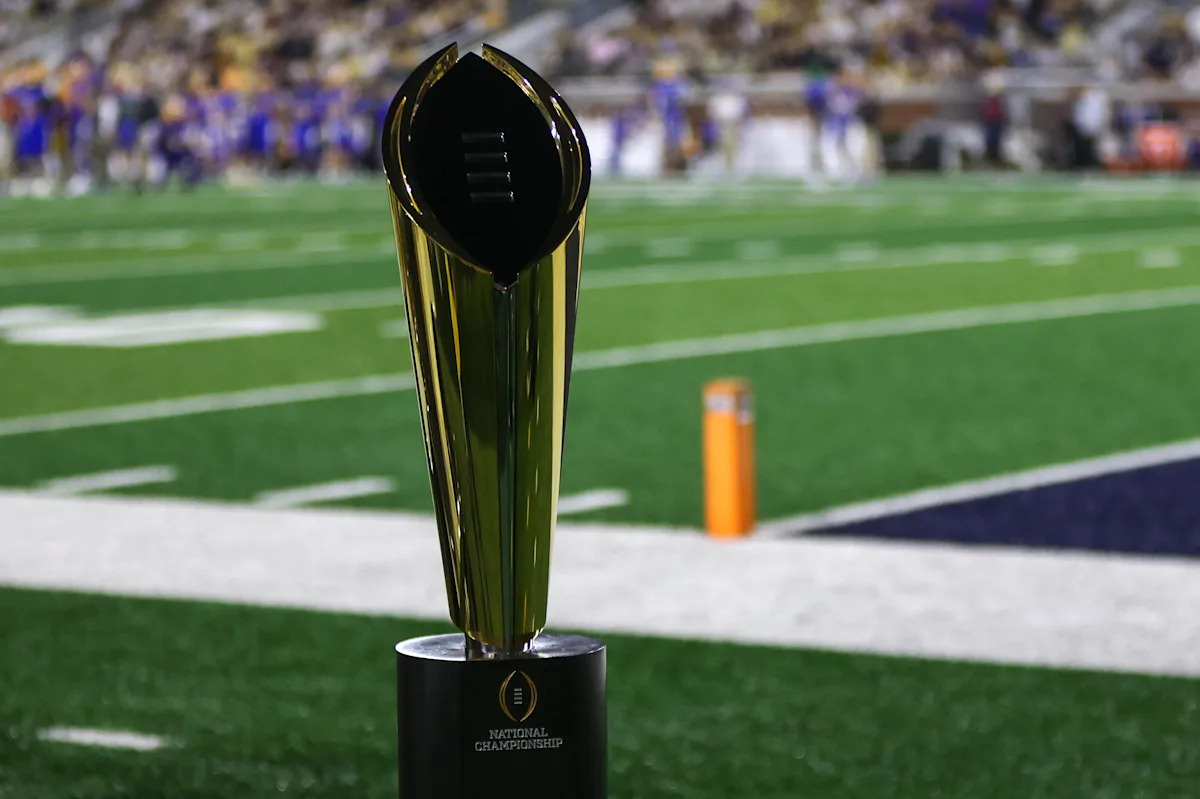
For years, proponents of a postseason playoff argued that it would more fairly determine a champion and remove the controversy that surrounded the few years in which multiple teams had legitimate title claims. For instance, I personally only acknowledge Colorado as the champion of the 1990 season.
And yet, here we are a dozen years into the playoff, still having the same stupid arguments. Parsing the difference between the meaning of “best” versus “most deserving” like the world’s lamest con law scholars. Weighing “bad losses” against “good wins.” Reading the tea leaves of the idiotic weekly rankings show to get some idea what the committee is thinking.
Advertisement
The original playoff arrangement offered four postseason berths to a sport with five power conferences. It was more or less explicitly designed to engender controversy to justify further expansion. We wouldn’t need to wait long for it, either. In the first season of the playoff, the committee had to choose between three one-loss teams in Baylor, TCU, and Ohio State. It picked Ohio State — not coincidentally, the biggest brand of the three.
The committee then more or less got things right until 2023, the last year of the four-team format, when it put a one-loss Alabama team in over an undefeated Florida State that had lost quarterback Jordan Travis. Amidst the furor, we were again assured that a bigger playoff field would fix problems like this one.
And yet, here we are again, mired in further idiotic controversy. Maybe next year, when it’s 16 teams, we’ll be fine. Or again in a few years when they expand to 24 like the FCS playoffs. Or maybe we should just have a big, 136-team tournament.
To be clear, I have no sympathy for Notre Dame, and I don’t find it to be a particularly grave injustice that they were left out. That’s what happens when you lose twice and leave it in the committee’s hands, as this writer correctly points out. And any pity I might have felt for the Irish would’ve evaporated when they threw their bowl-refusing tantrum.
Advertisement
I do find it a little annoying that the time Georgia finally breaks through and beats Alabama, the Tide still manage to avoid any penalty for getting absolutely romped.
Watching adults gravely call for official investigations into the committee’s process is deeply, deeply embarrassing. That’s not just my anti-Notre Dame bias at work. It was just as humiliating when Paul Finebaum, an Alabama PR flack who moonlights as a journalist, showed his entire ass stumping for the Tide on his unwatchable show. ALL OF YOU GROW UP!
Regardless, the playoff is doing what it was designed to do. The problem is that it was not designed primarily to select a champion.
The Sport Is Too Big
The first problem is that there is no legitimate way to crown a national champion in this sport as it’s currently structured.
Advertisement
The Football Bowl Subdivision has 136 teams competing (theoretically) for 12 playoff spots across 10 conferences, six of which are relegated to an unofficial second tier. That means, as of now, approximately 9 percent of teams make the playoff. When it’s expanded to 16 next year, that will go up to just under 12 percent. For comparison, 43.75 percent of NFL teams make the playoffs.
I don’t think a bigger playoff is the answer because, in most years, there aren’t really even 12 teams that deserve a title shot. But my point is that the sport is too sprawling and diffuse in its current form.
There are too many competing interests, from individual schools, coaches, and players, up through conferences, and the NCAA and ESPN, for any kind of coherent governance structure. And that’s unresolvable unless you believe the Group of Six schools will all willingly agree to officially become a second-tier league with their own playoff.
The Committee System Is Broken
There is no legitimate system for selecting playoff participants via committee.
Advertisement
No other sport has an independent committee select its playoff field. In part, that’s because college football has such a diffuse structure without true central governance.
But there’s a simpler reason no other sport does this: It’s a stupid way of determining a playoff field.
There is no fair way to assemble a panel of experts who can fairly adjudicate a field of this size to determine the dozen teams that should make the playoff. Nor could you locate enough people with the necessary expertise who don’t have some sort of potential conflict of interest. But including currently active athletic directors gives the further appearance of malfeasance. After the field was announced, I saw more than one accusation of corruption. The truth, I would argue, is that the committee is both stupid and cowardly.
Alabama made the playoff because Greg Sankey would’ve been announcing the end of the SEC Championship game today if the Tide got left out after playing in it. But having the sitting athletic director of an SEC school announce it undermines the system’s legitimacy.
Advertisement
The Criteria Are Incoherent
There aren’t enough objective criteria for selecting participants, nor is there a clear philosophy.
Looking again at professional models, teams earn a spot in their leagues’ playoffs by meeting objective criteria. Your team either has to win its subdivision or a wild card spot based on record. Sometimes this means teams win weak divisions — the 2014 Carolina Panthers made the playoffs at 7-9 — but it’s objective. Would something like that mean a five-loss Duke team made it this year? Yes, but they probably would’ve been more competitive against Oregon than James Madison will.
The only objective principle in the current setup is that the five highest-ranked conference champions earn berths. That means more than half of the playoff field is determined by subjective debate. The committee could establish more defined criteria, i.e., a team must have 10 wins, must meet a certain analytical threshold, must play for or win a conference championship, etc.. But they don’t because the current system allows the group to put whatever teams they want into the field.
Advertisement
Absent a clearer set of objective metrics, there should be a consistent philosophy, right? Viewed that way, the committee’s selection process would evolve based on precedent, similar to the way the law works.
Well, we’ve known there’s no guiding philosophy from year to year. In 2023, Georgia dropped five spots and was bounced from the playoff after losing by three points to Alabama on a neutral field in the SEC Championship. This year, Alabama got dominated in Atlanta and didn’t move at all, nor did Georgia move up for beating a top 10 team.
Each season is different, of course, so perhaps asking for consistent, durable philosophical principles would be overly limiting. But we’ve now seen that even the week-to-week rankings are equally bogus. No matter how many times Hunter Yuracheck says “body of work” or whatever nonsense, there’s not enough consistency to make the rankings appear legitimate.
The System Is Working As Intended
It’s evident that the purpose of the College Football Playoff is not to determine a legitimate national champion. The sport is too ungovernable, the committee system too compromised, and criteria too vague for the system to claim legitimacy.
Advertisement
Stafford Beer, who is my style icon, is famous for coining the maxim “the purpose of a system is what it does.” In short, this means we gauge a system not by what we want it to do, but by what it actually accomplishes. So, what exactly is the playoff for?
The College Football Playoff exists to market college football to a national audience.
As such, it can’t fail. Controversies like this one are good because they attract attention. They justify further playoff expansion. They provide fuel for hours and hours of ESPN chatter. Coaches debase themselves arguing for inclusion with a 9-3 or 8-4 record.
And no amount of playoff expansion will fix this. In a 16 team field, there will be extensive debate about teams 15-20. In a 24 team field, it’ll be an argument about 20-28. Because the arguing is the point.
Advertisement
Eventually, this will all do irreparable damage to college football. Not because Notre Dame or any other team gets left out in a given year, but because fans stop believing in the integrity of the process. Systems exist because people have a collective faith in them. What is a country and its governing legal structure except a group agreement to follow a certain set of rules? The College Football Playoff is far less serious, but its existence depends on schools, players, coaches, and fans all accepting its legitimacy.
Eventually, the endless controversy and relentless drive toward growth at all costs will become unsustainable. I have no idea what will happen then, nor do I have any idea about how to fix it. If I did, I certainly wouldn’t give it away for free. But this problem isn’t going away.
That being said, if Georgia doesn’t win the playoff, I will lock myself in the bathroom and cry in my shower while drinking a fifth of Famous Grouse.
