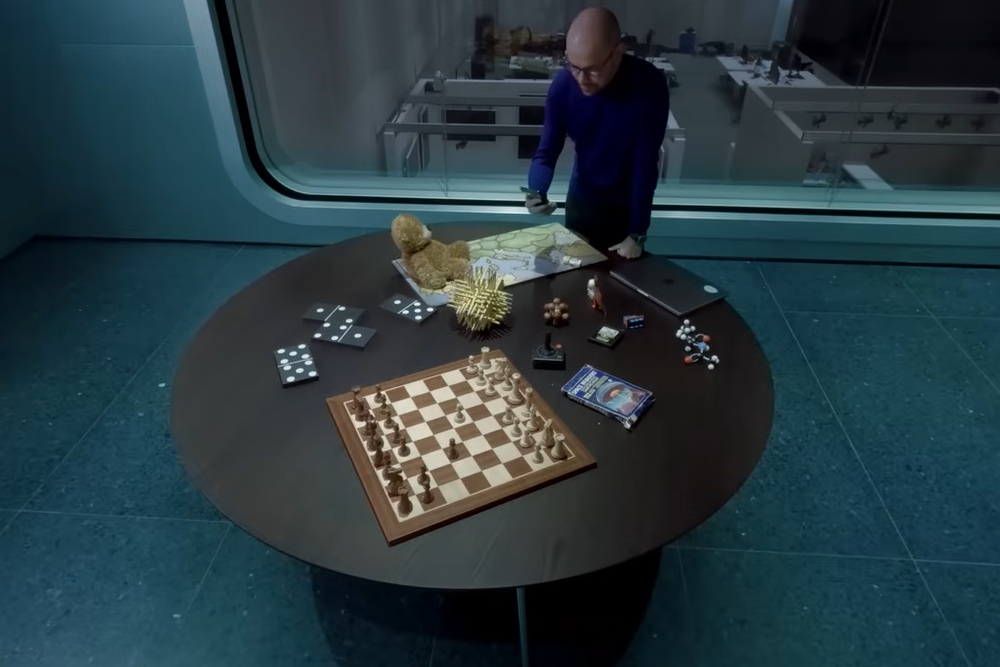
The story of DeepMind Technologies is a remarkable success story. In 2010, Demis Hassabis, Shane Legg, and Mustafa Suleyman founded the company in London and began to work intensively on artificial intelligence. As a first step, they examined how the human brain functions. They then modelled the structure of the human brain, developed learning algorithms, and constructed artificial neural networks in which the acquired knowledge could be stored. To make the thinking processes more flexible, they also developed “short-term memories.”
Investors and other high-tech companies soon took notice of the young enterprise. Among the backers were Elon Musk (Tesla, SpaceX), Peter Thiel (PayPal), Jaan Tallinn (Skype), Scott Banister (business angel), and Li Ka-shing (Horizon Ventures). In a bidding competition in 2014, Google LLC outmaneuvered Mark Zuckerberg’s Facebook and acquired DeepMind Technologies for an estimated purchase price of 400 million USD.
That same year, the Cambridge Computer Laboratory named DeepMind “Company of the Year.”
To test their ideas, DeepMind engaged with a wide range of strategy games and developed programs capable of learning these games from scratch and improving their skills all the way to perfection.
In 2017, DeepMind attracted major attention with its development of AlphaGo and AlphaGo Zero. Go had long been considered a particularly difficult challenge for computer programs, as the number of stones and possible positions is far greater than in chess. Yet AlphaGo defeated the multiple European champion Fan Hui as early as 2015, and in 2017 went on to beat the world’s best Go player, Lee Sedol, in match play.
In the next step, the DeepMind developers turned to chess. Here, the battle between humans and machines had already been decided in favor of the chess programs for some time. World Champion Kasparov had lost to IBM’s Deep Blue in 1997, and World Champion Kramnik was defeated by the software program Deep Fritz in 2006. By then, the open-source engine Stockfish had established itself as the strongest chess program and was chosen as the opponent for DeepMind. In a series of matches, the world’s best software engine was crushed by AlphaZero.
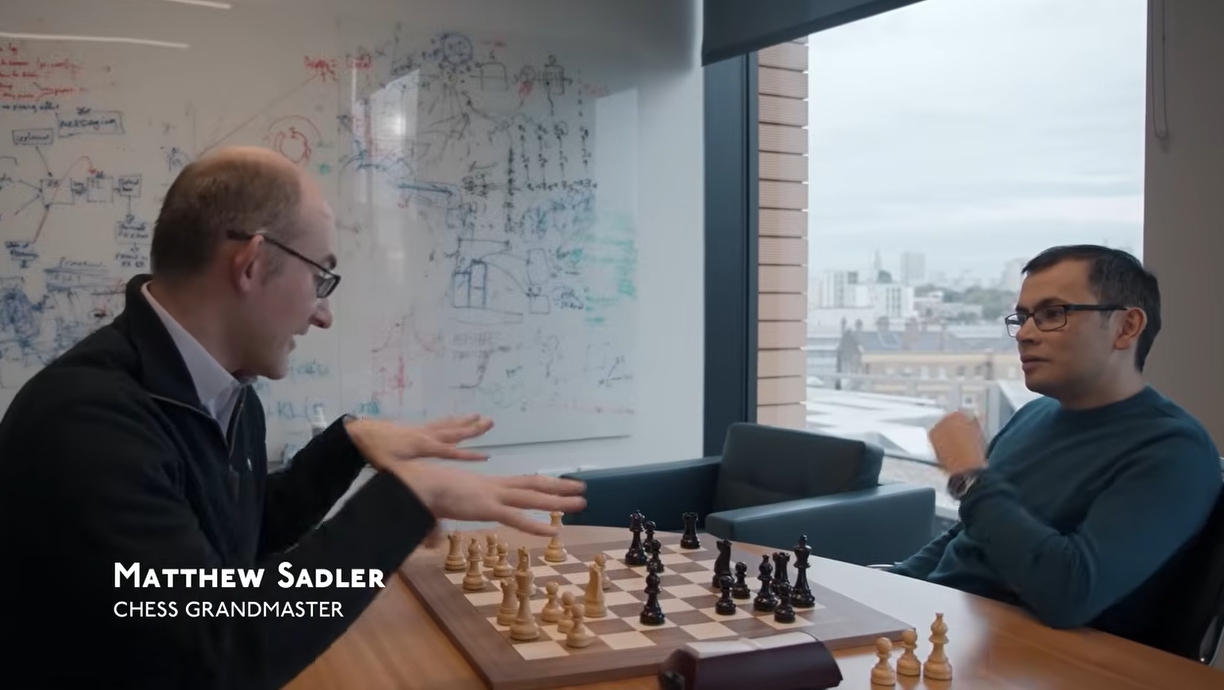
Demis Hassabis in conversation with GM Matthew Sadler
What is particularly astonishing is that the DeepMind programs start from zero. They are given the rules of the game in question as a basis and then begin to learn the game using the so-called Monte Carlo method. Monte Carlo method means that the program plays an enormous number of games against itself at high speed, analyzes which calculations or strategies give it an advantage, and stores these insights in its neural network. As a subsidiary of Google, DeepMind was able to draw on the company’s vast server farms for its developments and thus play unimaginably large numbers of games in a very short time.
The Monte Carlo method was well known among game programmers and had already been used in the development of chess engines. During a game, the engine plays rapid self-play games as part of its thinking process, tries out different possibilities, and then chooses the move that yields the best result or the highest winning probability. For a long time, however, the method was somewhat underestimated by chess programmers compared to the traditional alpha-beta search. That has changed in the meantime.
Of course, DeepMind Technologies did not set out to create programs that simply win games. The aim is far greater. Working with games served only to refine their methods.
The program AlphaTensor (2022), for example, focuses on optimizing matrix multiplication. AlphaEvolve (2025) is a KI agent developed as a programming tool. Specific tasks are formulated as algorithms and then optimized by AlphaEvolve in iterative steps using large language models (LLMs) such as Gemini.
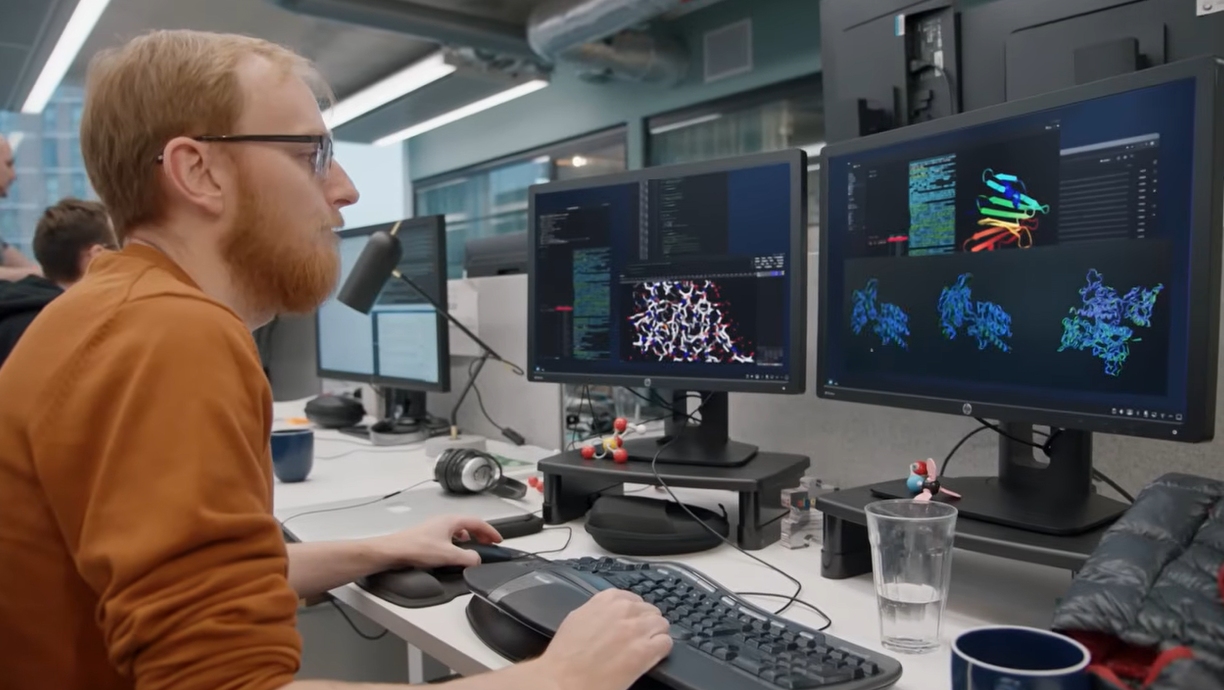
With AlphaFold and AlphaFold2, DeepMind succeeded in greatly improving predictions of protein folding, to the point that this problem is now considered solved in structural biology. Many regard AlphaFold as the most important achievement in AI development to date. Beyond that, DeepMind has developed a number of other groundbreaking algorithms that are applied to a wide range of tasks.

Demis Hassabis
For his research, Demis Hassabis was awarded the 2024 Nobel Prize in Chemistry together with John Jumper.
A feature-length documentary about the development of DeepMind was shown at the Tribeca Festival in New York and is now available on YouTube.
