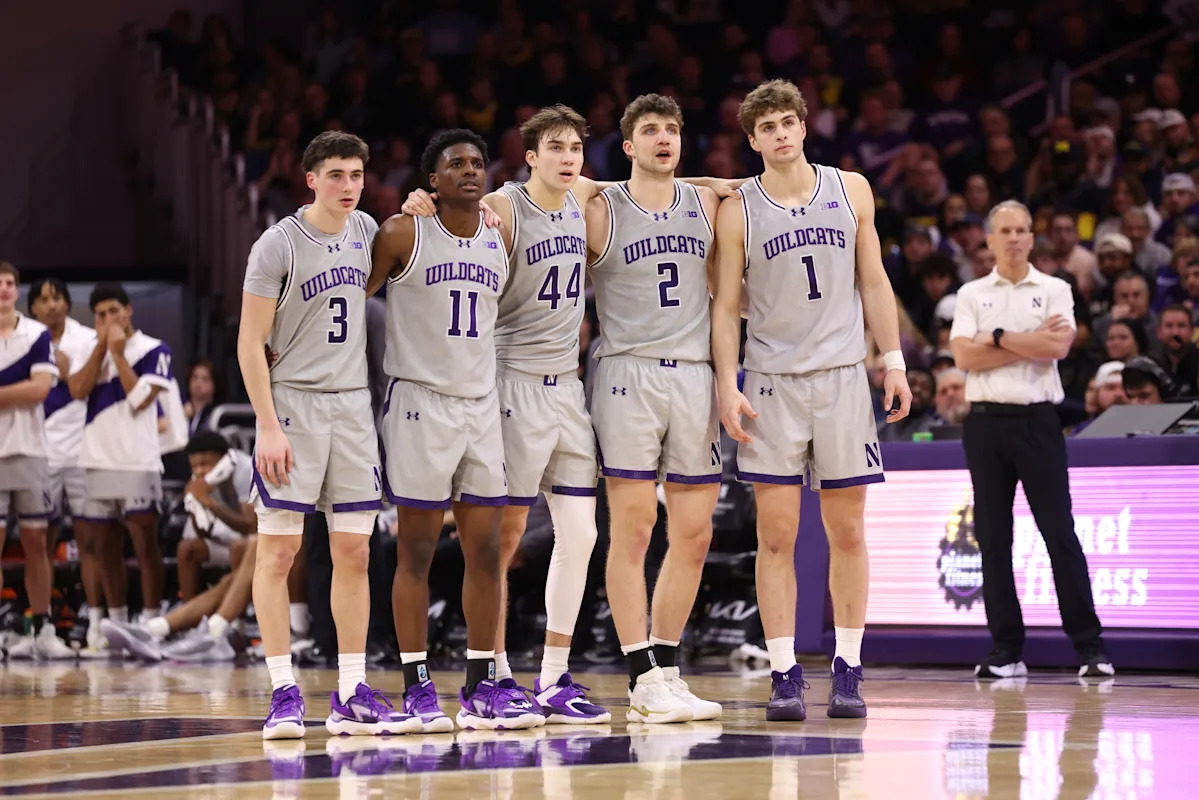
For the first time in nearly three weeks, the Northwestern Wildcats left a court victorious. Their 78-74 victory over Maryland on Wednesday night snapped a five-game losing streak and gave a desperate team something to build on. Nobody is going to frame this box score, but a win is a win for a team that needed one badly.
That said, with four games still to go and a Big Ten tournament still to be played, here are three takeaways from a night that featured a star’s return to form, a long-awaited breakout, and enough late-game tension to remind everyone why this team is still searching for consistency late in this season.
Advertisement
1. Nick Martinelli looked like himself again, but the closing issues remain
For the first time in a while, Nick Martinelli played like the player Northwestern fans know and love. His 29 points came on 9-of-17 shooting, a welcome sight after a rough stretch where efficiency had abandoned him. He knocked down three 3-pointers, grabbed nine rebounds, and generally carried the offensive load the way this team needs him to. In a game where every possession mattered, Martinelli’s return to form was the foundation of the Wildcats’ success.
But here is the complicating factor. The same issues that have haunted Northwestern in close games resurfaced in the final minutes, and Martinelli was at the center of them.
Over the last four minutes of game action, Martinelli made one basket. He missed three others, committed two fouls and missed a free throw that could have provided valuable breathing room. If that wasn’t problematic enough, with the game still in the balance, Martinelli’s errant pass gave Maryland a chance to make it a one-possession game in the final seconds. The Terps fortunately did not capitalize, but the moment felt uncomfortably familiar, echoing a similar turnover against Rutgers that allowed the Scarlet Knights to force overtime and inevitably cost NU that game.
Advertisement
This pattern is clearly worth examining. Martinelli is this team’s best player and its most consistent scoring threat. Asking him to be less involved in the offense during critical moments is not the answer. But the way he is involved matters. When the game slows down in the final minutes, defenses key in on him, crowd his space and rightfully make everything difficult. When he is the one inbounding the ball, as he was late against Maryland, the risk of a costly mistake increases.
Northwestern had timeouts available in those final moments. Chris Collins chose not to use them. Maybe a dead-ball situation would have allowed the staff to design a cleaner entry pass. Maybe it would have put the ball in the hands of a better passer. What is clear is that putting Martinelli in a position to inbound against pressure is asking for trouble, and against better teams, that trouble has been the difference between a win and a loss.
The good news is that Martinelli is back to producing at a high level. The concern is that Northwestern still has not figured out how to close games efficiently with him as the focal point.
What does that mean next season when Martinelli isn’t even in the equation?
Advertisement
2. Jordan Clayton finally had his moment, and it might be the start of something
There have been signs all season that Jordan Clayton was capable of more. His numbers in Big Ten play hinted at it. His teammates talked about it. His coaches believed in it. But believing something and seeing it happen are two different things, and on Wednesday night, Clayton made believers out of everyone who watched.
Clayton’s 20-point performance was not just a career-high, but was the kind of game that changes how people think about a player. Clayton went 6-for-7 from three-point range, and the shots were not just made. They were as timely as they were confident — the kind of shots that shift momentum and energize a building.
When Maryland cut the lead to three in the second half, Clayton answered with a 3-pointer. When the UMD threatened again, he hit another. By the time the “JORDAN CLAYTON” chants started rolling through Welsh-Ryan Arena, the game had taken on a different feel. A tiny crowd suddenly sounded like a ferocious one. A player who had spent most of the season in a supporting role became the center of attention.
Advertisement
The underlying numbers make me think this might actually be sustainable. In Big Ten play, Clayton is now shooting 41% from the field and 40% from three-point range. That is not a small-sample fluke. That is real shooting ability. Combine that with his rebounding and his defensive effort, and there is a path toward Clayton becoming a legitimate difference maker in this rotation.
Clayton’s leadership has never been in question. He is a captain for a reason. But leadership without production can only take a player so far. Now Clayton has both, and if he can replicate even a scaled-down version of this performance on a regular basis, Northwestern’s offense gains a dimension it has lacked all season.
The postgame press conference captured the moment perfectly. Clayton sat at the table with a smile that would not go away. He talked about the chants and said he tried not to smile on the court, but could not help it. That is what sports are supposed to feel like, and that is what a breakout is supposed to look like.
For one night at least, Jordan Clayton gave Northwestern fans a reason to believe the future might be brighter than the gloomy record suggests.
Advertisement
3. Forced turnovers only matter if you convert them
Let this sink in for a moment. Northwestern forced 15 turnovers against Maryland. The Wildcats recorded 12 steals. That is a defensive performance that should lead to a comfortable win.
Instead, it led to just 17 points.
Put another way, Northwestern generated 15 extra possessions through turnovers and turned them into just over one point per possession. Extrapolating those numbers to two points per turnover forced, the Wildcats left at least 13 theoretical points on the board. In a game decided by just four, those missing points would have been really nice.
Advertisement
This is not a new issue. It has been a recurring theme throughout the season. Northwestern’s defense is active enough to create chaos (sometimes), but the offense has not consistently capitalized on the opportunities that chaos creates. Transition opportunities turn into half-court possessions. Loose balls go unrecovered. Fast breaks stall out or end in contested shots.
Against Maryland, the problem was masked by a win. But the underlying inefficiency remains. A better team will make Northwestern pay for leaving points on the table. A tournament-caliber opponent will turn those 12 steals into 25 or 30 points and turn a close game into a comfortable margin. We saw that get proven in pretty much every loss this month.
The solution is simply about recognition and execution. When a steal happens, the immediate reaction should be to push the ball and attack before the defense can set. Too often, Northwestern’s players pull the ball out or hesitate, allowing the opposition to recover. Those split seconds matter, and are the difference between an easy bucket and a grind-it-out possession.
Chris Collins has talked about this all season, and the message is clearly being delivered. At some point, though, it needs to be received on the court. If not, you have to start questioning whether the right things are being said at the top.
Advertisement
One more thing while we are here:
Andre Mills scored 39 points against Northwestern on Wednesday night. He made 12 of 17 shots and 6 of 9 from 3-point range. He set a career high and looked unstoppable doing it.
Looking at the Wildcats’ games before this one, what do we see?
L.J. Cason had a career night off the bench against Northwestern in the Michigan game. Bennett Stirtz did too at Iowa, dropping what looked like an effortless 36 points.
Opposing guards keep setting personal records against this defense, and at some point, that has to stop being a coincidence. Containing hot guards has been a persistent weakness, and since that looks like it won’t change, any wins in this final stretch of the season will feel harder than they should have been.
Advertisement
Either way, the ‘Cats will take the W. They needed it too badly to be picky about how it looked. But if this team wants to finish the season strong and build something for next year, the lessons from this game need to stick. Martinelli needs help in the clutch, especially considering he won’t be on this team next season. Clayton needs to keep shooting. And a higher percentage of turnovers need to be converted into tangible opportunities.
On to Indiana…
