There were a number of lessons to take away from the Phillies’ failure to haul in Bo Bichette to a seven-year, $200 million contract last week.
Like with most teams, the luxury tax remains a self-imposed impediment to the Phils’ willingness to spend. The Dodgers and Mets are the two teams who will hold their noses to overpay players obscenely large average annual values in order to land them, eating tens of millions of luxury tax dollars in the process. They are willing to give away opt-outs throughout these short-term contracts, ceding much of the leverage to the player.
Advertisement
It’s clear if the Phillies want to play in the same free agency pool as Los Angeles and New York, they must re-evaluate their belief that young free agents prefer long-term security and big money deals. And if they continue to use the luxury tax as a soft salary cap, as most teams do, they will lose out on free agents to those two teams.
Maybe that’s a price they’re willing not to pay, but in the wake of the Bichette decision, it feels antiquated.
The price a team pays for needing to build out a roster through big-money free agent deals is sometimes unpalatable, but that is the bed Dave Dombrowski and the Phillies had to sleep in following the collapse of the 2007-2011 Phillies mini-dynasty that left the team with a roster of aging players and a farm system that offered little in terms of ready-to-play, impact talent.
Hopes were high that as the team traded away Cole Hamels, Chase Utley, Jimmy Rollins and others for prospects that the rebuild of 2013-2017 would be quick and fill the roster with young stars. Instead, the Phils’ return to respectability did not come because Scotty Jetpax, Dom Brown, Nick Martinez or Vince Velasquez took the team to the next level. It came because of free agent contracts to Bryce Harper, Nick Castellanos, Kyle Schwarber and others.
Advertisement
Some of those deals are showing their age. They will likely be paying Castellanos $20 million to play somewhere else in 2026. Taijuan Walker’s $18 million salary is a tad pricey for a No. 6 starter/swing man. One wonders if the Phillies would think twice about Trea Turner’s 11-year, $300 million contract if they could do it again, and one can assume most would love a do-over of Aaron Nola’s seven-year, $172 million contract that still has another six years left on it. Add to that Kyle Schwarber’s five year, $150 million deal, J.T. Realmuto’s three-year, $45 million and, of course, Bryce Harper’s 13-year, $330 million contract, and you’ve got an inflexible roster with a high price tag.
To be fair, some of those guys are still playing at a very high level. Whether Harper remains “elite” or not, one cannot argue his contract hasn’t been outstanding for the organization. After a rocky first season, Turner has given the Phillies what they hoped for at shortstop, and Schwarber is an elite power hitter. But all those deals helped butt Dombrowski up against the fourth luxury tax, and outside of re-signing Schwarber and Realmuto, the Phillies’ biggest expenditure on a position player in free agency this off-season was outfielder Adolis Garcia. Contract extensions may also come soon for Jesus Luzardo and Jhoan Duran at some point. More money will be spent.
The front office cannot un-spend all the cash they are committed to spending, so in order to keep the window of contention open, the Phillies must do what they were unable to do in 2012 when the 2008 championship core began to age and it all fall apart.
They need to actually produce impact talent from their minor league system. They need to produce the next generation of stars.
Advertisement
Even after all the investments the Phils have made since Dombrowski took over, Philadelphia’s farm system is not considered among the top half of the league. Fangraphs ranks it 20th, and ESPN and MLB Pipeline had it 21st in August of last year. There are few highly touted prospects in the minors with the exception of their Big 3: Andrew Painter, Justin Crawford and Aidan Miller.
Can they hit on all three?
They will certainly get their chances. This time a year ago, Phils fans were salivating at the notion of Painter and his electric stuff in the starting rotation, even coming off of Tommy John surgery. A disappointing season in AAA has taken some of the shine off his arrival, and no one is sure if he will be able to adequately replace Ranger Suarez’ absence in the rotation (it would be great if Nola could step up into the Ranger role and save Painter the need to do it.) If Painter doesn’t turn out to be a top-of-the-rotation starter sooner rather than later, it will be a profound disappointment.
Sorry, kid. You were presented to us as an ace in the making. Those are the expectations, if not right away, then soon.
Advertisement
Crawford’s numbers in the minors have always been good. It makes sense that the Phillies are handing him the everyday job in center field. He’ll hit No. 9 in the lineup, and hopefully won’t be needed to do more than get his feet wet and contribute from time to time in ‘26. He has his detractors, but with an outfield that projects to be one of the weakest in MLB this season, Crawford turning into a quality big league player would go a long way to solidifying what appears to be a real weakness, both in 2026 and beyond.
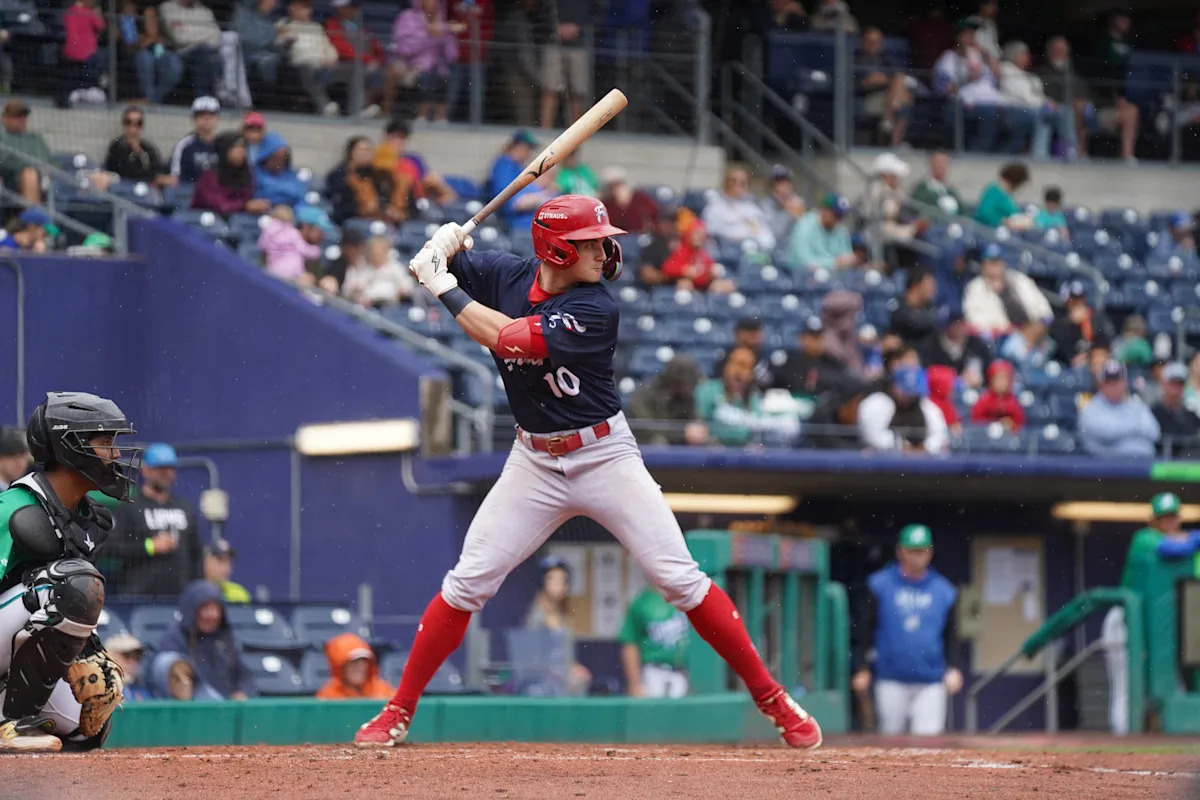
Then, there’s Miller. He’s the top prospect in the organization right now, a power-hitting shortstop who got off to a very rough start in AA Reading but came on over the final six weeks of the season, finishing with a flourish in AAA Lehigh in the final week. He’ll start there in 2026, and all eyes will be on whether he stays at shortstop or transitions to another spot on the diamond in an effort to get him to the big leagues quicker.
Like Painter, they need Miller to turn into a star. He needs to be better than Rhys Hoskins, Alec Bohm or Bryson Stott became. He needs to be a Harper/Schwarber/Turner type player. Will that happen right away? Of course not, but at some point in the next 2-3 years.
If you think that’s unreasonable, it’s not. The Phillies drafted and developed three superstar position players in Utley, Howard and Rollins that became the backbone of a championship team. There are prospects playing for other teams who made a major impact in the Majors right away. First round draft picks are supposed to be great. It’s why they were drafted first. As the existing core ages, these younger players need to make up for what will certainly be a dip in production.
Advertisement
The Phillies need the farm system to hit because, even if they wanted to spend the money, there are no high impact free agents hitting the market in the next two years, as noted by ESPN’s Jeff Passan last week.
The best of next winter: Nico Hoerner, Jazz Chisholm Jr., Brandon Lowe, Daulton Varsho, Randy Arozarena, Seiya Suzuki, Trent Grisham, Ha-Seong Kim, J.P. Crawford and Gleyber Torres. The top following the 2027 season: Jeremy Pena, William Contreras, Steven Kwan, Adley Rutschman, Isaac Paredes, Munetaka Murakami, Luis Robert Jr. and Freddie Freeman, who will be 38.
Sure, Bichette could opt-out of his Mets deal after the first year, but do you really see the Phillies re-engaging with him and his agent after what transpired last week? Given the paltry list of position players above, any help supplementing the roster, at least from an offensive standpoint, must come from within.
Outside of the Big 3, the player development side of the organization needs to do a better job getting players to be ready to play at a high level in the big leagues. Some organizations do a phenomenal job of churning out high-quality players year after year. The Dodgers almost never draft in the first round and always pick at the end of every round, and yet they have a top-five farm system in baseball. It’s not luck.
Last year’s first round pick for the Phils, pitcher Gage Wood, will start in high-A ball, although there are thoughts he could be a quick riser and potentially pitch in the bullpen this season. Aroon Escobar and Dante Nori are 21-year-olds in AA Reading this season. Neither projects as an All Star caliber player in the Majors, but much development remains. Gabriel Rincones Jr. is the likeliest to see time in the big leagues this season, with a powerful left-handed swing that murders right-handers and crumbles against southpaws. And then there is their big international signing, 17-year-old Francisco Renteria, the No. 3 international prospect this year, who has drawn comparisons to Hall of Fame candidate Bobby Abreu.
Advertisement
No one is putting that kind of pressure on the kid, but Renteria is as good a raw talent that has come into the Phillies farm system in a long time.
The Phillies also need to continue to develop pitching. Cristopher Sanchez wasn’t drafted by the Phils, but he was developed by the team and has turned into one of the five best starters in the game. Ranger Suarez, who just signed with Red Sox, was born and raised in the Phils’ system. Aaron Nola, despite his faults a year ago, is a future Wall of Famer and, if he has another few productive seasons, could warrant Cooperstown conversation. There are success stories there, but after Painter and Gage, there is a lack of young starting pitching prospects in the system, with Moises Chace’s lost 2025 season putting a dent in his prospects.
If the only way the Phils are going to be able to put a playoff caliber team on the field is through free agency, they’re going to have to run their payroll north of $350 million in the coming years. That doesn’t seem sustainable. Dombrowski spent his first year in Philadelphia diagnosing the problems and coming up with solutions to fixing them.
It’s time for some results.
