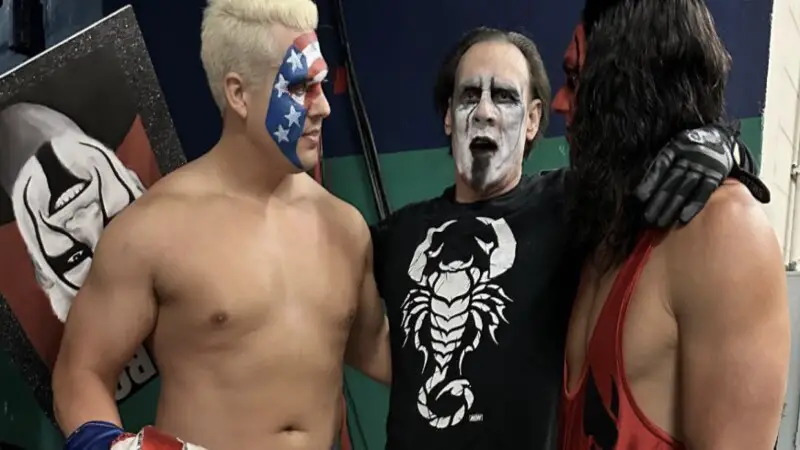
Second-generation wrestlers often arrive with immediate expectations attached to their last name. Fans tend to assume a fast track to television, flashy debuts, and instant pushes, especially when the parent is one of the most iconic figures the industry has ever produced. Steven Borden’s path so far suggests AEW is deliberately resisting that playbook, even as interest around his future continues to grow.
As the son of Sting, Borden’s presence alone sparks speculation about when he might formally appear on AEW programming. He has already worked independent shows and AEW dark matches, quietly building reps rather than hype. That slower pace, according to Tony Khan, is very much by design.
During an appearance on the “Battleground” podcast, Khan framed Borden as a long-term investment rather than an immediate attraction. “Steven still has never been on AEW TV, but he’s somebody we’re developing, and I have so much respect for Steven,” Khan explained. “He’s a rising young wrestler, he played college football at Kentucky, I followed his football career and now I’m proud to say we’re working on developing him as a pro wrestler for AEW.”
Khan’s comments made it clear that Borden’s lineage is not being treated as a shortcut. “One of the all-time greats, somebody who was undefeated in AEW is Sting, and absolutely Steven in developing him for the future is a huge priority to me and everyone in AEW,” he added, stressing development over debut timing.
That philosophy even extends to presentation. Fans who have seen Borden’s dark matches noticed him using Sting’s classic WCW-era “Turbo Charged” entrance theme. Khan revealed that decision was intentional and personal. “I wanted to use that song, it was my idea,” he said. “It’s a song that was in a library and we made a great deal to get a certain number of plays. We haven’t used it on air yet, but we have a deal to use Turbo Charged. I love licensing great music, and that’s one of my favorite songs from my childhood.” The choice nods to legacy without rushing it onto national television.
Behind the scenes, Borden’s training has been anything but limited. While All Elite Wrestling does not operate a centralized performance center, Khan outlined a decentralized system built around veteran-led schools. “We have training facilities and we’ve had Steven stay for extended periods of time,” Khan noted, citing trainers such as Pat Buck in New York, QT Marshall in Georgia, and Dustin Rhodes in Texas. Borden, he said, has spent significant time training in Texas while also working at the Nightmare Factory.
Khan emphasized that live experience remains the priority. Dark matches, travel, and repetition in front of real crowds are viewed as the most valuable tools for growth. That approach explains why Borden’s learning curve has unfolded mostly away from televised AEW shows, even as curiosity about him continues to rise.
The broader takeaway reflects AEW’s evolving stance on development. Rather than rushing recognizable names onto television, the company appears more comfortable letting prospects mature off-camera, even when the spotlight would be easy to justify.
In a wrestling landscape increasingly shaped by instant visibility, Borden’s situation highlights a quieter countertrend. AEW seems willing to trade short-term buzz for long-term readiness, betting that patience will ultimately matter more than pedigree alone.
