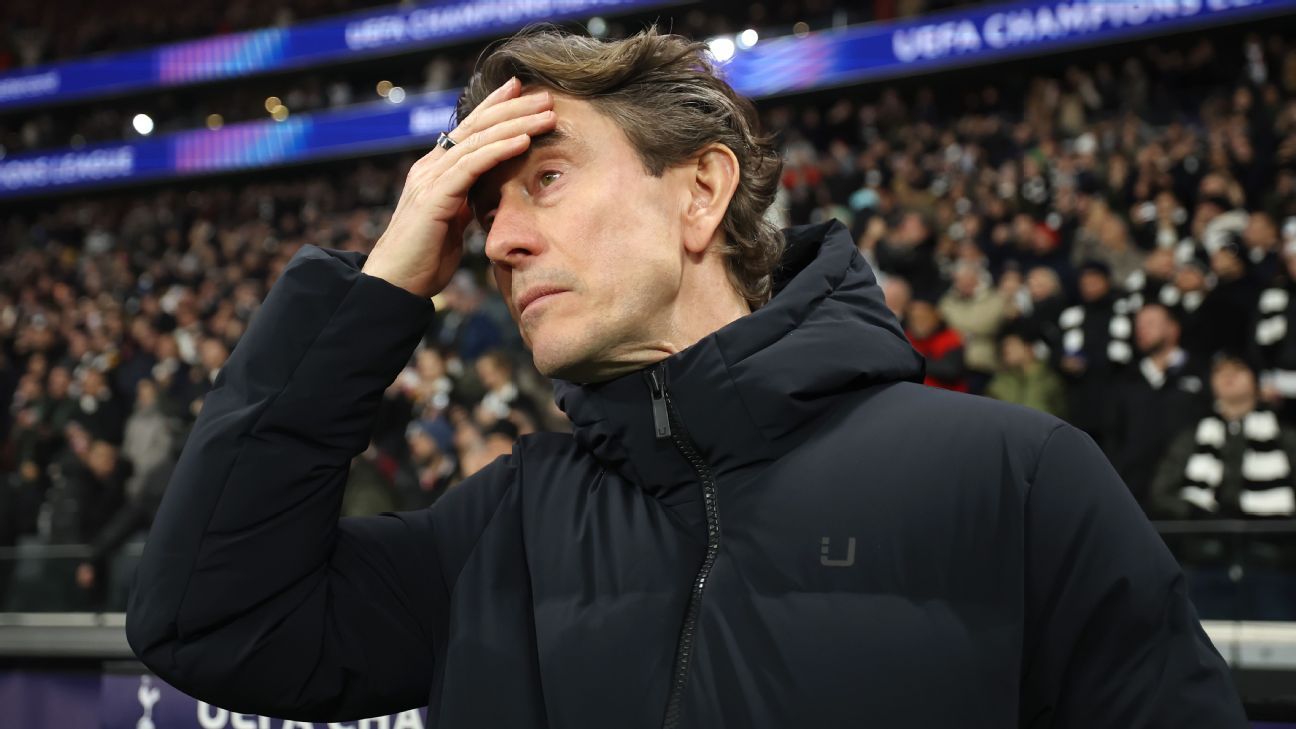
At the start of Tottenham Hotspur‘s preseason tour in Hong Kong last summer, Thomas Frank went for his customary early-morning run, a ritual from his days as Brentford manager. But shortly after leaving the Kerry Hotel to take in the views of Victoria Harbour, Frank was quickly recognised by local fans, many of whom had lined the entrances and lobby areas of the Premier League club’s luxurious base each day of their stay.
Before drowning in requests for selfies and autographs, he made it back to the hotel where club officials used it as an example of the step up he had made to Spurs: the scrutiny and exposure would be on another level to what he was used to. It was an adjustment Frank was never able to make.
– Tottenham supporters’ trust: We are fighting relegation
– Why Daniel Levy left Tottenham after 25 years as chairman
– Ranked: The top 25 manager jobs in soccer, from best to worst
The 52-year-old was sacked as Spurs head coach on Wednesday having never appeared the right fit almost from the outset. He departs after eight months, amassing 13 wins from 38 games and with Spurs 16th in the Premier League table. (They have zero league wins so far in 2026.) Spurs are safely through to the UEFA Champions League round-of-16 after a solid league phase campaign, but the club could not afford to hope history repeats itself.
Last season, they neglected their domestic season in pursuit of European glory. It ended with a UEFA Europa League triumph — their first trophy in 17 years — and the departure of Ange Postecoglou as head coach. If they compartmentalised the campaign this time around — in the hope of a (let’s be honest, highly unlikely) Champions League triumph — it could end in relegation.
Spurs are just five points above the bottom three having won just two of their past 17 games, and something had to give. But what went wrong, and who is to blame?
Frank made a promising start. Spurs were painfully porous under Postecoglou and Frank did stabilise Tottenham’s back line, racking up five clean sheets in his opening eight matches across all competitions, including a 2-0 win at Manchester City.
There was tactical flexibility — which felt a blessed relief after Postecoglou’s dogma — right from the beginning. Spurs were 2-0 up with five minutes to play against an undercooked Paris Saint-Germain in August’s UEFA Super Cup, before the European champions struck twice to force a penalty shootout that they won 4-3.
It was a collapse reminiscent of the worst of Spurs, an abrupt introduction to the club Frank had taken over. But it was only when the club’s Champions League campaign began in earnest that Spurs began to struggle. That flexibility gradually became a desperate scramble for answers.
The relentless schedule of playing three games in seven days for weeks would ultimately expose cracks everywhere: in Frank, the squad and the club itself.
Sources have told ESPN that friends living close to Frank in East Sheen, a south-west London suburb, had noticed the early-morning taxis taking him to Tottenham’s training ground every day were starting to drain a manager used to spending most midweeks without matches at Brentford. Sources at Tottenham’s training ground also told ESPN that players became surprised at the volume of work done on nullifying opponents in training, rather than focusing on developing their own style of play.
Discipline had also become an issue. Sources close to the dressing room have told ESPN that there was some concern over how he handled a difficult incident at the beginning of November in which Djed Spence and Micky van de Ven ignored Frank’s request to acknowledge the home support at the end of a dismal 1-0 defeat to Chelsea.
His lack of command over the dressing room was also thought to be a factor in a repeated refusal to publicly condemn Cristian Romero, despite the defender’s decision to criticise the club twice on social media over a perceived lack of investment and an injury crisis that left Spurs with roughly a dozen players unavailable for selection. Romero’s red card in Saturday’s 2-0 loss at Manchester United — his second of the campaign — was another rash moment which cost his team dearly. A four-game ban means he will not play again until mid-March.
Sources have told ESPN that there was a recognition both from Frank and within the club’s hierarchy that the squad lacked sufficient leadership. This was a motivating factor behind signing Conor Gallagher from Atlético Madrid in January and a failed attempt to bring in Andy Robertson from Liverpool.
Frank’s authority was also undermined by some questionable public statements. At his unveiling, Frank said: “One thing is 100% sure, we will lose football matches.” It was of course factually true and by itself not controversial, but some supporters compared it unfavourably with predecessors who talked about winning trophies and appeared to aim higher with their aspirations.
Frank explained on Monday that in addressing supporters through the media, “there needs to be the nice combo between reality and selling hope.” It was a balance he never got right.
1:50
Marcotti: Thomas Frank will be remembered over Arsenal cup nonsense
Gab Marcotti shares his thoughts on Thomas Frank’s ‘avoidable’ explanation over drinking from an Arsenal cup in Spurs’ game vs. Bournemouth.
His gaffe in holding an Arsenal-branded coffee cup before losing at AFC Bournemouth on Jan. 7 was again symptomatic of a head coach not used to the being alert to the optics of big-club management. Fans had never warmed to Frank and incidents like this, as trivial as they first appear, only widened the wedge between supporters and the team.
As early as Nov. 8, Frank’s substitutions were booed during the 2-2 draw with Manchester United. And yet, as those fans filed out of the ground, Spurs were third in the table.
But the football was dull. The team lacked confidence and conviction. And as the slide continued unabated, the dissent grew louder to the point where Tuesday’s 2-1 home defeat to Newcastle United was awful for all concerned.
Spurs fans sang “you’re getting sacked in the morning” at Frank, who had to endure the name of ex-Tottenham boss Mauricio Pochettino ringing out from the South Stand. The board had to act.
Major change at the top
It’s clear that Frank’s departure is not a panacea, with the club’s problems running far deeper than the head coach. Sources at the training ground have told ESPN that the club has a rudderless feel to it at present.
Daniel Levy, who left the club in September after 24 years as chairman, had his faults, but sources say he was always willing to listen and engage with staff. That engagement is missed by some members of staff who believe the restructured ownership are yet to present a compelling vision of the club’s future direction.
Spurs’ ownership is complicated. Current owners Enic Sports & Developments Holdings Ltd is a company owned by billionaire Joe Lewis which has an 86.58% stake in Tottenham. Lewis’s daughter Vivienne, his son Charles and grandson-in-law Nick Beucher — co-CEO of Tavistock Group, the Lewis family office and private investment company — have taken a more hands-on role. But the day-to-day running has been passed to chief executive Vinai Venkatesham and sporting director Johan Lange.
Sources close to the appointment process have told ESPN that Lange was instrumental in Frank succeeding Postecoglou. Fabio Paratici was rehired as co-sporting director in October, only for the club to confirm his departure in January as Lange continued to stick by Frank, who he has known for around 20 years. Venkatesham is overhauling the club’s infrastructure and seeking to drive higher standards, but those changes will take time. Meanwhile, sources say some at the club feel like they are treading water. One source suggested Beucher has attended first-team training sessions and spoken with players.
The dissonance around the club’s direction also meant that they struggled to back Frank in the transfer market. Failed moves for Morgan Gibbs-White of Nottingham Forest and Eberechi Eze, who instead joined Arsenal from Crystal Palace, complicated Frank’s effort to build a more dynamic side. Recruitment has long been an issue.
Injuries were also a major factor, with striker Dominic Solanke ruled out for several months while midfielders James Maddison and Dejan Kulusevski face battles to play again this season. Sources close to Frank have told ESPN that he believes the club’s medical department needs significant improvement.
Sources close to the hierarchy have told ESPN they recognise there is no quick fix. It is a key reason why they were reluctant for so long to part with Frank, who himself had privately acknowledged this season would be extremely difficult as the club sought to overhaul the squad and change a culture of underachievement which has held the club back.
But there is only so long that short-term results can be ignored. And if Spurs do indeed lack a coherent plan for the future, one possibility above all others sharpened minds: relegation.
And faced with that shocking prospect, the end for Frank became inevitable.
