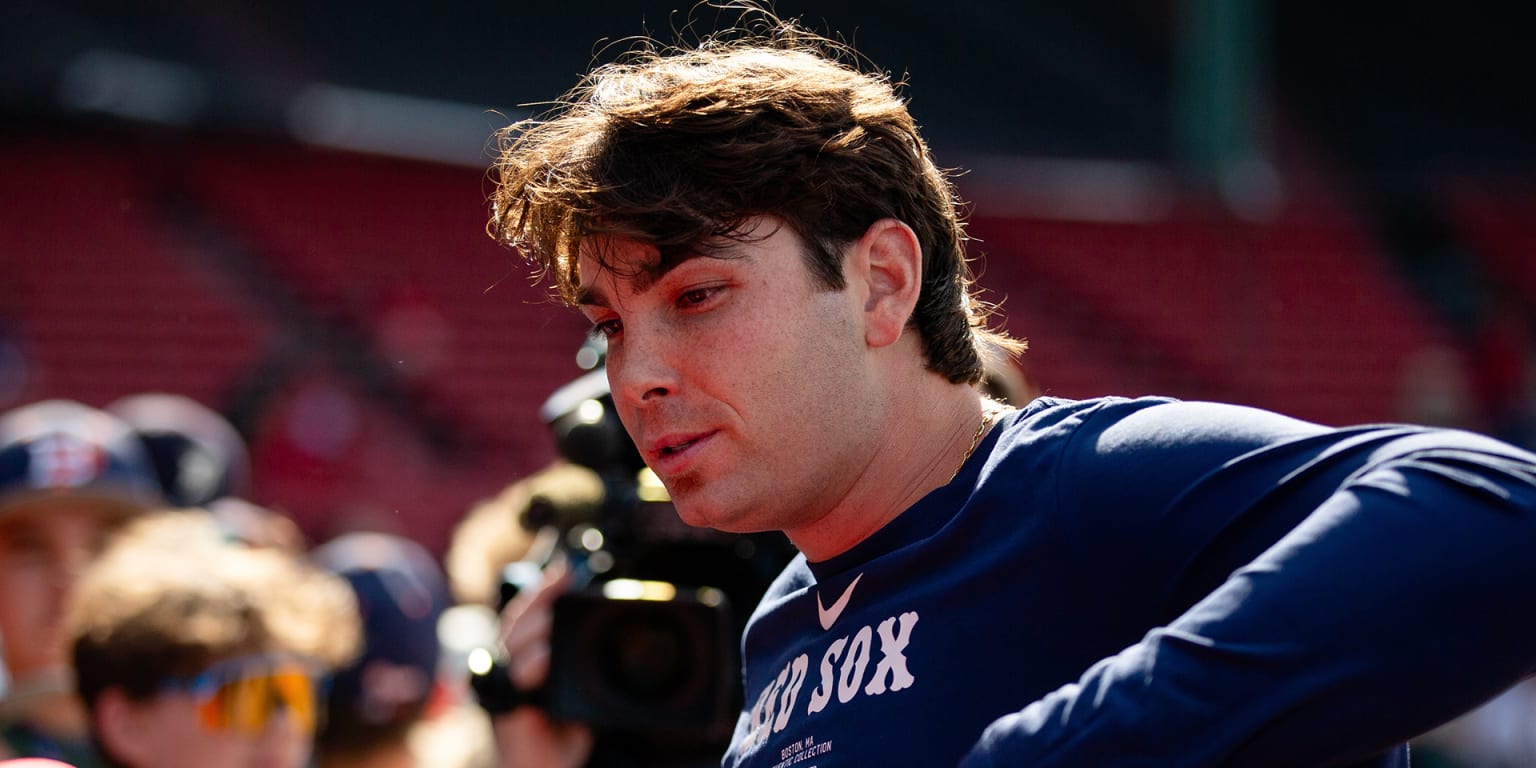
FORT MYERS, Fla. — When the Red Sox participate in their first full-squad workout on Sunday, Triston Casas will be doing his drills independently.
There is still catching up to do from the major injury (torn left patellar tendon) the big first baseman suffered in a jarring fall as he tried to beat out a grounder on May 2 of last season.
While Casas comes in as a forgotten man whose primary position (first base) has been taken by trade acquisition Willson Contreras, he still knows what he can do on a baseball field, and that’s what keeps him going as he goes through the final stages of his rehab.
“When I’m healthy, I fit on any team,” said Casas.
First, he needs to get back to full speed.
“I don’t see myself participating with the group, but I will be doing the same activities baseball-wise [as the rest of the team],” said Casas. “But as of right now, I haven’t had the clearance to get out there and participate with the group, but I will take ground balls and continue to hit at my own pace, without the structure of being in a team workout.”
It is a far different situation than the last three springs, when Casas came in as the team’s starting first baseman.
Now he fights not just to get his left knee back to 100 percent but to regain his place.
Health has betrayed him with major injuries the past two seasons, and Casas knows he can’t achieve what he needs to without his full foundation supporting his big frame.
But still, patience must be hard, right?
“No, not whatsoever,” said Casas. “This was a major injury and I’m a great player, and I don’t find any reason to rush this process. And whenever I feel ready to come back is when I am going to contribute best.”
In a different circumstance, DH could be a nice fallback for Casas.
But the Red Sox, with their bounty of riches in the outfield (Roman Anthony, Jarren Duran, Ceddanne Rafalea and Wilyer Abreu), could need that spot to deploy whichever player can’t fit in the field on a given day.
And that’s without even mentioning Masataka Yoshida, who is best off as a DH and also comes into the season with uncertainty about his playing time.
At Fenway Fest in January, Casas said that medical professionals told him his injury typically takes a year for a full recovery.
That would put him ready to play baseball again right around May 1.
“It’s progressing well, and I’m meeting all the benchmarks that I am supposed to be on the right timetable currently,” said Casas. “So everything’s pointing in the right direction, and I’m feeling great in my progression.”
Considering that, at least on paper, the Red Sox lack power, the re-emergence of Casas could be intriguing given that hitting the baseball over the fence is his strength.
He truly believes he will again get to show off that raw power. It’s just a matter of time, he thinks. But he can’t be worried about extraneous factors such as a roster logjam.
In baseball, things are always fluid. Casas, Boston’s first-round pick in the 2018 Draft and a third-place finisher in the 2023 American League Rookie of the Year Award voting, hasn’t lost an ounce of faith in himself.
“Absolutely. This process has made me more confident than any hit could have, and I’m really proud of the training staff, and the organization for how confident they’ve made me feel throughout this process,” Casas said. “They’ve been reassuring me and just making me feel comfortable and giving me all the tools that I need to be successful.”
Similarly to Casas, injuries have diminished Yoshida’s place on Boston’s depth chart. After his comeback from right shoulder surgery last July, the left-handed hitter had an unspectacular batting line of .266/.307/.388 with 11 doubles, four homers and 26 RBIs in 205 plate appearances.
But the plus side? In September, he had started to look like himself again, with an .837 OPS.
“I got my timing back, got my foot down, and I think that all came back to me at the end of the year,” said Yoshida.
The five-year, $90 million pact he signed to come to Boston in December 2022 has two years remaining.
“Now that I have three years under my belt, to be honest with you guys, these three years weren’t what I expected, so I’ll leave it at that,” Yoshida said.
Could a trade be best for him?
“That’s not what I’m thinking about right now, just all my thinking right now is perform, play well, play hard. That’s what I’m thinking,” Yoshida said. “Back in Japan, trades don’t really happen that much, as often as here. So it’s something new. But if you trade somebody, both parties have to agree, so that’s going to be tough. It’s part of the business.”
