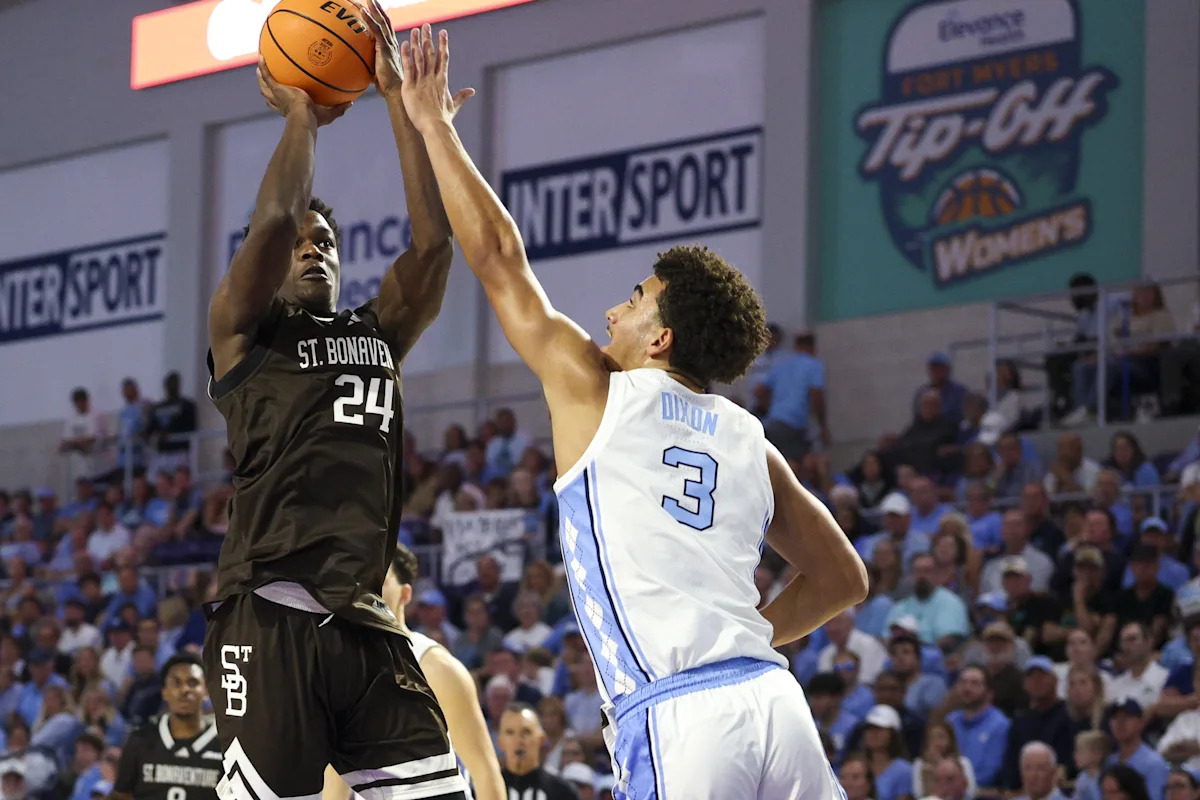
Last year’s Tar Heel men’s basketball team was small. How small? My son’s 2A high school started a larger line-up at every position. No, they weren’t nearly as skilled — although the big man does play professionally over in Europe now in one of the lower-level leagues. Reportedly, UNC’s NIL budget for this team grew from $4 million last season to $14 million. Guess what also grew? UNC’s size. As it turns out, being able to afford bigger basketball players who are just as fast and skilled as smaller basketball players creates a much better basketball team.
If nothing else, Belichick’s demands for a competitive NIL fund for football, combined with UNC basketball getting abused in the paint last season, may have forced UNC’s boosters and athletic department to an important realization. Jerseys in the rafters can get a discount on a basketball player or two, but not an entire roster, and especially not the positions in shorter supply and high demand, like quality big men. Players like Henry Veesaar and Caleb Wilson.
Advertisement
Yes, the schedule to start this season has been less challenging than last season’s, although it hasn’t been a cake walk by any means. Still…
Through 13 games last season, UNC allowed 79.4 points per game. Kansas, Michigan State, Alabama, and Florida all netted 90 or more, although one of those included an overtime. Auburn scored 85. So did Campbell. Elon put up 75. By game 13, UNC clearly wasn’t going to be much of a defensive challenge, especially against P4 competition.
Through 13 games this season, UNC has allowed 63.5 points per game. No team has scored better than 75 against the Tar Heels. The last time a UNC team started a season allowing 75 points or fewer to its first 13 opponents, George Michael, Madonna, Wham!, and Chaka Khan were topping the musical charts. Out of Africa and Prizzi’s Honor were dominating the Academy Awards. I was nervously waiting to hear back from UNC Admissions. That would be Dean Smith’s 1985-1986 team.
Last year’s team, over the course of the season, allowed a 3-point percentage of 34% and effective field goal percentage of 50%.
Advertisement
This year’s so far: 28% and 41%, respectively.
No, those percentages likely will not hold up through conference play. Kansas and Michigan State both hit threes at nearly a 50% clip with an effective field goal percentage of 55%. However, that was without Seth Trimble. With Trimble on the court against an Ohio State team that boasts one guard hitting 44% from three on the year and another at 38%, the two Buckeye sharpshooters were only good for 20% from three with an eFG of 43%.
Which raises this point: UNC’s defense has been this good despite missing its best perimeter defender for nine of its first 13 games.
Which raises another point: given (a) the only two returning players from last year team were Seth and James Brown, and given (b) that Brown barely plays and Trimble was out, these defensive results have been crafted by a bunch of guys entirely new to each other, and in the cases of Caleb Wilson and Derek Dixon, entirely new to the college game.
Advertisement
Frankly, that’s remarkable. It’s a testament to the kinds of players Hubert Davis and Jim Tanner brought into the program. It’s a testament to the quality of coaching the players have bought into. And yes, it’s a testament to the talent level an NIL budget of $14 million — versus $4 million — can attract.
Some of the more number-oriented posters here (and you know who you are), feel free to lend your considerable wisdom to this topic. Happy Holidays, and Go Heels.
