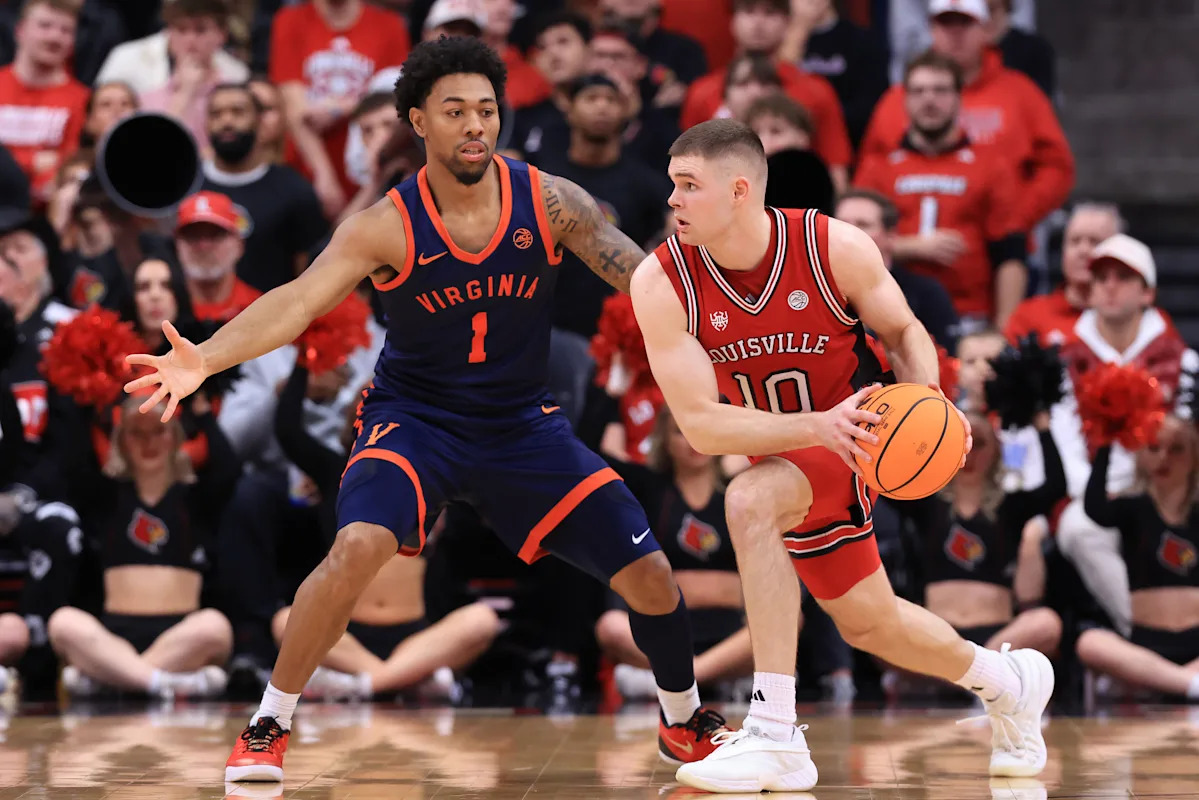
The Virginia Cavaliers men’s basketball team is throwing gas right now.
On Tuesday night, the ‘Hoos put on a complete nine-inning performance against Louisville Cardinals, one of the darlings of the national media entering the 2025-26 season. It’s worth noting that the Cardinals’ star freshman Mikel Brown – a consensus top-10 prospect in the 2026 NBA Draft – continued to sit out due to injury. Louisville has been on a bit of a struggle bus since he went out.
Advertisement
That shouldn’t discredit how impressive a win UVA picked up against the Cards. Particularly on the defensive side of the ball, the ‘Hoos continued their trend of improved play.
Louisville scored a mere 105.8 points per possession on Tuesday. That’s the team’s fourth-worst offensive performance this season. The Cardinals’ 43.3% effective field goal percentage was the worst of their 17 games so far. Former Wahoo Isaac McKneely was the biggest bright spot, scoring 23 points while shooting 5-for-14 (35.7%) from three.
The Cavaliers blocked nine shots – with four from Johann Gruenloh and three from Ugonna Onyenso. Louisville shot 48.3% from two-point range and just 26.3% from three as UVA’s perimeter defense, while stretched by McKneely and the Cards’ shooters, held up.
Since the start of ACC play, this Virginia defense has been on a different level. Per Bart Torvik, over that stretch, the ‘Hoos are:
Advertisement
-
1st nationally in adjusted defensive efficiency (87.4)
-
2nd in effective FG% defense (40.1)
-
9th in three-point shooting defense (24.4%)
On the season, the Cavaliers are:
-
16th in adjusted defensive efficiency (96.6)
-
4th in effective FG% defense (43.3)
-
10th in three-point shooting defense (28.6%)
-
2nd in block rate (18.1%)
The jump over the last month on defense has been tangible. Through non-conference play, the Wahoo defense was 60th in the country in defensive efficiency per Torvik. For that number to have risen to 16th in five games is impressive.
The nature of adjusted defensive efficiency is that it accounts for strength of schedule and, subsequently, strength (and weakness) of opposing offenses. Virginia has not merely been beating up on bad offenses. A few recent games have been against mediocre-to-bad ones – Virginia Tech (No. 87 offense), Stanford (No. 97) and Cal (No. 107 offense) are hardly word-beaters. Louisville (No. 11) and N.C. State (No. 26) aren’t slouches. UVA held all five of those teams to fewer than 1.0 points per possession.
The defense is content filtering opponents into Onyenso and Gruenloh in the paint. Shot blocking – like it was against Louisville – has been the backbone of the UVA defense this entire season.
Advertisement
“It’s huge,” Odom said after the win versus Louisville. “Teams can get inside of your defense and near the rim. A lot of the times, the metrics tell you, those are usually baskets or fouls. So, when you have guys back there who can protect the rim and can do so without fouling, it can certainly be a weapon for your defense.”
Onyenso and Gruenloh are elite rim protectors. Per KenPom, Onyenso is first in the country in block rate. Gruenloh is eighth. They are tied for 10th in the country in blocks per game, both at 2.6 per contest. The threat of those two in the paint has forced opponents to take worse shots. Virginia’s opponents’ average two-point shot attempt distance is 7.1 feet, per KenPom. That’s the 17th longest nationally and is a testament to teams’ fear of Onyenso and Gruenloh.
But the recent improvement of this UVA defense has gone beyond their impact around the rim. That has been there the entire season and, while it remains the fundamental strength of the Virginia defense
To simplify a complex concept: the team is playing better team defense, especially on the perimeter. Malik Thomas in particular has made significant strides as a team defender. He looks far less lost in rotations and has been more comfortable guarding on-ball than he was for stretches early in the season.
Advertisement
Ryan Odom and his staff are also employing new, and more diverse, defensive tactics as the personnel gets more comfortable playing together. Virginia doubles in the post occasionally – and did it effectively a few times versus Louisville – and has varied its ball screen coverage some as well. Those change-ups make the defense less predictable and can smooth over rough patches or individual limitations.
Astute observers will point out that this massive jump on defense coincided with Jacari White’s absence from the lineup. While he is an offensive spark plug off the bench, White leaves meat on the bone as a team defender. He consistently gets lost running through screens off-ball and when rotating within the flow of the defense.
He was punished early against the Cardinals, notably when he was guarding their shooters off the ball. It’s not unreasonable that he’s adjusting to competing against power conference offenses – the Summit League, the conference White played in while at North Dakota State, is renowned for poor defense.
The push and pull of White’s defensive liability (for now) and his shooting and shot creation on the other end will be an interesting dynamic to watch play out as this season unfolds. The Virginia offense took a hit while he was out, shooting 30.9% from three without one of their flamethrowers in the backcourt. Can he find his niche within the defense, utilize his length and quick-twitch instincts as an on-ball defender, and at least be a net-neutral on defense?
Advertisement
If we’re identifying weak points in the Wahoo defense, backup power forward Devin Tillis (who’s also dealt with injury this season) is another question mark. Whereas White has the physical traits to be an above average defender, Tillis doesn’t have the same tools. He’s an undersized and static defender. He has offensive skills that make him a useful bench piece – when used correctly within the team offense. Pairing him with Onyenso, the most physically gifted player on the Wahoo roster, as a frontcourt pairing can erase some, but not all of Tillis’ defensive limitations.
Not every player will be a difference-making defender and it’s okay to have some net-negatives as long as they’re not complete liabilities. That is some of the benefit of having elite shot-blockers who can clean up messes on the inside.
There’s also something to the light press that Virginia employs. A brief look at the team’s pace metrics produces surprising results. Yes, UVA is playing a faster brand of offensive basketball, averaging 17.0 second offensive possessions according to KenPom (137th fastest in the country). That’s up from averaging 20.3 seconds per offensive possession (359th fastest) last season. But, on defense, the ‘Hoos are actually averaging possessions just 0.1 seconds quicker than last season. Their 18.5 second average is 351st in the country. Last year, Virginia’s 18.6 second mark was 350th.
While it rarely causes turnovers because the Cavaliers don’t trap, UVA’s press chews up precious seconds early in possessions. Shot-blockers limit good looks at the rim. Increasingly-quality perimeter defense extends possessions.
Advertisement
Can the Virginia defense be elite? Does it have top-10 potential? That’s to be determined. The elite on-ball defenders aren’t there. Chance Mallory heats up the ball well and can create turnovers. The centers more than do their part. How well this roster’s new pieces continue to meld and learn how Odom wants to play defense will determine the answers to those questions.
Defense was Virginia’s calling card for 15 years – it was their fast ball they relied on to win games and, for better and for worse, it was what they counted on in March. This version of UVA basketball counts on elite shooting, literal next-level talent and an analytically sound style of play. But being able to win in multiple ways still matters, especially in the win-or-go-home nature of March.
The UVA defense is becoming very good with the right pieces to play the way Odom wants to. There might not be those elite perimeter stoppers or a lockdown forward that Wahoo fans are accustomed to being requisite to play elite defense. And it may be susceptible to opposing individual talent being better.
But the way this defense is performing right now suggests UVA basketball might have gotten its fast ball back – they just changed the grip.
