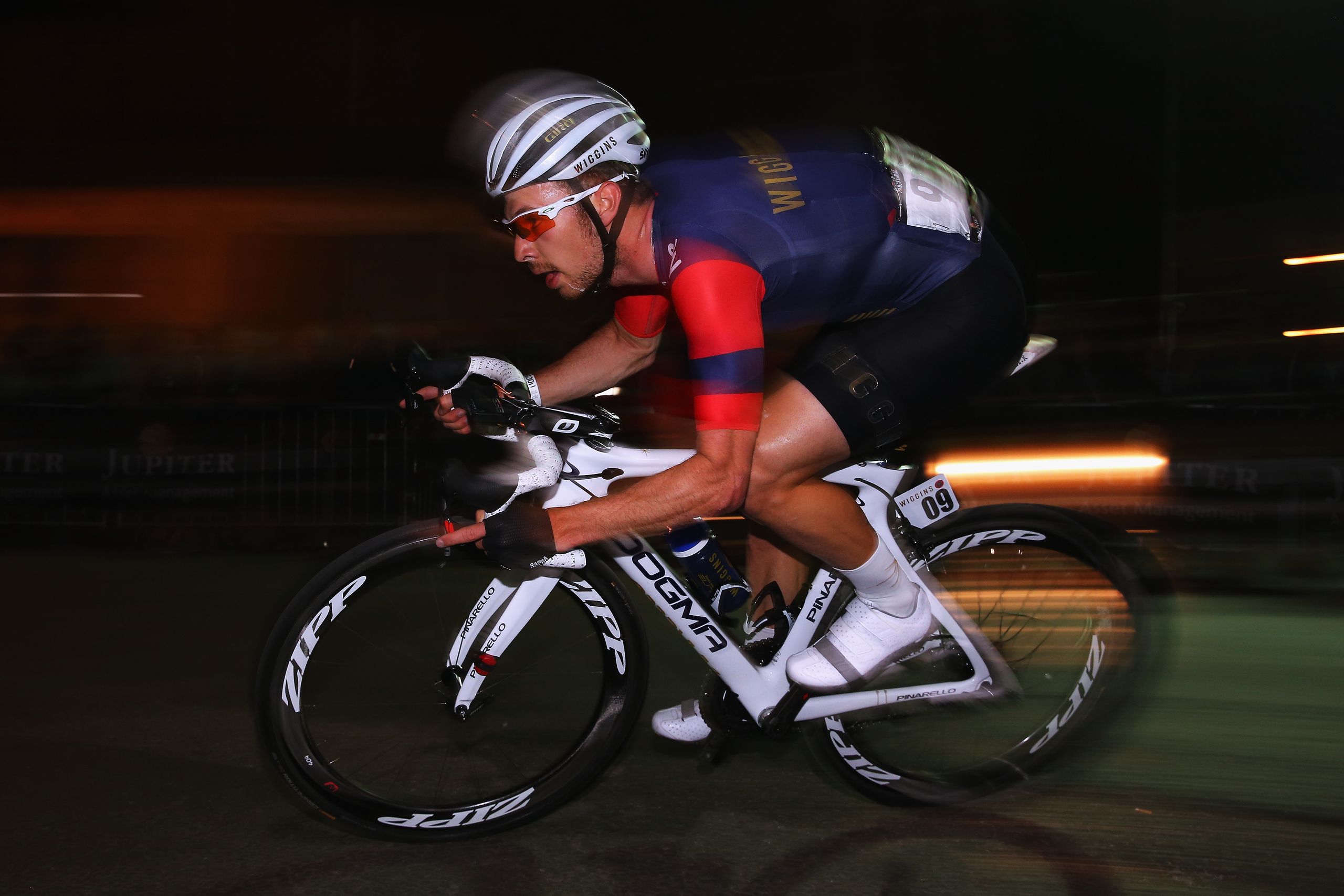
The popular London Nocturne criterium event will return in 2026 with UCI registration, after eight years off the British racing calendar.
Formerly known as the Smithfield Nocturne, with a list of winners that includes Geraint Thomas, Ed Clancy, Katie Archibald and Hannah Barnes, the event will return as the City of London Nocturne, and will be held over two days on 12-13 June 2026.
Its organiser, James Pope, who also managed the event when it ran from 2007 to 2018, hopes to bring a world-class field to the English capital, with television broadcasting to help “boost” the UK scene.
Speaking to Cycling Weekly, Pope explained the idea to revive the Nocturne initially came from the City of London, who approached him last year. “They had good memories of the Nocturne, and were very keen to bring a marquee cycling event back to the city,” Pope said.
“This new event, I wanted to be bigger and better, so I proposed two things to the City of London. I said, ‘Can we have a new race circuit, higher profile, that goes through Bank junction?’ So that’s what we’ve been working on, with a really iconic, city-skyline backdrop. You’ve got St Paul’s Cathedral at one end of the course, and the Bank of England and Royal Exchange at the other end. The other key development is to go to two days, so Friday and Saturday.”
Over the two days, the closed road circuit will host a festival of events, including: a corporate challenge to engage those working locally, family-friendly races, fun races – “penny farthings, folding bikes” – before Saturday evening’s finale of the men’s and women’s elite races, both of which already appear on the UCI calendar.
The two elite races will carry ‘CRTP – Pro Criterium’ classification – the same as the Tour de France Saitama and Singapore Criteriums – and, as such, do not award UCI ranking points. The reason for registering with the UCI, Pope explained, is that it allows him to invite WorldTour and ProTour teams to compete.
“I want the field to be an international field, albeit predominantly domestic riders,” Pope said.
“We’ll have to cover travel expenses, maybe pay a few people appearance fees, but we’re not going to have a massive budget to do that. I’m hoping to get a handful of international WorldTour riders on the men’s and women’s side. Obviously, we don’t know who those riders are yet, because people won’t know their calendars until they’ve been at the training camps in December. We’ll aim to get some good WorldTour riders represented, for sure.”
Double Olympic track champion Katie Archibald won the Nocturne in 2015.
(Image credit: Getty Images)
Pope also plans to televise the elite criteriums through a “traditional broadcaster”, something he hopes will help provide visibility for teams’ and riders’ sponsors.
“I think there is an opportunity to bring in a new level of televised, major-city racing,” he said. “My aim is that it just gives another boost to the UK racing scene and plays a part in this kind of renaissance.
“If you look at it as a pyramid, in that middle-bottom, there is a thriving race scene, then you’ve got the Tours of Britain at the top, and I’m hoping to try and create something in between the two that helps elevate the whole scene.”
Pope’s previous credentials count co-founding the track cycling Revolution Series, and working as the race director of the now defunct UCI Track Champions League. He said he holds “very, very fond memories” of organising the former Nocturne series.
“We really didn’t know what to expect,” he said of the first edition in 2007 around Smithfield Market. “Rapha and Condor came up with the idea to do a race, approached me and Fran [Millar, Pope’s business partner at the time], and said, ‘Hey, do you think you can organise it?’ And we just went for it. I think about 4,000-5,000 people showed up, we won an award, and it grew from there.”
The event closed down in 2018 after the sports management company that organised it, Face Partnership, went into administration. “There was nothing wrong with the Nocturne, per se,” Pope said. “It was more just collateral damage from what went wrong with the parent business. As an event itself, it was profitable, it was a great event.”
The plan now is to make the City of London Nocturne an annual fixture, “like it used to be,” Pope continued.
“If we can make the London event a success, then potentially we can look to try and replicate it in one or two other major cities in the UK. That’s my goal. I’m going to take it one step at a time.”
