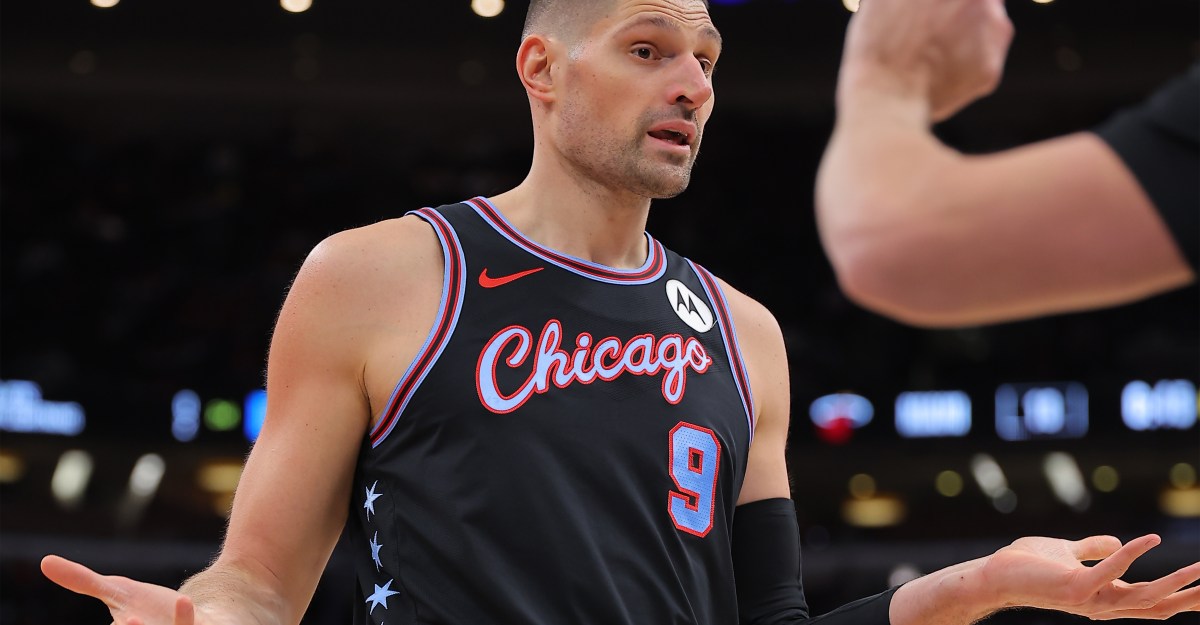
Everything seems to be official.
The NBA trade deadline has come and gone, and the Boston Celtics surprised most fans with their level of activity. Over a three-day span, Boston completed four trades, parting ways with Anfernee Simons, Xavier Tillman, Josh Minott, and Chris Boucher.
Each move carried meaningful financial implications, as the Celtics emerged from Thursday’s deadline below both the first and second aprons, and under the luxury tax. From an on-court perspective, however, their most notable player acquisition was former Chicago Bulls center Nikola Vucevic.
Vucevic comes to Boston as one of the most consistent double-double machines as a 35-year-old in his 15th season. In his last 10 campaigns, Vucevic has averaged 18.5 points and 10.5 rebounds per game, officially notching double-double status in eight of them.
This season, Vučević has continued to post strong offensive production, averaging 17 points, nine rebounds, and four assists per game while shooting an efficient 50/38/83 in 30 minutes a night. While it’s unlikely he sees that level of playing time in Boston, his skill set offers a different, but effective way to replace the microwave scoring fans enjoyed from Simons.
Speaking of Simons, it’s striking how similar he and Vucevic are aside from age and measurements. They both enter their Boston tenure on expiring contracts coming from subpar teams and viewed as very good offensive talents who struggle on defense.
And yes, later in this piece I will give you the speech about how if a defender as porous as Simons was in Portland can steadily improve on that end in Boston, there’s reason to believe Vučević can do the same. Before you yell at me, yes defense from the point guard position is a lot different than defense from the center position. But I then raise you one Luka Garza.
Garza has completely shattered most expectations he had coming into this season but please try to think back and remember what most thought of him defensively when he was signed. Garza still isn’t this great defender, but some hope should be gained seeing how he’s improved on that end and how he has continued to be successful despite those shortcomings.
If you think age and the drive to prove oneself are the key factors behind Simons and Garza improving defensively, fair enough. Vucevic definitely isn’t young, but I do believe the motivation overall is there.
With that being said, let’s get into what we may see from Vucevic ahead of his Celtics debut.
Vucevic brings a distinctly different offensive look to Boston’s center rotation. His shot making ability and shot variety have been one of the more unique profiles among big men for a while. He truly has a shot for every spot on the floor. Here’s a look at his shot profile in full.
Vucevic occupies rare air among NBA centers this season. He’s one of only four big men attempting four or more above-the-break threes while also taking three or more shots at the rim per game. That list reads Nikola Jokic, Victor Wembanyama, Karl Anthony Towns, and Nikola Vucevic.
When you factor in Vucevic’s most frequent scoring area, the paint (outside the restricted area), he and Nikola Jokic are the only two centers in the league attempting four or more above-the-break threes, three or more shots at the rim, and four or more shots in the paint per game. Just shows how rare his skillset is for a big.
Vucevic’s two-point shot variety is particularly valuable, especially alongside higher-caliber teammates in Boston. According to Bball-Index, he is the league’s best when it comes to scoring off the pick-and-roll as a screener, showcasing his ability to convert in multiple ways and keep defenses guessing.

This is mainly because again he has a shot for every part of the floor with good reliable touch. He uses floaters and hook shots frequently to put the ball in the basket.
Vucevic attempts 2.6 hook shots a game (99th percentile) and shoots them at a 56% clip.
When it comes to floaters, he takes 2.2 a game (94th percentile) and hits 58% of those.
What’s so good about these is you see him making them against every defensive coverage. If a big is in drop, that pocket is open and he will make money. If the big is up to the level, you can give him the ball and let him attack off the bounce. If Jaylen Brown is scorching hot and teams trap him as the pick-and-roll handler, he can get it off in the short roll. It makes an already great offense more unpredictable.
Stepping a few feet back, Vucevic’s mid-range should translate seamlessly in Boston, a team that already takes the third-most mid-range attempts per game in the league. Among Celtics players who attempt more than one mid-range shot per game, Vucevic would rank second on the roster in mid-range field-goal percentage.
Rounding out his scoring arsenal is Vucevic three-point shooting. Vučević is one of just four centers in the league shooting 38 percent or better on 4.5 or more three-point attempts per game. 91% of his threes are taken above the break, which definitely fits his new squad. Celtics rank first in above the break three-point attempts per game with 35.7.
When you watch him shoot, it becomes clear why he’s been the league’s best screener shot maker this season. We saw him roll and have great touch hitting floaters and hooks, but he can also pop and be lethal from deep. Rejecting screens with him popping can be lethal given the opposing big will either stick to his body or take steps towards the handler. Either decision creates an advantage, and the Celtics are well equipped to exploit it.
One thing I believe will be an evident difference between Vucevic and our other bigs, is the movement speed after defensive rebounds and in the half court. We see Garza and Neemias Queta fly up the court to set early offense screens every game for our scorers. In Chicago, Vucevic gets a good chunk of his threes trailing the play.
This doesn’t mean he won’t do what Queta and Garza do if asked by the Celtics, but I just see a difference in mindset due to skillset. Also, the Bulls have the fifth fastest pace in the league so it could look different here.
Lastly, I’m not sure how much the Celtics will dip into this, but Vucevic ranks in the 100th percentile in points per possession when coming off screens.
This play type is only 3.5% of his possessions, but I wouldn’t be surprised if I saw some “Korver” screens for Vucevic like.
Boston has grown markedly better at closing possessions with defensive rebounds as the season has gone on, but it never hurts to add a few more. It just so happens that Vucevic has been one of the best glass cleaners on that end for the past decade.

Over the past eight seasons, the Montenegrin big man has finished outside the top 10 in defensive rebounds per game just once, ranking 11th last year. This season, he sits 10th, and there’s little doubt he’ll help sustain, if not elevate, the team’s upward trend in defensive rebounding percentage.
He gets busy on the offensive glass as well. He’s no Garza, but he does grab just over two a game. He has a feel for positioning and great hands that allow for immediate putback attempts when he’s in close. He’s had monster rebounding outings vs the Pistons (16) and the Celtics (15) this season.
Vucevic ranks eighth among centers in assists, averaging 3.8 per game. His 3.8 potential assists per minute place him in the 96th percentile, while his 2.4 rim assists per game rank in the 94th percentile, justifying his value as a connective playmaker and cut hitter.
Wherever you want him to pass from, he can do it. He makes great reads out of the post, as a handoff passer, and in the short roll. He’s a player who can naturally command double teams in the post against mismatches, even with Brown on the floor. And if opponents choose not to send help, Vucevic has more than enough skill to make them pay.
My takeaway on Vucevic as a screener is fairly straightforward: he’s just good. Which is a good thing, but it’s not Garza or Queta. He may not rank among the very best in the league in that area, but his screen-assist numbers are more likely a reflection of his broader offensive skill set, popping, slipping, and drawing defensive attention, than any real deficiency as a screener.
When he set quality screens in Chicago, the ball often found its way back to him as the second scoring option on most nights. Additionally, the Bulls’ pace, and their 17.6 fast-break points per game (sixth in the league), naturally limited his opportunities to operate as a traditional half-court screener. His 2.3 screen assists aren’t bad at all but depending on what the Celtics ask of him, I can see that increasing some.
As most know by now, the biggest weakness in Vucevic’s game is his defense. While I do agree that he’s not a great or even good defender, I struggled to find the horrible defender most paint him as.
I’ve gone back and watched eight games of Vucevic this year and I want it to be known that eight games does not define a player’s body of work. These very well could’ve been the best defensive games Vucevic has ever played, but my goal was to watch him against great teams this season and see how he faired. Also, these games don’t take away the reputation he has built as a defender, which I assume is for a reason.
I primarily focused on the Bulls three meetings with the Pistons and the two they’ve had with the Celtics. In watching those games, I do not think this is a player that is incapable of being just solid defensively. He is not a stopper and will get scored on, but I believe he can be similar to or even slightly better than what Garza is defensively.
Some nights will look worse than others but in the grand scheme I don’t anticipate this being a player fans are screaming to get off the floor because of his defense.
Showing why matters so let’s get into the good and the bad.
The worst of the worst in the games I watched was Isaiah Stewart of the Detroit Pistons, giving Vucevic about 16 of his career high 31 points. He was definitely having “one of those nights,” but he was able to get into the chest of Vucevic and finish over him regularly. That was the first game I watched so I felt horribly about him, but things got better.
One thing that will not get better is his athleticism. In the second Pistons game I watched even though he defended much better overall, the lob throwing going against more athletic bigs like Jalen Duren was a problem.
While this is true, I think the Celtics can help with this. For one, the Celtics are going to put Vucevic in positions they think he can succeed more often than the Bulls will. Chicago’s primary pick and roll coverage defensively in these game with Vucevic was to be at the level of the screen and show on the handler for as long as possible.
I’m here saying that Vucevic can be solid, but I know for a fact that sliding his feet on the perimeter isn’t the best way to use him. Secondly, Chiago has guards who aren’t good taggers of the roll. They put Vucevic in a position where he must show high and get back most times, knowing he doesn’t have the best foot speed and run this coverage with Tre Jones and Josh Giddey as the only hopes to stop Duren rolling.
I am much more confident that any of Derrick White, Hugo Gonzalez, Jordan Walsh, Neemias Queta, or Baylor Scheierman can do a better job at sticking their nose in there.
When it’s bad for Vucevic, it’s bad but once again I just saw much more solid defense than the opposite.
He has surprisingly good hands and will elect to strip down on intruders driving to the paint. Against the Celtics he was able to hold his own and move well to avoid Spain action back screens with moments of decent switching.
All Vucevic has wanted to do for a while now is win.
When you put it all together, Nikola Vucevic brings a level of offensive versatility and reliability that few centers in the league can match. His shot variety, playmaking, and ability to function as both a scorer and connective piece fit naturally within Boston’s offensive ecosystem.
While his defense is far from where we would like, I have seen evidence of him being able to do the things that will be required of him. Consistency will be the key.
You don’t have to trust me, but I’m asking that you trust Joe Mazzulla.
