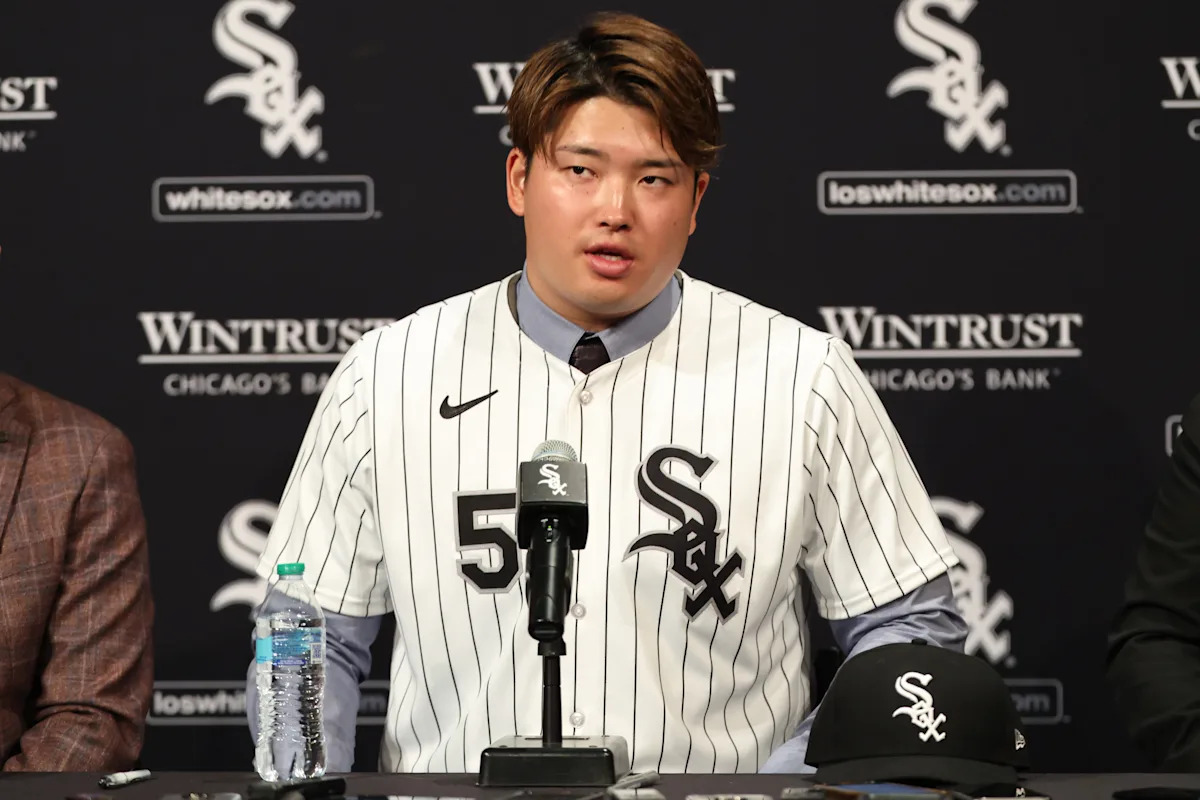
For most of the baseball prognostication industry, what a massive swing-and-miss.
Since breaking the NPB’s domestic home run record in 2022, Munetaka Murakami was hailed as the next Japanese phenom expected to make his mark stateside. That hype only intensified over the past few months, as it became clear that the Yakult Swallows, Murakami’s NPB club, were going to make him available to MLB teams via the posting system this winter.
Advertisement
And because Murakami’s was a very unique profile to hit the open market — still just 25 years old, with top-shelf raw power — the overwhelming assumption was that the Japanese slugger, between the contract and the posting fee paid to the Swallows, would incur a nine-figure cost for an MLB organization. Ben Clemens of FanGraphs projected a seven-year, $154 million deal. FanGraphs’ crowdsource project was a touch lower, at 6/132. Kiley McDaniel of ESPN was the low man with a relatively meager 5/80. The good folks at MLB Trade Rumors were the most bullish, tying an eight-year, $180 million deal to the corner infielder. Here at Yahoo, we didn’t put out contract projections, but if we had, we certainly would’ve eclipsed the $100 million mark.
In the end, we were all wrong.
On Sunday, Murakami signed a two-year, $34 million contract with the Chicago White Sox. For the South Siders, it’s a low-risk, high-reward move. Even with Murakami on board, the Sox are running a microscopic payroll. The worst-case scenario isn’t a disaster. And in the event that Murakami figures things out, they’ll have a middle of the order cog on the cheap.
But as exciting as the signing might be for Sox fans, Murakami’s story revolves around the underwhelming contract he ended up with. So what the heck happened here? How did a player projected for $100 million end up with a smaller deal than Joc Pederson got last winter?
Advertisement
Well, it turns out that for all of Murakami’s game-changing power, no team truly believed he was likely to become a game-changing force in the bigs. That is mostly to do with the slugger’s extremely concerning swing-and-miss numbers. Murakami’s in-zone contact rate was consistently in the low-70s for the Swallows. The MLB league average is usually around 82%. Just six qualified big leaguers were under 80% last season, and only one (Rafael Devers) was under 75%. Relatedly, Murakami’s strikeout rate over the past three seasons was a whopping 28.8%, the fourth-highest mark in NPB over that span.
Given those significant contact struggles against NPB pitching, MLB clubs were understandably doubtful that Murakami would make enough contact against elite arms to be an impact bat.
As one team official simply put it: “Like, can he actually hit?”
[Get more White Sox news: Chicago team feed]
And that’s where Murakami’s actual market diverged sharply from industry expectations. When push came to shove, clubs were generally scared off by the in-zone whiff. That’s also true for the White Sox, who should still be thrilled about the signing. The market for Murakami simply never actualized, and no team was willing to commit long-term to a hitter with such significant questions.
Advertisement
That Murakami’s defensive future was shrouded in a similar haze made teams only more wary of making a significant investment. On the public side, Murakami was discussed as a third baseman, though talent evaluators have always considered him a first baseman — and not a particularly good one. He lacks lateral agility, and though his arm is comfortably plus, the fielding hands are not. There were teams that would have immediately moved him to DH. Had there been anything resembling a defensive floor, Murakami’s immense offensive risk might have been easier for teams to swallow. That’s obviously not how it played out.
In retrospect, it’s interesting that Murakami’s journey through free agency was so quiet, so devoid of rumors or connections or buzz. That dynamic was thought to be related to his agency, the Casey Close-led Excel Sports Management, which has a track record of playing things close to the chest. Murakami was the agency’s first big Japanese client, and the silence was taken as strategy. It seems clear now, with the final figure so small, that the lack of news was more about a lack of interest.
Murakami’s case presents a fascinating contrast to many of the Japanese pitchers who have hopped the pond in recent years. World Series hero Yoshinobu Yamamoto, for instance, received a 12-year, $325 million deal from the Dodgers before the 2024 season at a similar age to Murakami. But it’s simply a very different dynamic for hitters and pitchers from Japan.
Advertisement
Thanks to pitching-tracking technology, evaluators had a strong sense for how Yamamoto’s stuff would play against MLB pitching. That’s why the Dodgers and a handful of other clubs were willing to surpass the $300 million mark for somebody who’d never thrown a pitch in The Show. Yamamoto was also an elite athlete with incredible stuff, so folks believed he would be able to make the necessary adjustments against elite hitters. And that’s exactly what happened.
In general, things aren’t as straightforward for Japanese bats. The difference in fastball velocity between NPB and MLB is significant. And hitting is reactive. There’s also a much, much shorter list of players who have made the leap successfully. For every Seiya Suzuki, it seems, there are multiple Yoshitomo Tsutsugos.
Even Shohei Ohtani, the ultimate outlier in every respect, had what appeared to be red-flag whiff rates when he signed with the Angels. And even though the four-time MVP has blossomed into one of the game’s most fearsome hitters, Ohtani hasn’t really fixed that flaw in his game. The Dodgers’ DH ran a fourth-percentile whiff rate in 2025. In that regard, Ohtani’s success serves as an insightful best-case scenario for Murakami; if you’re making quality contact often enough, you can afford to make less contact overall.
Advertisement
As it stands, Murakami’s exit velocities aren’t quite at Ohtani’s level, but they aren’t that far off. Still, in order for him to make an impact in the world’s best league, Murakami will need to make adjustments, both with his swing mechanics and with his approach. His type of power is a difficult attribute to acquire, particularly at his young age. That’s why people loved this guy to begin with, why people like me were throwing nine figures around and why the White Sox were willing to dole out $34 million.
For Murakami, the final outcome of his free agency is disappointing but far from disastrous. He will reenter the market two years from now ahead of his age-28 season. If he proves his talent between now and then, he will cash in. If he doesn’t, he won’t.
As it turns out, teams wanted to see him do it first.
