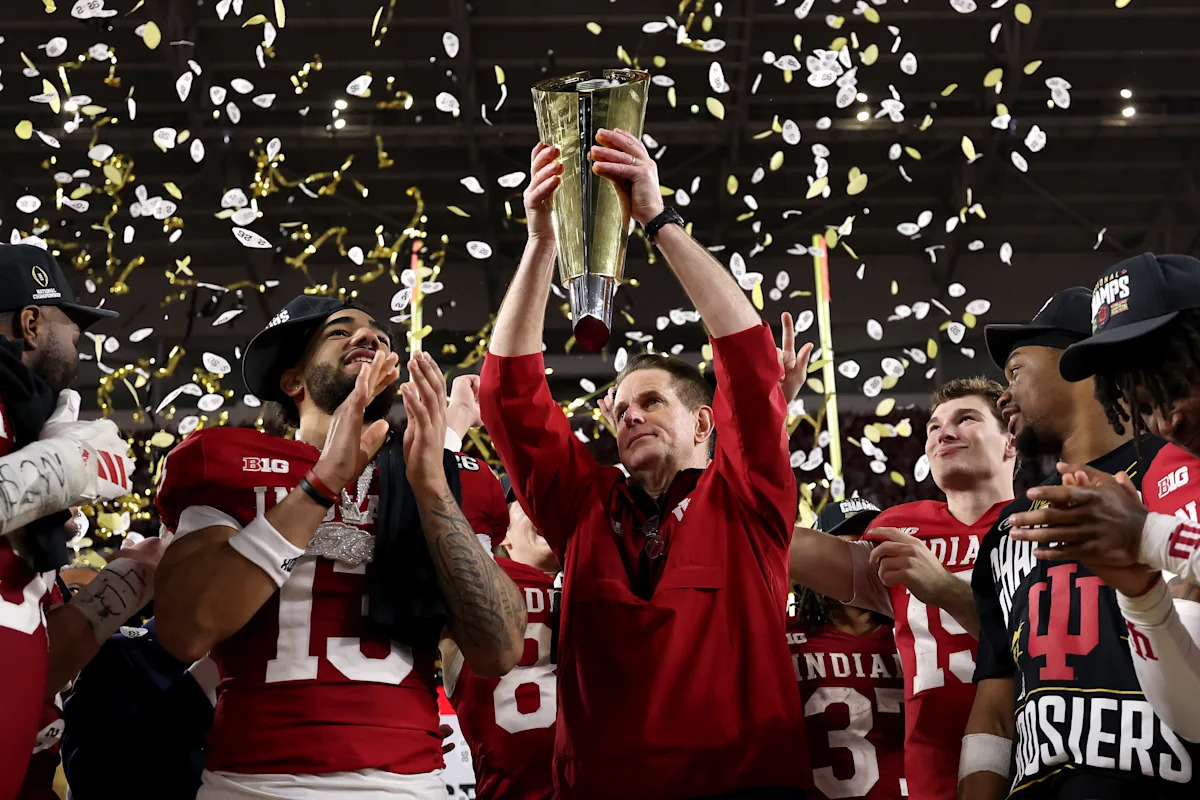
While Indiana went from 3 wins to 11 wins in one year, everyone wanted to know “how the heck to Curt Cignetti flip that roster so fast to get that sort of result?”
When Indiana stomped their way through the 2025 regular season, everyone wanted to know “how the heck does the losingest power program in FBS history become one of the most dominant in two years?”.
Advertisement
And when the Hoosiers hoisted the national championship trophy after going 16-0, everyone wanted to know “can my team do that?”.
Well, I don’t know if every team can do that, but we can at least try to figure that out!
Curt Cignetti and the Indiana Hoosiers beat the brakes off of damn near everyone and managed to coach circles around staffs with (alleged) payrolls much, much higher than what the folks in Bloomington had. So here are the key aspects of the 2025 Indiana Hoosiers that I believe are worth pointing out:
They’re spending in the $20-22 million range
Yes, that is an estimate. No, that is not nearly as high as some have claimed. We’ll never really know for sure on these things but a roster at Ohio State/Alabama/Michigan/Georgia/Texas/etc. is perceived to be in the $30-40m range, depending on who you ask. G5 schools are stoked if they have a $2-5m budget for players. And while that leaves a substantial gap in between the blue bloods and the G5s, the group-think average tends to be in $15-25m range for the rest of the power teams, and so that figure cited above puts Indiana squarely around the average. What does that mean? Well, it means that they’re spending an amount that any B1G/SEC school can reasonably spend, which means pouring money into a roster doesn’t solve all problems. Maybe it did in the past, but certainly not now, when the transfer portal can syphon away talent that isn’t being utilized/compensated appropriately and players can get paid at any school, not just the SEC schools. But what is spending “smart” in college football look like? What’s the “Moneyball” play here? Well…
Advertisement
They’re identifying, developing, and hanging on to the talent they want
It’s been widely covered at this point but, as a reminder, Indiana’s Heisman-winning quarterback was a 2-star recruit out of high school who was refused a walk-on spot at Miami and went to the only power program that offered – California – instead of going to Yale. Wide receiver Elijah Sarratt? No-star recruit who went to St. Francis (PA) out of high school. Blocking back Riley Nowakowski, guard Drew Evans, edge rusher (and punt block hero) Mikail Kamara, defensive tackles Tyrique Tucker and Hosea Wheeler, linebackers Rolijah Hardy and Aiden Fisher, safety Louis Moore, punter Mitch McCarthy…all starters, all no-star recruits out of high school. There are two 4-star receivers in the starting lineup but, other than that, everyone else were unheralded 3-stars. Indiana was not only excellent at identifying talent and making sure it fit with what they were doing, but they were dogged in doing whatever it took to keep that talent in Bloomington. Think of Mizzou guys like Zion Young and Drey Norwood: they certainly didn’t get you excited when they transferred in but they were excellent players and Mizzou made sure to keep them on the roster for multiple years, winding up with some great, multi-year starters with unheralded pedigrees. And Indiana managed to keep that core for two-ish straight years (more on that in a second) and utilize them correctly and make them better. That matters a ton when everyone’s roster is quarter-flipped on average year to year. Oh, and along those lines…
63% of Indiana’s snaps were transfer portal players
That’s according to a report from The Athletic, and is the second highest percentage of portal player snaps of all the teams in this year’s Playoff. Remember how I said above that Indiana’s roster stayed together and was developed by the same guys for this magical run? Well, that run technically started in 2022 at a school called James Madison where Curt Cignetti was entering his third year as head coach. That JMU recruiting class provided 13 transfers to Indiana when Coach Cig was hired at the beginning of 2024, including starters D’Angelo Ponds (CB), Tyrique Tucker (DT), Elijah Sarratt (WR), Kaelon Black (RB), Aiden Fisher (LB), and Mikail Kamara (DT). Plus, seven other backup/rotational guys who helped establish the JMU culture at Indiana.
Advertisement
But it’s not just that they imported key ingredients of a talent G5 roster and copy/pasted it onto Indiana’s; Colorado and Florida State have done plenty of portalling in the past three years and they both had one great year and two massive clunkers to show for it. No, the secret of Indiana’s portalling goes back to my second point: they held on to those guys. Mendoza was a first year starter, yes, but look at how long the 2025 Indiana position starters had been with Cignetti (not just at Indiana):
-
OL: 2, 2, 1, 2, and 1 year (going left to right)
-
DBs: 2, 1, 4, and 2 years
There were a few impact portal additions for ‘25 but the vast majority of this team had been playing together through one season and entering their second when their march to 16-0 began. Portalling in talent is important, as is making sure they stick around. Additionally…
They’re old
The average age of Indiana’s football roster is 23. That includes sixth-year, no-star, starting safety Louis Moore. But there is nary an underclassman to be found on Indiana’s two-deep, and the average years’ experience of an Indiana football starter is 4.5 years. This is the same strength I pointed out in my preview for the bowl game against Virginia: experience is important, and a 23-year old is going to be able to body up a 19-year old fairly reliably, even with a potential talent mismatch. Football is a physical, violent sport, and the fact of the matter is that 19-year olds are not as physically developed as 23-year olds and that matters over a full season. Indiana (and Virginia, to a certain extent) had the secret skill of “age” as a weapon for a roster of over-looked guys.
Advertisement
But there is one over-arching point that I believe helps tie all of this together…
It matters who your coach is
Curt Cignetti might just be the best college football coach in the country. We don’t know that for sure in January of 2026, but it could very well be true. Some of his shine was scuffed when he left Nick Saban’s 2010 Alabama staff and took a D-II head coaching job at Indiana University of Pennsylvania before heading to Elon and then James Madison. But he inherited an IUP team that went 4-10 over two years and got them to their first (and only) conference titles and Playoff appearances. That Elon team he coached at was 4-20 over two years and was in the middle of six consecutive losing seasons before winning 8-straight games in his first year and then getting the Phoenix back to the Playoffs and beating Top 5-ranked James Madison on their turf and winning coach of the year. Oh, and he took that James Madison team he beat and immediately had them in the Playoff every year, before guiding them through their FBS transition and winning a conference championship in year two (that the NCAA said they weren’t eligible for, but whatever).
The dude wins. He takes shitty programs and makes them Playoff contenders.
Advertisement
But, even at 64 years old, he’s surprisingly progressive in how he operates:
-
The NCAA allows 20 hours of practice per week. Cignetti has six of those as actual practices, the rest of that time is used for “mental reps”, i.e. installs, adjustments, and key situation reviews.
-
Practices are short, usually less than two hours. And he doesn’t allow tackling in practice because he believes teaching players to “thud up” – get in position to tackle a player without actually tackling them – saves wear and tear and teaches better technique. Indiana, by the way, has the lowest missed tackle rate in 2025, and was Top 10 in that stat in 2024.
-
Cignetti is also willing to maintain the team over the individual. A story that was shared a few years ago was that a talented Indiana defender from the previous staff was routinely late for meetings. Cignetti told the position coach to cut him. The coach pushed back and said, “coach, that’s the best player on this roster”. Cignetti responded: “not if he can’t make it to a meeting”. And that high expectation cuts to everyone as he is clear about not playing favorites.
-
Also, for his staff, Cignetti encourages coaches to not stay late at all. He’s of the mind that, if your stuff is done (or can be completed not in the office), then you should go home and see your family and be something other than “football coach”.
So all of those points above are true, but it might just be that this is one of the best college football coaches and what he does is not easily repeatable. It’s worth keeping that in mind, too.
So…uh…can Missouri do this?
The easy answer? Yes. But it’s a lot harder than just writing it down and replicating it.
I feel confident that Mizzou can routinely field a roster that’s in the $20-22 million range. I don’t know what they’re hit rate on keeping guys they want currently sits, but I’d like to think it’s over 50%. The Drinkwitz staff has shown to be adept at identifying good talent out of the portal and routinely fields teams that skew older.
Advertisement
Can they improve their retention rate with the guys they want? Can the develop more talent and hold on to them longer? Is Drinkwitz more than just an elite pitchman and culture builder? Those answer will likely never be known to us on the outside, or are “TBD” in a best case scenario.
Missouri can do what Indiana did. Spend smart. Build smart. Build long term, build with guys who buy into your program and will stick around. Give players and coaches time away from the sport but be ruthless in expectations.
But the last point – the one about being one of the best coaching minds in the sport – that’s not necessarily “replicable”.
The “Indiana model” is not the only way to win and certainly not impossible to replicate, it’s just difficult to replicate.
Advertisement
But that’s why its so special. Congratulations, Indiana. I hope that magical ride can happen for Mizzou some day.
