THERE IS A group of fans who are angry at baseball. There are a lot of them, and they do not exist only on social media. They are inside of group chats that talk about how much money the Los Angeles Dodgers are spending after winning the past two World Series, and they are in cities big and small that look at the Dodgers with envy masked by eye-rolls and curses, and they might just want to devote more time to the game — maybe they love the pitch clock or Shohei Ohtani or Aaron Judge or the in-person vibe or any number of things about the game today worth loving — but they’re not sure the whole thing is fair.
Owners are angry, too. Their franchise valuations aren’t growing as quickly as their billionaire peers in other sports, and they blame the system that governs Major League Baseball. They don’t like it. Nearly every owner believes MLB needs a salary cap. Its presence, owners say, immediately would juice franchise values, with the labor cost essentially fixed and no more chasing Dodgers teams spending $500 million annually on players. At the same time, they say, it would provide a pathway to competitive balance, which they believe is entirely out of whack. They think a salary cap will fix everything, even if it means jeopardizing the 2027 season. “They are ready to burn the f—ing house down,” one high-ranking team official said.
Players are also angry. At what feels to them like an inevitability that after the current collective bargaining agreement expires Dec. 1, the owners are going to lock them out and shut down the game with no end in sight. At the creeping notion MLB not only is going to propose a cap in the bargaining leading up to the expiration but will hold firm on its inclusion in further offers. At the reality that a majority of fans in public and private polling support MLB adopting a capped system, more out of familiarity than any sort of compelling argument for it compared with alternative structures. The players simply want to play ball and receive a fair portion of the $12 billion-plus in revenue the league generates annually. Their ability to do both, they say, shouldn’t be neutered by owners who four years ago voted unanimously in favor of the system they now deride.
Baseball is in a weird place today, with everybody gearing up for the biggest labor war since 1994, when owners last pursued a cap, players resisted and the World Series was canceled for the first time in 90 years. And yet for all the turmoil, the diametrically opposed visions of where the game needs to go, something else is unfolding in real time, a riveting bit of counterintuitiveness: Major League Baseball is having something of a moment. There are new fans. They’re young. It’s just what MLB wanted. They like the pitch clock. They like the stars. They like the storylines. They like the World Baseball Classic. They like the game — even as the Dodgers vanquish it.
Los Angeles bred an empire because in MLB’s current system, money and hypercompetence are a potent combination. And in spite of the Dodgers taking over the sport as they have — and, in lesser ways, because of what they’ve done — there has been a renaissance in recent years, a renewed interest in the game nationally to correspond with tremendous growth internationally, particularly in Japan. If the on-field product itself is the proper barometer for the true health of a sport, baseball is hale and hearty, coming off an all-time World Series, a love letter to what the game can be, featuring emerging hero vs. dastardly villain.
And even still fans are tired — of the disparity and the fight to come. It’s understandable. It’s hard rooting for a sport whose asymmetry is a defining feature. The Dodgers win everything. Offseason. World Series. Offseason. World Series. Offseason. Another World Series?
The disdain for Los Angeles has coalesced organically, just as it did 30 years ago, when the New York Yankees won World Series as it were their birthright and left fans of other teams forlorn. In the wake of that came a codified luxury tax through which baseball found a solution that kept the game stable enough for more than 30 years of labor peace, a notable achievement. Times change, though, and with them systems must as well. And if the Dodgers do anything, they distill the wishes of fans into a clear, potent dictate for all involved: Make it feel fair.
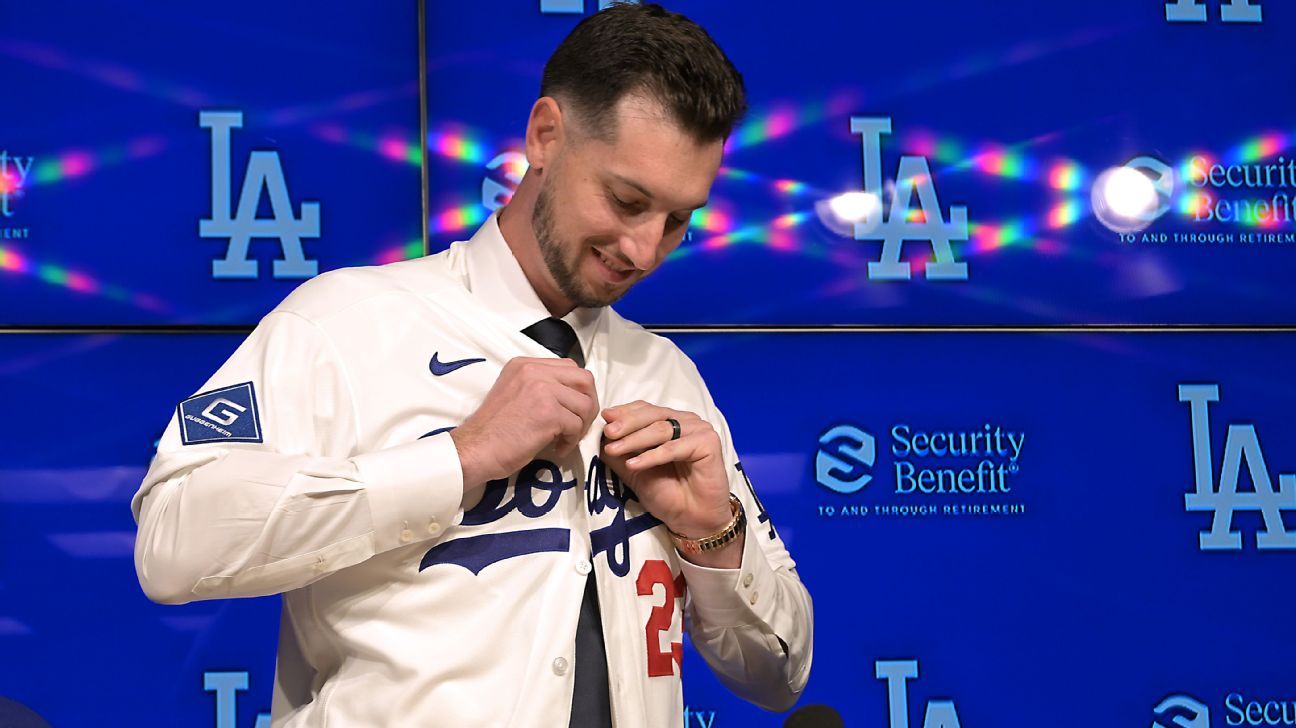
PLENTY OF OTHER teams are lavishing players with big-money contracts this offseason. Baltimore keeps spending. Toronto parlayed its World Series haul into multiple high-priced free agents. In perhaps the greatest sign the baseball apocalypse is nigh, the Pittsburgh Pirates signed a free agent to a multiyear contract, the first time they had done so in a decade. But all that felt moot when the Dodgers signed Kyle Tucker to the deal that gobsmacked the baseball universe.
Tucker, a four-time All-Star and the best free agent on the market this winter, had a choice to make. The Blue Jays, who were two outs from dethroning the Dodgers in the World Series and at least temporarily muffling the outcry against them, had offered him a 10-year, $350 million contract with no deferred money, according to sources. The Dodgers and the New York Mets represented a divergent route: both offered four-year deals, eager to capitalize on the prime of Tucker’s career. Los Angeles guaranteed $240 million with a $64 million signing bonus and $30 million deferred while the Mets countered with $220 million that included a $75 million upfront bonus and no deferrals.
Never in the 50 years of free agency had a player turned down a $300 million-plus offer. Then again, never had a team tried to cajole a player out of it with a deal like the Dodgers’ or Mets’. Five years earlier, reigning National League Cy Young Award winner Trevor Bauer charted the course by signing a three-year, $102 million free agent deal with Los Angeles, forsaking lengthier deals with lower average annual values. Last winter, third baseman Alex Bregman turned down a heavily deferred six-year offer from Detroit for a three-year, $120 million deal with Boston — and also got opt-outs, one of which he parlayed into the five-year, $175 million contract he signed this offseason with the Chicago Cubs.
Tucker supersized his version. He sold his prime years for a mint. He gave himself flexibility with opt-outs after the second and third seasons. He can bank $120 million for the next two years, hit the market again at 31 years old and get a more representative long-term deal. Or he can pocket a quarter-billion, spend four years with the scariest baseball machine in a generation and hit behind the most talented player in the game’s history.
Only Ohtani’s contract, signed before the 2024 season, is worth more on a per-year basis than Tucker’s, and it is so deeply deferred — Los Angeles is paying him $2 million a year and delaying for a decade payment on the remaining $680 million — that its present value is more in the mid-$400 millions. One year after Ohtani shattered the salary scale, Juan Soto one-upped him with a 15-year, $765 million, deferral-free deal with the Mets.
That the Dodgers and Mets are the nexus of outsize salaries should come as no surprise. They are owned and run by intelligent, curious, cutthroat businessmen. Guggenheim Partners, the investment firm that owns the Dodgers, manages $350 billion. Steve Cohen, the hedge-fund titan who bought the Mets in 2020, is worth more than $20 billion. They got rich by hunting alpha. Any edge, however minuscule, is still an edge. And in baseball, cash — and a commitment to spend it — separates shark from minnow. The Dodgers and Mets don’t know what the future of baseball holds. What they do know is that under this system, all it costs them to stock up on good player after good player is money, something they hold in abundance. And they use that money because teams willing to deploy cash on their major league rosters operate in a different stratosphere. It is them, and then it is everyone else.
Cash is imperative for the sorts of deals players seek. They love signing bonuses because they can save on taxes, and the Dodgers and Mets happily oblige. Players don’t balk at deferrals because as long as they own residences in tax-advantaged states, they benefit. The Dodgers and Mets are content funding the deferred money — in Ohtani’s case, for example, MLB rules require the Dodgers to put $44 million annually in an escrow account so it can grow to eventually pay what they owe him — because it lowers the salary used to calculate their luxury-tax bills. Other teams claim cash-flow issues keep them from larding deals with signing bonuses and deferrals.
Over the past five seasons, between payroll and competitive balance tax (CBT) penalties, the Mets have spent $1,785,385,388, just ahead of the Dodgers’ $1,716,051,502. The next-closest team is the Yankees, nearly $200 million behind the Dodgers, but it’s less about them than it is the gap between the top and bottom. Bringing up the rear are the A’s, who have spent $347,310,744 in the past decade. Not far ahead: Pittsburgh, at $356,028,106. Miami, Tampa Bay, Cleveland? None is at even a quarter of what the Mets or Dodgers spend.
It’s irrefutable that the Dodgers and Mets play a different game than everybody else — and it is exactly what every fan wishes its ownership would do. You hate them cause you ain’t them. The Dodgers don’t just carry the largest payroll in baseball. They have the biggest staff, one of the top farm systems, some of the best facilities and, even excluding payroll, what rivals consider the soundest operation in the game. They have built the Death Star, and the rest of baseball is their Alderaan.
Because of the tax levied on teams that spend over the CBT — payroll surcharges intended to dampen the desire for organizations to flex their financial muscles — the Dodgers must pay a 110% penalty on every dollar over the top $304 million threshold. Meaning that at a salary adjusted to $57.1 million to reflect its net present value, Tucker this year will cost the Dodgers $119.9 million. That is more than the current 2026 payrolls of 10 teams.
Such a degree of imbalance is astonishing, even with the reality that nothing in the rules stops other owners from replicating the Dodgers’ behavior, other than their own willingness to deficit spend. Few are willing. Which leaves them pushing for a cap, convincing themselves, with Mandalorian obduracy, that this is the way.
THE DODGERS ARE an easy scapegoat for any owner who cares to argue in favor of a salary cap. Cap enthusiasts cite a laundry list of facts pertaining to payroll and success, and they’re persuasive. How more than half of playoff teams since the turn of the century carried top-10 payrolls. Twelve of the past 15 World Series winners, too. Leaguewide winning percentages correlate more strongly with payroll than the NFL, NBA or NHL. Nobody can deny that in MLB, an owner’s spending matters.
Players are armed with a contrasting set of powerful facts. The team that won the most regular-season games in 2025? The Milwaukee Brewers, with a payroll of $117.1 million that ranked 23rd in MLB. The Cleveland Guardians, habitual misers, have won the past two American League Central division titles and booked more wins over the past decade than every team but the Dodgers, Houston Astros and Yankees. The Tampa Bay Rays win totals have been higher than the first two numbers of their payroll — which never has reached $98 million — five of the past 10 years. Since the turn of the century, more MLB franchises have won championships (16) than in the NHL (14), NFL (13) and NBA (12). Money helps, players acknowledge, but it offers no guarantees. See the Mets, whose only postseason appearances in the past nine years included a wild-card-round disaster against San Diego in 2021 and an National League Championship Series in 2024 that ended at the hands of the Dodgers despite having a top-two payroll each of the past four seasons.
All it takes, players argue, is a trip to the playoffs for baseball’s randomness to reveal itself.
Texas won the World Series as a No. 5 seed against No. 6 seed Arizona in 2023, the last time the Dodgers lost in the postseason. They responded over the next two-plus years by signing Ohtani, Yoshinobu Yamamoto, Tucker, two-time Cy Young winner Blake Snell, right-hander Tyler Glasnow, utilityman Tommy Edman, reliever Tanner Scott, three-time reliever of the year Edwin Díaz and Japanese sensation Roki Sasaki for a combined $1.8 billion. The guarantee to those nine players is more than the Rays, Marlins, Pirates and A’s have each spent in the entirety of the 21st century.
At the heart of the forthcoming battle between the union and league are different worldviews. The union’s is zero sum: The system offers organizations a wide breadth on how to build their teams, and it’s up to owners to decide their courses of action. Players don’t care how money is spent. They care only that it is spent. And it’s what bothers them most about a capped system. However lucrative a cap offer MLB wants to make, Ohtani and Soto and Tucker did not get their contracts in a system with limits on player compensation. Surrendering that in the aftermath of a winter in which Tucker reached the $60 million threshold, Bo Bichette snagged a contract with a $42 million annual value from the Mets and nine players have received nine-figure deals is like forsaking a golden goose for one that lays eggs of unknown metallurgy.
MLB and owners consistently suggest players on the whole would make more money in a capped system. This can be true. A cap consists of a predetermined pool of money and a defined revenue split with a ceiling and a floor. Its flexibility varies. The NFL operates with an inflexible cap, the NHL a hard cap with exceptions for long-term injuries and the NBA a soft cap that allows re-signing homegrown players but levies harsh penalties for exceeding the ceiling by too much.
Certainly MLB could engineer a capped system so magnanimous that players would set aside their preconceived notions, fostered by years of anti-cap rhetoric drilled into their heads during MLBPA meetings, and consider its merits. It’s exceptionally unlikely. But if MLB’s chief priority truly is competitive balance, and the league is convinced a cap would cultivate such an environment, its first offer could reflect that instead of looking like what players believe it will: a gambit to raise franchise values cosplaying as a vehicle for a fairer game.
Though academic research on the effectiveness of caps as tools of competitive balance is limited, a 2011 study by two economists at Middle Tennessee State determined no causative relationship between caps and balance. As much of a surprise as that might seem, the math tells the story, and ultimately every collective bargaining agreement is little more than a math problem.
And that, more than decades of anti-cap hostility, is where such a system loses baseball players’ interest. NBA players’ salaries were slashed by nearly $500 million last year because the league did not meet revenue expectations. Guaranteed money wasn’t guaranteed after all. Even if that weren’t an impediment, finding a floor and ceiling that satisfy all parties involved and achieve the league’s stated objective would be tricky.
Let’s use a potentially realistic example that would maintain the $5.5 billion or so teams paid for players in 2025. With a $280 million hard cap and $150 million hard floor, the money teams spend would be within $50,000 of last season. What players lose on the top end — $236 million from the Dodgers, $150 million from the Mets, $85 million from the Yankees and $69 million from the Philadelphia Phillies — would be made up on the bottom. To reach $150 million, the Marlins would need to spend an additional $82 million, the A’s and Rays $71 million, and so on — 11 teams and $540 million total.
The problems are manifold. The union would sneer at the ceiling on teams that have proved themselves willing to spend twice that amount. The lower-revenue organizations would cringe at the tens of millions extra more than a third of the league would be forced to pay. And in no universe does a $130 million gap between top and bottom constitute competitive balance. Levering both in the opposite directions — a $320 million cap and $130 million floor — would placate teams’ self-serving desires but would be lipstick on the parity pig. Moving everyone toward a middle, though more equitable, would exacerbate the disillusionment from restricting teams that want to spend and forcing teams that don’t.
MLB’s labor relations department recognizes the complications it faces not only via objections from the players but in building consensus among owners with varying degrees of belief in a cap. Some are cap-or-bust hardliners, others anti-runaway spending but flexible. All of them know, too, that as much as they covet a cap, the more pragmatic solution is not to leap over the MLBPA’s red line as if they’re Carl Lewis. There’s a compromise, one that mollifies players for now, that kicks the cap can down the road and positions the league to make a far more compelling argument in favor of its desired endgame.
For years, MLB commissioner Rob Manfred has dreamed of trying to follow the NFL model and nationalizing local television rights. With the expiration of the league’s national deals with Fox, TNT, NBC and ESPN after the 2028 season, Manfred, sources said, is also aiming to amass local rights for all 30 teams, as well, and take the entire suite of MLB’s TV properties to market.
And that’s where opportunity reveals itself. Currently, MLB’s national TV deals generate around $1.8 billion per year. With Amazon, Netflix, Apple, Paramount, ESPN, NBC, CBS, TNT and Fox all potential bidders — and with the ability to sell every minute of every baseball game within reach — baseball’s broadcast rights could stabilize vital revenue streams. Regardless of the MLBPA’s willingness to acquiesce to a capped system, the proceeds of a TV goldmine — and a proper revenue-sharing system designed with competitive balance in mind, something the union has resisted as a panacea — could buoy low-revenue laggards. When they’re strong, baseball is strong. When baseball is strong, popularity grows. When popularity grows, franchise values tend to follow.
“The only reason I’m confident we’re not going to miss games,” one team president said, “is because of what TV can do for us.”
Baseball’s critical choice is not cap or no cap. It’s adapt or tempt obsolescence. The longer fans feel alienated, the further franchise values serve as the divine purpose of owners, the more the union denies that the growing payroll gap is a short- and long-term issue, the likelier baseball is to wither toward the latter. Open-mindedness, creative thinking, clear communication — these are not simply buzzwords. They’re necessities to salvage a relationship as poisoned as that between the league and union.
How long owners have the stomach to stick with a cap proposal will guide these negotiations. They are the ones trying to introduce radical change to a system that has existed for more than a half-century, fed up with standard operating procedure, lighter and gas can in hand. They know that if baseball goes away, no matter the reason, people will find other things to do with their lives. Owners hear that and remain staunch, assured, posturing with righteous indignation as their paying customers say in unison a mantra bound to get louder.
Whatever it takes, please just figure it out and don’t screw up our game.
