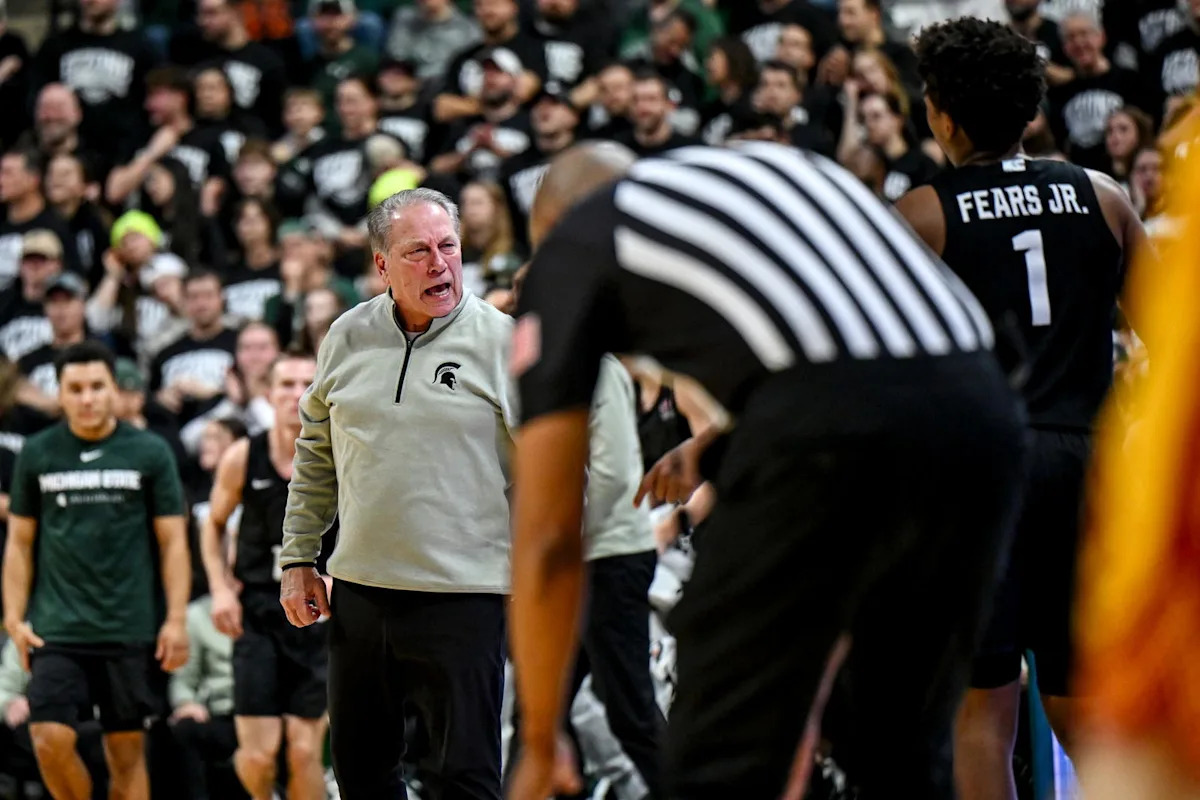
The Spartans returned home for a 29-point victory over the USC Trojans last night — a much-needed win after a crushing loss at the hands of Nebraska just days prior.
This was the type of game that rejuvenates a team, strengthens bonds, and sets the tone for the 16 remaining Big Ten games before tournament play. It’s easy to watch a decisive win filled with bench antics, Fears yelling at a smirking Izzo, crowd chaos, Paul Davis getting tossed, and say this team looks good. Hell — they look really good.
Advertisement
Michigan State won nearly every statistical category and simply looked like the more physical, better-shooting team. And let’s not forget: this wasn’t a tune-up against a lower-tier opponent. USC came in with 12 wins.
Even with a brilliant performance in front of a spectacular, fired-up crowd — one that may or may not have helped swing a few football transfer portal recruits (more on that in my next article) — there are still areas worth examining.
Much like a tree, a Tom Izzo team is always either growing or dying. There is no stagnant middle. And with every win comes moments to learn from and improve upon.
Turnovers
Nineteen turnovers against Nebraska was ugly. Plain and simple. You could almost directly attribute that two-point loss to unforced mistakes with the ball.
Advertisement
Against USC, the Spartans won the turnover battle — but still gave it away 12 times.
Currently, Michigan State ranks tied for 174th nationally in turnover percentage per possession (14.9%) and tied for 191st in turnovers per game (12.3). Compare that to Nebraska, which ranks 13th nationally at just 9.6 turnovers per game. In my eyes, that’s the difference between undefeated and not.
Izzo knows this team will struggle to keep pace with Michigan and other top-five teams if they can’t control the ball and their emotions. Throwing the ball away is the fastest way to lose a game you’re not supposed to lose.
Now, to be fair, Michigan actually averages more turnovers per game (12.6) than the Spartans. But when you’re averaging close to triple digits, turnovers matter less than when you’re hovering around 80 points per game.
Advertisement
Three-Point Shooting
The Spartans hit seven threes against USC and average 7.8 per game — tied for 199th nationally.
This isn’t a team that’s going to jack up threes just for the sake of it, and that’s fine. Michigan State lives and dies through its big men: Jaxon Kohler, Carson Cooper, and Coen Carr. Off the bench, they continue to feed Cam Ward and Jesse McCullough. This team can score inside — that’s their bread and butter.
But any competent opponent will eventually try to take that away.
When that happens, you need your backcourt to step up. You also need that perimeter shooting when you’re facing teams capable of scoring in bunches.
Advertisement
Now, 7.8 made threes per game doesn’t look great on paper. But if you watch this team, you know they don’t chuck shots. They connect on 36.3% from deep — tied for 72nd nationally — which is solid.
Good teams shoot efficiently. Great teams either attempt more when needed or hit more of what they already take.
In March, defense and rebounding win early tournament games. But once the field narrows and you’re matched up with elite teams, perimeter scoring becomes essential. The end of the season is not the time to figure out how to run an offense that needs buckets from deep.
The Spartans aren’t bad here. They’ve shown flashes where they can make it rain. But they’ll need production from players not named Jaxon Kohler beyond the arc to reach their ceiling.
Advertisement
There are 16 games left. The clock is moving fast, and the window to master these details is shrinking.
Michigan State is good — bordering on elite — and has a real chance to be great. Clean up these two areas, and you’re looking at a team primed for a Final Four return… and maybe more.
