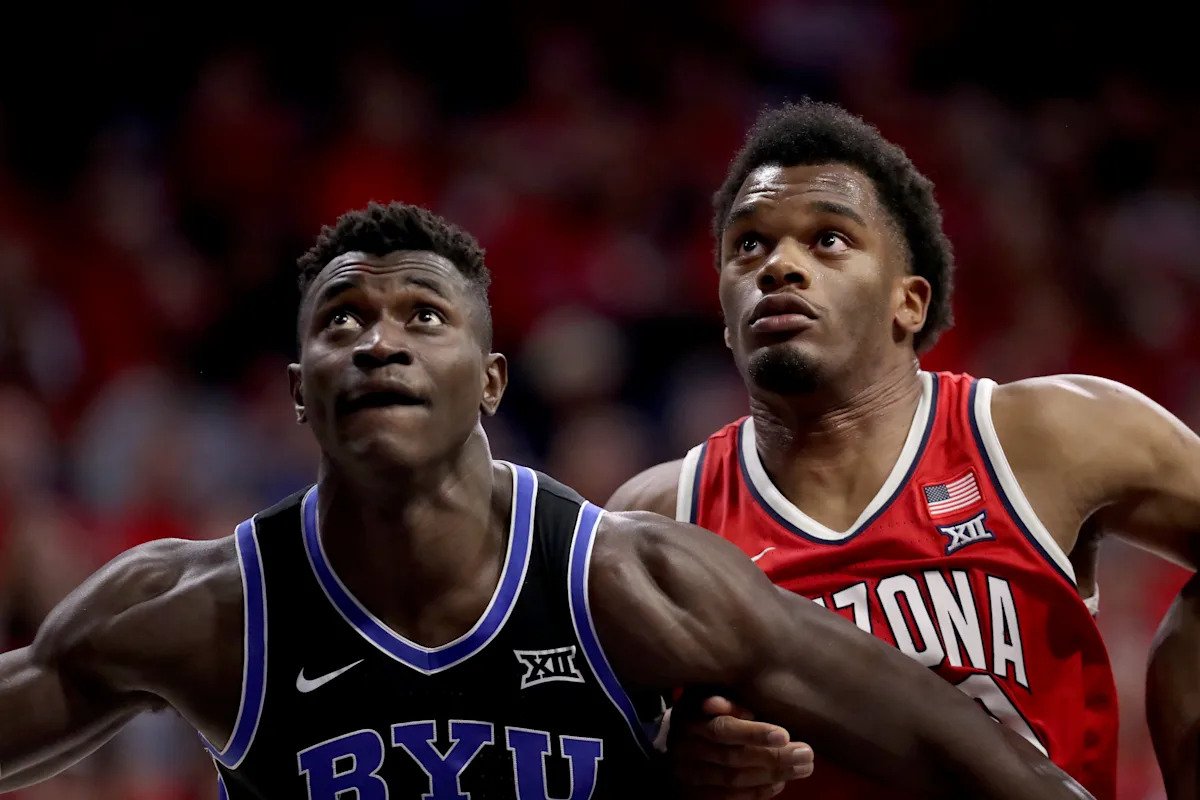
Arizona is off to the second-best start in school history, winning its first 20 games by an average of 22.2 points. The run began with the Wildcats navigating a nonconference gauntlet, one that included five ranked opponents including defending national champion Florida and UConn, the team that claimed the two titles before that and which sits right behind them at No. 2 in the AP poll.
But the competition over the past month hasn’t been nearly as tough. Since starting Big 12 play on Jan. 3 the UA has beaten seven conference opponents who are a combined 17-32 in the league. None of them have better than a 4-3 record in the Big 12.
Advertisement
“We haven’t really won anything,” guard Brayden Burries said last Wednesday, after a 77-51 win over Cincinnati. “We haven’t accomplished what we want to accomplish yet.”
It’s still only January, but Arizona’s level of competition will take a big jump on Monday night with a visit to No. 13 BYU. It’s the first of seven games left in the regular season against ranked opponents, including six out of seven at one point.
“We know there’s going to be some real challenges ahead,” Lloyd said. “We’re protecting nothing because we’ve done nothing. We’re a program that’s more excited about what’s ahead than protecting what we’ve already accomplished. What lies ahead for us is BYU.”
The teams play twice this season—BYU comes to Tucson on Feb. 18—and split their meetings in 2024-25, with each winning on the other team’s court.
Advertisement
Here’s what to watch for when the Wildcats face the Cougars on Big Monday:
A 3-headed attack
BYU is led by freshman AJ Dybantsa, a 6-foot-9 forward who is projected to be the No. 1 pick in the 2026 NBA Draft. He’s coming off a freshman school-record 43 points on Saturday against Utah, and for the season is averaging 23.6 points, 6.8 rebounds and 3.5 assists on 55.4 percent shooting.
“What I’ve always been impressed about with AJ is not only is he a supreme talent … he leaves space in the room for the other players to be their best version of themselves, too,” Lloyd said. “A lot of times you get a young talent like him, and he’s so talented that he could kind of suck the air out of the room, because it all becomes about him and his talent. AJ is not like that. So AJ not only can be the most talented player on the floor, he can also let their other talented players play really well, and I’ve always been impressed with that.”
Advertisement
Lloyd has firsthand knowledge of Dybantsa’s game, coaching him (alongside Koa Peat) with Team USA over the summer when they combined to win a gold medal at the 2025 FIBA U19 World Cup.
But as good as Dybantsa is, he’s far from a one-man team. He doesn’t need to, because BYU also has senior guard Richie Saunders (18.8 points per game) and sophomore guard Robert Wright (18.0). Saunders was the guy who made the final two free throws at McKale Center in BYU’s 1-point win last season, while Wright had 16 points in a game against the Wildcats with Baylor a year ago.
That trio is averaging 66 points per game in Big 12 play, responsible for 77 percent of the scoring and 73 percent of the field goal attempts. In the Cougars’ lone Big 12 loss, at Texas Tech, they combiend for 59 of 71 points but Dybantsa had a career-low 13 in 6-of-17 shooting.
Rebounds and free throws
Arizona has been the best in the conference so far in preventing offensive rebounds, with opponents grabbing just over 25 percent of their misses. BYU is the best at getting second chances, grabbing nearly 40 percent of available offensive boards.
Advertisement
Center Keba Keita is BYU’s dedicated glass guy, averaging 5.1 offensive rebounds per 40 minutes with 3.8 per game in Big 12 play. He’s only 6-foot-9 but, like Tobe Awaka, manages to find a way to get through the traffic for misses. Awaka is the top offensive rebounder in the country, at 23.4 percent, and Keita is top 50 in both offensive and defensive rebounding.
Burries is averaging 6.6 rebounds in Big 12 play, third-best on the team, and getting those defensive boards has been huge for Arizona to set up its transition offense.
With all that battling below there could be plenty of whistles on loose balls, and in general. Arizona has the best free throw attempt rate in the league, BYU third, though Arizona is also first in preventing teams from getting to the line.
That may be difficult, though, as Dybantsa is 18th in the country in fouls drawn per 40 minutes at 7.4. He’s attempted at least seven free throws in 14 of 19 games, though he only took one in the loss at Texas Tech.
Advertisement
All the ingredients for a first loss
A tough opponent, featuring arguably the best player in the country, is only part of what makes this Arizona’s most difficult matchup since mid-December. There’s also the environment, which will be unlike anything the Wildcats have seen this season.
The Marriott Center in Provo holds almost 18,000 fans, the 13th-largest Division I arena and fifth-biggest that’s on a college campus. The Cougars have won 13 in a row at home, the last loss there coming against the Wildcats last season.
“It was a great environment, fans showed out for sure,” said Awaka, who had 14 points and nine rebounds in that 85-71 win. “We’re expecting that to be the instance again this year.”
Advertisement
The UA has won road games this season at UConn, Utah, TCU and UCF, but none had crowds larger than 10,244.
At 60 percent according to KenPom.com, Arizona’s chance to win this game is second-lowest of the remaining ones, behind only the Feb. 21 visit to Houston (51 percent). That’s another way of saying this very well could be when the Wildcats’ perfect run ends.
If that happens, so be it, Lloyd said. Going undefeated wasn’t a goal and being afraid to lose isn’t productive, he said.
“We need to continue to understand we’re going to meet a lot of tough moments and tough environments, and we got to stay steady and be poised,” Lloyd said. “I don’t think we can’t be afraid to make teams hit our fastball and be aggressive and still be in attack mode. We don’t need to be conservative.”
