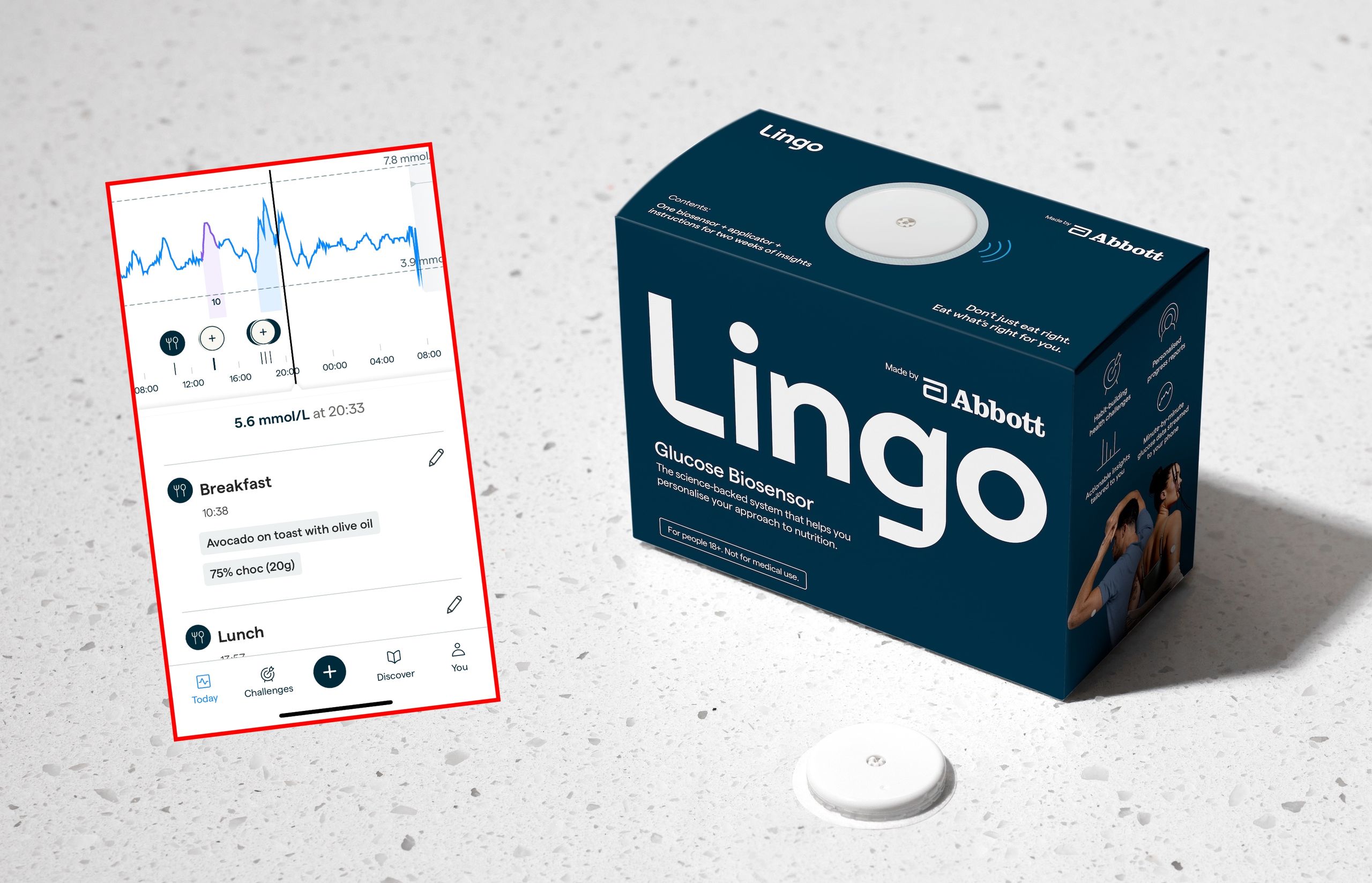
I peered dubiously at the plastic disc in my hand, with its little needle protruding from the centre. I have no major beef with needles, but this was different – I had to somehow find the gumption to press it in, all the way, and leave it there.
The disc was a CGM biosensor (CGM meaning continuous glucose monitor), and once stuck on the skin, it would transmit real-time blood-glucose levels to an app on my phone. All very Buck Rogers.
As for me, a perennial surfeit of adipose tissue (let’s just say it out loud – I’m overweight) meant I had extra skin in the game, and I was interested in whether real-time glucose monitoring might help me eat sensibly.
Pain-free gains
Applying the biosensor was, in the event, completely painless. The accompanying applicator that Lingo supplies certainly helped expedite the process (not to mention the fact that, unbeknownst to me, it was spring loaded). Once stuck on, the sensor began transmitting via Bluetooth and in a short while the data began appearing on the app.
Seeing the inner workings of your body appearing, in real time, on a line graph in front of you is quite impressive. Anyone who has ever used a heart-rate monitor will be familiar with it, of course, but this is a little different in that the actual content of your blood is being examined. It’s not like a pulse, which you can take by placing a couple of fingers on your wrist.
The Lingo app is easy to use and easy to read, and allows the user to add ‘events’ throughout the day, such as bouts of exercise and meals, which are then used to annotate a rolling glucose line graph which continues 24/7.
Each biosensor lasts two weeks before it stops transmitting – I was initially sent two. Enough, I hoped, to give a little insight into my body and exactly what it made of that second beer or that doorstep sandwich, and of course how the healthier parts of my diet were affecting it.
(Image credit: Lingo CGM)
No drama
As a fully signed-up member of hypochondriacs anonymous, when the initial figures came through I was gratified to note that there was no apparent need to head immediately to A&E. I studied the little line for a while as it… did not very much at all. I watched it meander across the screen with an almost disappointing lack of drama before putting the phone down and getting on with some work.
It will come as no surprise that snacks, meals, exercise, all affect blood glucose (sugar) levels. We’re constantly being told to avoid sugar spikes and associated crashes by choosing foods that are lower on the glycaemic index, or perhaps to pair sugary foods with fats or protein to reduce the spike, or to take a short walk after a meal to help reduce boost glucose control.
According to ZOE, co-founded by preeminent nutritional scientist Tim Spector, repeated large glucose spikes can be inflammatory and put heart health in jeopardy. Blood sugar that is consistently too high can also ultimately lead to diabetes, as the body becomes slowly less efficient at responding to it. There’s no doubt that blood sugar matters.
It isn’t only diet that affects blood sugar. Exercise, as you might expect, also plays a part. I was feeling pretty pleased with myself even as I was pulling on my cycling kit for my first bout of Lingo-assisted Zwifting, imagining the line on the graph falling to baseline levels that could only indicate some sort of mega-healthiness.
Imagine my surprise when it did no such thing; instead, it began rising steadily, staying within healthy range but only beginning to tail off once I’d stopped. It didn’t take much Googling (plus a little common sense) to realise that, of course, the muscles need glucose when they’re being tasked with exercise, and it is delivered via the blood. Despite the temporary spike, exercise leaves the body with long-term glucose-control benefits that are great for health, and is most definitely a good thing.
Once I’d realised that my body seemed to respond in a generally healthy way to both diet and exercise, it felt like the job of the CGM had largely been done. The only thing left to do was to refine my food choices and smooth out the spikes that did exist. I learned that much of my standard diet left the CGM with little to shout at me about, although perhaps a breakfast of Greek yoghurt and berries was slightly better than a bowl of low sugar muesli.
Call of the cake tin
However, when things went a bit sideways and the call of the cake tin proved more powerful than my own will, the line on the chart reacted with a predictably sharp upward spike. As such, wearing the CGM and being linked up to the app had the effect of making me eat more carefully during the time I was wearing it. No bad thing.
It’s worth pointing out that CGMs may not be perfectly accurate. A 2025 study by the University of Bath found that they tended to read higher than fingerprick blood tests, which are still deemed to be the gold standard, and could lead to unnecessary or poor dietary changes in healthy individuals. However, the study still rated CGMs as “fantastic tools for people with diabetes”.
The Lingo CGM comes at a cost, of course, and in the realm of CGMs it’s very reasonable – you can buy the biosensors for as little as £48 per two weeks if you sign up for a 12-week bundle. A one-off purchase will cost £59. A pair costs £99.
Would I spend my own money to sign up again? Not right away, but I could definitely imagine investing for, perhaps, a month a year. £99 doesn’t get you much in cycling (or anything else) these days, and for a potential annual health boost it sounds like remarkably good value.
