Lando Norris celebrated winning the Formula 1 title at the Abu Dhabi Grand Prix, but you won’t see any photos of him with the world championship trophy on Sunday night.
It remains a bizarre quirk of Formula 1 and one that is a throwback to the old era of the sport, before the popularity boom which made it more culturally relevant than ever before. As governing body of the series, the FIA oversees the awarding of the trophy for Formula 1, but there seems to be a lingering reluctance to make it a big deal or to properly associate it with the winning moment.
Given that it is the most prestigious and significant prize in all of motor racing, that is bizarre indeed.
The trophy Norris, Max Verstappen and Oscar Piastri were all fighting for was on show, briefly, in the build-up to Sunday’s climactic showdown event, presented in front of the contenders by FIA president Mohammed Ben Sulayem. It doesn’t have a very catchy name: the FIA Formula 1 World Drivers’ Championship trophy is what Norris officially won on Sunday, yet he won’t get his hands on it until a prizegiving gala hosted by the FIA, motor racing’s governing body, in Tashkent, Uzbekistan on Dec. 12.
It seems a real waste, when you consider how many iconic images have been created with championship trophies. A few instantly spring to mind.
Michael Jordan crying into the Larry O’Brien trophy. Nelson Mandela handing South Africa captain Francois Pienaar rugby’s William Webb Ellis trophy in 1995. England captain Bobby Moore hoisting the Jules Rimet trophy on the shoulders of his England teammates in 1966.
Formula 1’s trophy, by contrast, seems like an afterthought.
By the time Norris finally collects it, he won’t be in his race overalls, he won’t be covered in sweat and champagne, nor will he be paraded on the shoulders of his mechanics or lapping up the cheers of the fans who have spilled onto the track and stayed for hours chanting his name. He won’t be drinking champagne out of it. He won’t even still be in team colours. Instead, he’ll pick it up while dressed in a tuxedo, stood on the stage in a sterile hall, full of polite applause. That seems like a huge disservice to the winning moment.
So why is Formula 1’s biggest prize still hidden away from the very moment it was designed to celebrate?
The trophy itself
F1’s main trophy does not have the same history of the series itself, but it is a beautifully designed thing.
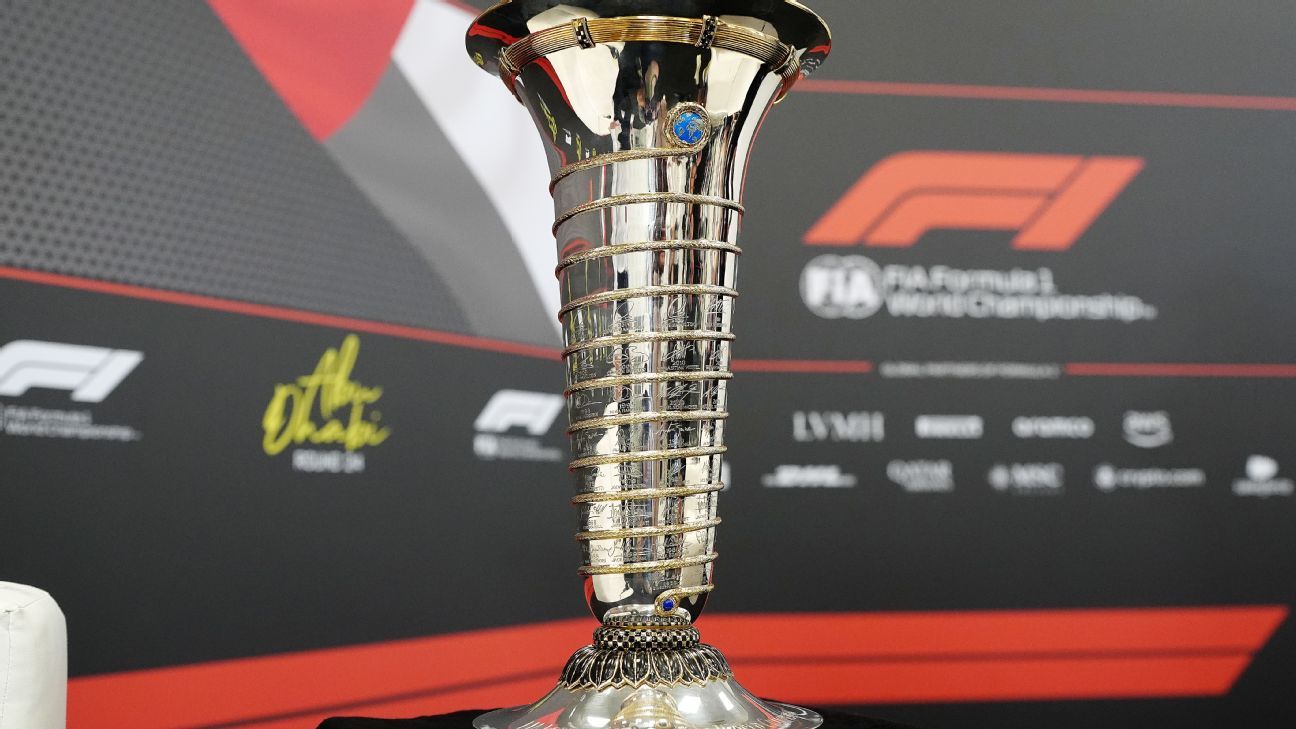
While the formalized world championship started at the 1950 British Grand Prix, and this year is celebrating its 75th season, there was no official trophy for the champion until one was commissioned in 1995. Designed and crafted by Richard Fox for a sum of £46,500 at the time, it is made of sterling silver, 24 ct gold and enamel, standing at 525mm in height and weighing in at 4.7KG. The champions’ signature is engraved on the side, alongside the corresponding year, leading to a striking trophy face.
The same year, Fox also made the constructors’ world championship trophy, which instead of signatures features the logos of the winning team every season. This one has arguably even less fanfare than the drivers’ version. Again, that’s a shame, as it looks spectacular.
There is only one proper version of the world drivers’ championship trophy, but it was not flown out for the showdown. A replica sat alongside the three drivers in Thursday’s press conference — Ferrari driver Charles Leclerc took a moment to inspect it up close in his own, hinting at a man unfamiliar with what it really looked like — and again on the grid on Sunday. The real one was in London — the FIA told ESPN it could not travel to Abu Dhabi as it needed to be engraved once a winner had been declared. This was a curious explanation, given that other sports and championships make a point about the winning name being engraved in real time while the confetti is still falling.
The original will travel to Tashkent for the ceremony and will be in the possession of Norris until it is required back in London next year to engrave the name of the 2026 champion. Norris will then be able to order his own copy. Verstappen appears to have done this at every available opportunity, with his previous world championship trophies often appearing in his live streams, dotted around his house.
“I have four of those at home,” Verstappen quipped on Thursday, nodding to the replica.
So why doesn’t Norris get it right away?
If you followed the build-up to this year’s championship, you might recognize the F1 trophy, but the chances most reading this will not be able to immediately imagine what it looks like without the helpful pictures littered through this article. This flies in the face of almost every sporting competition of any note. Think of the FIFA World Cup, and you immediately think of the golden goblet which goes to the winners every four years. Think of the Super Bowl, and you immediately think of the Vincent Lombardi trophy, covered in fingerprints, being lifted aloft. Think of the Stanley Cup, and you immediately think of the towering, 35.25 inch trophy of the same name.
It doesn’t even have to be a trophy either. Think of the Masters, and you think of the green jacket. Think of IndyCar’s Indianapolis 500 and you think of the winner pouring milk all over their face at the end (the Indy 500 also has the mighty Borg-Warner trophy, it should be added, one of the most iconic in all of racing). While so many other sports have made their winning moment synonymous with an object or a tradition, Fomrula 1 has not — at least not when it comes down to the ultimate prize. F1 has done this with the podium ceremony, when the top three spray each other with champagne while Les Toreadors from George Bizet’s opera Carmen plays out, a tradition stretching back to the mid-1990s, but so far has not managed to find something as brilliant for the championship-winning moment.
Firstly, if it was solely down to Formula 1, they probably would have by now. On taking over the sport in 2018, American owners Liberty Media quickly noticed the odd quirk of F1’s trophy and pushed for it to be on the grid ahead of the infamous 2021 Abu Dhabi showdown between Verstappen and Lewis Hamilton. The same pressure was applied with the constructors’ championship trophy ahead of the McLaren and Ferrari battle at the curtain-closing venue last weekend.
But it isn’t down to Formula 1 at all. The oddity of the trophy is a wider part of the curious divide between Formula 1 the entity and the FIA as the overarching governing body. Formula 1 owners Liberty Media are the commercial rights holder of the sport, but the governance and officiating of the sport itself is overseen by the FIA. This in itself has been a bone of contention for a while and a lingering source of frustration for F1 as a whole — see the ongoing discussion over FIA stewarding, penalties and racing rules this season, for example.
The official FIA reasoning for not awarding the trophy is two-fold. First, the championship is the centrepiece of the governing body’s prizegiving gala — in Uzbekistan, the winners and runners-up of every FIA-affiliated championship will be there to collect their prize. There has been a feeling within the FIA that it would be difficult for the gala to have the desired gravitas if F1’s world championship trophy had already been handed out at the end of the season. Currently the champion, runner-up and third-place finisher are required under the sporting rules to attend the gala — Hamilton was fined for not attending in 2021 — but the FIA believes it might struggle to hold F1’s drivers to this rule altogether if the championship prize had already been given out. It would essentially have to hand it out in Abu Dhabi, collect it back, then present it again. The same rules apply to the world constructors’ championship — it’s why you’ve not seen McLaren CEO Zak Brown and team boss Andrea Stella parading that around so far this season.
You can understand why the FIA takes this view. Young drivers and karting champions from around the world attend this event and it is the view of the governing body that champions from across the landscape — F1, rally, you name it — should be there for them as role models. But there must be a fairly simple way around this. The champion could still be required to attend, only they are responsible for bringing the trophy with them, which they walk out on stage in the key moment of the gala.
Protecting a prizegiving gala does ultimately seem to be a fairly weak excuse for keeping out of the public eye, though, especially as it is still a relatively new prize. If the process of the gala had been enshrined in F1 lore since 1950, maybe this would have taken on a life of its own like Augusta’s green jacket, but the trophy came to being a year after Ayrton Senna’s death at Imola in 1994. It was designed the same year Juan Manuel Fangio, winner of five championships in the 1950’s, passed away. If you google some of F1’s other greatest drivers, like Alain Prost, Jim Clark, Jackie Stewart, you will not find them with a championship trophy at any point.
Does the rule make sense?
Of course, winners do sometimes wait for their prizes.
Olympians sometimes wait a day to get their medals, but do so in the middle of the stadium, listening to their national anthem, in a moment of extreme national pride. Champions of the Premier League wait until the final day of the season to be awarded the famous prize for England’s top division of football, even if they won it weeks earlier, but this still feels incredibly special. The captain hoists it aloft surrounded by whooping teammates, coaches, family, medals bouncing around on their necks, fans chanting and confetti falling from the sky. The emotion of that moment is not diminished by the wait, but the location and being able to celebrate it in a human way makes it memorable.
The second reason the trophy is treated a bit like an afterthought exists within the FIA’s sporting code. Just as a race result can be subject to change after the race, whether via penalties or protest, Article 14.4.2 states a team must lodge any protest or appeal at the outcome of the championship four days before the prizegiving gala event. That happened in 2021, when Mercedes briefly protested the race after then-FIA race director Michael Masi ignored the rulebook to force a one-lap restart. Mercedes rescinded their appeal shortly before the gala, citing the “greater good of the sport”.
From the FIA’s perspective, they only want to hand the trophy over once it is absolutely, categorically certain who is meant to lift it. Now, on the surface, that makes a lot of sense. Imagine handing out a world championship trophy, only for it to change hands days or months later in court. As a reason for not making a bigger deal of the trophy it makes sense until you consider that it completely contradicts what the FIA does when handing out Formula 1 trophies for each grand prix. At the end of every race, the top three drivers go to the podium after the finish and collect the first-, second- and third-placed trophy. A representative from the team also goes to the podium to collect a trophy for the winning constructor.
But race results throughout the year are, like the outcome of the championship, also subject to any postrace reviews or protests from other teams within a certain time frame. Last month’s Las Vegas Grand Prix was a great example: Norris had already gone to the Bellagio Fountain podium ceremony to collect the second-place trophy when McLaren was thrown out of the race hours later. In that instance, his second-place trophy went to Russell, and Russell’s third-place trophy went to Antonelli with almost zero fanfare.
So if grand prix trophies are OK to change hands after the fact, why does a different rule exist for what is supposed to be the most important prize in all of motor racing? It doesn’t make a lot of sense.
F1 and the FIA together have an opportunity to build a new tradition and new legacy with both their trophies, especially on days like Sunday, when the world is watching. Given how the sport has been propelled to new heights by an embracing of newer, more modern ideas, its about time the same was done with the thing every young karting star dreams of one day having their signature engraved on.
