As the Mets continue to reshape the team following the Brandon Nimmo trade and signing of Devin Williams, their needs are obvious.
There’s the need to re-sign Edwin Diaz, which would give New York perhaps the best 1-2 late-game punch in baseball, or add another high-leverage reliever.
Advertisement
The starting rotation has to be addressed in a big way, with a trade for a top-of-the-rotation starter possibly the best way to go about it.
Power must be added to the lineup, whether it’s with the return of Pete Alonso or the addition of someone else.
And with Nimmo on the Rangers, there are now holes in both left field and center field.
Taking the above into account, the third base situation seems pretty settled, with Brett Baty penciled in as the starter.
But if Alonso isn’t retained, upgrading the offense by adding a third baseman could make a lot of sense.
Even if Alonso is back, addressing third base with a legitimate bat could still be in the cards in the event the Mets go internal or short-term at one or both vacant outfield spots.
Advertisement
Let’s break it down…
The Internal Candidates
In 432 plate appearances spanning 130 games last season, Baty hit .254/.313/.435 with 18 home runs and 13 doubles. His .748 OPS dwarfed his previous career-best OPS of .633, his OPS+ of 111 was solidly above league average, and his defense at third base was smooth and reliable.
In addition to Baty’s standard offensive numbers, his advanced metrics also told a nice story in 2025.
New York City, New York, USA; New York Mets second baseman Brett Baty (7) rounds the bases after hitting a two run home run against the Philadelphia Phillies during the second inning at Citi Field. / Brad Penner – Imagn Images
While his 51.0 percent groundball rate was improved from 2024 (54.5 percent), it was still well above the MLB average of 44.2 percent. Baty also strikes out at a pretty high clip for someone who doesn’t hit for a lot of power. And he won’t make an impact on the bases.
Advertisement
But Baty’s above average offensive performance last season, strong defense, age (26 for all of next season), cost, and team control are all pluses. He won’t become arbitration-eligible until after the 2026 season, is under team control through 2029, and made just $774,000 in 2025.
Following a down 2025, Mark Vientos is an option at third base as well.
While Vientos struggled this past season, he continued to hit the ball incredibly hard and barrel it up at a well above average rate. There’s also the fact that despite an overall down year, Vientos helped drive the offense for about a month, when he hit .304/.385/.759 with 10 homers and six doubles in 22 games from Aug. 17 to Sept. 9.
But given Vientos’ defensive struggles, it’s hard to imagine him being given a starting role at the hot corner. His fit would be better at DH, and it’s also a possibility he’ll get traded.
Advertisement
Ronny Mauricio remains intriguing, due largely to his power potential and ability to hit the ball incredibly hard. Mauricio is also a versatile defender, able to handle third base, second base, and shortstop. But he’s struggled offensively in the majors, slashing just .234/.295/.369.
The External Candidates
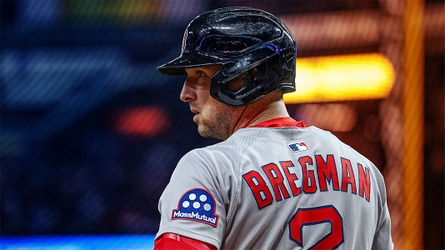
A possibility exists that the Red Sox sign Alonso, which would theoretically open the door for the Mets to turn to Alex Bregman.
In 114 games last season for Boston, Bregman slashed .273/.360/.462 with 18 homers and 28 doubles — in a year that was interrupted by a quad strain. The 128 OPS+ he put up was his best since 2022, and he continued to be elite when it came to making contact.
Advertisement
Defensively, Bregman was strong at third base, where he was in the 83rd percentile and worth 3 OAA. And in Boston’s dugout and in the clubhouse, Bregman had a huge impact — something that has been the case throughout his career.

Boston Red Sox third baseman Alex Bregman (2) plays third base during the game against the Houston Astros at Daikin Park / Troy Taormina – Imagn Images
Put it all together and it feels like Bregman checks all of the Mets’ boxes: Right-handed, above average hitter, strong defense, and great in the clubhouse. But it’s fair to wonder if New York will want to pay up for a player entering his age-32 season.
A wild card could be Bo Bichette, as unlikely as a potential signing might be. But if the Blue Jays sign Kyle Tucker, a return to Toronto could be a lot less likely for Bichette.
Advertisement
Before acquiring Marcus Semien in the Nimmo trade, Bichette — who played second base during the World Series for the Blue Jays — would’ve been a strong fit for New York there.
For the Mets to add him now, Bichette would have to be willing to move to third base — a position he’s never played in the majors.
But most shortstops are able to handle third base, and Bichette is a special hitter the Mets would be wise to pursue. He’s also entering his age-28 season, meaning a long-term deal might be more palatable.
If the Mets want a short-term option, Eugenio Suarez could make sense — especially if they’re trying to add right-handed power in a world without Alonso.
Advertisement
Suarez mashed 49 homers last season for the Diamondbacks and Mariners, tying the career-high he set in 2019.
On the negative side, Suarez had a sub-.300 OBP and was a poor defender, grading out in the ninth percentile. So if the Mets sign him, he’d make much more sense as a DH.
Then there’s Japanese stars Munetaka Murakami and Kazuma Okamoto, who are able to play both first base and third base.
When it comes to Murakami, most experts have him pegged as a first baseman only. And there are huge questions about whether he’ll make enough contact in the majors for his offense and insane power to properly translate.
Okamoto is a plus defender, and could fit at third base for New York in certain scenarios. But the guess here is that he’d be viewed as a first base option if the Mets pursue him.
