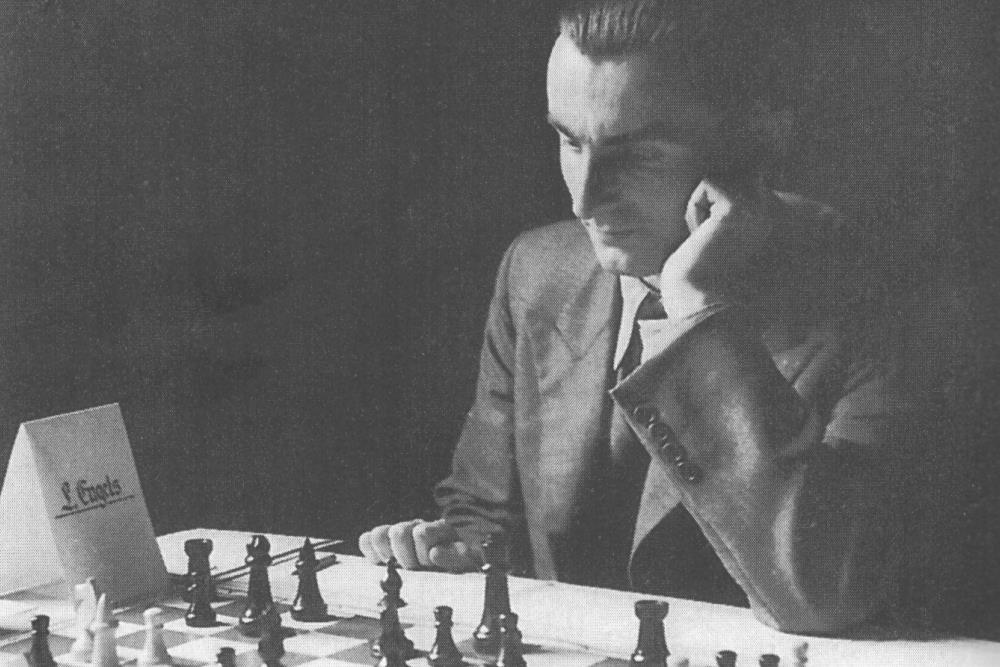
Today, the Düsseldorf chess champion Ludwig Engels is largely forgotten in his home country. Yet in the 1930s, he was one of the best German players, and in 1939 he was a member of the German national team that won gold at the Chess Olympiad — the only German team ever to do so. However, following Austria’s forced annexation to the German Reich, this was a ‘Greater German team’. The last Chess Olympiad before the Second World War, held in Buenos Aires, could only be brought to a reasonably orderly conclusion with great difficulty, as the war had begun in Europe with the German invasion of Poland.
None of the players on the German national team returned to Germany. After the war, a new generation of chess players emerged. Soon, those who had remained in South America were forgotten.
Ludwig Paul Engels was born on 11 December 1905 in Düsseldorf to merchants Louis and Catharina Engels. His twin brother, Johannes Clemens, died the following year. He also had an older sister, Mia, and a half-brother, Wilhelm, who were both from his father’s first marriage. Wilhelm died in 1918 while serving as a radio operator on a submarine during the First World War. When Ludwig was five, his mother died from a stomach ailment. He and Mia grew up with their grandmother in Witten for several years. Following her death in 1915, the siblings returned to their father in Düsseldorf.
Ludwig Engels had learnt to play chess from a school friend. In 1922, he joined the Düsseldorf Chess Club of 1854. He also played for another Düsseldorf chess club, the ‘Berührt-Geführt’ club. In 1927, the year that thrilled chess fans around the world with the world championship match between Capablanca and Alekhine, Ludwig Engels celebrated his first major success by becoming the Rhineland and Westphalia champion. He then began to play chess professionally.
At the start of the 1930s, Ludwig Engels found a strong training partner in the form of Georg Kieninger (1902–1975) in Düsseldorf.
Engels participated in various national tournaments in the first half of the decade with some success. However, he was sometimes overly nervous, which caused him to lose games against weaker opponents at the end of tournaments when victory was within reach, thus preventing him from achieving success.
In 1936, the newly formed Greater German Chess Federation organised an Olympic training tournament in Dresden, in which the best German players competed against top international players, including Alexander Alekhine, Paul Keres and Géza Maróczy.
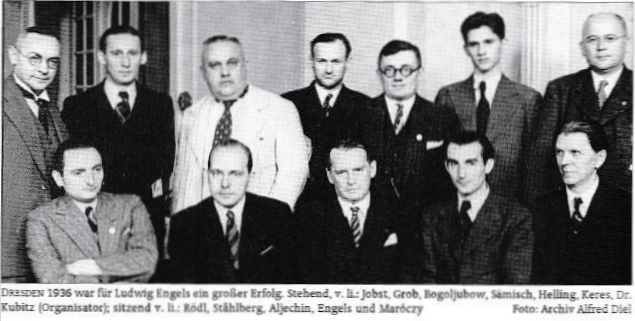
Engels achieved victories against the three top players, ultimately finishing a close second behind the former world champion, who had lost his title to Euwe the previous year and was regaining his form. Engels’ attacking victory against Karl Helling also attracted considerable attention.
On this DVD GMs Rogozenco, Marin, Müller, and IM Reeh present outstanding games, stunning combinations and exemplary endgames by Alekhine. And they invite you to improve your knowledge with the help of video lectures, annotated games and interactive tests
Engels was also successful at the training tournament in Bad Nauheim in 1936, sharing second place with Eliskases.
At the next Chess Olympiad, held in Munich in 1936, Engels played on board three for the German national team. He achieved only a mediocre result, primarily due to a weak second half of the tournament. Germany won the bronze medal at this Chess Olympiad, which was not officially recognised by FIDE, finishing behind Hungary and Poland.
Later that year, Engels was invited to Iceland to coach the national team. He stayed for around six months, from December 1936 to May 1937, coaching the best players and most promising talent, giving simultaneous exhibitions, and participating in tournaments organised to coincide with his visit. He also visited the extensive chess book collection bequeathed to the Icelandic National Library by the American Daniel Fiske following his visits to the island in the 19th century.
Between 1937 and 1939, Engels played in several tournaments in Germany, including regional ones, but, with one exception, none abroad.

Compared to the national elite, Engels was usually able to place himself at the top of the tables, but he also suffered a few setbacks.
In July 1939, the German national team and Friedl Rinder, who was due to play in the Women’s World Cup, travelled to Argentina on the Priapolis. The Greater German Olympic team included Erich Eliskases, Peter Michel, Ludwig Engels, Albert Becker and Heinrich Reinhardt. Other players were absent for various reasons. Efim Bogoljubow demanded too high a salary (1,000 marks per month). Kurt Richter did not travel abroad. Meanwhile, Georg Kieninger and Karl Gilg foresaw the war and did not want to leave their families.

At the 1939 Chess Olympiad in Buenos Aires, scoring was based on board points, with preliminary rounds played in groups. On 1 September 1939, just as the preliminary rounds had concluded, the German Wehrmacht invaded Poland, marking the beginning of the Second World War. The English team left. The remaining teams were persuaded to stay, enabling the tournament to be completed.
However, some teams no longer wanted to play against each other. These matches were scored as 2–2 without a fight, including three involving the German team. At the end of the tournament, Germany won gold. Ludwig Engels was the best German player (+16 =4), as well as being the best player on board three, for which he was awarded an individual gold medal.
Many players, including all the German players, remained in South America after the Chess Olympiad ended. Life was difficult for the refugees. Engels received some support from the German Embassy in Buenos Aires, which helped him to make a living by giving simultaneous exhibitions and doing odd jobs. He also competed in several tournaments, achieving 4th–5th place in Mar del Plata in 1939 and 3rd–4th place in Montevideo in 1941.
In 1941, when a new hotel opened in São Paulo, Brazil, a chess tournament was organised and some of the Europeans stranded in Argentina were invited to take part, including Ludwig Engels. The tournament took place at various locations in and around São Paulo. The final round took place in the Edifício Martinelli, the city’s oldest skyscraper, which was built in 1940. Erich Eliskases and Carlos Guimard won the tournament. Ludwig Engels shared third and fourth place with Paulin Frydman.
On his way back to Buenos Aires, Engels spent about four weeks in the Brazilian province of Santa Catarina, home to many German immigrants, giving simultaneous exhibitions and competing in tournaments. The German colony of Blumenau, in particular, was very enthusiastic about the visit of the famous chess master at the time.
However, in the meantime, Brazil had declared war on Germany and closed its borders, preventing Engels from returning to Argentina. It is not known exactly where Engels spent the time until the end of the war, but it was probably in Porto Alegre or the southern states of Brazil, or perhaps São Paulo.
In Lourenço Cordioli, Engels found a friend who supported him during these difficult times. In return, Engels gave Cordioli chess lessons. Cordioli later became São Paulo champion three times. After the war ended, Engels was able to participate in well-attended tournaments again. He also competed in team matches in Brazil.
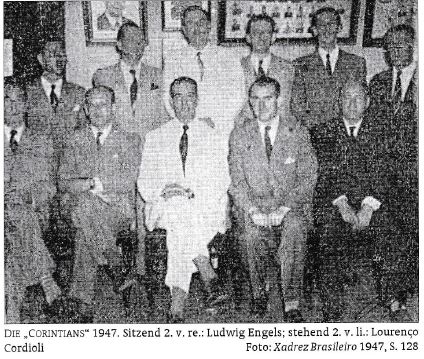
In São Paulo in 1947, Engels came third, behind Eliskases and Najdorf. In Recife, also in 1947, he came second behind Eliskases. Having become an employee of a chess club and editor of the chess magazine Xeque!, as well as a columnist for a chess column in a daily newspaper, Engels now had a regular income.
In 1952, he played in the anniversary tournaments of the chess departments of Fluminense in Rio de Janeiro (6th place) and the São Paulo chess club. At the latter’s 50th anniversary tournament, Engels shared first place with Braslav Rabar, finishing ahead of Héctor Rossetto and Erich Eliskases. In 1953, Engels came third in another Fluminense tournament, behind Svetozar Gligorić and Petar Trifunović.
During the 1950s, Engels, who was approaching 50, slowly lost touch with the top players in the country. At the 1957 Zonal Tournament, he still managed to finish sixth. In 1960, he played in another Zonal Tournament, finishing in the middle of the field. Engels’ final tournament appearance was at the São Paulo Chess Club tournament in 1966. Henrique Mecking won, while Engels finished eighth out of ten players.
Ludwig Engels died of a heart attack in São Paulo on 10 January 1967. The São Paulo Chess Club arranged for him to be buried at the Cemitério da Lapa in São Paulo. During a visit in 2011, Friedrich-Karl Hebeker and Lourenço Cordioli were able to locate the neglected grave (Q.70–T.84).
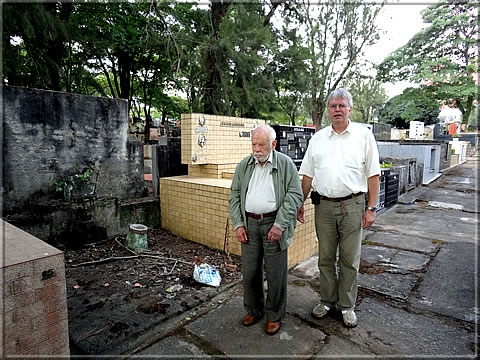
Lourenco Cordiolo and Friedrich-Karl Hebeker | Photo: Hebeker
Chess enthusiasts in Düsseldorf, particularly Erich Noldus and Professor Friedrich-Karl Hebeker, have made a valuable contribution to researching the life of Ludwig Engels. In 2016, Hebeker published a comprehensive biography of the Düsseldorf chess master which provides detailed insights into contemporary history, the history of chess in the Rhineland and Düsseldorf, and the history of chess in South America. Much of the information in this short biography comes from his book Vom Rhein nach São Paulo: Ludwig Engels 1905–1967 (From the Rhine to São Paulo: Ludwig Engels 1905–1967).
The premiere chess database with over 11.7 million games
The ChessBase Mega Database 2026 is the premiere chess database with over 11.7 million games from 1475 to 2025 in high quality.
