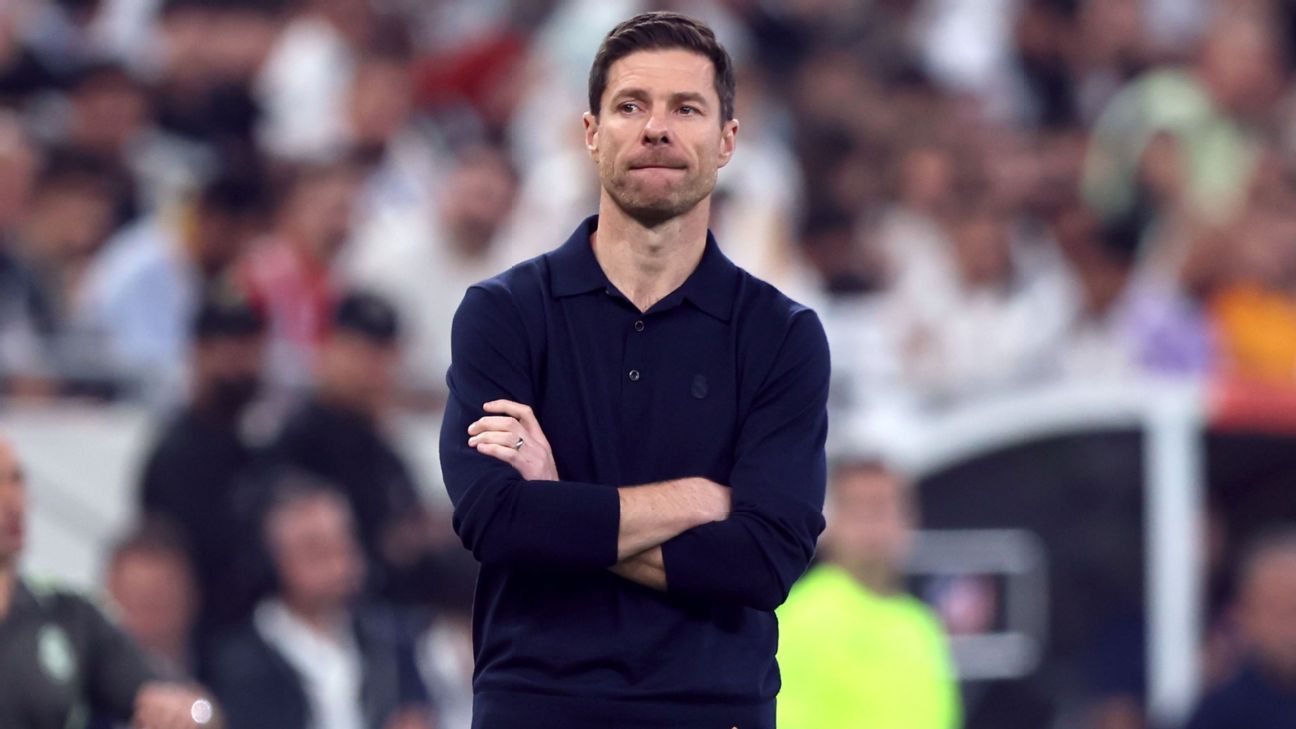
On Sunday night in Jeddah, Xabi Alonso was talking about the future. Real Madrid had just lost to Barcelona in the Spanish Supercopa final, missing out on the season’s first trophy, and their coach was keen to turn the page.
“We have to move on, as soon as possible,” Alonso told Spanish TV. “It’s the least important of the competitions we play. Now we have to look forward, get [injured] players and our morale back, and carry on.”
It’s true that this week, Real Madrid are moving on, but without Alonso. Less than a day after that 3-2 loss to their biggest rivals, the club announced that he was leaving. A short statement, released just after 6 p.m. Spanish time on Monday, read: “By mutual agreement between the club and Xabi Alonso, it has been decided to bring his time as first team coach to an end.”
Just 233 days after being appointed, Alonso — a Madrid legend as a player, and one of the most highly rated young coaches in world football — was gone. On Monday evening, his coaching staff were already collecting their things at the club’s Valdebebas training ground. Alonso’s successor had already been confirmed: his former teammate, friend and coach of reserve team Castilla, Álvaro Arbeloa.
– Alonso wasn’t perfect, but sacking him ignores Madrid’s real problems
– How Alonso’s Madrid tenure compared with Mourinho, Ancelotti, Zidane
– Arbeloa, Alonso’s successor, will bring a bit of Mourinho back to Madrid
The timing of Alonso’s exit — which, sources close to the coach told ESPN, was a sacking, and not “by mutual agreement” as stated by the club — was a surprise. But within the club, doubts about the coach had been growing for months. Sources close to both Alonso and the dressing room told ESPN those doubts started at the very top, with club president Florentino Pérez.
It wasn’t just the Supercopa defeat to Barcelona. It wasn’t just the UEFA Champions League losses to Manchester City and Liverpool. It wasn’t just the embarrassing 2-0 LaLiga home defeat to Celta Vigo, or the unacceptable 5-2 derby thrashing by Atlético Madrid. It wasn’t only Vinícius Júnior‘s angry, public reaction at being substituted in October’s Clásico, although with hindsight, that looks like a tipping point.
From the very beginning, last summer, there were questions inside the club — both at the executive level and within the squad — about aspects of Alonso’s management. Those questions got louder as results and performances dropped off, and Alonso’s relationships with key players deteriorated. The coach felt undermined by a lack of support from what sources close to him called a minority in the dressing room. He had tried to adapt and build bridges, they said, and there had been some, limited signs of improvement; but in the eyes of the club, it wasn’t enough.
The situation was not viewed as sustainable. Alonso’s departure was agreed. And now the postmortem of his time in charge begins.
Additional reporting by ESPN’s Rodra and Rodrigo Faez
Uncertain start
The strength of Alonso’s position as Madrid coach had one significant drawback from the start, club sources told ESPN. His arrival as coach had not been instigated by Pérez. Instead, Alonso’s champion was José Ángel Sánchez, the club’s popular director general. He spoke to Alonso when his Bayer Leverkusen team came to Madrid in January 2025, to play Atlético in the Champions League.
Sánchez and others felt that given his Real Madrid past and historic achievements at Leverkusen — winning the league and cup double without losing a single match — Alonso was the obvious candidate to replace Carlo Ancelotti. Pérez was concerned about Alonso’s relative inexperience, and viewed him as a gamble, but accepted the recommendation.
Sources within the club, and close to Alonso, said there was never the same degree of connection between Pérez and Alonso that had been there, at times, with Ancelotti or Zinedine Zidane. Alonso himself felt that Pérez had not completely bought into his methods, while some players felt Alonso’s decision-making was limited by a lack of support from the president. It was a major, eventually fatal handicap for the Alonso era, and one that was built into its foundations.
Alonso’s appointment was confirmed on May 25, 2025, with a formal presentation the following day. The coach had not wanted to take charge before the FIFA Club World Cup, believing it would be more advantageous to begin a new project with a more conventional preseason. The club had other ideas.
Alonso struggled to hide his feelings. “These are the circumstances,” he said at his unveiling, showing little enthusiasm for the summer tournament. “And as it’s like that, I see it as an opportunity.”
In the team’s time in the United States, the first fault lines between Alonso and senior members of the squad developed. Multiple sources close to the dressing room told ESPN that Alonso’s handling of Vinícius Júnior upset the player. Alonso first considered experimenting with Vinícius on the right wing, and then planned to drop him for Madrid’s semifinal with Paris Saint-Germain. Only a late reshuffle, forced by injury, changed his plans. The episode badly damaged the pair’s relationship.
There were disagreements with the club, too, over squad planning. Trent Alexander-Arnold, Dean Huijsen, Álvaro Carreras and Franco Mastantuono were signed last summer. None of them were the tempo-setting midfielder Alonso wanted. Martín Zubimendi, who joined Arsenal, had a close relationship with Alonso, having worked with him at Real Sociedad. The club didn’t believe such a signing was necessary, pointing to the squad’s existing midfield options. Sources close to the coach told ESPN that Alonso felt that decision had significantly hindered the teams’ possibilities of success this season.
Alonso had the misfortune to succeed Ancelotti, a genius at squad management and perhaps the coach best-qualified to deal with Madrid’s star-studded, ego-filled roster. Despite his success at Leverkusen, and his past as an elite player, it was a challenge Alonso had never faced.
Locker room sources told ESPN that early in the season, Alonso — a man with clear ideas, determined to implement them — gave the players little leeway. He wanted to change various features of the players’ daily routine, and their habits. He wanted to see an improvement in punctuality. He wanted to see fewer outside figures — people close to players, but not part of the squad and coaching staff — present at the training ground. It was a change which was not well received by some in the dressing room.
Clásico flash point
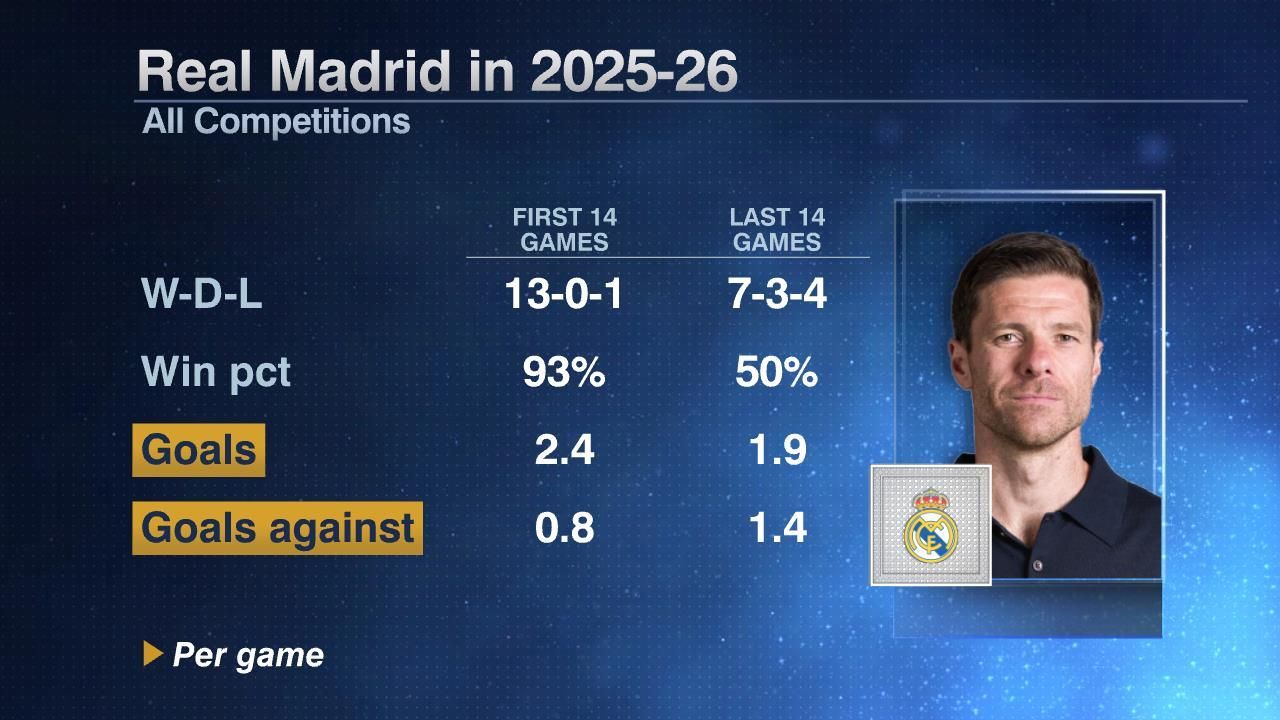
It would be unfair not to recognize the high points of Alonso’s brief reign. There were early signs of change and improvement in the team’s play at the Club World Cup. When 2025-26 started, Madrid won 13 of their first 14 games. The season peaked with a 2-1 Clásico win over Barcelona at the Bernabéu in LaLiga, on Oct. 26. A year earlier, Ancelotti’s Madrid had lost the same fixture 4-0.
It felt like progress, but a result that should have served as confirmation that Alonso’s Madrid were heading in the right direction was undermined by one, headline-grabbing moment: Vinícius Júnior’s furious reaction at being substituted in the 72nd minute. “Me voy del equipo” (“I’ll leave, shall I?”),” TV images appeared to show Vinícius shouting as he left the field and headed down the tunnel. “Mejor me voy” (“Best that I leave”).
Alonso had already omitted the Brazil forward from the starting XI for games against Real Oviedo and Marseille. His management of the player, starting at the Club World Cup, had raised eyebrows inside the club, with senior executives questioning the wisdom of Alonso’s approach, with Vinícius’ contract renewal — his deal up in 2027 — in the balance. Now, Vinícius’s reaction, in the most public setting possible, a packed Bernabéu, the biggest game of the season, had laid bare the extent of the tension.
Just as damaging for Alonso was the reaction in the days that followed, as Vinícius apologised to everyone — except his manager. Sources close to the locker room told ESPN that other players, already unhappy, now sensed weakness in Alonso and his lack of support from within the club. In his first real crisis, the coach hadn’t received the backing he needed; instead, his decision to substitute Vinícius had been undermined.
Downward turn
Then came a run of desperately bad form and results, the kind of run from which few Madrid coaches have successfully recovered. The team lost 1-0 at Liverpool, drew 0-0 at Rayo Vallecano and drew 2-2 at Elche. An unconvincing 4-3 win at Olympiacos was followed by a 1-1 draw at Girona. A 3-0 victory at Athletic Club was an outlier, and what came next left Alonso hanging by a thread: a 2-0 home defeat to Celta, and a 2-1 loss to City three days later.
The team’s form was not helped by an injury crisis that robbed Alonso of a number of senior players, and forced him to rely excessively on others, to their detriment. Eight first-team players were missing for the City game, including star striker Kylian Mbappé. Senior executives have raised concerns about the number of injuries. Alonso’s decision to sideline Antonio Pintus — previously responsible for the physical preparation of the first team, working with Zidane and Ancelotti — was debated. A day after Alonso’s sacking, Pintus was back working with the team at Valdebebas, alongside Arbeloa. In the face of mounting problems and growing pressure, Alonso tried to adapt, and improve his relationship with the squad. Sources in the locker room said that he relaxed some of his earlier rules, gave the players more days off, tried to make Vinícius feel more important, a more ‘Ancelotti style’ approach.
“As Real Madrid coach you have to be ready to deal with these situations,” Alonso said. “It’s not about changing, it’s about adapting. I know the culture at Real Madrid. That’s why it’s the biggest job in the world. You need to adapt, you need to learn.
“There’s a process, an interaction with the players. Some days are good, some days are not so good, but in every game we take steps. We’re in this position now, and we have to face it with energy and positivity.”
There was little sign of that energy and positivity on the pitch, but Alonso survived until Christmas with three wins in a week against Alavés, Talavera and Sevilla. Sources told ESPN that most of the squad supported the coach, and the players were willing to accept some of the features of Alonso’s management style — such as an increased emphasis on video analysis — which they had rejected at first. However, there was also a recognition that at Real Madrid, when the team is on the kind of run they faced in November and December, the usual outcome is that the coach loses his job.
Alonso urged journalists to “keep calm” in his last words before the Christmas break, suggesting he expected to remain in charge. 2026 began with a 5-1 win over Real Betis, and then the Supercopa. Madrid were fortunate to beat Atlético 2-1 in the semifinal, and then competed against Barcelona while adopting a pragmatic, defensive approach.
In the aftermath of the Supercopa, his position was viewed as fragile, but intact, with even journalists close to Pérez confidently writing that Alonso had bought himself time. As it turned out, it was just a few hours.
Adiós
Sources close to the coach told ESPN that Alonso leaves Real Madrid disappointed on multiple fronts: disappointed with the contributions of some key players; disappointed that, unlike at Leverkusen, he had not had the freedom to implement his ideas; disappointed with himself, believing he could have handled certain situations differently.
A number of issues had hindered the team, sources said. Alonso felt some players were not looking after themselves properly, citing concerns with their diet. The coach was also concerned with the number of dressing-room leaks appearing in the media, a feeling shared by some of the players who backed him.
Sources close to the coach pinpointed an influential, vocal minority of players who had been unwilling to take on board his ideas. They named three senior players: Vinícius Júnior in particular, but also Jude Bellingham and Federico Valverde.
A source told ESPN that Bellingham had been reluctant to accept Alonso’s tactical vision, although — unlike with Vinícius — those differences had not played out in public. Bellingham denied reports of dressing room unrest this month, saying the squad were “all behind” the manager and that claims of behind-the-scenes issues were “fabricated” and “exaggerated.”
On Tuesday, Vinicius was among a handful of players who had not posted about Alonso’s departure on social media. Sources close to the Brazilian told ESPN that he had no plans to do so.
At board level, there was frustration at various aspects of Alonso’s management, with injuries, and the coach’s handling of Vinícius, two of the main concerns, as well as one, inescapable reality: the team had not been playing well, consistently, for months. One club source said that Alonso’s downbeat demeanor at the training ground in recent weeks had not gone down well with executives as the coach tried, and failed, to unlock the team’s potential. In the end, the club reached the conclusion that it wasn’t going to happen.
“If we carry on like this, we’d better leave it,” Sánchez told Alonso in a conversation after the Supercopa, according to one source. The terms of his departure mean Alonso will only be paid for one of the three years anticipated in his contract.
“It didn’t go as we would have liked,” Alonso posted on social media on Tuesday. “Coaching Real Madrid has been an honour and a responsibility. I leave with respect, gratitude and pride that I did my best.”
