Not even a large heap of coal could prevent the start of this year’s Tata Steel Chess Tournament. When the organisers, helpers and later the players, amateurs and professionals, arrived on Sunday for the first round of this year’s Tata Steel tournament at the De Moriaan hall, they found the way into the venue blocked.
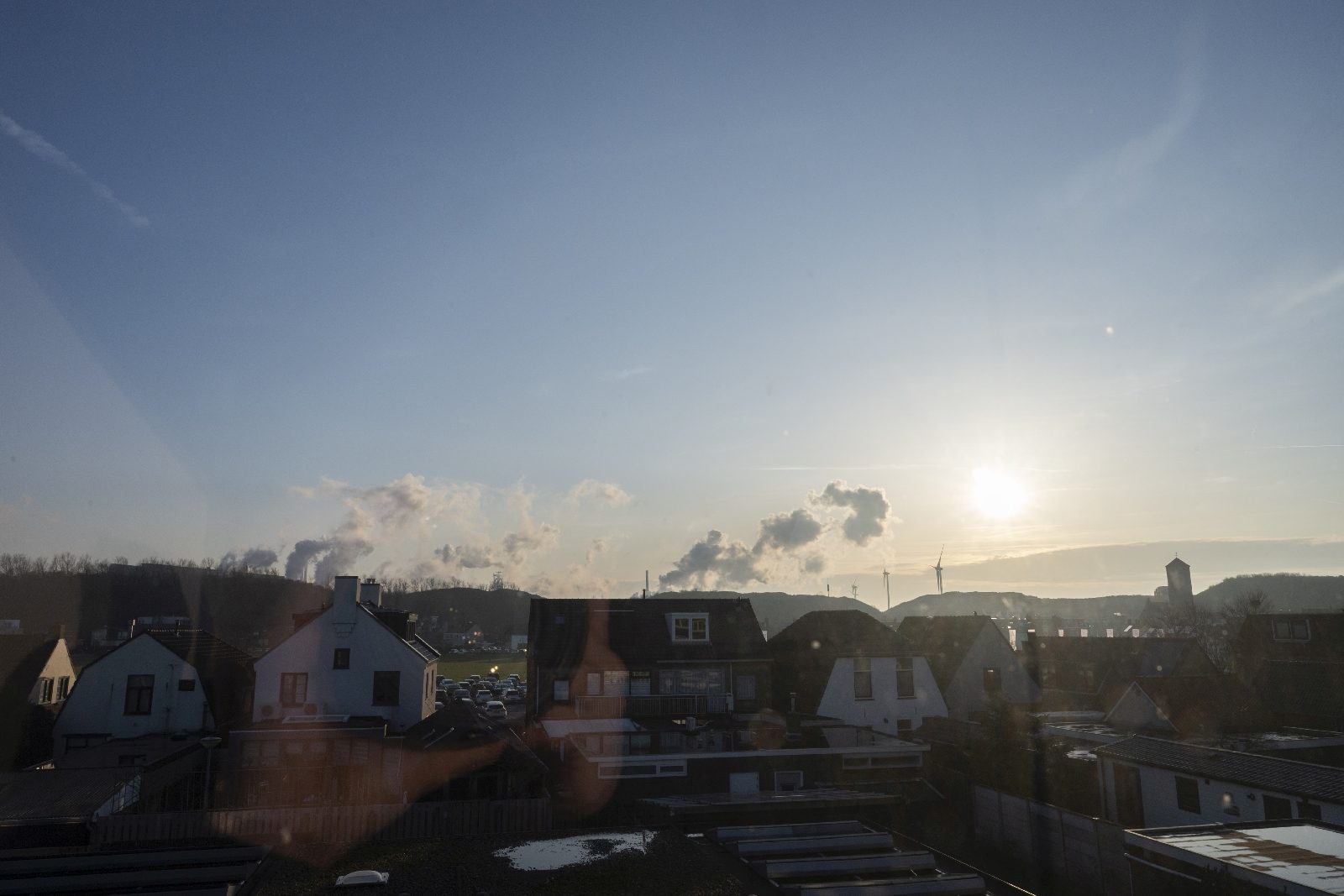
Activists from a protest group called “Extinction Rebellion” had obstructed the path to the tournament building with a large pile of coal. A group of people on the opposite side explained with chants and slogans, as part of a demonstration, why disrupting the start of the traditional chess tournament was sensible and necessary. The protest was directed against the tournament sponsor, Tata Steel – more precisely, against the existence of the steel plant nearby. Since its founding in 1916, its emissions have polluted the air and contributed to increased illness among the local population – an understandable reason for protest.
The King’s Indian Defence is one of the most dynamic openings in chess – and Pirc structures share much of the same DNA. With colours reversed (the King’s Indian Attack), these setups can be just as powerful. What may look modest at first often transforms into highly complex middlegames, where timing, precision, and a deep feel for dynamics make all the difference.
Free video sample: Introduction
Free video sample: Misplaced Pieces
Vandaag blokkeren we de ingang van het Tata Steel Chess Tournament in Wijk aan Zee. Rebellen storten 2025 kilo kolen, gebruiken lock-ons en hangen een banner op: No Chess on a Dead Planet. 2025 is het jaar waarin Tata Steel klimaatneutraal had moeten zijn. [1/4] pic.twitter.com/WSW2wA7eFQ
— Extinction Rebellion Nederland (@NLRebellion) January 17, 2026
The chess players themselves are not directly involved in the emission process, at least not to any significant extent, but they are still part of it, the demonstrators argue. According to them, by participating in this event, they help the sponsor with “sportswashing”, even if chess enthusiasts are not aware of this and it is not their intention — but it is convenient to have a catchy term like “sportswashing” for everything.
The coal was eventually removed, as were the activists who had chained themselves to the entrance. The action attracted the desired attention, and thus its purpose was fulfilled. After all, it is better than having a beautiful painting in a museum smeared with paint in the name of species conservation.
With a delay of one and a half hours, the tournament was nevertheless able to begin, even though the large number of chess enthusiasts in the hall immediately began converting oxygen into carbon dioxide – but they would have done that anyway.
Despite the protest outside the chess tournament, the sponsor intends to continue its financial support, tournament director Jeroen van den Berg reported in an interview.
The tournament was originally founded by employees of the steelworks – chess players who spontaneously organised an event. In 1938, this became an official chess tournament. The Hoogovens company, co-owner of the steel plant, supported the initiative, and over time the tournament grew larger and more prestigious.
The steel plant changed ownership, but the sponsorship of the tournament remained. Under the current owner, the Indian Tata Group, the event has experienced another boost. Tata now even supports a second tournament in India. This makes a great deal of sense for the company, as chess has become incredibly popular in India since Vishy Anand’s successes, and a number of young Indian grandmasters now rank among the world’s elite. With Gukesh Dommaraju, an Indian player is again world champion. Chess is virtually a national sport.
At times before Tata’s involvement, the tournament’s sponsorship was uncertain, but that is no longer an issue, says Jeroen van den Berg. After various discussions, he believes that Tata aims to reach at least 100 editions of the tournament.
Interview with Jeroen van den Berg
During the tournament, the entire town of Wijk aan Zee revolves around chess. Getting to the tournament is not entirely straightforward. Chess fans from Amsterdam have a reasonably short journey by taking the train to Beverwijk and then continuing by bus – but it still takes an hour. Visitors from abroad can fly to Amsterdam and then continue as described.
Those who enjoy adventure can travel entirely by train. In the Netherlands, the railway company follows its own timetable. Unless there has been heavy snowfall or severe storms, it works quite reliably. There is not much excitement here. But if you first rely on Deutsche Bahn, things become more interesting: the train may arrive, arrive later, or not arrive at all. Coming from the west, you can also drive your own car. In the Netherlands, this works well. In Germany, well…
Anyone who makes it to the town sign of Wijk aan Zee is greeted by signs and lanterns. Chess pieces or boards can be seen in windows throughout town. The few restaurants are fully booked every evening. A top tip is Tarantella, a kind of Sicilian enclave on the Dutch North Sea coast. Perhaps a Sicilian sailor was once shipwrecked here and stayed. Anyone entering the restaurant immediately feels they have left Dutch soil. Naturally, it is family-run.
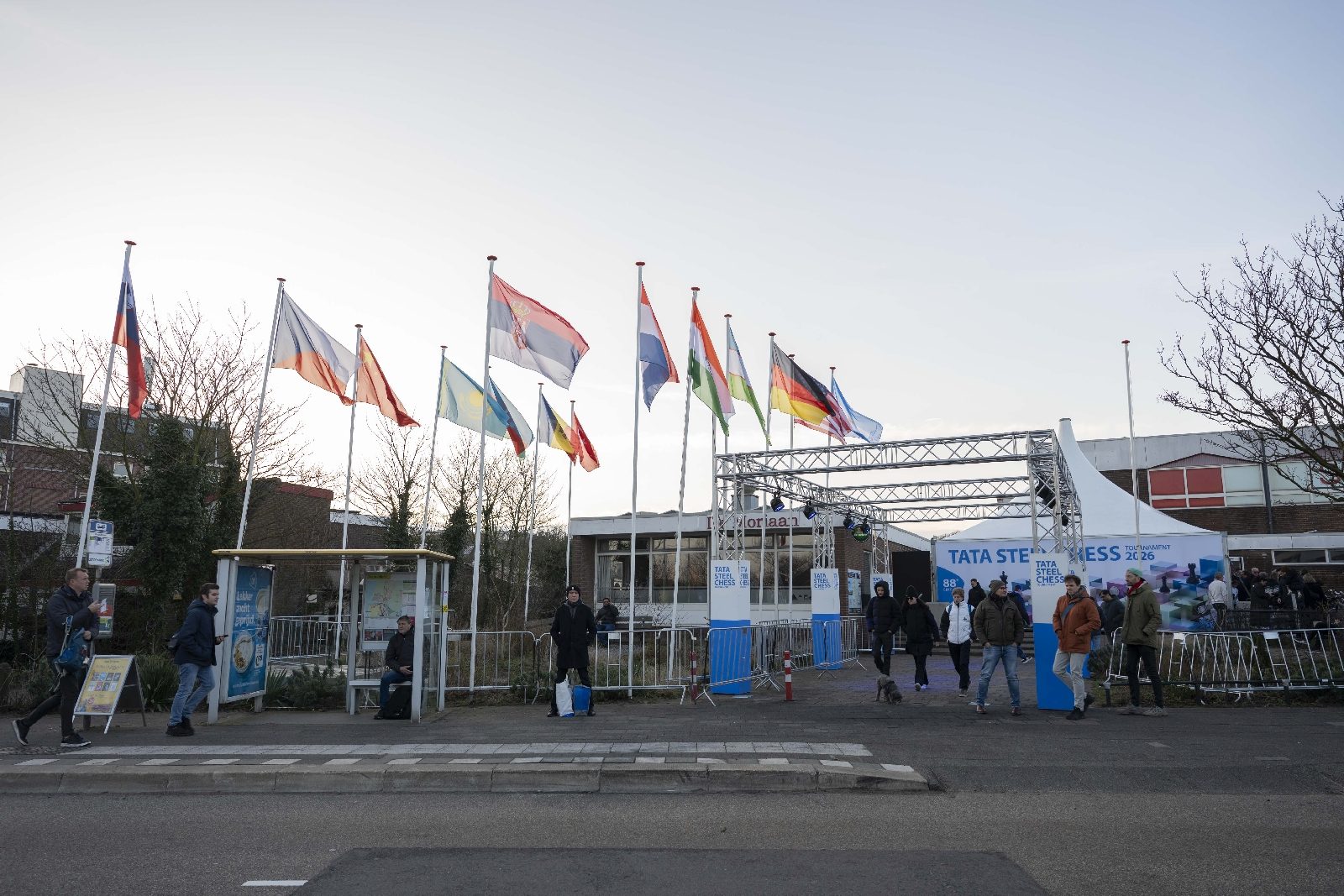
Entrance to the hall
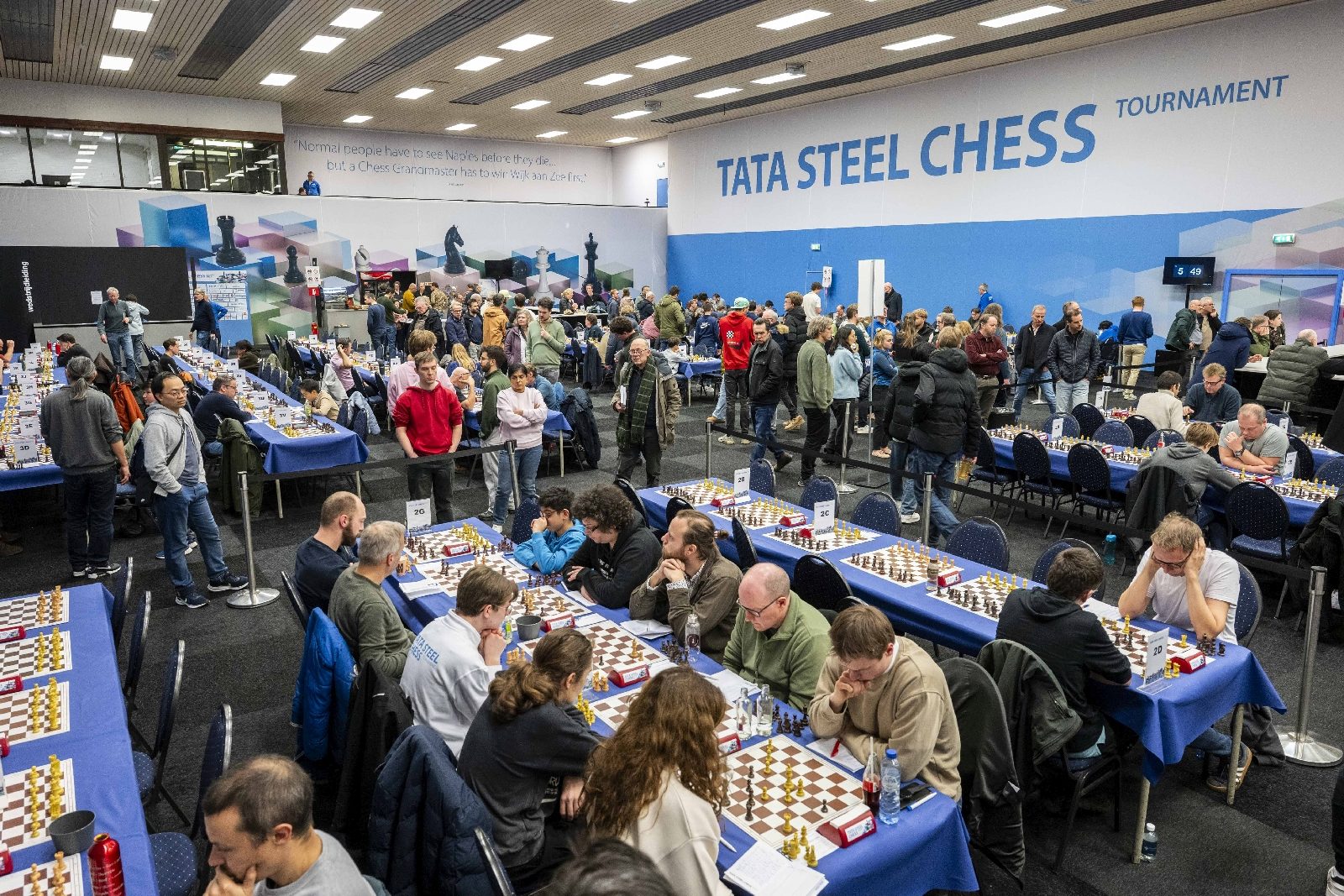
A particular organisational achievement is transforming the rather plain sports hall De Moriaan into a large chess tournament venue. Part of the hall is partitioned off with room elements and reserved for the games of the top players. At the other end of the hall there is a counter for food and drinks. The changing rooms are turned into meeting rooms, rooms for the arbiters and the many helpers, a medical room, exhibition rooms, or rooms for the press.
The live commentary has been moved to the pub next door, De Zon.
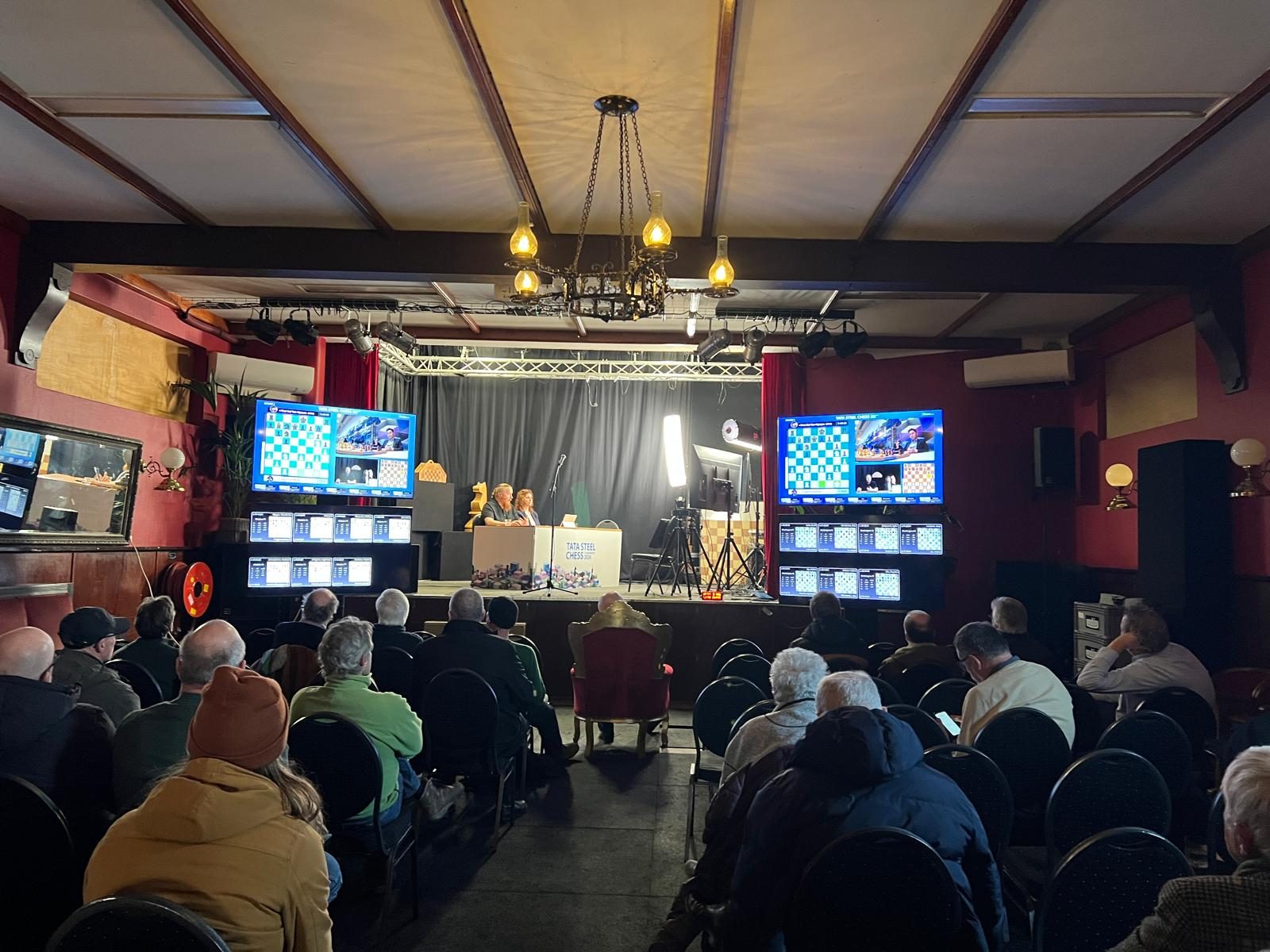
Here, Simon Williams and Jovanka Houska sit in front of quite a large audience and explain the games for the spectators, especially those online. But the seats in front of the stage are also well filled.
Interview with Jovanka Houska
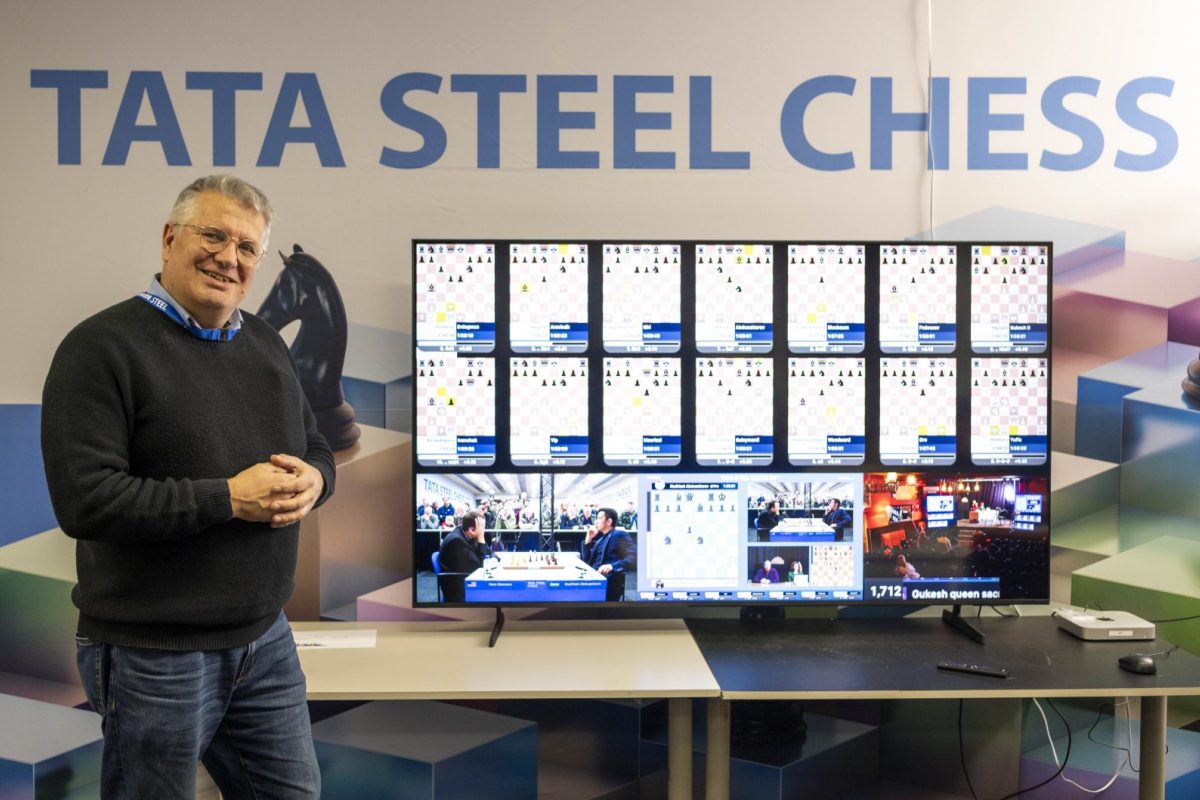
In terms of web presentation, the Tata Steel tournament is well ahead. Menno Pals and his company Menno Sport are responsible for the technology. He is something of a technical wizard with many innovative ideas, such as mini cameras, different perspectives and screens at the tables showing the board positions. Lennart Ootes supports him with many inputs that can be used for the webcast, such as tournament statistics.
Interview with Menno Pals
Interview with Lennart Ootes
The transmission technology using DGT boards is also significant. DGT leader Hans Pees reports on several innovations that are to be introduced soon.
In the tournament’s best years, there were three invitational events. Now there are two, each with 14 players. The Masters is packed with world-class grandmasters. It is the youngest edition of all time. In fact, the players at the absolute top of the world rankings are getting younger and younger. The top star is, of course, the Indian world champion Gukesh. However, he is not number one on the seeding list by Elo. That distinction belongs to the young German grandmaster Vincent Keymer.
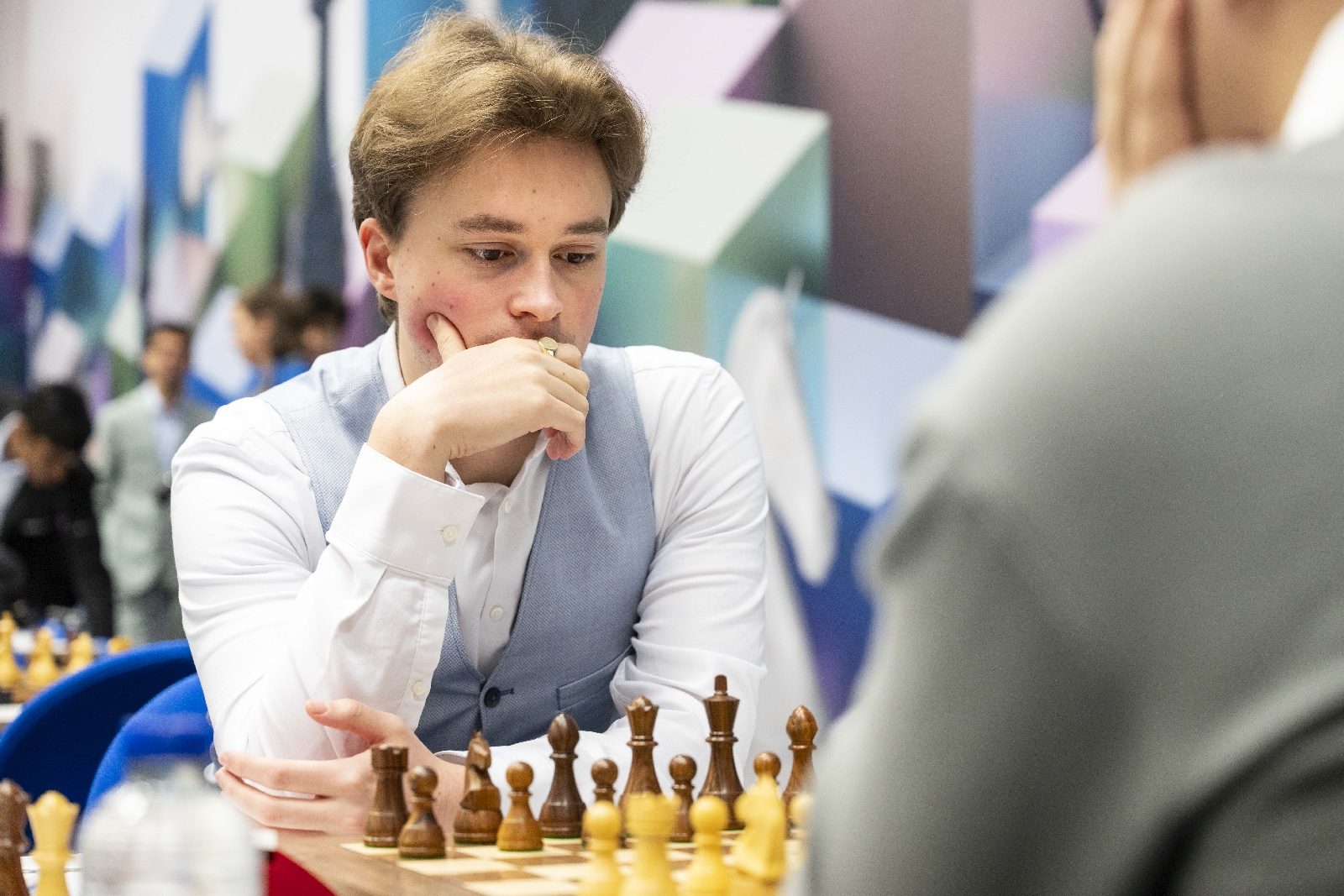
He is one of two German players in the Masters. Two-time European champion (something no one else has achieved) and Candidates participant Matthias Bluebaum is the second German in the field.
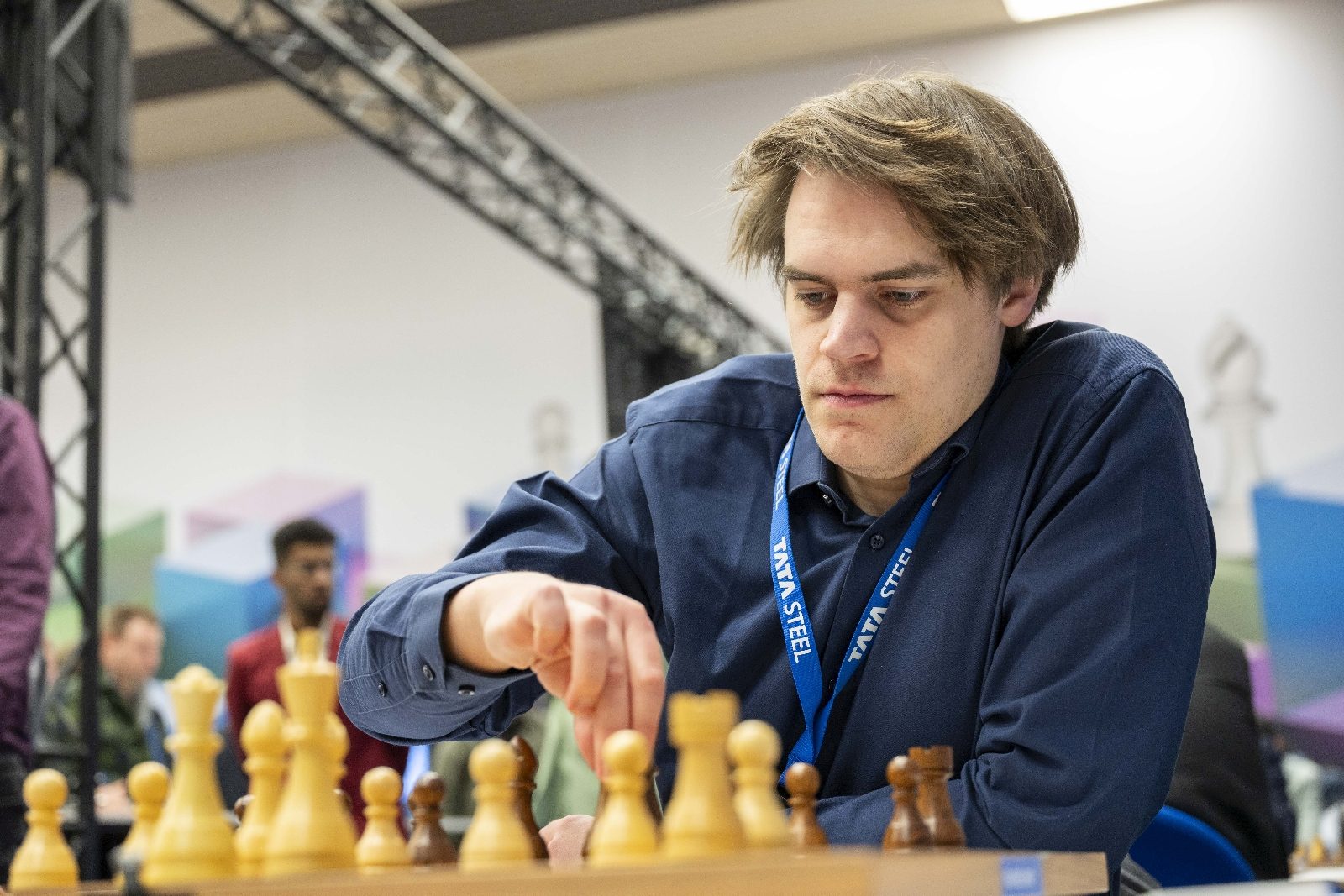
Alongside Gukesh, three more Indians — Erigaisi, Praggnanandhaa and Aravindh — are competing in the Masters. Also from Asia are the Uzbek representatives Nodirbek Abdusattorov and Javokhir Sindarov. The centre of elite chess is gradually shifting more and more towards Central Asia – India, Uzbekistan, Kazakhstan, while Iran and Turkey have a growing number of strong players.
Yagiz Kaan Erdogmus, currently the best 14-year-old in the world, is also playing in the Masters. He comes from Turkey. Thai Dai Van Nguyen is now the top Czech player. Hans Niemann represents the US federation. Anish Giri and Jorden van Foreest fly the host nation’s colours in the Masters, and finally Vladimir Fedoseev is also in the field, now representing Slovenia. He left his homeland Russia after the Russian invasion of Ukraine.
In the Challengers, Faustino Oro is the star.
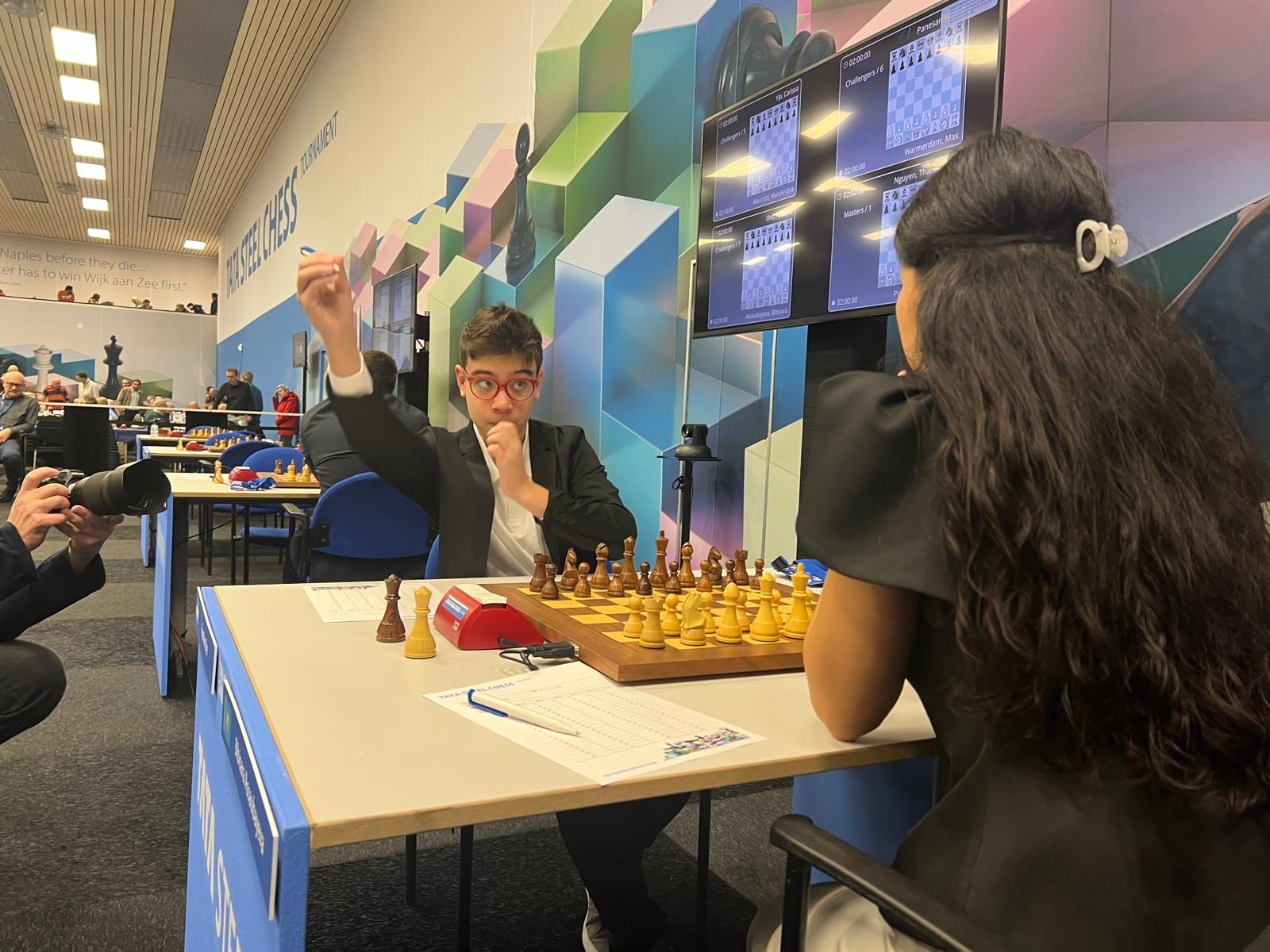
Who is the star of the Challengers?
The 12-year-old Argentine now lives in Spain and already appears remarkably professional and mature. He is expected to surpass Abhimanyu Mishra as the youngest GM of all time. Oro is well on course. Even if he does not manage it, it will not matter, as he is certain to make his way to the world elite. His plan is to win the Challengers and play in the Masters next year.
Oro started with three wins and two draws, placing him among the leading trio after five rounds, together with Aydin Suleymanli and Andy Woodward. Against the Chinese star Lu Miaoyi, the young world-class aspirant showed what he can do, although his 15-year-old opponent was hampered by a cold.
On the other side of the success scale for a while were Erwin l’Ami and Eline Roebers. L’Ami began with three defeats before managing to beat the veteran Vasyl Ivanchuk.
Eline Roebers had to cope with four losses, then won a fine attacking game against Velimir Ivic, but lost the following games.
In the Masters, Niemann and the two Uzbeks were leading after five rounds with 3½ points. Keymer won his opener against Giri, but then lost to Fedoseev and Bluebaum.
After a draw against Erdogmus, Keymer scored his second win against Aravindh, levelled his score and followed up with a victory over joint leader Niemann. In round seven, however, Keymer lost his now positive score after a defeat to Abdusattorov. This was followed by a draw against Javokhir Sindarov. With fifty-percent, Keymer is certainly not satisfied.
Bluebaum is one of three players under 2700 in the field but has so far held his own very well. After draws against Aravindh and Niemann, he defeated Keymer. However, he then lost to Sindarov. From rounds five to eight, Bluebaum drew all his games. The German number two is difficult to beat. After eight rounds, Bluebaum, like Keymer, has 4 points, with a performance rating of 2727.
The sole leader is Abdusattorov with 5½ points. The Uzbek star could even afford a loss to Giri in round eight and kept the lead.
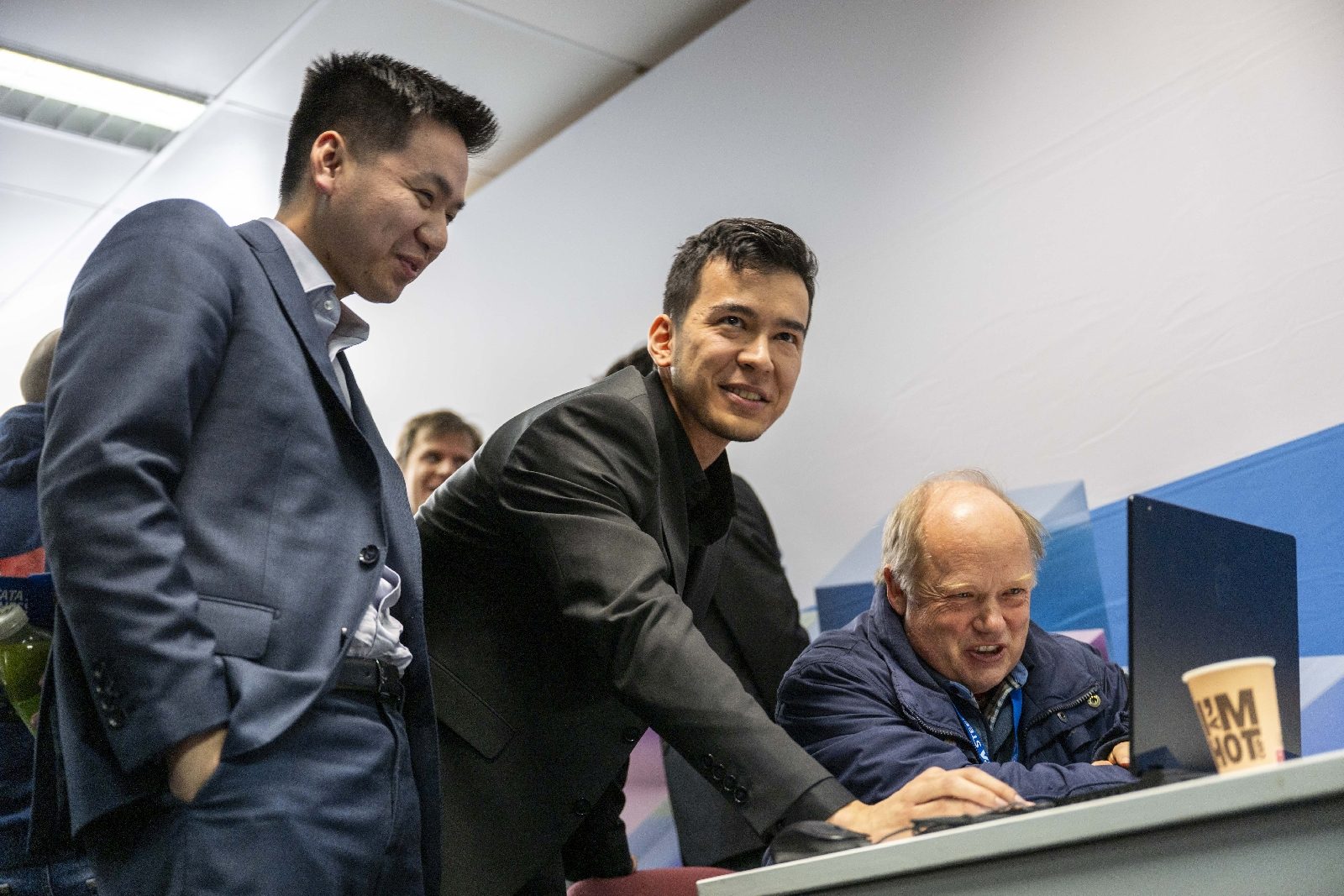
Thai Dai Van Nguyen and a cheerful Nodirbek Abdusattorov at Miechel Abeln’s computer
Erdogmus is playing a very good tournament. After four draws and a loss to Sindarov, the Turkish rising star scored wins against Van Foreest and Erigaisi and has so far achieved a performance rating close to 2780.
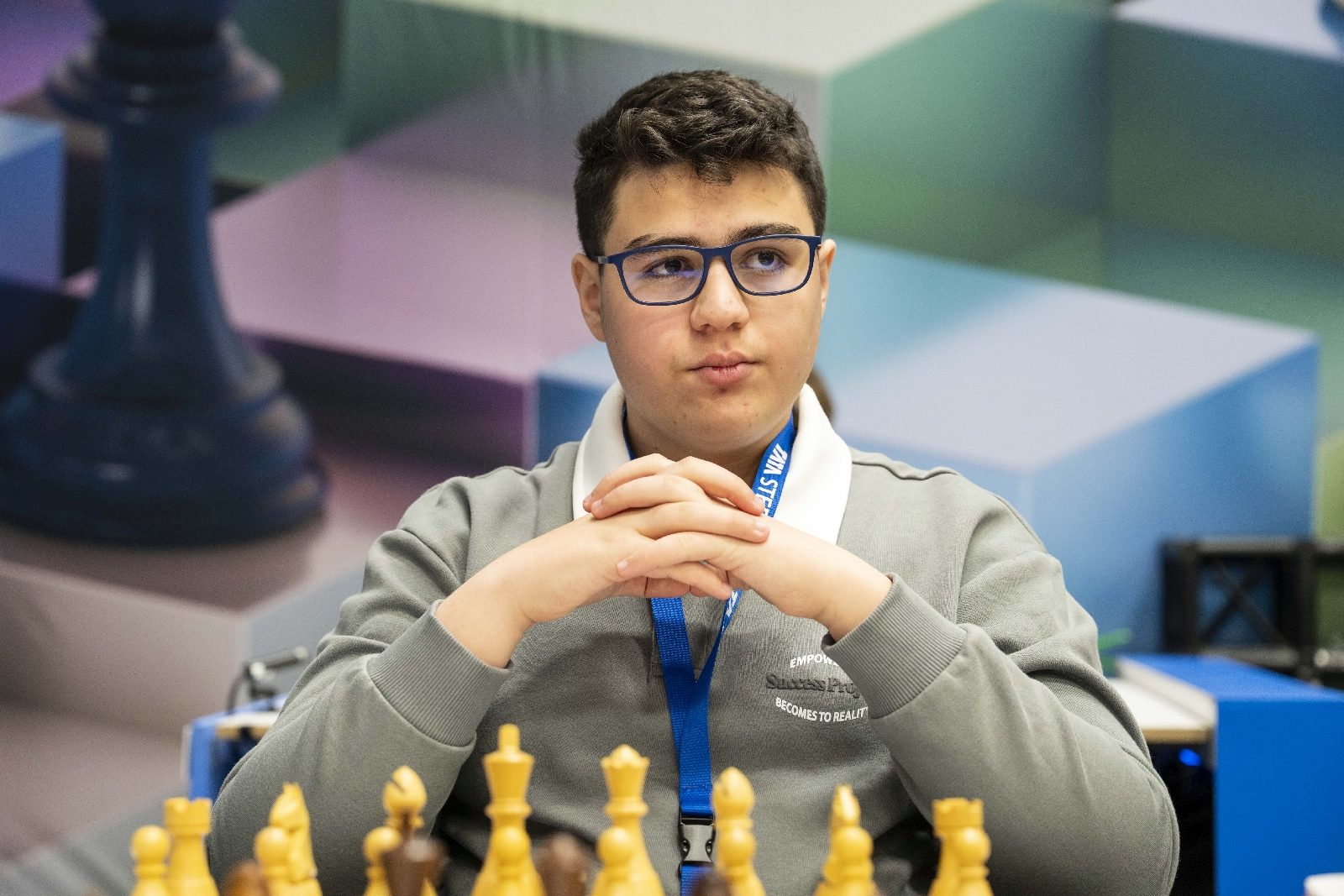
The four Indians have not been particularly convincing this time around. Reigning world champion Gukesh, after a solid start, blundered horribly against Abdusattorov in round six and sits in the group from sixth to tenth place with 4 points.
Nevertheless, Gukesh is the player with the most fans.
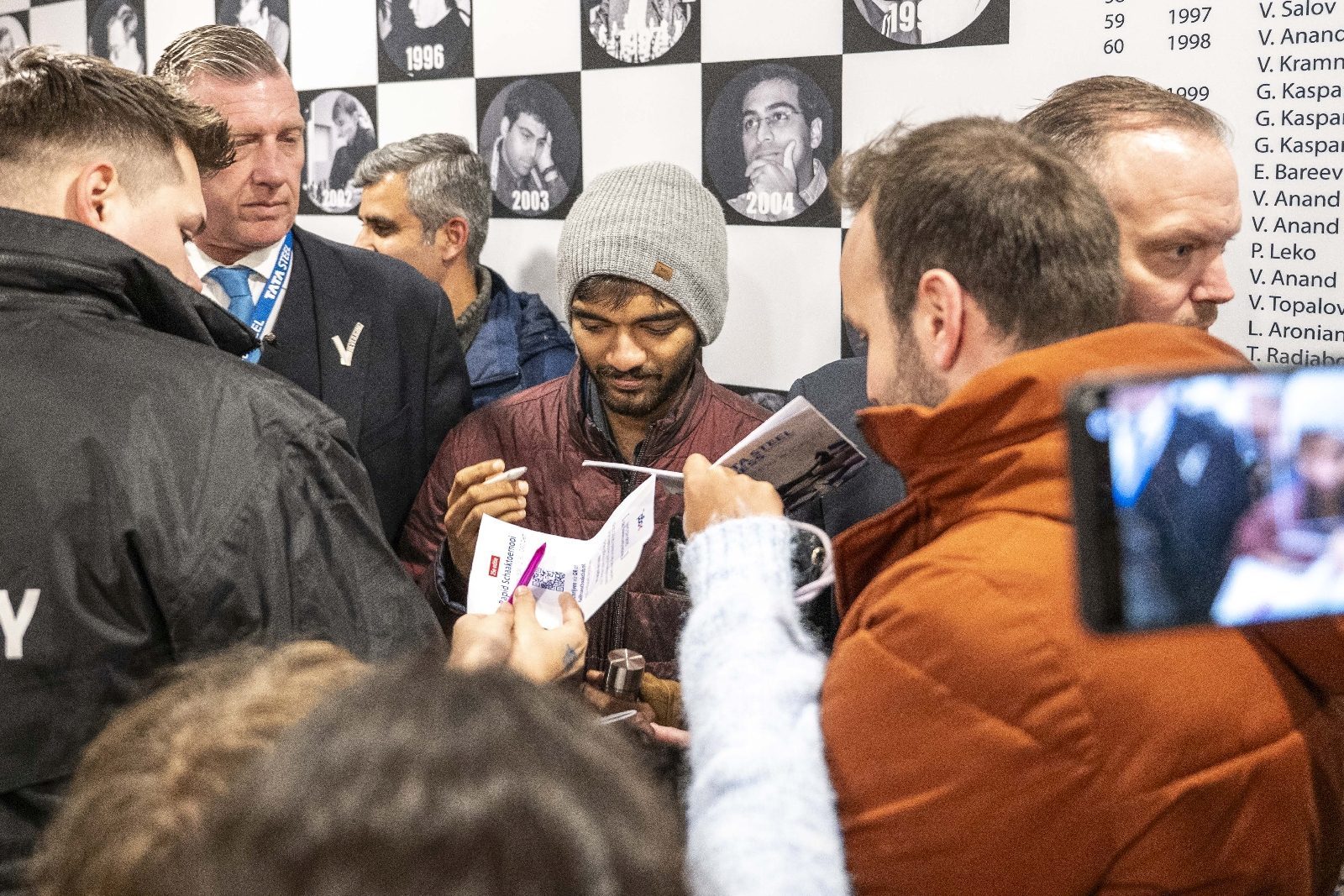
Erigaisi, Praggnanandhaa and Aravindh have even fewer points. Perhaps it is simply too cold on the Dutch North Sea coast.
In the Challengers, Oro, who had been so successful at the start of the event, suffered two losses in the last three rounds and is now somewhat further from tournament victory. After eight rounds, Marc’Andria Maurizzi, who won the last three rounds, and the 15-year-old Andy Woodward lead with 6½ points.
After a longer break, ChessBase has once again sent a team to Wijk to capture some of the atmosphere with a few short videos and interviews.
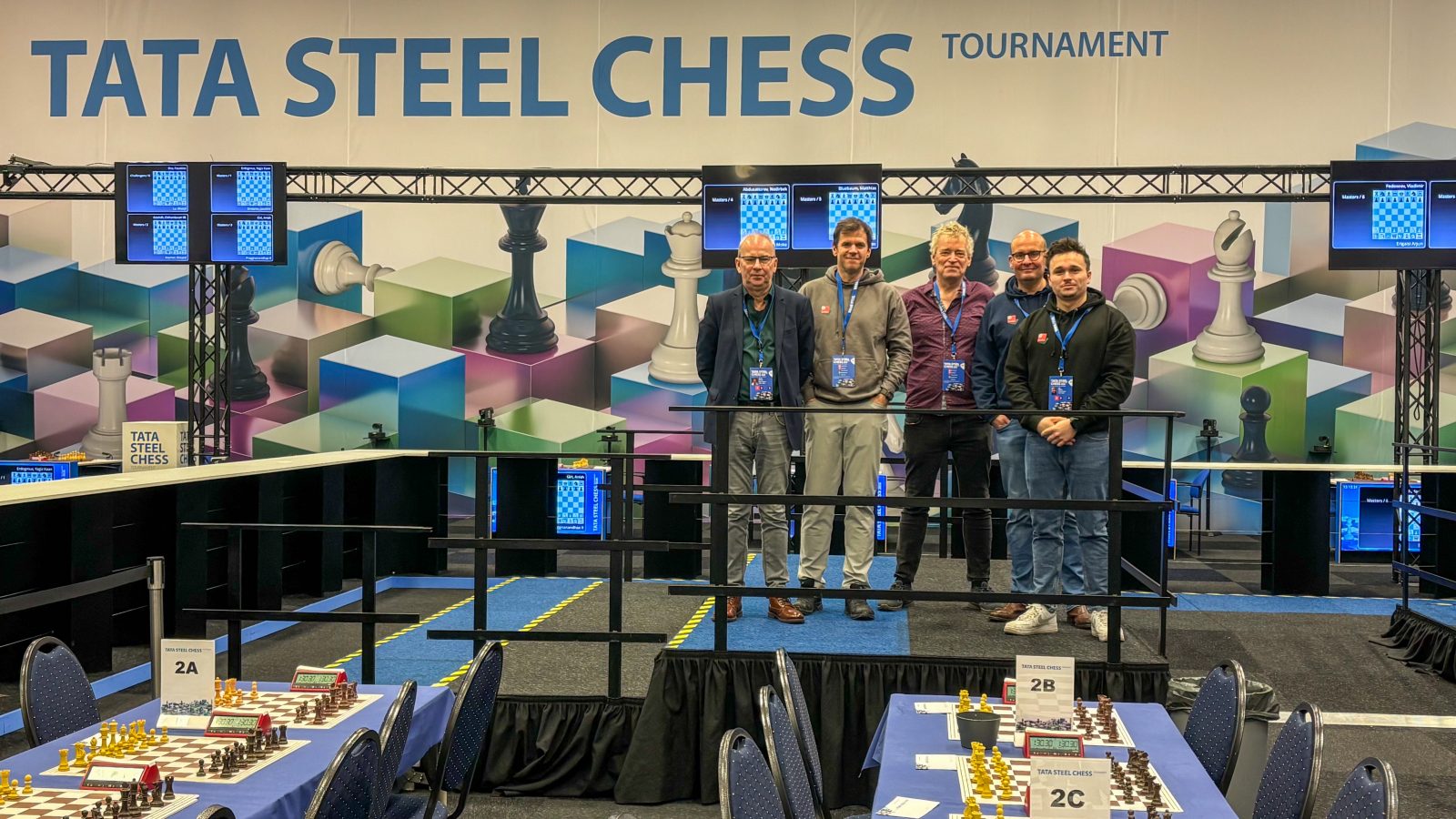
André Schulz, Arne Kaehler, Jeroen van den Belt, Ben Bartels, Nils Rhode. Missing is Pascal Lautenschläger, who had already left.
At the start of the round, journalists with photo accreditation are allowed onto the stage to take their snapshots. For the players, it is somewhat tiresome to sit in a kind of shop window every day and have to be photographed, but they endure it with stoic patience. It always has something to do with the tournament situation. Players with a healthy point tally, in fact, enjoy the attention. Those without points would rather be invisible.
Activity in the press centre picks up more and more as the round progresses. At first, it is quiet, then the players gradually stream in. Fiona Steil-Antoni invites the round’s winners for interviews on behalf of the organisers, after which they may also give interviews to the rank-and-file press, depending on mood and tiredness.
Interview with Fiona Steil-Antoni
At the entrance to the press centre is the cloakroom, also used by the players. So you can intercept anyone and ask for a comment. The losers of the round, however, somehow manage to collect their coats and jackets without being seen or approached by journalists. They wear camouflage jackets or make themselves invisible in some other way. Presumably, they also manage to leave the building through a secret passage to avoid autograph hunters.
All chess players know this: is there anyone who enjoys talking about their loss?
In this course, we will learn how to identify passively placed pieces in any given situation and how to improve their health by bringing them into active squares.
