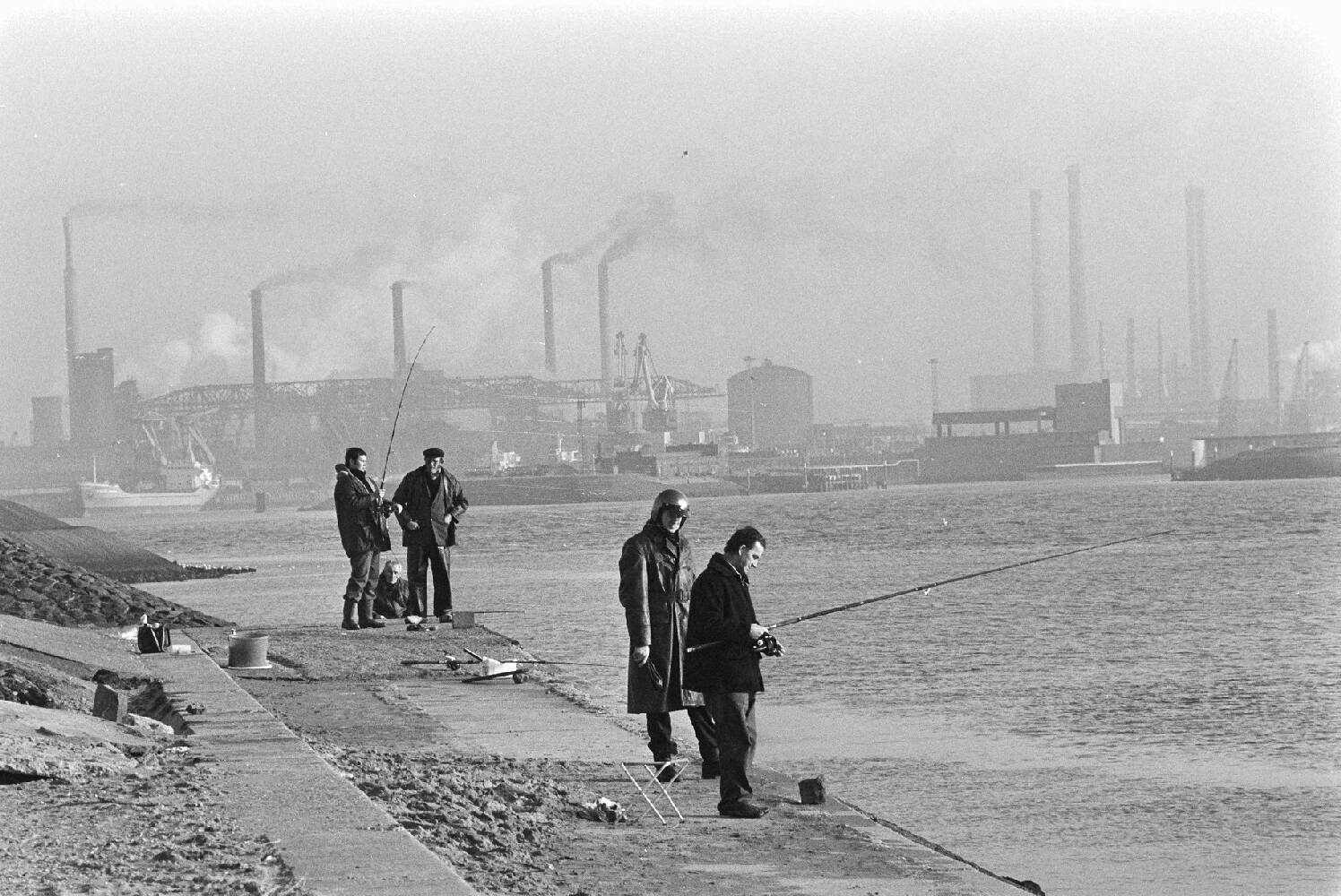
The top tournaments in Wijk aan Zee have a long tradition that reaches far back into the last century. Initially the event was held in Beverwijk, but due to lack of space—as the tournament continued to grow with its side events—it later moved to Wijk aan Zee, a small fishing village nearby, now a seaside resort. The first tournament at the new venue was played in 1968. The sponsor of the chess activities was the nearby Hoogovens steelworks in IJmuiden, located on the North Sea Canal, a shipping route connecting the Markermeer with the North Sea.
The plant had been founded here in 1918 to serve Dutch steel production. In 1999, Koninklijke Nederlandse Hoogovens merged with British Steel to form Corus, and the tournaments were no longer held under the name “Hoogovens Wijk aan Zee” but as “Corus Wijk aan Zee”. In 2007, Corus was acquired by the Indian conglomerate Tata and became part of Tata Steel. From then on, the tournaments in Wijk aan Zee carried the name “Tata Steel Chess Wijk aan Zee”.
Virtually everyone of stature in international chess has played in Wijk aan Zee at least once, with one prominent exception: Bobby Fischer was never there. Perhaps the weather on the Dutch North Sea coast in January was simply too cold for the American.
Traditionally, the tournaments were held in the second half of January, and this year the event will again take place during that period, from January 16 to February 1. In addition to the main event—the Masters or A Tournament—there were always supplementary competitions: amateur opens, weekend tournaments, and additional master events, provided the sponsor’s budget allowed. The traditional number of participants was 14 players or players. However, this could not always be maintained consistently, depending on the financial resources available for organisation.
This year, however, both the Masters and the Challengers will feature 14 players competing for first place. The winner of the Challengers will be invited to the Masters the following year—another long-standing tradition. German chess fans can look forward to the participation of the two strongest German players in the Masters. Vincent Keymer even tops the seeding list by Elo rating. The second German participant is the two-time European champion and World Championship candidate Matthias Blübaum.
A journey back in time: 50 years ago
The long tradition of the tournaments in Wijk aan Zee invites a journey back in time. Let us travel 50 years into the past. We find ourselves in January 1976. The year before, Anatoly Karpov had been declared World Champion. Paul Keres died of a heart attack, and Vladimir Kramnik was born. Chess players did not have to worry about ringing mobile phones—such things did not yet exist. Anyone preparing for a tournament or for their next opponent had to carry around many volumes of the Chess Informant. Founded in 1966, the Yugoslav Informant publishing house had significantly improved the dissemination of chess knowledge with its semi-annual Chess Informant. At the end of the 1970s, the first volume of the Encyclopaedia of Chess Openings (a total of five volumes) also appeared, featuring tabular opening surveys. But in 1976, the masters still had to do without this work. Digital chess databases—or anything resembling the internet—were, of course, still unimaginable.
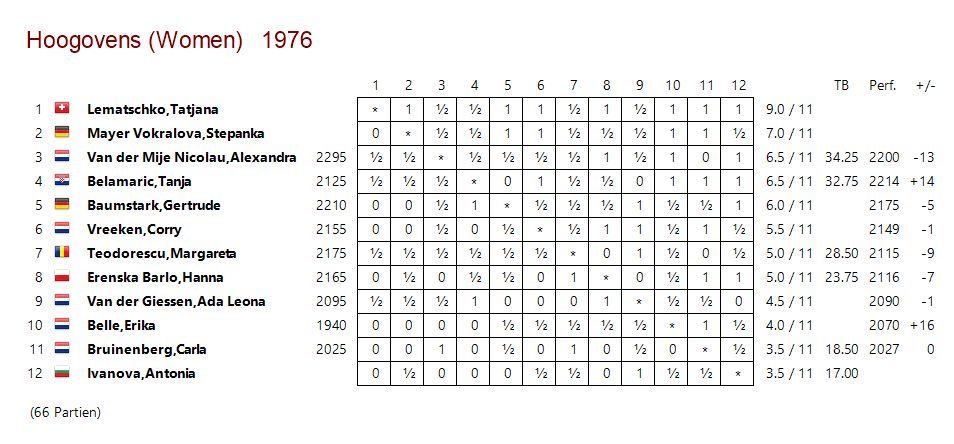
From January 16 to 29, 1976, three master tournaments were held in Wijk aan Zee, each with 12 participants, respectively female participants: an A Tournament, a B Tournament, and a Women’s Tournament.
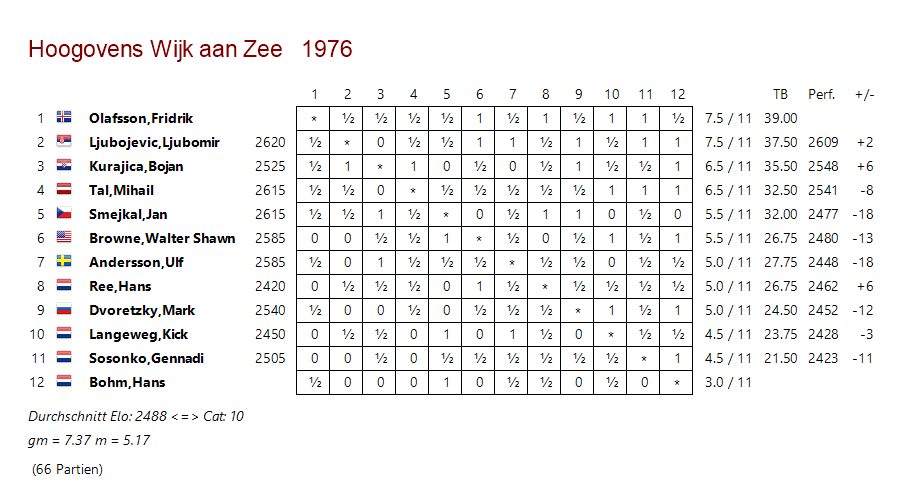
In the A Tournament, Ljubomir Ljubojevic (2620), Mihail Tal and Jan Smejkal (both 2615) were the Elo favourites. Compared to today, the Elo ratings of the leading players were at a lower level.
|
January 1976 – FIDE Rating List 1 . Karpov,An. USR 2695 |
The concept for inviting players was already broadly similar to today’s. International top players and leading Dutch players were invited. However, Jan Timman (2550) was absent in 1976. This was the list of participants.
Hoogovens Wijk aan Zee 1976
Participants – A Tournament
Ljubojevic, Ljubomir 2620
Tal, Mihail 2615
Smejkal, Jan 2615
Browne, Walter 2585
Andersson, Ulf 2585
Olafsson, Fridrik 2550
Dvoretzky, Mark 2540
Kurajica, Bojan 2525
Sosonko, Gennadi 2505
Langeweg, Kik 2450
Bohm, Hans 2420
Hans Ree 2420
Ljubomir Ljubojevic made the best start, defeating Mark Dvoretzky, Hans Böhm and Ulf Andersson in the first three rounds.
Ljubomir Ljubojevic | Photo: Hans Peters, Anefo
After a draw against Fridrik Olafsson, Ljubojevic also defeated Walter Browne. The win against Browne was hard work. In the Najdorf Variation, Ljubojevic missed a win and then had to toil for a long time in an endgame, in which he also failed to make use of all his chances. In those days, games were still adjourned. The game lasted 133 moves and 15 hours before Browne was finally worn down.
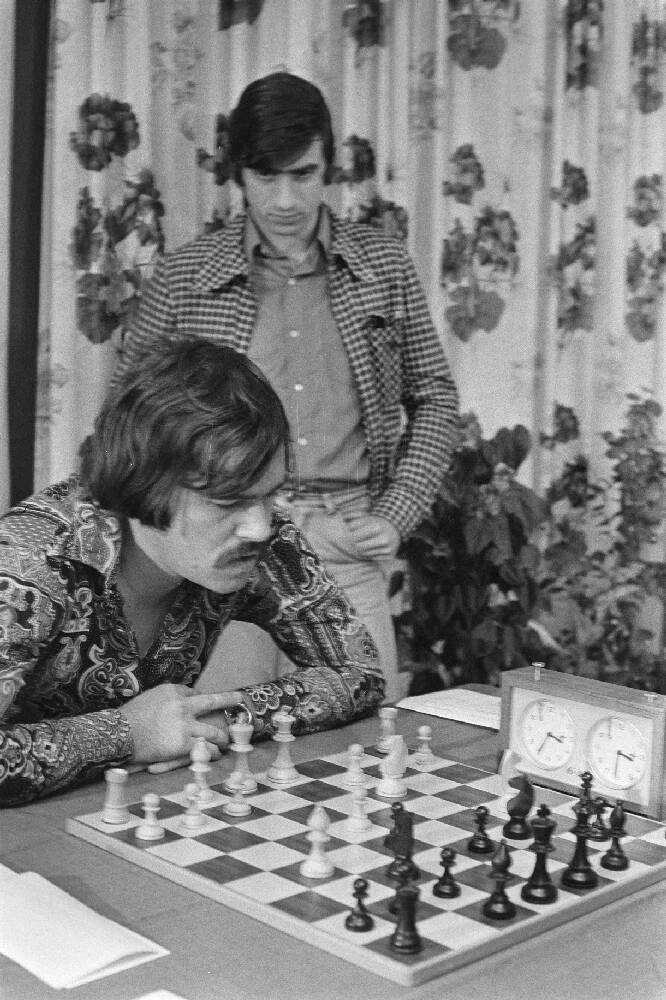
Walter Browne, observed by Ljubojevic | Photo: Hans Peters, Anefo
This was followed by a draw against Hans Ree, but then Ljubojevic lost to his compatriot Bojan Kurajica.
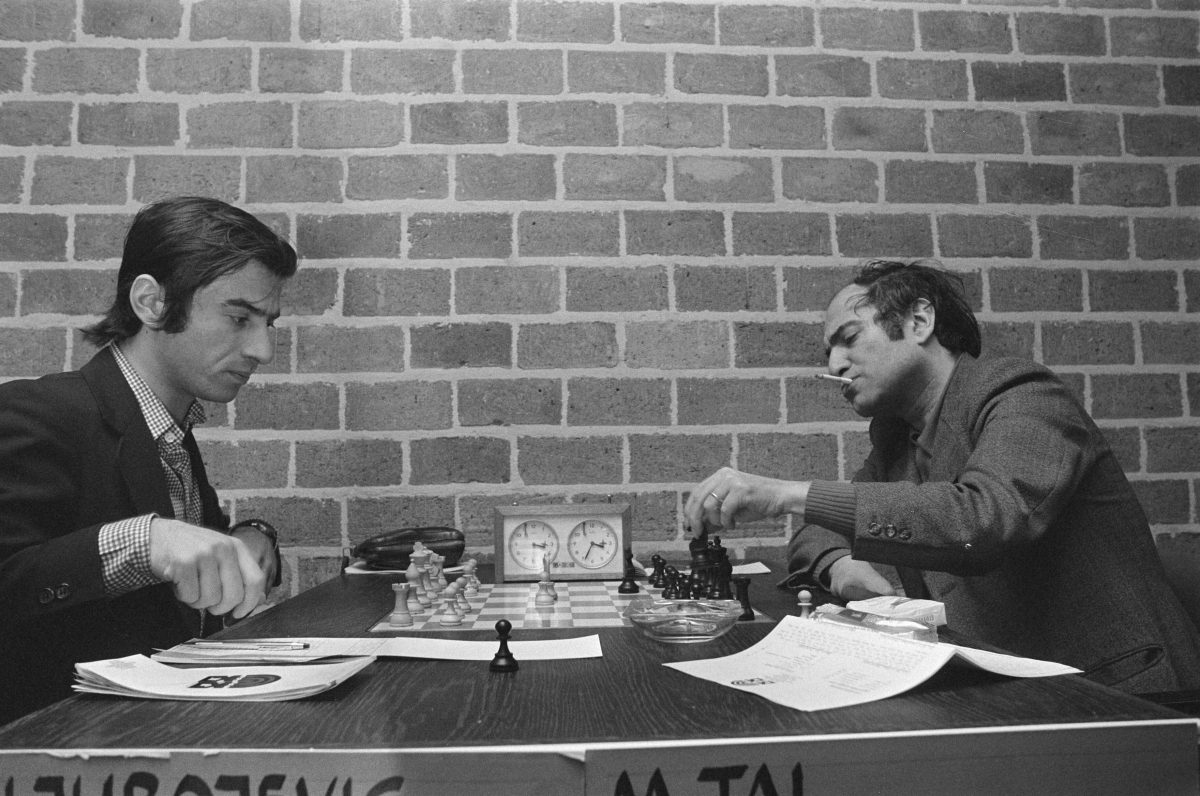
Smoking at the board was still permitted. | Photo: Rob Bogaerts. Anefo
The co-favourite Mihail Tal initially failed to live up to his role after a series of draws at the start and a loss to Bojan Kurajica. But then the former World Champion won two games and moved back into contention at the top. Fridrik Olafsson also began with a string of draws before starting to score wins. After seven rounds, Ljubomir Ljubojevic and Kurajica led with 5 points, followed by Tal and Olafsson one point behind.
In round eight, Kurajica lost to Ulf Andersson, while Olafsson defeated Hans Ree. Tal and Ljubojevic drew their game. In round nine, Ljubojevic beat Gennadi Sosonko and now held a full-point lead. In the final two rounds, however, Ljubojevic conceded two more draws, while Olafsson won both of his games and caught up with the Yugoslav.
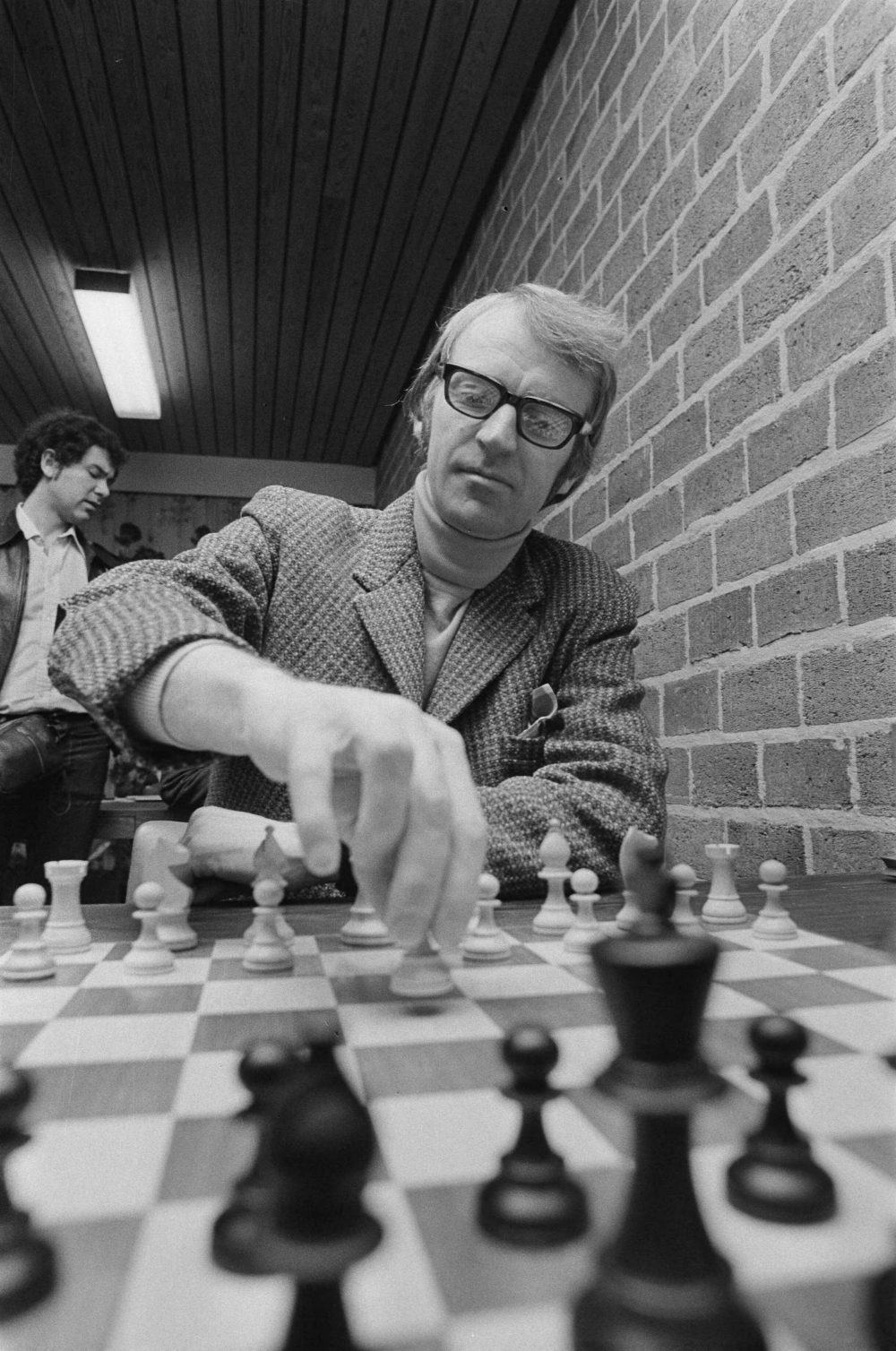
Fridrik Olafsson | Photo: Rob Mieremet
As a result, Fridrik Olafsson and Ljubomir Ljubojevic shared first place in the tournament.
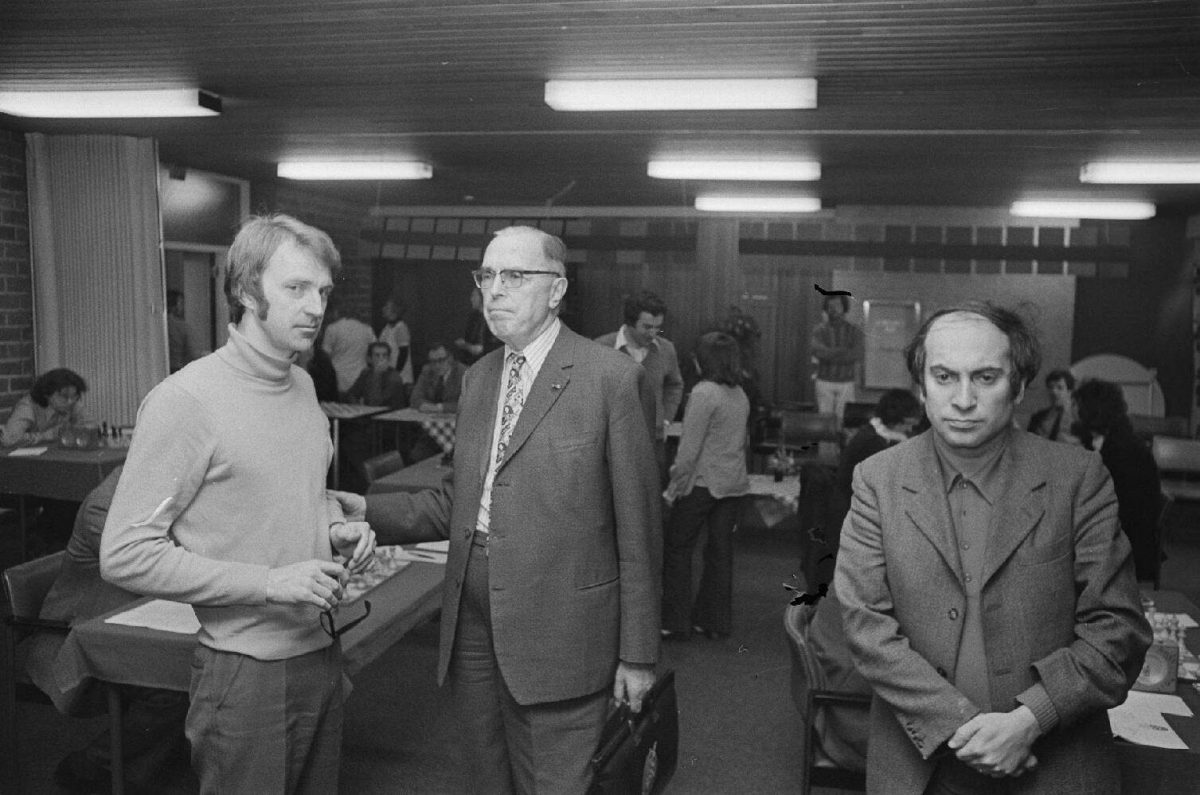
Max Euwe, President of FIDE, paid a visit. A schoolteacher by profession, Euwe, too, always had his briefcase close at hand. | Photo: Rob Mieremet, Anefo
Fridrik Olafsson was an absolute sporting idol in his home country. Two years after this tournament, he became President of FIDE and held the office for four years. In 1980, while serving as federation president, he achieved a win against the then reigning World Champion Anatoly Karpov. He died on April 4, 2025, at the age of 90.
Ljubomir Ljubojevic celebrated his 75th birthday on November 2, 2025. Bojan Kurajica (born 1947) is approaching 80, but remains active and still competes regularly in tournaments.
Mihail Tal died in 1992 after suffering from numerous illnesses.
The Czech grandmaster Jan Smejkal was famous for his chronic time trouble. He retired from chess in 2001 and, according to rumours, later ran a grocery store.
The American grandmaster Walter Browne, born in Australia, was a typical “gambler”. His main strength lay in blitz chess. Alongside chess, he was an active poker player, winning well over USD 100,000 in tournaments. He died in 2015 in Las Vegas.
Ulf Andersson was Sweden’s leading chess player for decades. He celebrated his 70th birthday in 2021 and was still active in several tournaments last year.
Mark Dvoretzky became known as the “endgame pope” through his books. He died in 2016 at the age of 69.
Gennadi Sosonko, Hans Ree, Hans Böhm and Kick Langeweg went on to become successful commentators, authors and chess journalists in the Netherlands.
B-Tournament
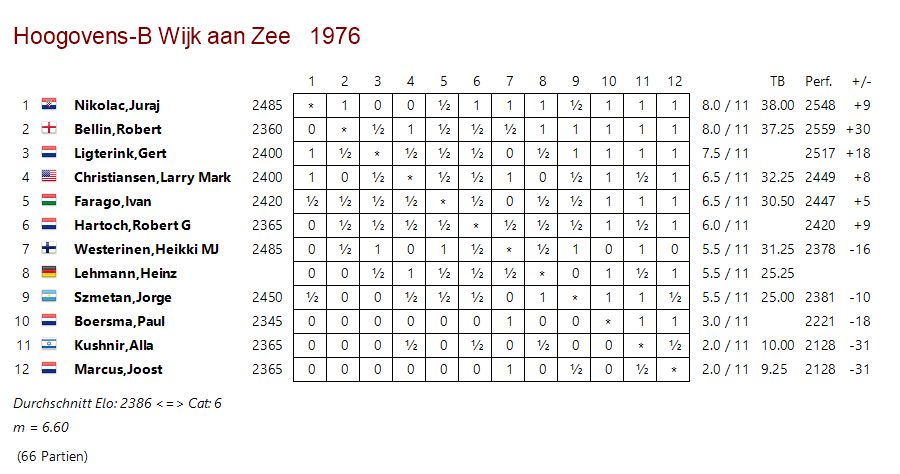
In the B-Tournament, Juraj Nikolac and Robert Bellin shared first place. Born in 1932, the Croatian Nikolac played for a time in the German Bundesliga with Münchener SC 1836 (from 1984 to 1990). He is currently the oldest living grandmaster. Robert Bellin (born 1952) became British Champion in 1978.
Women’s Tournament
Tatiana Lematschko won the Women’s Tournament convincingly. Born in Moscow in 1948, Lematschko enjoyed great success in the Soviet Union before moving to Bulgaria in 1974, where she became a national team player for her new home country. From 1984 onward, she lived in Switzerland. She died in 2020 in Zurich.
Second place went to the Czech player Stepanka Mayer-Vokralova. At the time, she was the strongest female player in her country and already a three-time Czech champion. She later added two more national titles. Mayer-Vokralova emigrated first to Sweden and later to Germany.
Gertrude Baumstark, who finished fifth overall, was a German-Romanian player. She took part several times in Women’s World Championship Interzonal tournaments and was a two-time Romanian national champion. In 1997, she moved to Germany. She died in 2020 in Munich.