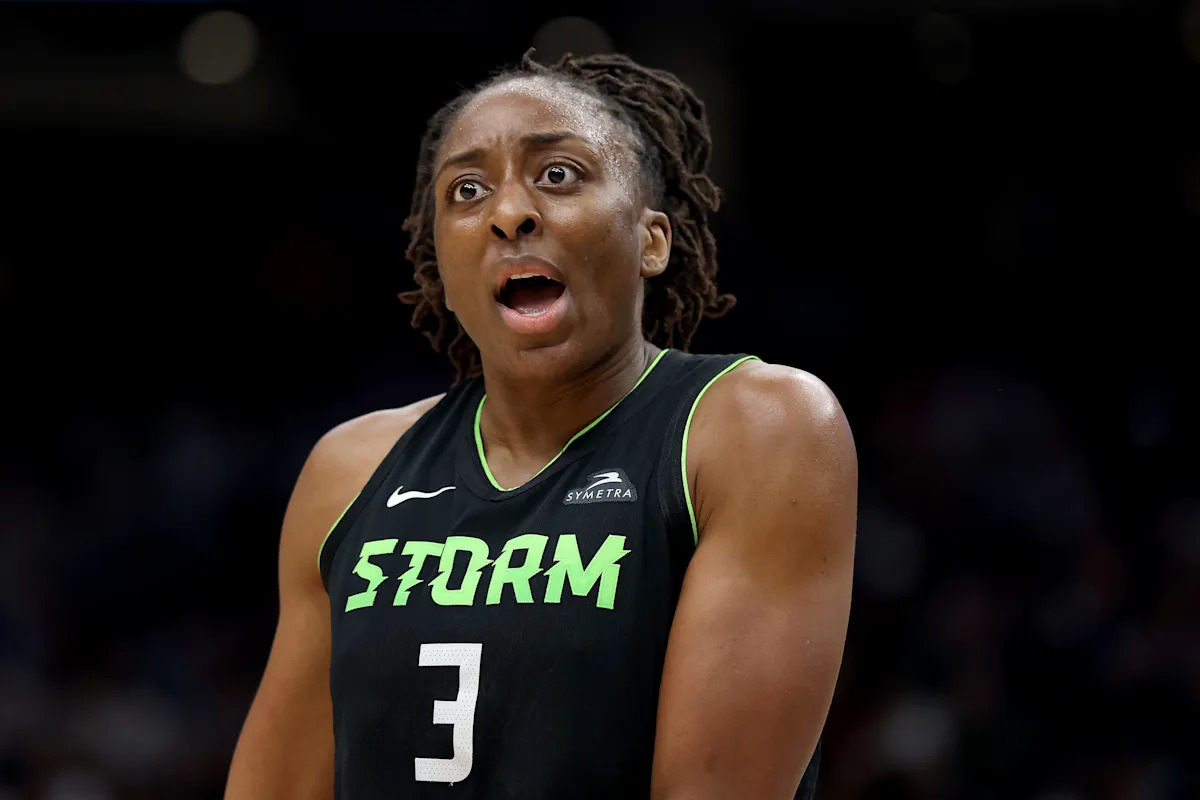
“I don’t feel like there’s any cultivation of a culture of trust. We don’t feel valued in these talks as they stand today. … I feel like we’ve been heard, but not listened to.”
That’s what WNBPA president Nneka Ogwumike said about the players’ perspective of WNBA collective bargaining agreement (CBA) negotiations, according to reporting from The Athletic.
Advertisement
Ogwumike added, “And I’m hoping that that changes in this 40-day extension, because what we want to do is get a good deal done.”
The more details that emerge about the WNBA’s latest CBA proposals, it’s hard to argue with the players’ stance, as the league’s concessions are balanced by asks that seem untenable, undermining or both. An earlier training camp start date and the elimination of player housing are only the beginning of proposed league stipulations that seemed intentionally designed to irritate players, rather than collaborate with them.
The already-bizarre new training camp timeline becomes even more puzzling, as The Athletic dug up a quotation from Cathy Engelbert from earlier in 2025, when the Commissioner, speaking about the footprint of the WNBA season, said on The Bill Simmons podcast:
It’s a challenge on the front end. You can’t move it too much forward if you want the rookies to come in, which we do because it’s a great feeder system for us. So we’ll look at the back end and how far can we go? And how many NFL and college football Saturdays can we go into, and we’ll evaluate all that under the CBA.
However, a league source told Khristina Williams of NBC and the In Case Your Missed It with Khristina Williams podcast that “the league’s proposed earlier season start could let it explore the season’s footprint and new ways to generate revenue, which may contribute to higher revenue sharing.”
The Athletic also reported that, in addition to eliminating team-provisioned housing for players, the league also is seeking to no longer require teams to provide players with cars.
Advertisement
In light of the initial reporting about the cutting of player housing, Natasha Cloud shared her thoughts on social media, emphasizing that “this makes no sense for our younger players, for the players that get cut and are stuck in leases instead of the teams that bring in the replacement players, nor for players in bigger markets. Let alone talking about player safety…”
Regarding the elimination of team-issued housing, a source told Williams that the move is part of the “professionalization of the WNBA,” with the WNBA, like other pro leagues, only planning to assist players’ with finding housing.
Here’s what else is known, unknown, unclear and unresolved from the WNBA’s most recent CBA offerings:
Advertisement
Revenue sharing remains the main thing
Revenue sharing remains the primary point of contention.
The WNBA has proclaimed that it’s most recent proposals, in the words of The Athletic, “delivered a salary structure based on revenue rather than being fixed in the CBA.”
But, how “revenue” will be calculated is complicated. According to the reporting of The Athletic:
[T]he WNBA’s current salary structure proposal would result in the players receiving less than 15 percent of total league revenue. That percentage would decrease over the life of the CBA, based on the league’s revenue projections.
Additionally:
The WNBA is proposing a system in which a portion of league revenue would be shareable, with 50 percent of that portion going to players, sources with knowledge of the negotiations said. How that metric is determined is unclear, but it would result in a projected $1.2 million of total compensation for max players in the first year of the agreement, with that figure expected to rise significantly.
As was the case in the 2020 CBA, in which revenue sharing, while possible, was never triggered, there would be a certain percent of league revenue that would be removed from the revenue sharing calculation as part of a “cost-of-revenue component.” This mechanism is not expected to prevent revenue sharing, as was the case in the previous CBA, although it would certainly decrease the amount of revenue that is shared with the players. However, per The Athletic, the league has agreed to ensure that players receive 50 percent of the revenue under their revenue sharing calculation, with the league issuing payouts to players if needed.
Advertisement
So, based on the latest reporting, the WNBA is proposing real revenue sharing, although how the revenue that is up for sharing will be calculated is unclear. The players’ share of revenue also would come in at only around 15 percent of league revenue and would decrease, rather than increase, over time.
A draft combine, revised rookie contracts and the future of the core designation have been discussed
The WNBA has also proposed introducing a draft combine, with prospects’ draft eligibility contingent upon participation. According to The Athletic, any drafted players who do not participate would only receive half of their rookie-scale salary, unless their absence was excused.
In instituting a mandatory combine, the WNBA would be following the example of the NBA. Yet, such a combine would seem to severely conflict with the league’s proposed earlier training camp start date. A draft combine presumably would be held after the conclusion of the college season in early April, which would be a few weeks after the WNBA’s desired advanced training camp start dates.
Advertisement
Per the reporting of The Athletic, the players have not pushed back on the possibility of a draft combine; instead, they have prioritized advocating for shortened rookie-scale contracts, allowing players to reach free agency after three, rather than the current four, seasons.
Currently, a young player might not become an unrestricted free agent until she is no longer a young player. A player’s four-year rookie scale contract can be followed by a one-year contract after restricted free agency and two seasons under a core-designated contract. As The Athletic notes, that means the typical US-based WNBA rookie who enters the league at age 22 might not reach unrestricted free agency until she is 29 years old.
The league has rebuffed the union’s efforts to revise rookie contracts. They likewise have not been receptive to the players’ desire to eliminate the core designation, the WNBA’s version of a “franchise tag” that gives teams exclusive negotiating rights with star players who otherwise would be unrestricted free agents.
The WNBA and WNBPA have also discussed, and failed to agree on, how many guaranteed contracts teams are permitted to offer, with the league looking to preserve the six-player limit and the union pushing for no limit.
Advertisement
The players are not neglecting other quality-of-life priorities
Even with the focus on revenue sharing, players have not neglected the effort to expanded many of the quality-of-life priorities they pushed for in the 2020 CBA.
Parental leave for non-birthing parents, mental health care, benefits for retired players and facility and staffing standards are among players asks, according to The Athletic.
Both sides have presented proposals that would grant parental leave for non-birthing parents, with the WNBA offering one week of paid leave. The players’ preferred allotment is not known. Both parties also have exchanged ideas about benefits for retired players, including a one-time payment to players who played in the WNBA for a certain number of seasons. The players are also advocating for medical benefits for uninsured retired players.
Advertisement
Regarding mental health care, the WNBPA is asking for players to be reimbursed when they seek mental health services, while the WNBA has included mental health care access in its proposals. The Athletic notes that “a gap remains in the financial component.”
The players also are seeking consistent, league-wide standards for practice facilities, including private locker rooms and weight rooms, and for organizational staffing, with a required number of strength and conditioning coaches, athletic trainers and doctors per team. According to The Athletic, the league has been receptive to discussing standardized staffing requirements, but has resisted collaborating on facility standards.
