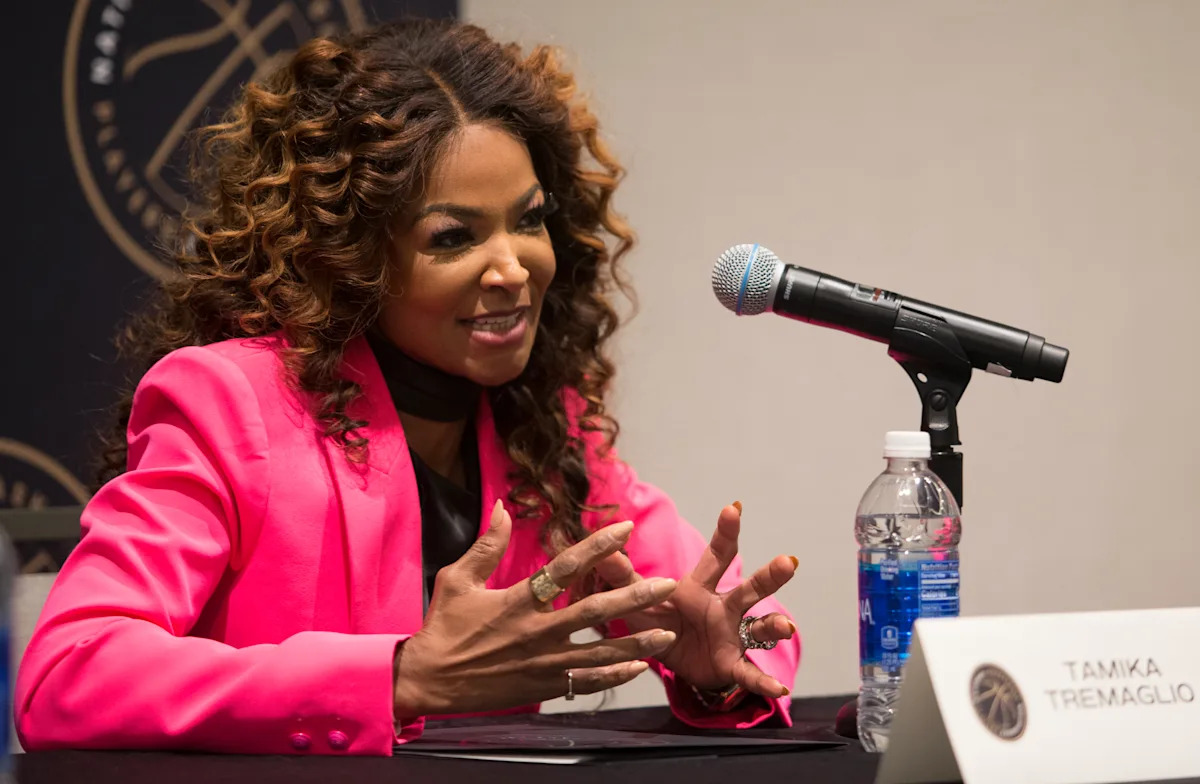
Tamika Tremaglio’s career involves a string of acronyms. None is more important than the final two letters of all of them.
PA. Players Association.
Tremaglio has worked with unions associated with the NFL, NBA and WNBA while they negotiated collective bargaining agreements (CBAs), dating back to the late 2000s. Her first was the landmark 2010 NFL CBA while working at Deloitte. Her last was the 2022 NBA CBA as executive director of the union.
Advertisement
In between, she also worked on the influential 2020 WNBA deal as a consultant, while her former Deloitte coworker Cathy Engelbert led the league side shortly after her appointment as commissioner. Tremaglio worked pro bono since 2013 with the women’s union, and served on the union’s advisory board, including as president.
Her vantage point is now further removed, though she’s still locked into the ongoing negotiations in the WNBA. The union wants more than just to build on the CBAs it previously agreed to under the tutelage of people like Tremaglio.
“They really are asking for a CBA that is much more transformational,” Tremaglio, the managing director at consulting firm Secretariat, told Yahoo Sports. “What this is, is just putting a band-aid on a scar that keeps bleeding, as opposed to really focusing on, how can we redo this? How can we start again and start from scratch?”
Tamika Tremaglio has consulted on CBAs across the sports world throughout her career. (Photo by Chris Gardner/Getty Images)
(Chris Gardner via Getty Images)
The league’s bargaining windows have come a long way from its first in 1999, when players implemented the first CBA in women’s professional league history. The current negotiations were extended to Jan. 9, 2026 under a 40-day deal agreed to by both parties as they sort out a transformational change.
Advertisement
“Extensions don’t signal failure, correct?” Sonia Chase, a 1998 draft pick who worked on that first deal, told Yahoo Sports. “They signal seriousness in terms of both sides recognizing the magnitude of this decision, and they just want to get it right.”
Tremaglio and Chase spoke to Yahoo Sports about their previous experiences in CBA negotiations, why revenue sharing is the major priority and the equity that should be implemented for transparency.
Why revenue share is the headliner
The larger issues the union successfully achieved in 2020 were better salaries, maternity benefits, marketing options and travel support. The discussion around revenue sharing was a big one, and Tremaglio worked directly on revenue and rev share as a consultant working with the union.
Advertisement
Tremaglio: To some extent, while I think that was a tremendous accomplishment, I think in hindsight, I think the expectation is that it would play out very differently than it’s playing out now.
The agreement split revenue 50-50 between the league and players, with the players split in half, with one part going directly to players and the other going to marketing deals that are paid to select players. The target thresholds based on projected revenue for those splits were not met due to the COVID-19 pandemic’s impact on sports at large. It did not show up as a share of basketball-related income, as it does for the men. That is the union’s main focus now.
Tremaglio: The reality is, they weren’t as financially — the [WNBA] didn’t have the additional revenue, at least from what the players could see, that it was worth going to the grave on. So if you have to give up some things, it’s not going to be on something that you don’t know if it’s going to happen anyway.
As opposed to, did you get the travel changes? Did you get maternity benefits? Did you get marketing benefits? Those were the things that were the kickers, because we knew those things were happening. But we also had the foresight to recognize that there was a possibility that they would start to become profitable. That they would pay back what they needed to pay to the NBA, that they would be in a better position. And so that’s why it was added.
Advertisement
This summer, the WNBA announced three additional expansion teams, all of which are associated with NBA ownership groups and paid a reported $250 million expansion fee. The media deal touted by Engelbert as a way to increase salaries came in at $2.2 billion over 11 years.
Chase: The WNBA has entered a new economic era, and the CBA must reflect the reality of today — not just the assumptions of a decade ago. And I think that there’s three things that have skyrocketed. I think visibility, revenue and expectations have certainly skyrocketed, and with that comes the responsibility, I think, to recalibrate the economic model so that growth is sustainable and shared.
Tremaglio: The reason that there’s so much focus on it now is because they are actually profitable. Not to, by the way, suggest that they weren’t profitable then, because if we really had access to all the books and records, I think we would have seen more profitability than what was actually reported. … I think that the reality is, is that the reason we’re paying attention is because it has been so public on the media deal, it has been so public on the purchasing of the additional teams, that it’s now just not making any sense. And that’s why I think it’s really becoming such a huge conversation piece, and they see that as a significant way for them to actually earn additional compensation that they are rightfully entitled to because, but for them playing, they wouldn’t have the teams.
Impact of the NBA-WNBA relationship
The structure of the WNBA under the NBA umbrella has served as a shield. The NBA propped up the league for a long time after it founded it in 1996, but there is clearly money in the banana stand now. That structure makes accounting tricky.
Advertisement
Tremaglio: Does it complicate it? Yes, 100% yes. Has it been a significant benefit to the women for a very long time? The answer to that is yes as well. So with that, however, the challenge now comes in that, OK, now we’re doing well, and we want to sort of move out from under the structure of paying so much back to the NBA, because their piece, by the way, is taken off the top. So before we even share in their revenue, there’s a lot of cost that goes back to the NBA.
Even this last year, in terms of revenue share, they spent a lot of money preparing for the media deal so that obviously, they are able to show up with their best foot forward, right? And so there was a lot of investment that went into making sure they’re well-positioned for what turned out to be a great thing, right? Because they have a $2.2 billion deal for the future. But what about the women who are working now that have made that happen? They aren’t reaping that benefit, right? And so that’s a lot of the challenge, too. And there’s so many costs that you know are overhead, etc., that go to the W that have to be paid first, because they sit under the umbrella of the NBA. So there is no question it’s good and bad, if you will.
Transparency goes beyond sharing books
Union reps and players have said over the years that it’s difficult to negotiate with the league since the NBA is not fully transparent with the financials related to the WNBA. A WNBA spokesperson disputed that issue in September, saying they have provided players with “extensive financial and other business information, including detailed league and team financial statements.” The challenges go beyond simply sharing the books.
Advertisement
Tremaglio: Yes, [players] have the ability to audit. But I will tell you, in the PA for the men, we had an entire audit team that we paid a lot of money to to audit basketball-related income. It was a significant cost in the yearly negotiations with the league, a cost for which the [WNBA]PA does not have. It would far exceed the 50% that they’re actually receiving.
And so that’s a part that really needs to be considered: if you’re going to share in revenue, just like with any other partnership or ownership, you have to make those records available, and you have to give people the ability to audit and quite frankly, it should be something that’s shared costs on both sides. Whether it’s an independent party, whether you get to hire your person, they hire their person, but they need to include that as a cost that’s being covered, because otherwise, the women couldn’t afford to do that. If it’s a matter of do we pay [women] who may have children and families to feed, etc? Or [do] we audit these numbers, and you’re going to have to take the league’s word for it and do it that way.
And that’s really precisely where a lot of the problem has come from, is they don’t have the ability to go in and say, ‘You know what? That’s not right.’ Or you know what, the fact that you have this arena there, and you haven’t included in revenue this one restaurant that makes millions of dollars that’s only open when we have our game. Why aren’t we receiving a part of that? That’s the level of transparency that they need.
How negotiations have changed in sports history
Tremaglio said the one constant in any negotiation is the give-and-take on both sides. Yet, historically, negotiations were more legalese revisions focused on benefits, such as safeguarding healthcare, or how athletes are treated by their teams and league. That began to shift in the last decade, first in 2017 for the NBA and in 2020 for the WNBA.
Advertisement
Tremaglio: Where we see negotiations taking place is more on the business side. So now there are more discussions around revenue generation, as opposed to, it’s not the best example, but maternity benefits. Because you’re just seeing more people do more things that are creating generational wealth. I think there’s more impact on that. It comes from, obviously, where our men are in terms of their wealth, and then for the women, it comes from a very sophisticated background of females that are entering into this sport who have had the benefit for many years of NIL and know their value, and know their worth.
And so now, when they think about, well, why would I do something for $66,000 when I can get NIL at that amount and not have to work so hard, or play so hard, or do those things? So I think that’s where you’re seeing this transformation, is you’re seeing much more business savvy, entrepreneurial individuals engaged in negotiation that I think we haven’t historically seen. … It’s a totally different time period. It’s totally, totally different.
Tremaglio quoted a statement Chase had made to her previously, specifically about the WNBA’s history of negotiations. When the first set of players negotiated the 1999 CBA they were focused on “elevating the floor,” whereas this set of players is “elevating the ceiling.” Chase said they were focused then on simply keeping the league alive and were proud to introduce minimum salaries, travel standards (per diems), health insurance and retirement contributions.
Advertisement
Chase: That time period was what I call survival mode. A time period where we just wanted to create history in a way where it was meaningful, where we were proving that we belonged, and the sports environment was heavily, primarily on the men’s side, focused, if you will. And we just wanted to make sure that people understood our passion. So I think the survival mode has now turned into strategy mode. But I would best describe that time period for me as wanting to make sure that we started off with a great foundation and the very basics that you could.
It was never about the money at that time. It was just about surviving and understanding that we belong, proving our talent, and letting that speak for ourselves. We are no longer at that period right now, though. We have traveled long and far from that area, but the foundation, I want to say, was definitely strong at that point.
In Chase’s era, there were eight teams accounting for 96 players. The league was brand new, and many players, she said, didn’t feel empowered or informed, and therefore didn’t believe they would have “meaningful influence on the league structure.”
Chase: I think today’s players are more unified. They’re more data-driven. They’re more strategically aligned than in any era before. And I applaud the women today, because they are just tremendous, well-rounded, well-rooted people, not just on the court, but also off the court and in the world. And I think what I’m seeing now is a level of sophistication from the union that reflects both business acumen and a deeper understanding of long-term league economics. That’s what I’m seeing right now. And I’m excited about that because I think I experienced firsthand what it means when [the] business model does not fully account for player value.
